Record Information
Version1.0
Creation Date2010-04-16 21:39:22 UTC
Update Date2026-04-06 12:24:27 UTC
Accession NumberCHEM002649
Identification
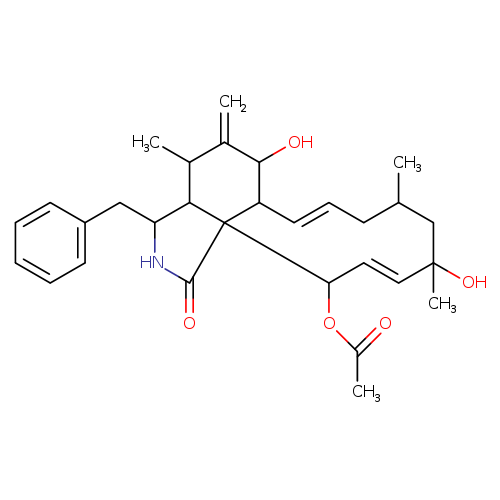
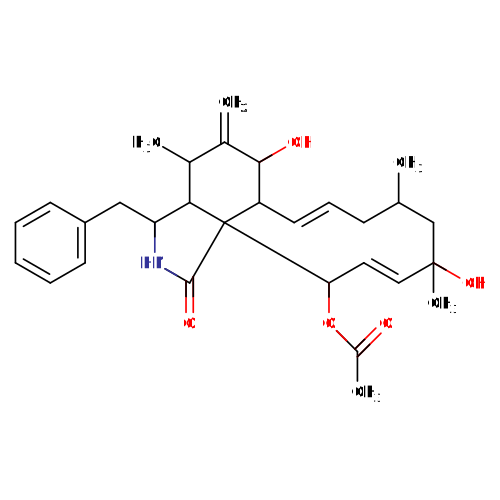
Common NameCytochalasin H
ClassSmall Molecule
DescriptionCytochalasins are mycotoxins that have the ability to bind to actin filaments and block polymerization and the elongation of actin. As a result, they can change cellular morphology, inhibit cellular processes such as cell division, and cause cells to undergo apoptosis. Cytochalasins also have the ability to permeate cell membranes, prevent cellular translocation, cause cells to enucleate, and affect other aspects of biological processes unrelated to actin polymerization. Cytochalasin H is has been isolated from the fungus Phomopsis paspali. It also regulates plant growth and has shown CNS activity. (2, 3, 5, 6)
Contaminant Sources
  • T3DB toxins
Contaminant Type
  • Amide
  • Amine
  • Ester
  • Ether
  • Fungal Toxin
  • Mycotoxin
  • Natural Compound
  • Organic Compound
Chemical Structure
Thumb
SynonymsNot Available
Chemical FormulaC30H39NO5
Average Molecular Mass493.634 g/mol
Monoisotopic Mass493.283 g/mol
CAS Registry Number53760-19-3
IUPAC Name3-benzyl-6,12-dihydroxy-4,10,12-trimethyl-5-methylidene-1-oxo-1H,2H,3H,4H,5H,6H,6aH,9H,10H,11H,12H,15H,15bH-cycloundeca[e]isoindol-15-yl acetate
Traditional Name3-benzyl-6,12-dihydroxy-4,10,12-trimethyl-5-methylidene-1-oxo-2H,3H,4H,6H,6aH,9H,10H,11H,15H,15bH-cycloundeca[e]isoindol-15-yl acetate
SMILESCC1C2C(CC3=CC=CC=C3)NC(=O)C22C(\C=C\CC(C)CC(C)(O)\C=C\C2OC(C)=O)C(O)C1=C
InChI IdentifierInChI=1S/C30H39NO5/c1-18-10-9-13-23-27(33)20(3)19(2)26-24(16-22-11-7-6-8-12-22)31-28(34)30(23,26)25(36-21(4)32)14-15-29(5,35)17-18/h6-9,11-15,18-19,23-27,33,35H,3,10,16-17H2,1-2,4-5H3,(H,31,34)/b13-9+,15-14+
InChI KeyNAEWXXDGBKTIMN-BBXOWAOSSA-N
Chemical Taxonomy
Description belongs to the class of organic compounds known as cytochalasans. These are fungal metabolites structurally characterized by the presence of an isoindolone nucleus fused to a macrocyclic ring, which can either a lactone, as in cytochalasin B, a carbonate, as in cytochalasin E, or a carbocycle, as in cytochalasin D, H, and K.
KingdomOrganic compounds
Super ClassAlkaloids and derivatives
ClassCytochalasans
Sub ClassNot Available
Direct ParentCytochalasans
Alternative Parents
Substituents
  • Carbocyclic cytochalasan skeleton
  • Cytochalasan
  • Isoindolone
  • Isoindoline
  • Isoindole
  • Isoindole or derivatives
  • Monocyclic benzene moiety
  • Pyrrolidone
  • 2-pyrrolidone
  • Benzenoid
  • Tertiary alcohol
  • Pyrrolidine
  • Cyclic alcohol
  • Secondary alcohol
  • Secondary carboxylic acid amide
  • Carboxamide group
  • Lactam
  • Carboxylic acid ester
  • Organoheterocyclic compound
  • Monocarboxylic acid or derivatives
  • Azacycle
  • Carboxylic acid derivative
  • Alcohol
  • Organic oxygen compound
  • Organic nitrogen compound
  • Organopnictogen compound
  • Organic oxide
  • Hydrocarbon derivative
  • Organonitrogen compound
  • Organooxygen compound
  • Carbonyl group
  • Aromatic heteropolycyclic compound
Molecular FrameworkAromatic heteropolycyclic compounds
External DescriptorsNot Available
Biological Properties
StatusDetected and Not Quantified
OriginExogenous
Cellular Locations
  • Membrane
Biofluid LocationsNot Available
Tissue LocationsNot Available
PathwaysNot Available
ApplicationsNot Available
Biological RolesNot Available
Chemical RolesNot Available
Physical Properties
StateSolid
AppearanceWhite powder.
Experimental Properties
PropertyValue
Melting Point250-263°C
Boiling PointNot Available
SolubilityNot Available
Predicted Properties
PropertyValueSource
Water Solubility0.0035 g/LALOGPS
logP3.54ALOGPS
logP3.37ChemAxon
logS-5.2ALOGPS
pKa (Strongest Acidic)13.93ChemAxon
pKa (Strongest Basic)-0.37ChemAxon
Physiological Charge0ChemAxon
Hydrogen Acceptor Count4ChemAxon
Hydrogen Donor Count3ChemAxon
Polar Surface Area95.86 ŲChemAxon
Rotatable Bond Count4ChemAxon
Refractivity140.96 m³·mol⁻¹ChemAxon
Polarizability54.77 ųChemAxon
Number of Rings4ChemAxon
Bioavailability1ChemAxon
Rule of FiveYesChemAxon
Ghose FilterNoChemAxon
Veber's RuleNoChemAxon
MDDR-like RuleNoChemAxon
Spectra
Spectra
Spectrum TypeDescriptionSplash KeyView
Predicted LC-MS/MSPredicted LC-MS/MS Spectrum - 10V, Positivesplash10-004l-0000900000-00fe57e23a29015062faSpectrum
Predicted LC-MS/MSPredicted LC-MS/MS Spectrum - 20V, Positivesplash10-003r-1000900000-2488098b198b6b6a012cSpectrum
Predicted LC-MS/MSPredicted LC-MS/MS Spectrum - 40V, Positivesplash10-0pbc-8902400000-a3601bb85816f5098600Spectrum
Predicted LC-MS/MSPredicted LC-MS/MS Spectrum - 10V, Negativesplash10-0006-1000900000-b60624bb64e149126009Spectrum
Predicted LC-MS/MSPredicted LC-MS/MS Spectrum - 20V, Negativesplash10-0khc-3000900000-e9116b5615659aa77ef7Spectrum
Predicted LC-MS/MSPredicted LC-MS/MS Spectrum - 40V, Negativesplash10-0006-9036300000-53e1f689fa5a2f57ba97Spectrum
Toxicity Profile
Route of ExposureOral, dermal, inhalation, and parenteral (contaminated drugs). (4)
Mechanism of ToxicityCytochalasins are known to bind to the barbed, fast growing plus ends of microfilaments, which then blocks both the assembly and disassembly of individual actin monomers from the bound end. Once bound, cytochalasin essentially caps the end of the new actin filament. One cytochalasin will bind to one actin filament. By blocking the polymerization and elongation of actin, cytochalasins can change cellular morphology, inhibit cellular processes such as cell division, and cause cells to undergo apoptosis. (2, 3, 5)
MetabolismNot Available
Toxicity ValuesNot Available
Lethal DoseNot Available
Carcinogenicity (IARC Classification)No indication of carcinogenicity to humans (not listed by IARC).
Uses/SourcesCytochalasin H is has been isolated from the fungus Phomopsis paspali. (6)
Minimum Risk LevelNot Available
Health EffectsMajor biological effects of cytochalasins include inhibition of the division of cytoplasm, reversible inhibition of cell movement, induction of nuclear extrusion, inhibition of such processes as phagocytosis, platelet aggregation and clot retraction, glucose transport, thyroid secretion, and release of growth hormone. Some cytochalasins have been shown to have developmental effects. (6)
SymptomsNot Available
TreatmentConsider activated charcoal after gastrointestinal absportion. Nitroprusside is recommended to reverse peripheral ischemia secondary to vasoconstriction and for the treatment of hypertension. Anticoagulant therapy with intravenous heparin is also recommended. (1)

Concentrations
Not Available
DrugBank IDNot Available
HMDB IDNot Available
FooDB IDNot Available
Phenol Explorer IDNot Available
KNApSAcK IDNot Available
BiGG IDNot Available
BioCyc IDNot Available
METLIN IDNot Available
PDB IDNot Available
Wikipedia LinkNot Available
Chemspider IDNot Available
ChEBI IDNot Available
PubChem Compound ID5351303
Kegg Compound IDNot Available
YMDB IDNot Available
ECMDB IDNot Available
References
Synthesis ReferenceNot Available
MSDSNot Available
General ReferencesNot Available