Record Information
Version1.0
Creation Date2010-04-15 18:58:24 UTC
Update Date2026-05-14 19:10:00 UTC
Accession NumberCHEM002644
Identification
Common NameZeranol
ClassSmall Molecule
DescriptionZeranol is isolated from Fusarium species. It is an anabolic agent and estrogenic agent (mainly veterinary use). Zeranol is used as a growth promoter for food animals. It was banned by the EU in 1989, but is still permitted in the USA and some other countries. It may also arise in livestock by ingestion of Fusarium contaminated pasture or feeds. Zeranol has been shown to exhibit muscle building function (6). Zeranol belongs to the family of Macrolides and Analogues. These are organic compounds containing a lactone ring of at least twelve members[1]. The term 'macrolide' encompasses a diverse family of unrelated compounds with large macrolactam rings[2].
Contaminant Sources
  • FooDB Chemicals
  • STOFF IDENT Compounds
  • T3DB toxins
  • ToxCast & Tox21 Chemicals
Contaminant Type
  • Ester
  • Ether
  • Food Toxin
  • Fungal Toxin
  • Metabolite
  • Mycotoxin
  • Natural Compound
  • Organic Compound
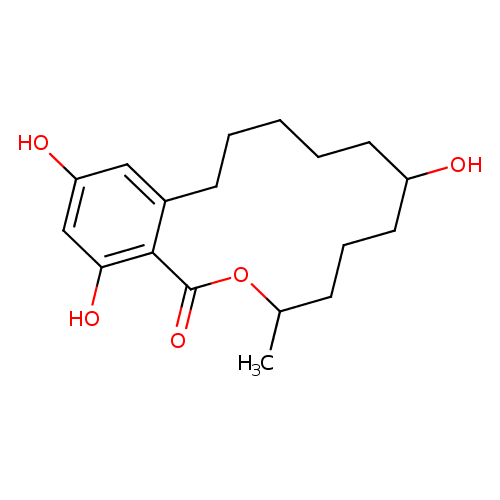
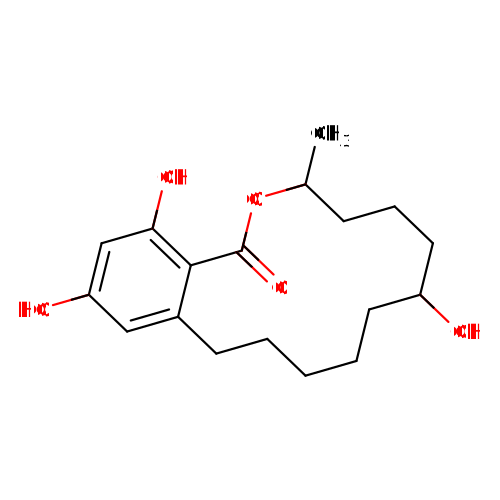
Chemical Structure
Thumb
Synonyms
ValueSource
6-(6,10-Dihydroxyundecyl)-beta-resorcylic acid, mu-lactoneHMDB
a-ZearalanolHMDB
alpha ZearalanolHMDB
alpha-ZearalanolHMDB
alpha-ZeranolHMDB
Dihydroxyundecyl resorcylic acid lactoneHMDB
FrideronHMDB
MK 188HMDB
p 1496HMDB
RalabolHMDB
RalgroHMDB
RaloneHMDB
TaleranolHMDB
XeranolHMDB
ZearalanolHMDB
ZearanolHMDB
ZeranoHMDB
Zeranol, ban, inn, usanHMDB
ZeranolMeSH
Chemical FormulaC18H26O5
Average Molecular Mass322.396 g/mol
Monoisotopic Mass322.178 g/mol
CAS Registry Number26538-44-3
IUPAC Name(3S,7R)-7,14,16-trihydroxy-3-methyl-3,4,5,6,7,8,9,10,11,12-decahydro-1H-2-benzoxacyclotetradecin-1-one
Traditional Name7,14,16-trihydroxy-3-methyl-3,4,5,6,7,8,9,10,11,12-decahydro-2-benzoxacyclotetradecin-1-one
SMILESCC1CCCC(O)CCCCCC2=CC(O)=CC(O)=C2C(=O)O1
InChI IdentifierInChI=1S/C18H26O5/c1-12-6-5-9-14(19)8-4-2-3-7-13-10-15(20)11-16(21)17(13)18(22)23-12/h10-12,14,19-21H,2-9H2,1H3
InChI KeyDWTTZBARDOXEAM-UHFFFAOYSA-N
Chemical Taxonomy
Description belongs to the class of organic compounds known as macrolides and analogues. These are organic compounds containing a lactone ring of at least twelve members.
KingdomOrganic compounds
Super ClassPhenylpropanoids and polyketides
ClassMacrolides and analogues
Sub ClassNot Available
Direct ParentMacrolides and analogues
Alternative Parents
Substituents
  • Macrolide
  • Dihydroxybenzoic acid
  • 1-hydroxy-4-unsubstituted benzenoid
  • 1-hydroxy-2-unsubstituted benzenoid
  • Benzenoid
  • Vinylogous acid
  • Carboxylic acid ester
  • Lactone
  • Secondary alcohol
  • Carboxylic acid derivative
  • Polyol
  • Monocarboxylic acid or derivatives
  • Oxacycle
  • Organoheterocyclic compound
  • Organooxygen compound
  • Organic oxide
  • Organic oxygen compound
  • Alcohol
  • Hydrocarbon derivative
  • Aromatic heteropolycyclic compound
Molecular FrameworkAromatic heteropolycyclic compounds
External DescriptorsNot Available
Biological Properties
StatusDetected and Not Quantified
OriginExogenous
Cellular Locations
  • Membrane
Biofluid LocationsNot Available
Tissue LocationsNot Available
PathwaysNot Available
ApplicationsNot Available
Biological RolesNot Available
Chemical RolesNot Available
Physical Properties
StateSolid
AppearanceWhite powder.
Experimental Properties
PropertyValue
Melting Point182 - 184°C
Boiling PointNot Available
SolubilityNot Available
Predicted Properties
PropertyValueSource
Water Solubility0.16 g/LALOGPS
logP3.23ALOGPS
logP4.45ChemAxon
logS-3.3ALOGPS
pKa (Strongest Acidic)8.68ChemAxon
pKa (Strongest Basic)-1.3ChemAxon
Physiological Charge0ChemAxon
Hydrogen Acceptor Count4ChemAxon
Hydrogen Donor Count3ChemAxon
Polar Surface Area86.99 ŲChemAxon
Rotatable Bond Count0ChemAxon
Refractivity88.25 m³·mol⁻¹ChemAxon
Polarizability35.52 ųChemAxon
Number of Rings2ChemAxon
Bioavailability1ChemAxon
Rule of FiveYesChemAxon
Ghose FilterYesChemAxon
Veber's RuleNoChemAxon
MDDR-like RuleNoChemAxon
Spectra
Spectra
Spectrum TypeDescriptionSplash KeyView
Predicted GC-MSPredicted GC-MS Spectrum - GC-MS (Non-derivatized) - 70eV, Positivesplash10-0pi0-0039000000-13fad28bcc84596403c8Spectrum
Predicted GC-MSPredicted GC-MS Spectrum - GC-MS (3 TMS) - 70eV, Positivesplash10-00xr-9400750000-880938071e9cf0d46601Spectrum
Predicted GC-MSPredicted GC-MS Spectrum - GC-MS (Non-derivatized) - 70eV, PositiveNot AvailableSpectrum
Predicted GC-MSPredicted GC-MS Spectrum - GC-MS (TMS_1_1) - 70eV, PositiveNot AvailableSpectrum
Predicted GC-MSPredicted GC-MS Spectrum - GC-MS (TMS_1_2) - 70eV, PositiveNot AvailableSpectrum
Predicted GC-MSPredicted GC-MS Spectrum - GC-MS (TMS_1_3) - 70eV, PositiveNot AvailableSpectrum
Predicted GC-MSPredicted GC-MS Spectrum - GC-MS (TMS_2_1) - 70eV, PositiveNot AvailableSpectrum
Predicted GC-MSPredicted GC-MS Spectrum - GC-MS (TMS_2_2) - 70eV, PositiveNot AvailableSpectrum
Predicted GC-MSPredicted GC-MS Spectrum - GC-MS (TMS_2_3) - 70eV, PositiveNot AvailableSpectrum
Predicted GC-MSPredicted GC-MS Spectrum - GC-MS (TBDMS_1_1) - 70eV, PositiveNot AvailableSpectrum
Predicted GC-MSPredicted GC-MS Spectrum - GC-MS (TBDMS_1_2) - 70eV, PositiveNot AvailableSpectrum
Predicted GC-MSPredicted GC-MS Spectrum - GC-MS (TBDMS_1_3) - 70eV, PositiveNot AvailableSpectrum
Predicted GC-MSPredicted GC-MS Spectrum - GC-MS (TBDMS_2_1) - 70eV, PositiveNot AvailableSpectrum
Predicted GC-MSPredicted GC-MS Spectrum - GC-MS (TBDMS_2_2) - 70eV, PositiveNot AvailableSpectrum
Predicted GC-MSPredicted GC-MS Spectrum - GC-MS (TBDMS_2_3) - 70eV, PositiveNot AvailableSpectrum
Predicted GC-MSPredicted GC-MS Spectrum - GC-MS (TBDMS_3_1) - 70eV, PositiveNot AvailableSpectrum
Predicted LC-MS/MSPredicted LC-MS/MS Spectrum - 10V, Positivesplash10-0ab9-0119000000-dfc5ec37377b5cb44b1fSpectrum
Predicted LC-MS/MSPredicted LC-MS/MS Spectrum - 20V, Positivesplash10-06di-9467000000-8c76013cb1dc4d675963Spectrum
Predicted LC-MS/MSPredicted LC-MS/MS Spectrum - 40V, Positivesplash10-0cdv-9810000000-436eeea064627406d1c2Spectrum
Predicted LC-MS/MSPredicted LC-MS/MS Spectrum - 10V, Negativesplash10-00di-0009000000-c6fef88c1fc77cd2daebSpectrum
Predicted LC-MS/MSPredicted LC-MS/MS Spectrum - 20V, Negativesplash10-0fk9-1119000000-ba401efa49d57ecccd16Spectrum
Predicted LC-MS/MSPredicted LC-MS/MS Spectrum - 40V, Negativesplash10-054k-2390000000-42d3932aa047c309abdaSpectrum
Predicted LC-MS/MSPredicted LC-MS/MS Spectrum - 10V, Negativesplash10-00di-0009000000-97dc86be510de646590cSpectrum
Predicted LC-MS/MSPredicted LC-MS/MS Spectrum - 20V, Negativesplash10-0udi-0009000000-2cd138540b8019f5060dSpectrum
Predicted LC-MS/MSPredicted LC-MS/MS Spectrum - 40V, Negativesplash10-0gbl-7098000000-932554e8d65256b31a67Spectrum
Predicted LC-MS/MSPredicted LC-MS/MS Spectrum - 10V, Positivesplash10-0a4i-0009000000-b59a570e604dc41d65bfSpectrum
Predicted LC-MS/MSPredicted LC-MS/MS Spectrum - 20V, Positivesplash10-0a4i-0009000000-43ce6ed6cc07dfd96e01Spectrum
Predicted LC-MS/MSPredicted LC-MS/MS Spectrum - 40V, Positivesplash10-0a4i-0093000000-db5e6ea92c271bf7050fSpectrum
Toxicity Profile
Route of ExposureOral, dermal, inhalation, and parenteral (contaminated drugs). (5)
Mechanism of ToxicityZeranol acts as an agonist at the estrogen receptors, interfering with the binding of natural estrogens. This disrupts hormone levels and affects a number of signaling processes, leading to various reproductive disorders in males and females. Mycotoxins are often able to enter the liver and kidney by human organic anion transporters (hOATs) and human organic cation transporters (hOCTs). They can also inhibit uptake of anions and cations by these transporters, interefering with the secretion of endogenous metabolites, drugs, and xenobiotics including themselves. This results in increased cellular accumulation of toxic compounds causing nephro- and hepatotoxicity. (2, 1, 4)
MetabolismMetabolism of zeranol occurs in the liver. During phase I metabolism, dehydrogenation produces zearalanone as the major metabolite and beta-zearalanol as the minor metabolite. Cytochrome P450 enzymes also catalyze the aromatic hydroxylation of zeranol, producing 13-hydroxy-alpha-zearalanol and 15-hydroxy-alpha-zearalanol. During phase II metabolism reduction/oxidation occurs, forming the glucuronide and sulfate conjugates of zearalanone and beta-zearalanol. In humans, the metabolites are excreted mainly in the urine. (3)
Toxicity ValuesNot Available
Lethal DoseNot Available
Carcinogenicity (IARC Classification)Not listed by IARC.
Uses/SourcesZeranol is a mycotoxin derived from fungi in the Fusarium family, and may be found as a contaminant in fungus-infected crops. (7)
Minimum Risk LevelEstimated acceptable daily intake is 0 - 0.5 ug/kg. (8)
Health EffectsZeranol is an estrogen-like endocrine disrupting chemical that interferes with the binding of natural estrogens, disrupting hormone levels and causing various reproductive disorders in males and females. It has been shown to cause developmental problems in animals by causing tissue malformations and produce irregularities in the estrous cycle. In humans, zeranol induces breast cancer cell growth. (2)
SymptomsNot Available
TreatmentNot Available
Concentrations
Not Available
DrugBank IDNot Available
HMDB IDHMDB0032702
FooDB IDFDB010663
Phenol Explorer IDNot Available
KNApSAcK IDC00057300
BiGG IDNot Available
BioCyc IDNot Available
METLIN IDNot Available
PDB IDNot Available
Wikipedia LinkZeranol
Chemspider ID20916
ChEBI IDNot Available
PubChem Compound ID22283
Kegg Compound IDC14752
YMDB IDNot Available
ECMDB IDNot Available
References
Synthesis ReferenceNot Available
MSDSNot Available
General References
1. Roeder RA, Gunn JM: Effects of zeranol on protein turnover in L6 myotubes. Domest Anim Endocrinol. 1987 Jan;4(1):61-7.
2. Yannai, Shmuel. (2004) Dictionary of food compounds with CD-ROM: Additives, flavors, and ingredients. Boca Raton: Chapman & Hall/CRC.