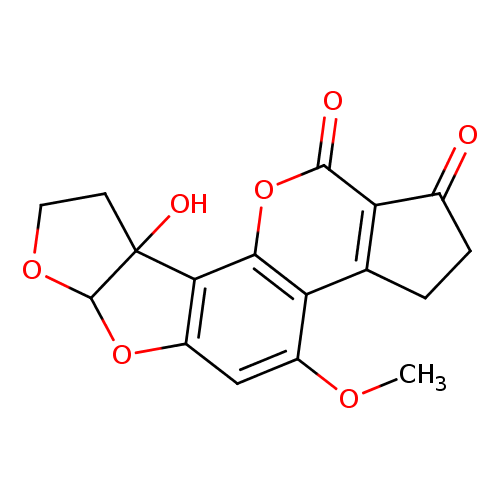
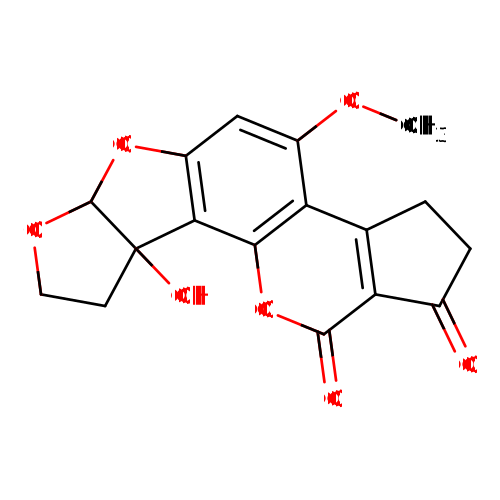
Trace mycotoxin of Aspergillus flavus [CCD].Aflatoxins are naturally occurring mycotoxins that are produced by many species of Aspergillus, a fungus, most notably Aspergillus flavus and Aspergillus parasiticus. Aflatoxins are toxic and among the most carcinogenic substances known. Aflatoxin M2 is a metabolite of aflatoxin B2 in milk of cattle fed on contaminated foods. (Wikipedia)
Aflatoxin M2 belongs to the family of Difurocoumarocyclopentenone Series. These are polycyclic aromatic compounds containing a cyclopenten-2-one ring fused to the coumarin moiety of the difurocoumarin skeleton. Difurocoumarocyclopentenones are a subgroup of the aflatoxins and related compounds.
belongs to the class of organic compounds known as difurocoumarocyclopentenones. These are polycyclic aromatic compounds containing a cyclopenten-2-one ring fused to the coumarin moiety of the difurocoumarin skeleton.
Oral, dermal, inhalation, and parenteral (contaminated drugs). (5)
Mechanism of Toxicity
Aflatoxins produce singlet oxygen upon their exposure to UV (365-nm) light. Singlet oxygen in turn activates them to mutagens and DNA binding species. Aflatoxin metabolites can intercalate into DNA and alkylate the bases through their epoxide moiety, binding particularity to N7-guanine bases. In addition to randomly mutating DNA, this is thought to cause mutations in the p53 gene, an important gene in preventing cell cycle progression when there are DNA mutations, or signaling apoptosis. (11, 2, 3) The mechanism of action many furocoumarins is based on their ability to form photoadducts with DNA and other cellular components such as RNA, proteins, and several proteins found in the membrane such as phospholipases A2 and C, Ca-dependent and cAMPdependent protein-kinase and epidermal growth factor. Furocoumarins intercalate between base pairs of DNA and after ultraviolet-A irradiation, giving cycloadducts. (10)
Metabolism
Aflatoxins are metabolized in the liver by the cytochrome P-450-dependent polysubstrate mono-oxygenase system to less toxic metabolites. The main reactions in aflatoxin metabolism are hydroxylation, oxidation, and demethylation. (4)
Not directly listed by IARC. IARC evaluated aflatoxins other than aflatoxin M2 and concluded that aflatoxins are carcinogenic to humans (Group 1). (9)
Uses/Sources
The native habitat of Aspergillus is in soil, decaying vegetation, hay, and grains undergoing microbiological deterioration and it invades all types of organic substrates whenever conditions are favorable for its growth. Crops which are frequently affected include cereals (maize, sorghum, pearl millet, rice, wheat), oilseeds (peanut, soybean, sunflower, cotton), spices (chile peppers, black pepper, coriander, turmeric, ginger), and tree nuts (almond, pistachio, walnut, coconut, brazil nut). The toxin can also be found in the milk of animals which are fed contaminated feed. Thus, aflatoxins are usually encountered in thecontext of chronic exposure, via food intake or secondary to the handling of foodstuffs. (13)
Minimum Risk Level
Not Available
Health Effects
The main target organ in mammals is the liver so aflatoxicosis is primarily a hepatic disease. Protracted exposure to aflatoxins may cause liver damage and necrosis, cholestasis, and hepatomas. Moreover, protracted exposure to aflatoxins has been associated with hepatocellular carcinoma, acute hepatitis, Reye's syndrome, bile duct cell proliferation, periportal fibrosis, hemorrhages, mucous membrane jaundice, fatty liver changes, cirrhosis in malnourished children, and kwashiorkor. However, aflatoxins accumulate in the presence of liver disease, and the association with hepatic cancer is confounded by the occurrence of hepatitis-B. Thus, it is not clear in these various instances whether aflatoxin is a primary cause of the disease, is an innocent bystander which accumulates secondary to the disease process, or is a contributing cause in conjunction with other factors. It is also mutagenic and teratogenic. Inhaled aflatoxins may produce pulmonary adenomatosis. Aflatoxins modify the immune system by affecting antibody formation, complement, cell-mediated immunity, and phagocytosis. (1, 13) The furocoumarin 8-methoxypsoralen is carcinogenic to humans, and possibly 5-methoxypsoralen as well (9). There is some evidence from mouse studies that other furocoumarins are carcinogenic when combined with exposure to UVA radiation (6). The SKLM regards the additional risk of skin cancer arising from the consumption of typical quantities of furocoumarin-containing foods, which remain significantly below the range of phototoxic doses, as insignificant. However, the consumption of phototoxic quantities cannot be ruled out for certain foods, particularly celery and parsnips, that may lead to significant increases in furocoumarin concentrations, depending on the storage, processing and production conditions. (14) Furocoumarin photochemotherapy is known to induce a number of side-effects including erythema, edema, hyperpigmentation, and premature aging of skin. All photobiological effects of furocoumarins result from their photochemical reactions. Because many dietary or water soluble furocoumarins are strong inhibitors of cytochrome P450s, they will also cause adverse drug reactions when taken with other drugs. Limited evidence of carcinogenic effect. (10)
Symptoms
A broad range of symptoms can be found depending upon dosage, including, vomiting, abdominal pain, hemorrhage, and pulmonary edema. (12)
Treatment
Administration of phonobarbital enhances hepatic transformation activities and also protects against AFB-induced toxicity, carcinogenicity and DNA binding in vivo. In cases of ingestion, feeding large quantities of an adsorbent such as activated charcoal may be used. Antioxidants such as ellagic acid and inducers of some cytochromes P450, such as indole-3-carbinol, may give a protective effect. (1, 12)