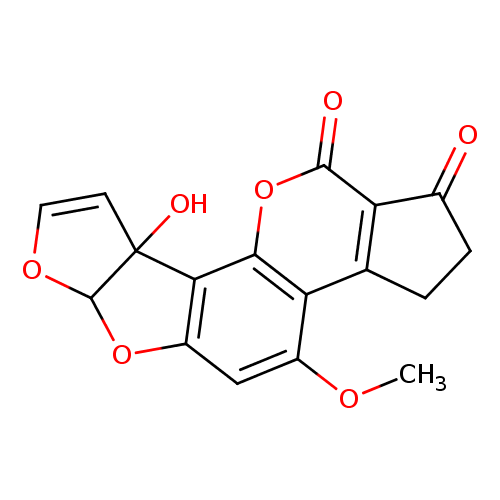
Record Information
Version1.0
Creation Date2010-04-13 22:40:51 UTC
Update Date2026-03-25 19:20:08 UTC
Accession NumberCHEM002635
Identification
Common NameAflatoxin M1
ClassSmall Molecule
DescriptionAflatoxin M1 is found in milk and milk products. Minor mycotoxin of Aspergillus flavus, also found in the milk of cows and sheep fed toxic meal. Metab. of Aflatoxin B1 JHZ87-P [CCD].Aflatoxins are naturally occurring mycotoxins that are produced by many species of Aspergillus, a fungus, most notably Aspergillus flavus and Aspergillus parasiticus. Aflatoxins are toxic and among the most carcinogenic substances known. Aflatoxin M1 is a metabolite of aflatoxin B1 in humans and animals. (Wikipedia) Aflatoxin m1 belongs to the family of Difurocoumarocyclopentenone Series. These are polycyclic aromatic compounds containing a cyclopenten-2-one ring fused to the coumarin moiety of the difurocoumarin skeleton. Difurocoumarocyclopentenones are a subgroup of the aflatoxins and related compounds.
Contaminant Sources
  • FooDB Chemicals
  • IARC Carcinogens Group 2B
  • T3DB toxins
Contaminant Type
  • Ester
  • Ether
  • Food Toxin
  • Fungal Toxin
  • Metabolite
  • Mycotoxin
  • Natural Compound
  • Organic Compound
Chemical Structure
Thumb
SynonymsNot Available
Chemical FormulaC17H12O7
Average Molecular Mass328.273 g/mol
Monoisotopic Mass328.058 g/mol
CAS Registry Number6795-23-9
IUPAC Name3-hydroxy-11-methoxy-6,8,19-trioxapentacyclo[10.7.0.0²,⁹.0³,⁷.0¹³,¹⁷]nonadeca-1(12),2(9),4,10,13(17)-pentaene-16,18-dione
Traditional Nameaflatoxin M1
SMILESCOC1=CC2=C(C3=C1C1=C(C(=O)CC1)C(=O)O3)C1(O)C=COC1O2
InChI IdentifierInChI=1S/C17H12O7/c1-21-9-6-10-13(17(20)4-5-22-16(17)23-10)14-12(9)7-2-3-8(18)11(7)15(19)24-14/h4-6,16,20H,2-3H2,1H3
InChI KeyMJBWDEQAUQTVKK-UHFFFAOYSA-N
Chemical Taxonomy
Description belongs to the class of organic compounds known as difurocoumarocyclopentenones. These are polycyclic aromatic compounds containing a cyclopenten-2-one ring fused to the coumarin moiety of the difurocoumarin skeleton.
KingdomOrganic compounds
Super ClassPhenylpropanoids and polyketides
ClassCoumarins and derivatives
Sub ClassFuranocoumarins
Direct ParentDifurocoumarocyclopentenones
Alternative Parents
Substituents
  • Difurocoumarocyclopentenone
  • Benzopyran
  • 1-benzopyran
  • Coumaran
  • Anisole
  • Aryl alkyl ketone
  • Aryl ketone
  • Alkyl aryl ether
  • Pyranone
  • Pyran
  • Benzenoid
  • Tertiary alcohol
  • Dihydrofuran
  • Heteroaromatic compound
  • Lactone
  • Ketone
  • Acetal
  • Oxacycle
  • Ether
  • Organoheterocyclic compound
  • Organooxygen compound
  • Hydrocarbon derivative
  • Organic oxide
  • Organic oxygen compound
  • Alcohol
  • Aromatic heteropolycyclic compound
Molecular FrameworkAromatic heteropolycyclic compounds
External DescriptorsNot Available
Biological Properties
StatusDetected and Not Quantified
OriginExogenous
Cellular Locations
  • Cytoplasm
  • Extracellular
Biofluid LocationsNot Available
Tissue LocationsNot Available
PathwaysNot Available
ApplicationsNot Available
Biological Roles
Chemical RolesNot Available
Physical Properties
StateSolid
AppearanceColorless to pale yellow crystals.
Experimental Properties
PropertyValue
Melting Point299°C
Boiling PointNot Available
SolubilityNot Available
Predicted Properties
PropertyValueSource
Water Solubility0.99 g/LALOGPS
logP1.21ALOGPS
logP0.93ChemAxon
logS-2.5ALOGPS
pKa (Strongest Acidic)11.42ChemAxon
pKa (Strongest Basic)-4.4ChemAxon
Physiological Charge0ChemAxon
Hydrogen Acceptor Count6ChemAxon
Hydrogen Donor Count1ChemAxon
Polar Surface Area91.29 ŲChemAxon
Rotatable Bond Count1ChemAxon
Refractivity79.67 m³·mol⁻¹ChemAxon
Polarizability31.02 ųChemAxon
Number of Rings5ChemAxon
Bioavailability1ChemAxon
Rule of FiveYesChemAxon
Ghose FilterYesChemAxon
Veber's RuleNoChemAxon
MDDR-like RuleNoChemAxon
Spectra
Spectra
Spectrum TypeDescriptionSplash KeyView
Predicted LC-MS/MSPredicted LC-MS/MS Spectrum - 10V, Positivesplash10-004i-0019000000-ed1a7dfa6d8bdd4f1c48Spectrum
Predicted LC-MS/MSPredicted LC-MS/MS Spectrum - 20V, Positivesplash10-004i-0039000000-2cd79d60556438462dc2Spectrum
Predicted LC-MS/MSPredicted LC-MS/MS Spectrum - 40V, Positivesplash10-03xs-2390000000-b22ffb9577209213cde4Spectrum
Predicted LC-MS/MSPredicted LC-MS/MS Spectrum - 10V, Negativesplash10-004i-0029000000-927508d8713045699f27Spectrum
Predicted LC-MS/MSPredicted LC-MS/MS Spectrum - 20V, Negativesplash10-004i-0039000000-f1846ea7b90515ff572eSpectrum
Predicted LC-MS/MSPredicted LC-MS/MS Spectrum - 40V, Negativesplash10-03fu-2290000000-0ca55a29e3b2c2b17730Spectrum
Toxicity Profile
Route of ExposureOral, dermal, inhalation, and parenteral (contaminated drugs). (5)
Mechanism of ToxicityAflatoxins produce singlet oxygen upon their exposure to UV (365-nm) light. Singlet oxygen in turn activates them to mutagens and DNA binding species. Aflatoxin M1 is P450 activated to its epoxide. Aflatoxin metabolites can intercalate into DNA and alkylate the bases through their epoxide moiety, binding particularity to N7-guanine bases. In addition to randomly mutating DNA, this is thought to cause mutations in the p53 gene, an important gene in preventing cell cycle progression when there are DNA mutations, or signaling apoptosis. (7, 2, 4)
MetabolismAflatoxin M1 is P450 activated to its epoxide and detoxified by glutathione S transferase. [Pubchem] (4)
Toxicity ValuesNot Available
Lethal DoseNot Available
Carcinogenicity (IARC Classification)2B, possibly carcinogenic to humans. (6)
Uses/SourcesThe native habitat of Aspergillus is in soil, decaying vegetation, hay, and grains undergoing microbiological deterioration and it invades all types of organic substrates whenever conditions are favorable for its growth. Crops which are frequently affected include cereals (maize, sorghum, pearl millet, rice, wheat), oilseeds (peanut, soybean, sunflower, cotton), spices (chile peppers, black pepper, coriander, turmeric, ginger), and tree nuts (almond, pistachio, walnut, coconut, brazil nut). The toxin can also be found in the milk of animals which are fed contaminated feed. Thus, aflatoxins are usually encountered in thecontext of chronic exposure, via food intake or secondary to the handling of foodstuffs. (9)
Minimum Risk LevelNot Available
Health EffectsThe main target organ in mammals is the liver so aflatoxicosis is primarily a hepatic disease. Protracted exposure to aflatoxins may cause liver damage and necrosis, cholestasis, and hepatomas. Moreover, protracted exposure to aflatoxins has been associated with hepatocellular carcinoma, acute hepatitis, Reye's syndrome, bile duct cell proliferation, periportal fibrosis, hemorrhages, mucous membrane jaundice, fatty liver changes, cirrhosis in malnourished children, and kwashiorkor. However, aflatoxins accumulate in the presence of liver disease, and the association with hepatic cancer is confounded by the occurrence of hepatitis-B. Thus, it is not clear in these various instances whether aflatoxin is a primary cause of the disease, is an innocent bystander which accumulates secondary to the disease process, or is a contributing cause in conjunction with other factors. It is also mutagenic and teratogenic. Inhaled aflatoxins may produce pulmonary adenomatosis. Aflatoxins modify the immune system by affecting antibody formation, complement, cell-mediated immunity, and phagocytosis. (1, 9)
SymptomsA broad range of symptoms can be found depending upon dosage, including, vomiting, abdominal pain, hemorrhage, and pulmonary edema. (8)
TreatmentAdministration of phonobarbital enhances hepatic transformation activities and also protects against AFB-induced toxicity, carcinogenicity and DNA binding in vivo. In cases of ingestion, feeding large quantities of an adsorbent such as activated charcoal may be used. Antioxidants such as ellagic acid and inducers of some cytochromes P450, such as indole-3-carbinol, may give a protective effect. (1, 8)

Concentrations
Not Available
DrugBank IDNot Available
HMDB IDNot Available
FooDB IDNot Available
Phenol Explorer IDNot Available
KNApSAcK IDNot Available
BiGG IDNot Available
BioCyc IDNot Available
METLIN IDNot Available
PDB IDNot Available
Wikipedia LinkAflatoxin M1
Chemspider IDNot Available
ChEBI IDNot Available
PubChem Compound ID23236
Kegg Compound IDNot Available
YMDB IDNot Available
ECMDB IDNot Available
References
Synthesis ReferenceNot Available
MSDSNot Available
General ReferencesNot Available