Record Information
Version1.0
Creation Date2009-12-03 20:13:26 UTC
Update Date2026-04-17 19:22:41 UTC
Accession NumberCHEM002612
Identification
Common NameDicyclohexyl phthalate
ClassSmall Molecule
DescriptionDicyclohexyl phthalate is a phthalate ester. Phthalate esters are esters of phthalic acid and are mainly used as plasticizers, primarily used to soften polyvinyl chloride. They are found in a number of products, including glues, building materials, personal care products, detergents and surfactants, packaging, children's toys, paints, pharmaceuticals, food products, and textiles. Phthalates are hazardous due to their ability to act as endocrine disruptors. They are being phased out of many products in the United States and European Union due to these health concerns. (4)
Contaminant Sources
  • HPV EPA Chemicals
  • My Exposome Chemicals
  • STOFF IDENT Compounds
  • Sludge Chemicals
  • T3DB toxins
  • ToxCast & Tox21 Chemicals
Contaminant Type
  • Aromatic Hydrocarbon
  • Cosmetic Toxin
  • Ester
  • Ether
  • Food Toxin
  • Household Toxin
  • Industrial/Workplace Toxin
  • Organic Compound
  • Phthalate
  • Plasticizer
  • Synthetic Compound
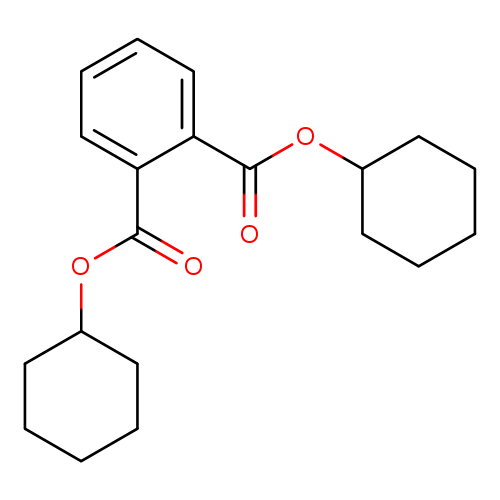
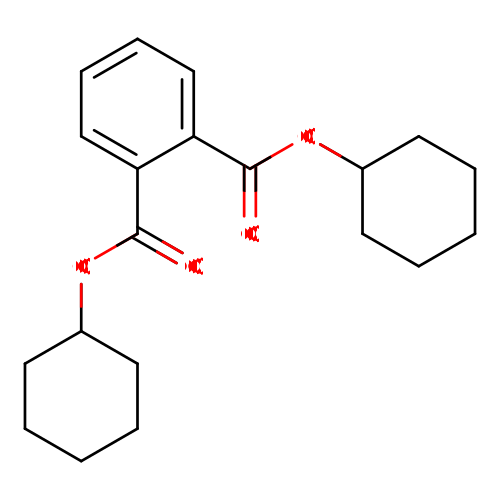
Chemical Structure
Thumb
Synonyms
ValueSource
Dicyclohexyl phthalic acidGenerator
Chemical FormulaC20H26O4
Average Molecular Mass330.418 g/mol
Monoisotopic Mass330.183 g/mol
CAS Registry Number84-61-7
IUPAC Name1,2-dicyclohexyl benzene-1,2-dicarboxylate
Traditional Namedicyclohexyl phthalate
SMILESO=C(OC1CCCCC1)C1=CC=CC=C1C(=O)OC1CCCCC1
InChI IdentifierInChI=1S/C20H26O4/c21-19(23-15-9-3-1-4-10-15)17-13-7-8-14-18(17)20(22)24-16-11-5-2-6-12-16/h7-8,13-16H,1-6,9-12H2
InChI KeyVOWAEIGWURALJQ-UHFFFAOYSA-N
Chemical Taxonomy
Description belongs to the class of organic compounds known as benzoic acid esters. These are ester derivatives of benzoic acid.
KingdomOrganic compounds
Super ClassBenzenoids
ClassBenzene and substituted derivatives
Sub ClassBenzoic acids and derivatives
Direct ParentBenzoic acid esters
Alternative Parents
Substituents
  • Benzoate ester
  • Benzoyl
  • Dicarboxylic acid or derivatives
  • Carboxylic acid ester
  • Carboxylic acid derivative
  • Organic oxygen compound
  • Organic oxide
  • Hydrocarbon derivative
  • Organooxygen compound
  • Aromatic homomonocyclic compound
Molecular FrameworkAromatic homomonocyclic compounds
External Descriptors
Biological Properties
StatusDetected and Not Quantified
OriginExogenous
Cellular Locations
  • Membrane
Biofluid LocationsNot Available
Tissue LocationsNot Available
PathwaysNot Available
ApplicationsNot Available
Biological RolesNot Available
Chemical RolesNot Available
Physical Properties
StateSolid
AppearanceColorless liquid.
Experimental Properties
PropertyValue
Melting Point66°C
Boiling PointNot Available
Solubility0.004 mg/mL at 24°C
Predicted Properties
PropertyValueSource
Water Solubility0.0011 g/LALOGPS
logP5.01ALOGPS
logP5.58ChemAxon
logS-5.5ALOGPS
pKa (Strongest Basic)-6.7ChemAxon
Physiological Charge0ChemAxon
Hydrogen Acceptor Count2ChemAxon
Hydrogen Donor Count0ChemAxon
Polar Surface Area52.6 ŲChemAxon
Rotatable Bond Count6ChemAxon
Refractivity92.14 m³·mol⁻¹ChemAxon
Polarizability36.74 ųChemAxon
Number of Rings3ChemAxon
Bioavailability1ChemAxon
Rule of FiveNoChemAxon
Ghose FilterYesChemAxon
Veber's RuleNoChemAxon
MDDR-like RuleYesChemAxon
Spectra
Spectra
Spectrum TypeDescriptionSplash KeyView
Predicted GC-MSPredicted GC-MS Spectrum - GC-MS (Non-derivatized) - 70eV, Positivesplash10-001i-9130000000-bf0948298eaf003c4b85Spectrum
Predicted GC-MSPredicted GC-MS Spectrum - GC-MS (Non-derivatized) - 70eV, PositiveNot AvailableSpectrum
LC-MS/MSLC-MS/MS Spectrum - 45V, Positivesplash10-0002-0900000000-6292662bbf9b60a81a1fSpectrum
LC-MS/MSLC-MS/MS Spectrum - 30V, Positivesplash10-0002-0900000000-2cfad1f4af158b70d42bSpectrum
LC-MS/MSLC-MS/MS Spectrum - 50V, Positivesplash10-0002-0900000000-b282160570c579fdfe29Spectrum
LC-MS/MSLC-MS/MS Spectrum - 15V, Positivesplash10-014j-0900000000-485433678a4139d43b45Spectrum
LC-MS/MSLC-MS/MS Spectrum - 20V, Positivesplash10-00kb-0900000000-1571f7fd0d316e936cd1Spectrum
LC-MS/MSLC-MS/MS Spectrum - 10V, Positivesplash10-00kb-0961000000-c88d62b294acffd6dcb1Spectrum
LC-MS/MSLC-MS/MS Spectrum - 30V, Positivesplash10-0002-0900000000-2efae9c6305335252bfaSpectrum
LC-MS/MSLC-MS/MS Spectrum - 40V, Positivesplash10-0002-0900000000-1a9c5667074c58fd3aeaSpectrum
LC-MS/MSLC-MS/MS Spectrum - 45V, Negativesplash10-000i-0900000000-dc2329b6e9627b0ab41eSpectrum
LC-MS/MSLC-MS/MS Spectrum - 60V, Negativesplash10-000i-0900000000-0e9e05d84dece9c4fcf4Spectrum
LC-MS/MSLC-MS/MS Spectrum - 90V, Negativesplash10-0592-1900000000-5dde58db5f1d07da7958Spectrum
LC-MS/MSLC-MS/MS Spectrum - 15V, Negativesplash10-004i-0009000000-d6f710e95c96144c9293Spectrum
LC-MS/MSLC-MS/MS Spectrum - 30V, Negativesplash10-004r-0908000000-2feeaa694888a4f85bc6Spectrum
LC-MS/MSLC-MS/MS Spectrum - 75V, Negativesplash10-059b-1900000000-1bcdee72e6811fa5577aSpectrum
LC-MS/MSLC-MS/MS Spectrum - 90V, Positivesplash10-006t-2900000000-7fd656f0fb35208fe09eSpectrum
LC-MS/MSLC-MS/MS Spectrum - 35V, Positivesplash10-0002-0900000000-65d03365935b622d1c5aSpectrum
LC-MS/MSLC-MS/MS Spectrum - 60V, Positivesplash10-0002-0900000000-7d99b84ee48e55ce76c7Spectrum
LC-MS/MSLC-MS/MS Spectrum - 75V, Positivesplash10-0002-0900000000-5b09efcb9bfbcd703743Spectrum
Predicted LC-MS/MSPredicted LC-MS/MS Spectrum - 10V, Positivesplash10-001i-4049000000-19a242cdddec79ba89d4Spectrum
Predicted LC-MS/MSPredicted LC-MS/MS Spectrum - 20V, Positivesplash10-001i-9252000000-827bb993f2bceb843e28Spectrum
Predicted LC-MS/MSPredicted LC-MS/MS Spectrum - 40V, Positivesplash10-0536-9200000000-85eeb6af0b4b3ace20c3Spectrum
Predicted LC-MS/MSPredicted LC-MS/MS Spectrum - 10V, Negativesplash10-004i-2019000000-b1267d2f456e3940f8d8Spectrum
Predicted LC-MS/MSPredicted LC-MS/MS Spectrum - 20V, Negativesplash10-004j-6289000000-9268ea958926bcb137a8Spectrum
Predicted LC-MS/MSPredicted LC-MS/MS Spectrum - 40V, Negativesplash10-0002-9210000000-911ce1d58439498b5221Spectrum
Predicted LC-MS/MSPredicted LC-MS/MS Spectrum - 10V, Positivesplash10-001i-1295000000-0cb0458e63126d3c03d4Spectrum
MSMass Spectrum (Electron Ionization)splash10-0002-4900000000-a0f78df766b297c29260Spectrum
1D NMR1H NMR SpectrumNot AvailableSpectrum
1D NMR13C NMR SpectrumNot AvailableSpectrum
Toxicity Profile
Route of ExposureOral (4) ; inhalation (4) ; dermal (4)
Mechanism of ToxicityPhthalate esters are endocrine disruptors. They decrease foetal testis testosterone production and reduce the expression of steroidogenic genes by decreasing mRNA expression. Some phthalates have also been shown to reduce the expression of insulin-like peptide 3 (insl3), an important hormone secreted by the Leydig cell necessary for development of the gubernacular ligament. Animal studies have shown that these effects disrupt reproductive development and can cause a number of malformations in affected young. (2)
MetabolismPhthalate esters are first hydrolyzed to their monoester derivative. Once formed, the monoester derivative can be further hydrolyzed in vivo to phthalic acid or conjugated to glucuronide, both of which can then be excreted. The terminal or next-to-last carbon atom in the monoester can also be oxidized to an alcohol, which can be excreted as is or first oxidized to an aldehyde, ketone, or carboxylic acid. The monoester and oxidative metabolites are excreted in the urine and faeces. (3)
Toxicity ValuesLD50: >3200 mg/kg (Oral, Mouse) (1) LD50: 1600 mg/kg (Intraperitoneal, Mouse) (1)
Lethal DoseNot Available
Carcinogenicity (IARC Classification)No indication of carcinogenicity to humans (not listed by IARC).
Uses/SourcesPhthalate esters are mainly used as plasticizers, primarily used to soften polyvinyl chloride. They are found in a number of products, including glues, building materials, personal care products, detergents and surfactants, packaging, children's toys, paints, pharmaceuticals, food products, and textiles. Phthalates are used in a variety of household applications such as shower curtains, vinyl upholstery, adhesives, floor tiles, food containers and wrappers, and cleaning materials. Personal care items containing phthalates include perfume, eye shadow, moisturizer, nail polish, liquid soap, and hair spray. (4)
Minimum Risk LevelNot Available
Health EffectsPhthalate esters are endocrine disruptors. Animal studies have shown that they disrupt reproductive development and can cause a number of malformations in affected young, such as reduced anogenital distance (AGD), cryptorchidism, hypospadias, and reduced fertility. The combination of effects associated with phthalates is called 'phthalate syndrome’. (2)
SymptomsPhthalate esters are endocrine disruptors and can cause a number of developmental malformations termed 'phthalate syndrome'. (2)
TreatmentNot Available
Concentrations
Not Available
DrugBank IDNot Available
HMDB IDHMDB0251213
FooDB IDNot Available
Phenol Explorer IDNot Available
KNApSAcK IDNot Available
BiGG IDNot Available
BioCyc IDNot Available
METLIN IDNot Available
PDB IDNot Available
Wikipedia LinkNot Available
Chemspider ID6519
ChEBI IDNot Available
PubChem Compound IDNot Available
Kegg Compound IDC14529
YMDB IDNot Available
ECMDB IDNot Available
References
Synthesis ReferenceNot Available
MSDSNot Available
General ReferencesNot Available