Record Information
Version1.0
Creation Date2009-11-29 00:38:09 UTC
Update Date2026-04-17 19:22:48 UTC
Accession NumberCHEM002607
Identification
Common NameDiethyl phthalate
ClassSmall Molecule
DescriptionDiethyl phthalate is a phthalate ester. This synthetic substance is commonly used to make plastics more flexible. Products in which it is found include toothbrushes, automobile parts, tools, toys, and food packaging. Diethyl phthalate can be released fairly easily from these products, as it is not part of the chain of chemicals (polymers) that makes up the plastic. Diethyl phthalate is also used in cosmetics, insecticides, and aspirin. Phthalate esters can cause reproductive and developmental toxicity. (5, 2)
Contaminant Sources
  • Clean Air Act Chemicals
  • Cosmetic Chemicals
  • EPA Endocrine Screening
  • HPV EPA Chemicals
  • My Exposome Chemicals
  • STOFF IDENT Compounds
  • Suspected Compounds – Schymanski Project
  • T3DB toxins
  • ToxCast & Tox21 Chemicals
Contaminant Type
  • Aromatic Hydrocarbon
  • Cosmetic Toxin
  • Ester
  • Ether
  • Food Toxin
  • Household Toxin
  • Industrial/Workplace Toxin
  • Lachrymator
  • Organic Compound
  • Pesticide
  • Phthalate
  • Plasticizer
  • Pollutant
  • Synthetic Compound
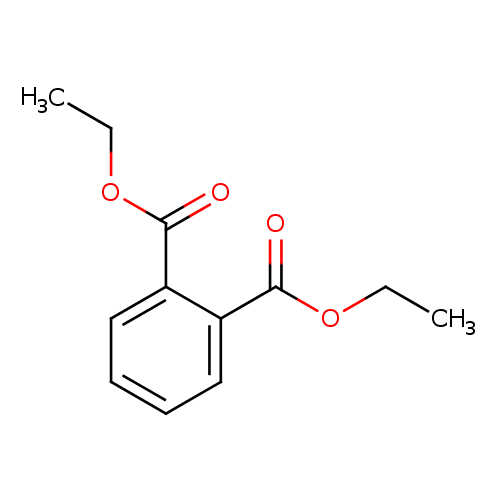
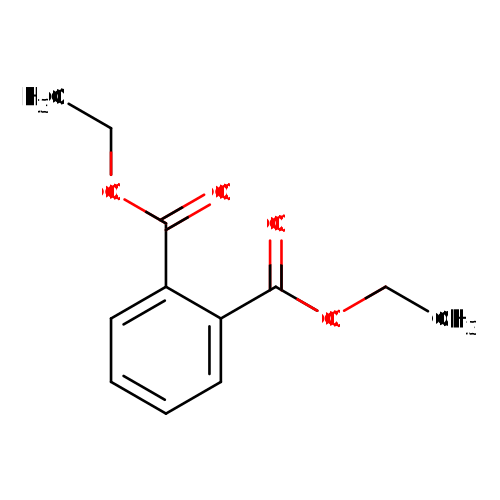
Chemical Structure
Thumb
Synonyms
ValueSource
1,2-Benzenedicarboxylic acid diethyl esterChEBI
1,2-Diethyl phthalateChEBI
DEPChEBI
Diethyl 1,2-benzenedicarboxylateChEBI
Diethyl benzene-1,2-dicarboxylateChEBI
Diethyl O-phthalateChEBI
Ethyl phthalateChEBI
O-Benzenedicarboxylic acid diethyl esterChEBI
O-Bis(ethoxycarbonyl)benzeneChEBI
Phthalic acid diethyl esterChEBI
PhthalsaeurediaethylesterChEBI
1,2-Benzenedicarboxylate diethyl esterGenerator
1,2-Diethyl phthalic acidGenerator
Diethyl 1,2-benzenedicarboxylic acidGenerator
Diethyl benzene-1,2-dicarboxylic acidGenerator
Diethyl O-phthalic acidGenerator
Ethyl phthalic acidGenerator
O-Benzenedicarboxylate diethyl esterGenerator
Phthalate diethyl esterGenerator
Diethyl phthalateGenerator
Diethyl phthalic acidGenerator
Chemical FormulaC12H14O4
Average Molecular Mass222.237 g/mol
Monoisotopic Mass222.089 g/mol
CAS Registry Number84-66-2
IUPAC Name1,2-diethyl benzene-1,2-dicarboxylate
Traditional Namediethyl phthalate
SMILESCCOC(=O)C1=CC=CC=C1C(=O)OCC
InChI IdentifierInChI=1S/C12H14O4/c1-3-15-11(13)9-7-5-6-8-10(9)12(14)16-4-2/h5-8H,3-4H2,1-2H3
InChI KeyFLKPEMZONWLCSK-UHFFFAOYSA-N
Chemical Taxonomy
Description belongs to the class of organic compounds known as benzoic acid esters. These are ester derivatives of benzoic acid.
KingdomOrganic compounds
Super ClassBenzenoids
ClassBenzene and substituted derivatives
Sub ClassBenzoic acids and derivatives
Direct ParentBenzoic acid esters
Alternative Parents
Substituents
  • Benzoate ester
  • Benzoyl
  • Dicarboxylic acid or derivatives
  • Carboxylic acid ester
  • Carboxylic acid derivative
  • Organic oxygen compound
  • Organic oxide
  • Hydrocarbon derivative
  • Organooxygen compound
  • Aromatic homomonocyclic compound
Molecular FrameworkAromatic homomonocyclic compounds
External Descriptors
Biological Properties
StatusDetected and Not Quantified
OriginExogenous
Cellular Locations
  • Membrane
Biofluid LocationsNot Available
Tissue LocationsNot Available
PathwaysNot Available
Applications
Biological Roles
Chemical RolesNot Available
Physical Properties
StateLiquid
AppearanceColorless liquid.
Experimental Properties
PropertyValue
Melting Point-40.5°C
Boiling Point295 °C
Solubility1.08 mg/mL at 25°C
Predicted Properties
PropertyValueSource
Water Solubility0.38 g/LALOGPS
logP2.6ALOGPS
logP2.69ChemAxon
logS-2.8ALOGPS
pKa (Strongest Basic)-6.7ChemAxon
Physiological Charge0ChemAxon
Hydrogen Acceptor Count2ChemAxon
Hydrogen Donor Count0ChemAxon
Polar Surface Area52.6 ŲChemAxon
Rotatable Bond Count6ChemAxon
Refractivity59.61 m³·mol⁻¹ChemAxon
Polarizability23.16 ųChemAxon
Number of Rings1ChemAxon
Bioavailability1ChemAxon
Rule of FiveYesChemAxon
Ghose FilterYesChemAxon
Veber's RuleNoChemAxon
MDDR-like RuleNoChemAxon
Spectra
Spectra
Spectrum TypeDescriptionSplash KeyView
GC-MSGC-MS Spectrum - EI-B (Non-derivatized)splash10-002b-1900000000-503cf95871c5904aff71Spectrum
GC-MSGC-MS Spectrum - CI-B (Non-derivatized)splash10-004i-0930000000-7086cd5850c044d82e6aSpectrum
GC-MSGC-MS Spectrum - EI-B (Non-derivatized)splash10-0002-1900000000-4412971f705146d2fd1fSpectrum
GC-MSGC-MS Spectrum - EI-B (Non-derivatized)splash10-004j-0910000000-3da30560fd9393855d42Spectrum
GC-MSGC-MS Spectrum - CI-B (Non-derivatized)splash10-004i-0900000000-417398cedfbfc7e8f2c4Spectrum
GC-MSGC-MS Spectrum - EI-B (Non-derivatized)splash10-0002-1900000000-40ef56b72df55d26c8ceSpectrum
GC-MSGC-MS Spectrum - EI-B (Non-derivatized)splash10-002b-1900000000-503cf95871c5904aff71Spectrum
GC-MSGC-MS Spectrum - CI-B (Non-derivatized)splash10-004i-0930000000-7086cd5850c044d82e6aSpectrum
GC-MSGC-MS Spectrum - EI-B (Non-derivatized)splash10-0002-1900000000-4412971f705146d2fd1fSpectrum
GC-MSGC-MS Spectrum - EI-B (Non-derivatized)splash10-004j-0910000000-3da30560fd9393855d42Spectrum
GC-MSGC-MS Spectrum - CI-B (Non-derivatized)splash10-004i-0900000000-417398cedfbfc7e8f2c4Spectrum
GC-MSGC-MS Spectrum - EI-B (Non-derivatized)splash10-0002-1900000000-40ef56b72df55d26c8ceSpectrum
Predicted GC-MSPredicted GC-MS Spectrum - GC-MS (Non-derivatized) - 70eV, Positivesplash10-004i-4900000000-95f8663192d5c11641bbSpectrum
Predicted GC-MSPredicted GC-MS Spectrum - GC-MS (Non-derivatized) - 70eV, PositiveNot AvailableSpectrum
LC-MS/MSLC-MS/MS Spectrum - LC-ESI-QFT , negativesplash10-00di-7950000000-17006e6795e6cbb4bcf7Spectrum
LC-MS/MSLC-MS/MS Spectrum - LC-ESI-QFT , negativesplash10-00di-9810000000-2c960e7f0228478b0576Spectrum
LC-MS/MSLC-MS/MS Spectrum - LC-ESI-QFT , negativesplash10-00di-9600000000-4bf131a7544bb092312aSpectrum
LC-MS/MSLC-MS/MS Spectrum - LC-ESI-QFT , negativesplash10-00di-9400000000-2a69601f610fdcd4f477Spectrum
LC-MS/MSLC-MS/MS Spectrum - LC-ESI-QFT , negativesplash10-00di-9200000000-19d7f94c7af5b78aca58Spectrum
LC-MS/MSLC-MS/MS Spectrum - LC-ESI-QFT , negativesplash10-0100-9100000000-744178d47d141e29f10cSpectrum
LC-MS/MSLC-MS/MS Spectrum - LC-ESI-QFT , negativesplash10-004i-9000000000-c4fa127cbd14a64144deSpectrum
LC-MS/MSLC-MS/MS Spectrum - LC-ESI-QFT , negativesplash10-004i-9000000000-136161f75c32091bf180Spectrum
LC-MS/MSLC-MS/MS Spectrum - LC-ESI-QFT , positivesplash10-004j-0900000000-8845fcd110c6da94d554Spectrum
LC-MS/MSLC-MS/MS Spectrum - LC-ESI-QFT , positivesplash10-0002-0900000000-70f0da44ec73bc26362cSpectrum
LC-MS/MSLC-MS/MS Spectrum - LC-ESI-QFT , positivesplash10-0002-0900000000-a7761aec74b20d2eb58dSpectrum
LC-MS/MSLC-MS/MS Spectrum - LC-ESI-QFT , positivesplash10-0002-0900000000-f41b5fc7349bff165407Spectrum
LC-MS/MSLC-MS/MS Spectrum - LC-ESI-QFT , positivesplash10-006t-1900000000-fea3964d97a7809c1bcfSpectrum
LC-MS/MSLC-MS/MS Spectrum - LC-ESI-QFT , positivesplash10-00xs-4900000000-ac8b2ce4bcb6a6724cf3Spectrum
LC-MS/MSLC-MS/MS Spectrum - LC-ESI-QFT , positivesplash10-014i-9200000000-4d7079f620d5ad4e4a28Spectrum
LC-MS/MSLC-MS/MS Spectrum - LC-ESI-QFT , positivesplash10-014i-9000000000-06f59bdd387a43c56886Spectrum
LC-MS/MSLC-MS/MS Spectrum - LC-ESI-QFT , positivesplash10-014i-9000000000-23fb179d6576972a10d3Spectrum
LC-MS/MSLC-MS/MS Spectrum - LC-ESI-QFT , positivesplash10-0002-0900000000-adbdc25fa7d0fdb4f868Spectrum
LC-MS/MSLC-MS/MS Spectrum - 45V, Negativesplash10-00di-0900000000-3a6c7d7f9113fed59174Spectrum
Predicted LC-MS/MSPredicted LC-MS/MS Spectrum - 10V, Positivesplash10-00di-0590000000-19c4c903328f99b0457dSpectrum
Predicted LC-MS/MSPredicted LC-MS/MS Spectrum - 20V, Positivesplash10-00ba-0930000000-1634c3a90c28e33287eeSpectrum
Predicted LC-MS/MSPredicted LC-MS/MS Spectrum - 40V, Positivesplash10-0a6r-3900000000-e4a1aeacabe307c97572Spectrum
Predicted LC-MS/MSPredicted LC-MS/MS Spectrum - 10V, Negativesplash10-00di-0390000000-6eb1e81609a1c2b23bf8Spectrum
Predicted LC-MS/MSPredicted LC-MS/MS Spectrum - 20V, Negativesplash10-00di-2960000000-3743338637ef15aafeeaSpectrum
Predicted LC-MS/MSPredicted LC-MS/MS Spectrum - 40V, Negativesplash10-0092-4900000000-9ae1ef130a13535ace14Spectrum
MSMass Spectrum (Electron Ionization)splash10-0002-2900000000-c0f3a0df2bad7bb63a1aSpectrum
1D NMR1H NMR SpectrumNot AvailableSpectrum
1D NMR13C NMR SpectrumNot AvailableSpectrum
Toxicity Profile
Route of ExposureOral (7) ; inhalation (7) ; dermal (7)
Mechanism of ToxicityPhthalate esters are endocrine disruptors. They decrease foetal testis testosterone production and reduce the expression of steroidogenic genes by decreasing mRNA expression. Some phthalates have also been shown to reduce the expression of insulin-like peptide 3 (insl3), an important hormone secreted by the Leydig cell necessary for development of the gubernacular ligament. Animal studies have shown that these effects disrupt reproductive development and can cause a number of malformations in affected young. (2)
MetabolismDiethyl phthalate is hydrolyzed to its monoester derivative by diethyl phthalate hydrolase. Once formed, the monoester derivative can be further hydrolyzed in vivo to phthalic acid or conjugated to glucuronide, both of which can then be excreted. The terminal or next-to-last carbon atom in the monoester can also be oxidized to an alcohol, which can be excreted as is or first oxidized to an aldehyde, ketone, or carboxylic acid. The monoester and oxidative metabolites are excreted in the urine and faeces. (5, 3)
Toxicity ValuesLD50: 8600 mg/kg (Oral, Mouse) (1) LD50: 2800 mg/kg (Intraperitoneal, Mouse) (1) LD50: >20 mL/kg (Dermal, Guinea pig) (6) LC50: >4.64 mg/L over 6 hours (Inhalation, Rat) (6)
Lethal DoseNot Available
Carcinogenicity (IARC Classification)No indication of carcinogenicity to humans (not listed by IARC).
Uses/SourcesDiethyl phthalate is commonly used to make plastics more flexible. Products in which it is found include toothbrushes, automobile parts, tools, toys, and food packaging. Diethyl phthalate can be released fairly easily from these products, as it is not part of the chain of chemicals (polymers) that makes up the plastic. Diethyl phthalate is also used in cosmetics, insecticides, and aspirin. (5)
Minimum Risk LevelAcute Oral: 7 mg/kg/day (4) Intermediate Oral: 6 mg/kg/day (4)
Health EffectsPhthalate esters are endocrine disruptors. Animal studies have shown that they disrupt reproductive development and can cause a number of malformations in affected young, such as reduced anogenital distance (AGD), cryptorchidism, hypospadias, and reduced fertility. The combination of effects associated with phthalates is called 'phthalate syndrome’. (2)
SymptomsDiethyl phtalate may cause skin and eye irritation. (5)
TreatmentNot Available
Concentrations
StatusValueUnitSample LocationReference
DrugBank IDNot Available
HMDB IDHMDB0094660
FooDB IDNot Available
Phenol Explorer IDNot Available
KNApSAcK IDC00042472
BiGG IDNot Available
BioCyc IDNot Available
METLIN IDNot Available
PDB IDNot Available
Wikipedia LinkDiethyl_phthalate
Chemspider IDNot Available
ChEBI ID34698
PubChem Compound ID6781
Kegg Compound IDC14175
YMDB IDNot Available
ECMDB IDNot Available
References
Synthesis ReferenceNot Available
MSDSNot Available
General References
1. https://www.ncbi.nlm.nih.gov/pubmed/?term=16784196
2. https://www.ncbi.nlm.nih.gov/pubmed/?term=19840837
3. https://www.ncbi.nlm.nih.gov/pubmed/?term=23880707
4. https://www.ncbi.nlm.nih.gov/pubmed/?term=24418706
5. https://www.ncbi.nlm.nih.gov/pubmed/?term=26004250
6. https://www.ncbi.nlm.nih.gov/pubmed/?term=26730679
7. https://www.ncbi.nlm.nih.gov/pubmed/?term=27639077
8. https://www.ncbi.nlm.nih.gov/pubmed/?term=28577407
9. https://www.ncbi.nlm.nih.gov/pubmed/?term=28580013
10. Guo Y, Wang L, Kannan K: Phthalates and parabens in personal care products from China: concentrations and human exposure. Arch Environ Contam Toxicol. 2014 Jan;66(1):113-9. doi: 10.1007/s00244-013-9937-x. Epub 2013 Jul 24.