Record Information
Version1.0
Creation Date2009-11-17 20:50:33 UTC
Update Date2026-03-26 18:37:27 UTC
Accession NumberCHEM002591
Identification
Common NameNodularin-R
ClassSmall Molecule
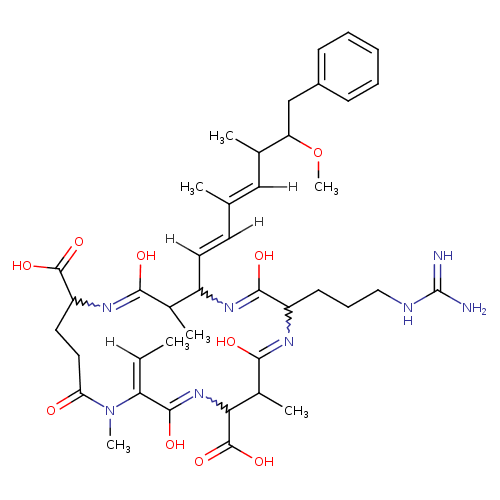
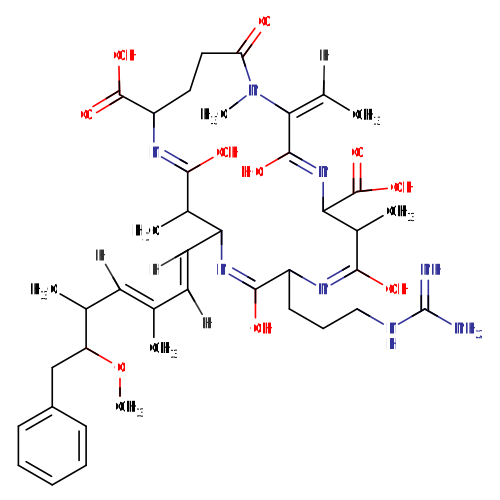
DescriptionNodularin-R is a cyclic nonribosomal peptide produced by the planktonic cyanobacterium Nodularia spumigena. This cyanobacterium forms blooms in brackish water bodies throughout the world. Nodularin-R is a pentapeptide and contains several unusual non-proteinogenic amino acids such as methyldehydrobutyrine and the _-amino acid ADDA, (all-S,all-E)-3-amino-9-methoxy-2,6,8-trimethyl-10-phenyldeca-4,6-dienoic acid. Nodularin-R is a cyanotoxin and poses a health risk for wild and domestic animals as well as humans. Nodularin-R is a potent hepatotoxin and may cause serious damage to the liver.
Contaminant Sources
  • IARC Carcinogens Group 3
  • T3DB toxins
Contaminant Type
  • Amide
  • Amine
  • Bacterial Toxin
  • Ester
  • Ether
  • Microcystin
  • Natural Compound
  • Organic Compound
Chemical Structure
Thumb
Synonyms
ValueSource
(2E)-9-(3-Carbamimidamidopropyl)-2-ethylidene-3,7,10,14-tetrahydroxy-12-[(3E)-6-methoxy-3,5-dimethyl-7-phenylhepta-1,3-dien-1-yl]-1,6,13-trimethyl-19-oxo-1,4,8,11,15-pentaazacyclononadeca-3,7,10,14-tetraene-5,16-dicarboxylateGenerator
NodularinMeSH
Chemical FormulaC41H60N8O10
Average Molecular Mass824.977 g/mol
Monoisotopic Mass824.443 g/mol
CAS Registry Number118399-22-7
IUPAC Name(2E)-9-(3-carbamimidamidopropyl)-2-ethylidene-3,7,10,14-tetrahydroxy-12-[(1E,3E)-6-methoxy-3,5-dimethyl-7-phenylhepta-1,3-dien-1-yl]-1,6,13-trimethyl-19-oxo-1,4,8,11,15-pentaazacyclononadeca-3,7,10,14-tetraene-5,16-dicarboxylic acid
Traditional Name(2E)-9-(3-carbamimidamidopropyl)-2-ethylidene-3,7,10,14-tetrahydroxy-12-[(1E,3E)-6-methoxy-3,5-dimethyl-7-phenylhepta-1,3-dien-1-yl]-1,6,13-trimethyl-19-oxo-1,4,8,11,15-pentaazacyclononadeca-3,7,10,14-tetraene-5,16-dicarboxylic acid
SMILES[H]\C(C)=C1/N(C)C(=O)CCC(N=C(O)C(C)C(N=C(O)C(CCCNC(N)=N)N=C(O)C(C)C(N=C1O)C(O)=O)C([H])=C([H])C(\C)=C(/[H])C(C)C(CC1=CC=CC=C1)OC)C(O)=O
InChI IdentifierInChI=1S/C41H60N8O10/c1-8-31-38(54)48-34(40(57)58)26(5)36(52)46-29(15-12-20-44-41(42)43)37(53)45-28(25(4)35(51)47-30(39(55)56)18-19-33(50)49(31)6)17-16-23(2)21-24(3)32(59-7)22-27-13-10-9-11-14-27/h8-11,13-14,16-17,21,24-26,28-30,32,34H,12,15,18-20,22H2,1-7H3,(H,45,53)(H,46,52)(H,47,51)(H,48,54)(H,55,56)(H,57,58)(H4,42,43,44)/b17-16+,23-21+,31-8+
InChI KeyIXBQSRWSVIBXNC-ANPQUZCZSA-N
Chemical Taxonomy
Description belongs to the class of organic compounds known as oligopeptides. These are organic compounds containing a sequence of between three and ten alpha-amino acids joined by peptide bonds.
KingdomOrganic compounds
Super ClassOrganic acids and derivatives
ClassCarboxylic acids and derivatives
Sub ClassAmino acids, peptides, and analogues
Direct ParentOligopeptides
Alternative Parents
Substituents
  • Alpha-oligopeptide
  • Gamma-glutamyl alpha peptide
  • Macrolactam
  • Beta amino acid or derivatives
  • Alpha-amino acid or derivatives
  • Monocyclic benzene moiety
  • Dicarboxylic acid or derivatives
  • Benzenoid
  • Tertiary carboxylic acid amide
  • Carboxamide group
  • Guanidine
  • Lactam
  • Secondary carboxylic acid amide
  • Carboxylic acid
  • Dialkyl ether
  • Azacycle
  • Ether
  • Organoheterocyclic compound
  • Organic 1,3-dipolar compound
  • Propargyl-type 1,3-dipolar organic compound
  • Carboximidamide
  • Organic oxygen compound
  • Organic oxide
  • Carbonyl group
  • Hydrocarbon derivative
  • Organic nitrogen compound
  • Organonitrogen compound
  • Organooxygen compound
  • Aromatic heteromonocyclic compound
Molecular FrameworkAromatic heteromonocyclic compounds
External DescriptorsNot Available
Biological Properties
StatusDetected and Not Quantified
OriginExogenous
Cellular Locations
  • Cytoplasm
  • Extracellular
Biofluid LocationsNot Available
Tissue Locations
  • Liver
PathwaysNot Available
ApplicationsNot Available
Biological RolesNot Available
Chemical RolesNot Available
Physical Properties
StateSolid
AppearanceWhite powder.
Experimental Properties
PropertyValue
Melting PointNot Available
Boiling PointNot Available
SolubilityNot Available
Predicted Properties
PropertyValueSource
Water Solubility0.0055 g/LALOGPS
logP1.85ALOGPS
logP2.11ChemAxon
logS-5.2ALOGPS
pKa (Strongest Acidic)2.96ChemAxon
pKa (Strongest Basic)11.94ChemAxon
Physiological Charge-1ChemAxon
Hydrogen Acceptor Count17ChemAxon
Hydrogen Donor Count9ChemAxon
Polar Surface Area296.4 ŲChemAxon
Rotatable Bond Count13ChemAxon
Refractivity233.07 m³·mol⁻¹ChemAxon
Polarizability86.9 ųChemAxon
Number of Rings2ChemAxon
Bioavailability0ChemAxon
Rule of FiveNoChemAxon
Ghose FilterNoChemAxon
Veber's RuleNoChemAxon
MDDR-like RuleNoChemAxon
Spectra
Spectra
Spectrum TypeDescriptionSplash KeyView
Predicted LC-MS/MSPredicted LC-MS/MS Spectrum - 10V, Positivesplash10-004i-1100001960-8a4e594a9011a3468547Spectrum
Predicted LC-MS/MSPredicted LC-MS/MS Spectrum - 20V, Positivesplash10-02or-3120003910-48cde95757ea7365bbc8Spectrum
Predicted LC-MS/MSPredicted LC-MS/MS Spectrum - 40V, Positivesplash10-00xr-9311111000-5693c7f883c19f0cfd9cSpectrum
Predicted LC-MS/MSPredicted LC-MS/MS Spectrum - 10V, Negativesplash10-05d0-1001001930-b04d421063d32c4661b8Spectrum
Predicted LC-MS/MSPredicted LC-MS/MS Spectrum - 20V, Negativesplash10-0cdi-4100021910-e762ef74566165167a65Spectrum
Predicted LC-MS/MSPredicted LC-MS/MS Spectrum - 40V, Negativesplash10-0a4l-9611210100-c38eb1027d0f6f85a2f9Spectrum
Toxicity Profile
Route of ExposureOral
Mechanism of ToxicityThe site of action of microcystins is the hepatocyte, the commonest cell type in the liver. They act by disrupting the cytoskeleton, the adaptable protein framework that constantly shapes and reshapes the cell as it responds to the environment. The cells die and this destroys the finer blood vessels of the liver leading to massive hepatic bleeding. The molecular target are a group of enzymes called protein phosphatases that play a role in regulating protein interactions and activities. Very well-defined types of protein phosphatase (type 1 and type 2A) are inhibited very specifically by very low concentrations of microcystins. This enzyme removes phosphate from a protein, a common step in many biochemical pathways. This inhibition, with subsequent build up of phosphorylated proteins, is believed to be a mechanism by which microcystins destroy livers. Microcystins also activate the enzyme phosphorylase b, which plays a very important role in the affairs of the hepatocyte. The combination of inhibition and activation is rapidly lethal to the cell. The specificity of some of these toxins makes them valuable research tools.
MetabolismMicrocystins are extremely stable and resist common chemical breakdown such as hydrolysis or oxidation under conditions found in most natural water bodies. These toxins can break down slowly at high temperature (40 °C or 104 o F ) at either very low (<1) or high (>9) pH. The half-life, the time it takes for one-half of the toxin to degrade, at pH 1 and 40 oC is 3 weeks; at typical ambient conditions half-life is 10 weeks.
Toxicity ValuesLD50 for rats and mice are in the range 36-122 micrograms/kg with the inhalation toxicity 180 mg/min/m3 or 43 micrograms/kg.
Lethal DoseIn comparing the available indications of hazards from cyanotoxins with other water-related health hazards, it is conspicuous that cyanotoxins have caused numerous fatal poisonings of livestock and wildlife, but no human fatalities due to oral uptake hav
Carcinogenicity (IARC Classification)3, not classifiable as to its carcinogenicity to humans. (2)
Uses/SourcesMicrocystins are produced by the cyanobacterial cells. When the algae dies, the cell walls burst, releasing the toxin into the water.
Minimum Risk LevelWHO developed a drinking water concentration limit of 1.5 μg/L for microcystin LR. They assumed that a 60 kg (132 lbs.) person drinks two liters of water each day and that 80% of the two liters is from a contaminated source.
Health EffectsLiver damage. While microcystin-LR does not cause cancer, microcystin may stimulate the growth of cancer cells.
SymptomsThe most common sign of human poisoning with microcystins is liver damage.
TreatmentMicrocystins can be broken down by some bacterial proteases.

Concentrations
Not Available
DrugBank IDNot Available
HMDB IDNot Available
FooDB IDNot Available
Phenol Explorer IDNot Available
KNApSAcK IDNot Available
BiGG IDNot Available
BioCyc IDNot Available
METLIN IDNot Available
PDB IDNot Available
Wikipedia LinkNot Available
Chemspider IDNot Available
ChEBI IDNot Available
PubChem Compound ID6437077
Kegg Compound IDNot Available
YMDB IDNot Available
ECMDB IDNot Available
References
Synthesis ReferenceNot Available
MSDSNot Available
General ReferencesNot Available