Record Information
Version1.0
Creation Date2009-11-13 22:01:12 UTC
Update Date2026-03-31 21:04:57 UTC
Accession NumberCHEM002580
Identification
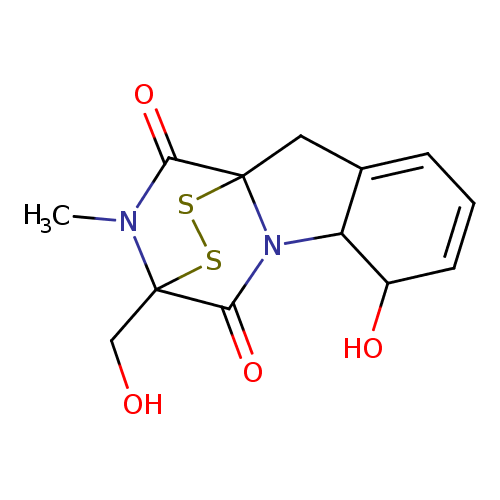
Common NameGliotoxin
ClassSmall Molecule
DescriptionGliotoxin is a sulfur-containing antibiotic produced by several species of fungi, some of which are pathogens of humans such as Aspergillus, and also by species of Trichoderma, and Penicillium. Gliotoxin possesses immunosuppressive properties as it may suppress and cause apoptosis in certain types of cells of the immune system, including neutrophils, eosinophils, granulocytes, macrophages, and thymocytes. (5)
Contaminant Sources
  • T3DB toxins
Contaminant Type
  • Amide
  • Amine
  • Fungal Toxin
  • Mycotoxin
  • Natural Compound
  • Organic Compound
Chemical Structure
Thumb
SynonymsNot Available
Chemical FormulaC13H14N2O4S2
Average Molecular Mass326.391 g/mol
Monoisotopic Mass326.039 g/mol
CAS Registry Number67-99-2
IUPAC Name7-hydroxy-11-(hydroxymethyl)-15-methyl-12,13-dithia-9,15-diazatetracyclo[9.2.2.0¹,⁹.0³,⁸]pentadeca-3,5-diene-10,14-dione
Traditional Namegliotoxin
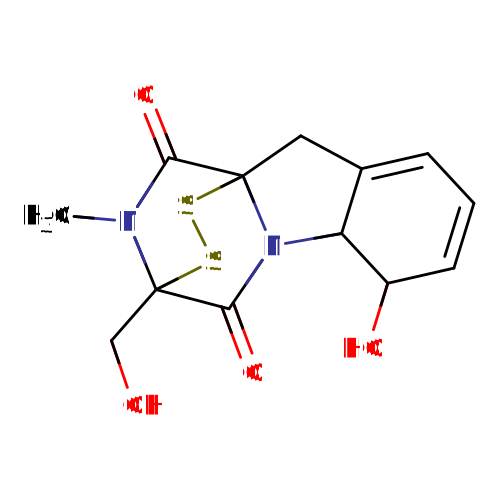
SMILESCN1C(=O)C23CC4=CC=CC(O)C4N2C(=O)C1(CO)SS3
InChI IdentifierInChI=1S/C13H14N2O4S2/c1-14-10(18)12-5-7-3-2-4-8(17)9(7)15(12)11(19)13(14,6-16)21-20-12/h2-4,8-9,16-17H,5-6H2,1H3
InChI KeyFIVPIPIDMRVLAY-UHFFFAOYSA-N
Chemical Taxonomy
Description belongs to the class of organic compounds known as epipolythiodioxopiperazines. Epipolythiodioxopiperazines are compounds containing an epipolythiodioxopiperazine moiety, which consists of a 2,3-dithia-5,7-diazabicyclo[2.2.2]octane-6,8-dione ring system. One distinct characteristics of Epipolythiodioxopiperazines is the presence of unique di- or polysulfide bridges.
KingdomOrganic compounds
Super ClassOrganoheterocyclic compounds
ClassDiazinanes
Sub ClassPiperazines
Direct ParentEpipolythiodioxopiperazines
Alternative Parents
Substituents
  • Alpha-amino acid or derivatives
  • Epipolythiodioxopiperazine
  • Indole or derivatives
  • N-alkylpiperazine
  • N-methylpiperazine
  • Dithiazinane
  • Tertiary carboxylic acid amide
  • Pyrrolidine
  • Carboxamide group
  • Lactam
  • Organic disulfide
  • Secondary alcohol
  • Carboxylic acid derivative
  • Azacycle
  • Organonitrogen compound
  • Hydrocarbon derivative
  • Organic oxide
  • Organopnictogen compound
  • Alcohol
  • Organic oxygen compound
  • Carbonyl group
  • Organic nitrogen compound
  • Organooxygen compound
  • Primary alcohol
  • Aliphatic heteropolycyclic compound
Molecular FrameworkAliphatic heteropolycyclic compounds
External DescriptorsNot Available
Biological Properties
StatusDetected and Not Quantified
OriginExogenous
Cellular Locations
  • Cytoplasm
  • Extracellular
Biofluid LocationsNot Available
Tissue LocationsNot Available
PathwaysNot Available
ApplicationsNot Available
Biological RolesNot Available
Chemical RolesNot Available
Physical Properties
StateSolid
AppearanceWhite to light yellow solid.
Experimental Properties
PropertyValue
Melting PointNot Available
Boiling PointNot Available
SolubilityNot Available
Predicted Properties
PropertyValueSource
Water Solubility12.9 g/LALOGPS
logP-0.36ALOGPS
logP-0.018ChemAxon
logS-1.4ALOGPS
pKa (Strongest Acidic)13.81ChemAxon
pKa (Strongest Basic)-3.2ChemAxon
Physiological Charge0ChemAxon
Hydrogen Acceptor Count4ChemAxon
Hydrogen Donor Count2ChemAxon
Polar Surface Area81.08 ŲChemAxon
Rotatable Bond Count1ChemAxon
Refractivity81.69 m³·mol⁻¹ChemAxon
Polarizability30.61 ųChemAxon
Number of Rings4ChemAxon
Bioavailability1ChemAxon
Rule of FiveYesChemAxon
Ghose FilterYesChemAxon
Veber's RuleNoChemAxon
MDDR-like RuleNoChemAxon
Spectra
Spectra
Spectrum TypeDescriptionSplash KeyView
Predicted GC-MSPredicted GC-MS Spectrum - GC-MS (Non-derivatized) - 70eV, Positivesplash10-0a4i-6891000000-dc755a3faf80227a1a30Spectrum
Predicted GC-MSPredicted GC-MS Spectrum - GC-MS (Non-derivatized) - 70eV, PositiveNot AvailableSpectrum
Predicted GC-MSPredicted GC-MS Spectrum - GC-MS (TMS_1_1) - 70eV, PositiveNot AvailableSpectrum
Predicted GC-MSPredicted GC-MS Spectrum - GC-MS (TMS_1_2) - 70eV, PositiveNot AvailableSpectrum
Predicted GC-MSPredicted GC-MS Spectrum - GC-MS (TMS_2_1) - 70eV, PositiveNot AvailableSpectrum
Predicted GC-MSPredicted GC-MS Spectrum - GC-MS (TBDMS_1_1) - 70eV, PositiveNot AvailableSpectrum
Predicted GC-MSPredicted GC-MS Spectrum - GC-MS (TBDMS_1_2) - 70eV, PositiveNot AvailableSpectrum
Predicted GC-MSPredicted GC-MS Spectrum - GC-MS (TBDMS_2_1) - 70eV, PositiveNot AvailableSpectrum
Predicted LC-MS/MSPredicted LC-MS/MS Spectrum - 10V, Positivesplash10-0a4i-0009000000-95f8aa33f1fa88022b54Spectrum
Predicted LC-MS/MSPredicted LC-MS/MS Spectrum - 20V, Positivesplash10-0a4i-0029000000-11ac950ebb2f67150fd5Spectrum
Predicted LC-MS/MSPredicted LC-MS/MS Spectrum - 40V, Positivesplash10-0fr6-9120000000-203d8b9fa3d5f9a1520aSpectrum
Predicted LC-MS/MSPredicted LC-MS/MS Spectrum - 10V, Negativesplash10-004j-0093000000-6c5b359bc2d3cc2081a5Spectrum
Predicted LC-MS/MSPredicted LC-MS/MS Spectrum - 20V, Negativesplash10-004i-0090000000-814b6894ed33c4bbd0a7Spectrum
Predicted LC-MS/MSPredicted LC-MS/MS Spectrum - 40V, Negativesplash10-06ur-0091000000-7d83439eed6bfbd31908Spectrum
Predicted LC-MS/MSPredicted LC-MS/MS Spectrum - 10V, Positivesplash10-004i-0009000000-98bf454948e4c3f35f0cSpectrum
Predicted LC-MS/MSPredicted LC-MS/MS Spectrum - 20V, Positivesplash10-004i-0009000000-d85fccb9caf720b47b9bSpectrum
Predicted LC-MS/MSPredicted LC-MS/MS Spectrum - 40V, Positivesplash10-0udi-5091000000-cf96ab72715599cb355cSpectrum
Predicted LC-MS/MSPredicted LC-MS/MS Spectrum - 10V, Negativesplash10-004i-0009000000-85b64da2463f3f133a6aSpectrum
Predicted LC-MS/MSPredicted LC-MS/MS Spectrum - 20V, Negativesplash10-004i-0049000000-46f3823b9aa2e41be386Spectrum
Predicted LC-MS/MSPredicted LC-MS/MS Spectrum - 40V, Negativesplash10-066r-3393000000-0294d462d54fd6f7cde7Spectrum
1D NMR13C NMR SpectrumNot AvailableSpectrum
1D NMR1H NMR SpectrumNot AvailableSpectrum
1D NMR13C NMR SpectrumNot AvailableSpectrum
1D NMR1H NMR SpectrumNot AvailableSpectrum
1D NMR13C NMR SpectrumNot AvailableSpectrum
1D NMR1H NMR SpectrumNot AvailableSpectrum
1D NMR13C NMR SpectrumNot AvailableSpectrum
1D NMR1H NMR SpectrumNot AvailableSpectrum
1D NMR13C NMR SpectrumNot AvailableSpectrum
1D NMR1H NMR SpectrumNot AvailableSpectrum
1D NMR13C NMR SpectrumNot AvailableSpectrum
1D NMR1H NMR SpectrumNot AvailableSpectrum
1D NMR13C NMR SpectrumNot AvailableSpectrum
1D NMR1H NMR SpectrumNot AvailableSpectrum
1D NMR13C NMR SpectrumNot AvailableSpectrum
Toxicity Profile
Route of ExposureOral, dermal, inhalation, and parenteral (contaminated drugs). (3)
Mechanism of ToxicityGliotoxin possesses immunosuppressive properties as it may suppress and cause apoptosis in certain types of cells of the immune system, including neutrophils, eosinophils, granulocytes, macrophages, and thymocytes. It also acts as an inhibitor of farnesyl transferase. Gliotoxin noncompetitively inhibits the chymotrypsin-like activity of the 20S proteasome and displays anti-inflammatory activity. It acts by blocking thiol groups in the cell membranes. Gliotoxin is also cytotoxic and causes neurite degeneration. Mycotoxins are often able to enter the liver and kidney by human organic anion transporters (hOATs) and human organic cation transporters (hOCTs). They can also inhibit uptake of anions and cations by these transporters, interefering with the secretion of endogenous metabolites, drugs, and xenobiotics including themselves. This results in increased cellular accumulation of toxic compounds causing nephro- and hepatotoxicity. (5, 1, 2)
MetabolismNot Available
Toxicity ValuesNot Available
Lethal DoseNot Available
Carcinogenicity (IARC Classification)No indication of carcinogenicity to humans (not listed by IARC).
Uses/SourcesGliotoxin is a sulfur-containing antibiotic produced by several species of fungi, some of which are pathogens of humans such as Aspergillus, and also by species of Trichoderma, and Penicillium. Gliotoxin possesses immunosuppressive properties. (5)
Minimum Risk LevelNot Available
Health EffectsGliotoxin has immunosuppressive effects. It is also cytotoxic and causes neurite degeneration. (5, 1)
SymptomsNot Available
TreatmentNot Available
Concentrations
Not Available
DrugBank IDNot Available
HMDB IDHMDB0252746
FooDB IDNot Available
Phenol Explorer IDNot Available
KNApSAcK IDC00002340
BiGG IDNot Available
BioCyc IDNot Available
METLIN IDNot Available
PDB IDNot Available
Wikipedia LinkGliotoxin
Chemspider ID3358
ChEBI IDNot Available
PubChem Compound IDNot Available
Kegg Compound IDNot Available
YMDB IDNot Available
ECMDB IDNot Available
References
Synthesis ReferenceNot Available
MSDSNot Available
General ReferencesNot Available