Record Information
Version1.0
Creation Date2009-11-11 22:18:18 UTC
Update Date2026-03-27 01:00:36 UTC
Accession NumberCHEM002576
Identification
Common Name4-Aminophenol
ClassSmall Molecule
Description4-Aminophenol is an amphoteric molecule and a reducing agent. Aminophenols are intermediates in the synthesis of dyes and can thus be found in numerous cosmetics products, particularly hair dyes. 4-aminophenol is considered a minor nephrotoxic metabolite of phenacetin and acetaminophen (paracetamol) in man. 4-Aminophenol can undergo autoxidations and metal-catalyzed and enzymatic oxidations in man to produce reactive oxygen species. (2) (15)
Contaminant Sources
  • FooDB Chemicals
  • HMDB Contaminants - Urine
  • HPV EPA Chemicals
  • OECD HPV Chemicals
  • STOFF IDENT Compounds
  • T3DB toxins
  • ToxCast & Tox21 Chemicals
Contaminant Type
  • Amine
  • Aromatic Hydrocarbon
  • Cosmetic Toxin
  • Food Toxin
  • Household Toxin
  • Metabolite
  • Organic Compound
  • Synthetic Compound
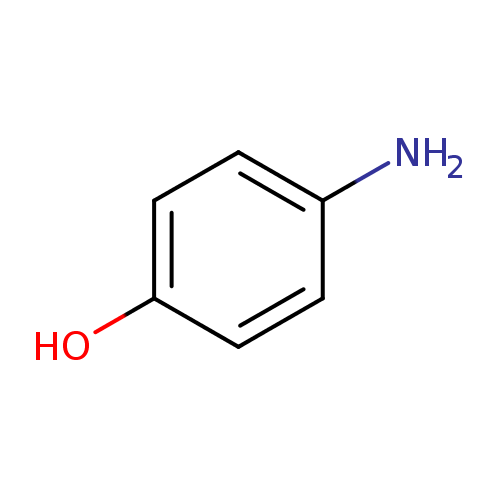
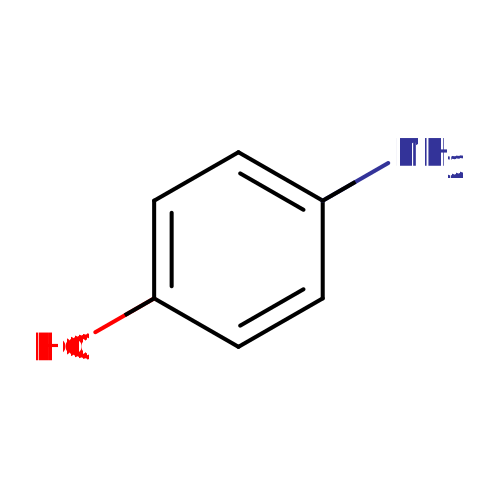
Chemical Structure
Thumb
Synonyms
ValueSource
4-AminobenzenolChEBI
4-HydroxyanilineChEBI
p-AminophenolChEBI
p-HydroxyanilineChEBI
4-Aminophenol conjugate monoacidMeSH
4-Aminophenol hydrochlorideMeSH
4-Aminophenol monopotassium saltMeSH
4-Aminophenol monosodium saltMeSH
4-Aminophenol sulfateMeSH
4-Aminophenol sulfate (2:1)MeSH
4-Aminophenol, 18O-labeledMeSH
4-Aminophenol, 3H-labeledMeSH
4-Aminophenol, ion(1+)MeSH
p-Aminophenol phosphateMeSH
Para-aminophenolMeSH
1-amino-4-HydroxybenzeneHMDB
4-amino-1-HydroxybenzeneHMDB
ActivolHMDB
AminophenolHMDB
EnergolHMDB
Fouramine PHMDB
P-HydroxyphenylamineHMDB
ParamidophenolHMDB
ParanolHMDB
4-AminophenolKEGG
Chemical FormulaC6H7NO
Average Molecular Mass109.126 g/mol
Monoisotopic Mass109.053 g/mol
CAS Registry Number123-30-8
IUPAC Name4-aminophenol
Traditional Nameaminophenol
SMILESNC1=CC=C(O)C=C1
InChI IdentifierInChI=1S/C6H7NO/c7-5-1-3-6(8)4-2-5/h1-4,8H,7H2
InChI KeyPLIKAWJENQZMHA-UHFFFAOYSA-N
Chemical Taxonomy
Description belongs to the class of organic compounds known as aniline and substituted anilines. These are organic compounds containing an aminobenzene moiety.
KingdomOrganic compounds
Super ClassBenzenoids
ClassBenzene and substituted derivatives
Sub ClassAniline and substituted anilines
Direct ParentAniline and substituted anilines
Alternative Parents
Substituents
  • P-aminophenol
  • Aniline or substituted anilines
  • Aminophenol
  • 1-hydroxy-2-unsubstituted benzenoid
  • Phenol
  • Organic nitrogen compound
  • Organic oxygen compound
  • Organopnictogen compound
  • Hydrocarbon derivative
  • Primary amine
  • Organooxygen compound
  • Organonitrogen compound
  • Amine
  • Aromatic homomonocyclic compound
Molecular FrameworkAromatic homomonocyclic compounds
External Descriptors
Biological Properties
StatusDetected and Not Quantified
OriginExogenous
Cellular Locations
  • Cytoplasm
  • Extracellular
Biofluid LocationsNot Available
Tissue Locations
  • Epidermis
  • Spleen
PathwaysNot Available
ApplicationsNot Available
Biological Roles
Chemical RolesNot Available
Physical Properties
StateLiquid
AppearanceWhite powder. (16)
Experimental Properties
PropertyValue
Melting Point187.5°C
Boiling Point187.5°C
Solubility16 mg/mL at 20°C
Predicted Properties
PropertyValueSource
Water Solubility121 g/LALOGPS
logP0.47ALOGPS
logP0.84ChemAxon
logS0.04ALOGPS
pKa (Strongest Acidic)10.4ChemAxon
pKa (Strongest Basic)5.43ChemAxon
Physiological Charge0ChemAxon
Hydrogen Acceptor Count2ChemAxon
Hydrogen Donor Count2ChemAxon
Polar Surface Area46.25 ŲChemAxon
Rotatable Bond Count0ChemAxon
Refractivity32.74 m³·mol⁻¹ChemAxon
Polarizability11.23 ųChemAxon
Number of Rings1ChemAxon
Bioavailability1ChemAxon
Rule of FiveYesChemAxon
Ghose FilterNoChemAxon
Veber's RuleNoChemAxon
MDDR-like RuleNoChemAxon
Spectra
Spectra
Spectrum TypeDescriptionSplash KeyView
GC-MSGC-MS Spectrum - EI-B (Non-derivatized)splash10-0a4i-6900000000-9c5bfea7a6ff3c845001Spectrum
GC-MSGC-MS Spectrum - EI-B (Non-derivatized)splash10-0pe9-9300000000-8ff47e2157f6fbfe6754Spectrum
GC-MSGC-MS Spectrum - GC-EI-TOF (Non-derivatized)splash10-0f79-1890000000-c8247060f46131c693d1Spectrum
GC-MSGC-MS Spectrum - GC-EI-TOF (Non-derivatized)splash10-03di-1927000000-b873199d9ac85605a4dfSpectrum
GC-MSGC-MS Spectrum - EI-B (Non-derivatized)splash10-0a4i-6900000000-9c5bfea7a6ff3c845001Spectrum
GC-MSGC-MS Spectrum - EI-B (Non-derivatized)splash10-0pe9-9300000000-8ff47e2157f6fbfe6754Spectrum
GC-MSGC-MS Spectrum - GC-EI-TOF (Non-derivatized)splash10-0f79-1890000000-c8247060f46131c693d1Spectrum
GC-MSGC-MS Spectrum - GC-EI-TOF (Non-derivatized)splash10-03di-1927000000-b873199d9ac85605a4dfSpectrum
Predicted GC-MSPredicted GC-MS Spectrum - GC-MS (Non-derivatized) - 70eV, Positivesplash10-0a4i-5900000000-e64da39e73e3c0ea696cSpectrum
Predicted GC-MSPredicted GC-MS Spectrum - GC-MS (1 TMS) - 70eV, Positivesplash10-060r-6900000000-2c6cd652b49e26ce3fceSpectrum
Predicted GC-MSPredicted GC-MS Spectrum - GC-MS (Non-derivatized) - 70eV, PositiveNot AvailableSpectrum
LC-MS/MSLC-MS/MS Spectrum - Quattro_QQQ 10V, Positive (Annotated)splash10-03di-3900000000-906f96b14dfdad2310deSpectrum
LC-MS/MSLC-MS/MS Spectrum - Quattro_QQQ 25V, Positive (Annotated)splash10-014i-9000000000-d56be0077647bc66e962Spectrum
LC-MS/MSLC-MS/MS Spectrum - Quattro_QQQ 40V, Positive (Annotated)splash10-014i-9000000000-937794addf5b73c988e9Spectrum
LC-MS/MSLC-MS/MS Spectrum - LC-ESI-QFT , positivesplash10-03di-2900000000-1d20b6ad92e8fe4dcb55Spectrum
LC-MS/MSLC-MS/MS Spectrum - 35V, Positivesplash10-03di-2900000000-5950ca2352822bea4a01Spectrum
LC-MS/MSLC-MS/MS Spectrum - 35V, Positivesplash10-02tc-9300000000-3524fecaa931f284564bSpectrum
Predicted LC-MS/MSPredicted LC-MS/MS Spectrum - 10V, Positivesplash10-03di-0900000000-da3b2114d9298a0363e7Spectrum
Predicted LC-MS/MSPredicted LC-MS/MS Spectrum - 20V, Positivesplash10-03di-1900000000-b43943b1e137b2912b0fSpectrum
Predicted LC-MS/MSPredicted LC-MS/MS Spectrum - 40V, Positivesplash10-00lr-9000000000-8ca8655366b90d8f42dfSpectrum
Predicted LC-MS/MSPredicted LC-MS/MS Spectrum - 10V, Negativesplash10-0a4i-0900000000-28f35dbe83fee57d4a70Spectrum
Predicted LC-MS/MSPredicted LC-MS/MS Spectrum - 20V, Negativesplash10-0a4i-0900000000-6aa4cd1a9d2a859fa70bSpectrum
Predicted LC-MS/MSPredicted LC-MS/MS Spectrum - 40V, Negativesplash10-0a7i-9300000000-177dcaf10b9e95cb409cSpectrum
Predicted LC-MS/MSPredicted LC-MS/MS Spectrum - 10V, Positivesplash10-03di-0900000000-c89e2460dc3caf4abe05Spectrum
Predicted LC-MS/MSPredicted LC-MS/MS Spectrum - 20V, Positivesplash10-014i-9100000000-b0a8e0715ece78a9716dSpectrum
Predicted LC-MS/MSPredicted LC-MS/MS Spectrum - 40V, Positivesplash10-0159-9000000000-aed714f11873786e9c3aSpectrum
Predicted LC-MS/MSPredicted LC-MS/MS Spectrum - 10V, Negativesplash10-0a4i-0900000000-875d8abd6f6773a40634Spectrum
Predicted LC-MS/MSPredicted LC-MS/MS Spectrum - 20V, Negativesplash10-0a4i-0900000000-875d8abd6f6773a40634Spectrum
Predicted LC-MS/MSPredicted LC-MS/MS Spectrum - 40V, Negativesplash10-0f6x-9200000000-17afc5bcee8bb56bc9e8Spectrum
MSMass Spectrum (Electron Ionization)splash10-0a4i-9700000000-00bffb48fd955696bcccSpectrum
1D NMR1H NMR SpectrumNot AvailableSpectrum
1D NMR13C NMR SpectrumNot AvailableSpectrum
2D NMR[1H,13C] 2D NMR SpectrumNot AvailableSpectrum
Toxicity Profile
Route of ExposureOral (13) ; inhalation (13)
Mechanism of Toxicity4-Aminobiphenyl requires metabolic activation in order to exert its toxicity. This is catalyzed by N-hydroxylation via cytochrome P450 1A2, then followed by O-sulfation and O-acetylation by sulfotransferase 1A1 and arylamine N-acetyltransferase 2. The metabolites of 4-aminobiphenyl then form adducts with DNA, inducing mutations. 4-Aminobiphenyl and its metabolites may also cross the placenta and have fetal effects. (1, 2, 3, 4). It is also though that the mode of action involves metabolic activation by N-hydroxylation, followed by N-esterification leading to the formation of a reactive electrophile, which binds covalently to DNA, principally to deoxyguanosine, leading to an increased rate of DNA mutations and ultimately to the development of cancer. In humans and dogs, the urinary bladder urothelium is the target organ, whereas in mice it is the bladder and liver; in other species, other tissues can be involved. Differences in organ specificity are thought to be due to differences in metabolic activation versus inactivation (12).
MetabolismNot Available
Toxicity ValuesLD50: 375 mg/kg (Oral, Rat) (17)
Lethal DoseNot Available
Carcinogenicity (IARC Classification)Not listed by IARC.
Uses/Sources4-Aminophenol is commonly used as a developer in black and white film, marketed under the name Rodinal. Aminophenols are also intermediates in the synthesis of dyes and can thus be found in numerous cosmetics products, particularly hair dyes. (15, 16)
Minimum Risk LevelNot Available
Health Effects4-Aminophenol may act as a skin sensitizer and cause contact dermatitis. In addition, inhalation of large amounts can cause methemoglobinemia and bronchial asthma. (18)
Symptoms4-Aminophenol may cause contact dermatitis. Signs and symptoms of methemoglobinemia may include shortness of breath, cyanosis, mental status changes, headache, fatigue, exercise intolerance, dizziness and loss of consciousness. Severe methemoglobinemia can result in dysrhythmias, seizures, coma, and death. (18, 14)
TreatmentMethemoglobinemia can be treated with supplemental oxygen and methylene blue 1% solution administered intravenously slowly over five minutes followed by IV flush with normal saline. Methylene blue restores the iron in hemoglobin to its normal (reduced) oxygen-carrying state. (14)
Concentrations
Not Available
DrugBank IDNot Available
HMDB IDHMDB0001169
FooDB IDFDB022462
Phenol Explorer IDNot Available
KNApSAcK IDNot Available
BiGG IDNot Available
BioCyc IDCPD-259
METLIN ID6051
PDB IDNot Available
Wikipedia Link4-Aminophenol
Chemspider ID392
ChEBI ID17602
PubChem Compound ID403
Kegg Compound IDC02372
YMDB IDNot Available
ECMDB IDNot Available
References
Synthesis ReferenceZhu, Jianliang; Yang, Ying; Xu, Jinlai; Gu, Zhiqiang; Zhang, Xiaowei; Zheng, Zhigang; Li, Jianlin; Hao, Xiangyang. Method for preparation of p-aminophenol. Faming Zhuanli Shenqing Gongkai Shuomingshu (2005), 6 pp.
MSDSLink
General References
1. https://www.ncbi.nlm.nih.gov/pubmed/?term=11304127
2. https://www.ncbi.nlm.nih.gov/pubmed/?term=1395635
3. https://www.ncbi.nlm.nih.gov/pubmed/?term=22770225
4. https://www.ncbi.nlm.nih.gov/pubmed/?term=7179289
5. Zhu, Jianliang; Yang, Ying; Xu, Jinlai; Gu, Zhiqiang; Zhang, Xiaowei; Zheng, Zhigang; Li, Jianlin; Hao, Xiangyang. Method for preparation of p-aminophenol. Faming Zhuanli Shenqing Gongkai Shuomingshu (2005), 6 pp.
6. Pan L, Yu J, Mi Z, Mo L, Jin H, Yao C, Ren D, Menghe B: A Metabolomics Approach Uncovers Differences between Traditional and Commercial Dairy Products in Buryatia (Russian Federation). Molecules. 2018 Mar 22;23(4). pii: molecules23040735. doi: 10.3390/molecules23040735.
7. Zhu, Jianliang; Yang, Ying; Xu, Jinlai; Gu, Zhiqiang; Zhang, Xiaowei; Zheng, Zhigang; Li, Jianlin; Hao, Xiangyang. Method for preparation of p-aminophenol. Faming Zhuanli Shenqing Gongkai Shuomingshu (2005), 6 pp.
8. Lampinen M, Bondesson U, Fredriksson E, Hedeland M: Validation of a method for quantification of ketobemidone in human plasma with liquid chromatography-tandem mass spectrometry. J Chromatogr B Analyt Technol Biomed Life Sci. 2003 Jun 15;789(2):347-54.
9. Clark PM, Clark JD, Wheatley T: Urine discoloration after acetaminophen overdose. Clin Chem. 1986 Sep;32(9):1777-8.
10. Kanishchev PA, Bereza NM, Seniuk VF, Perevziaka AV: [Quantitative determination of blood loss from the gastrointestinal tract using Metol in chronic diseases of the digestive organs]. Lab Delo. 1989;(3):36-8.
11. Xu Y, Halsall B, Heineman WR: Heterogeneous enzyme immunoassay of alpha-fetoprotein in maternal serum by flow-injection amperometric detection of 4-aminophenol. Clin Chem. 1990 Nov;36(11):1941-4.
12. Bomhard EM, Herbold BA: Genotoxic activities of aniline and its metabolites and their relationship to the carcinogenicity of aniline in the spleen of rats. Crit Rev Toxicol. 2005 Dec;35(10):783-835.
13. Nohynek GJ, Duche D, Garrigues A, Meunier PA, Toutain H, Leclaire J: Under the skin: Biotransformation of para-aminophenol and para-phenylenediamine in reconstructed human epidermis and human hepatocytes. Toxicol Lett. 2005 Sep 15;158(3):196-212.
14. Van Bocxlaer JF, Clauwaert KM, Lambert WE, De Leenheer AP: Quantitative colorimetric determination of urinary p-aminophenol with an automated analyzer. Clin Chem. 1997 Apr;43(4):627-34.
15. Gil EP, Tang HT, Halsall HB, Heineman WR, Misiego AS: Competitive heterogeneous enzyme immunoassay for theophylline by flow-injection analysis with electrochemical detection of p-aminophenol. Clin Chem. 1990 Apr;36(4):662-5.
16. Arndt CA, Colvin OM, Balis FM, Lester CM, Johnson G, Poplack DG: Intrathecal administration of 4-hydroperoxycyclophosphamide in rhesus monkeys. Cancer Res. 1987 Nov 15;47(22):5932-4.
17. Hegedus ZL, Nayak U: Para-aminophenol and structurally related compounds as intermediates in lipofuscin formation and in renal and other tissue toxicities. Arch Int Physiol Biochim Biophys. 1991 Feb;99(1):99-105.