Record Information
Version1.0
Creation Date2009-11-11 22:17:57 UTC
Update Date2026-05-14 17:14:25 UTC
Accession NumberCHEM002575
Identification
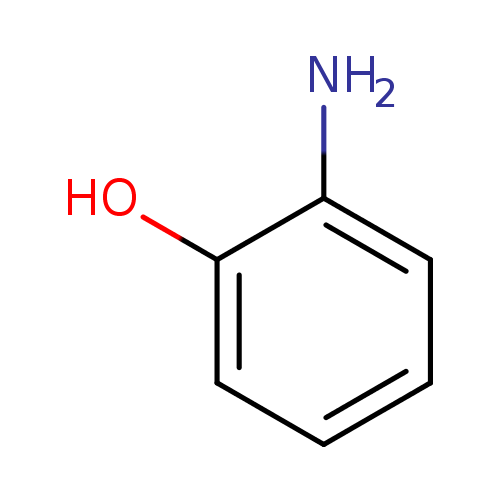
Common Name2-Aminophenol
ClassSmall Molecule
Description2-Aminophenol is an amphoteric molecule and a reducing agent. It is a useful reagent for the synthesis of dyes and heterocyclic compounds. As it is used synthesis of dyes, it can often be found in cosmetic products such as hair dyes. (4)
Contaminant Sources
  • EAFUS Chemicals
  • HPV EPA Chemicals
  • STOFF IDENT Compounds
  • T3DB toxins
  • ToxCast & Tox21 Chemicals
Contaminant Type
  • Amine
  • Aromatic Hydrocarbon
  • Cosmetic Toxin
  • Household Toxin
  • Industrial/Workplace Toxin
  • Organic Compound
  • Synthetic Compound
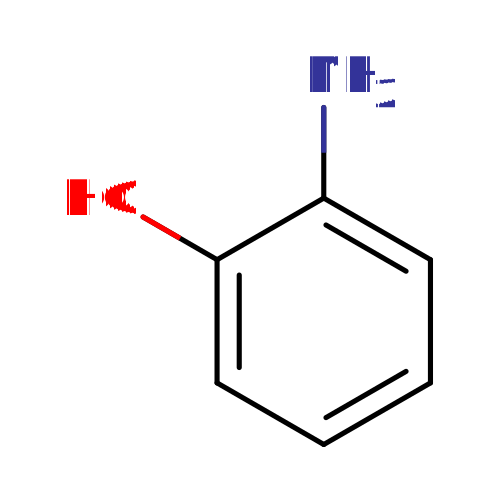
Chemical Structure
Thumb
Synonyms
ValueSource
2-AminobenzenolChEBI
2-HydroxyanilineChEBI
O-AminophenolChEBI
O-HydroxyanilineChEBI
ortho-AminophenolMeSH
2-Aminophenol, ion (1+)MeSH
2-Aminophenol, hydrochlorideMeSH
2-Aminophenol, monopotassium saltMeSH
2-Aminophenol, monosodium saltMeSH
Chemical FormulaC6H7NO
Average Molecular Mass109.126 g/mol
Monoisotopic Mass109.053 g/mol
CAS Registry Number95-55-6
IUPAC Name2-aminophenol
Traditional Name2-aminophenol
SMILESNC1=CC=CC=C1O
InChI IdentifierInChI=1S/C6H7NO/c7-5-3-1-2-4-6(5)8/h1-4,8H,7H2
InChI KeyCDAWCLOXVUBKRW-UHFFFAOYSA-N
Chemical Taxonomy
Description belongs to the class of organic compounds known as aniline and substituted anilines. These are organic compounds containing an aminobenzene moiety.
KingdomOrganic compounds
Super ClassBenzenoids
ClassBenzene and substituted derivatives
Sub ClassAniline and substituted anilines
Direct ParentAniline and substituted anilines
Alternative Parents
Substituents
  • O-aminophenol
  • Aniline or substituted anilines
  • Aminophenol
  • 1-hydroxy-4-unsubstituted benzenoid
  • 1-hydroxy-2-unsubstituted benzenoid
  • Phenol
  • Organic nitrogen compound
  • Organic oxygen compound
  • Organopnictogen compound
  • Hydrocarbon derivative
  • Primary amine
  • Organooxygen compound
  • Organonitrogen compound
  • Amine
  • Aromatic homomonocyclic compound
Molecular FrameworkAromatic homomonocyclic compounds
External Descriptors
Biological Properties
StatusDetected and Not Quantified
OriginExogenous
Cellular Locations
  • Cytoplasm
  • Extracellular
Biofluid LocationsNot Available
Tissue LocationsNot Available
PathwaysNot Available
ApplicationsNot Available
Biological Roles
Chemical RolesNot Available
Physical Properties
StateSolid
AppearanceWhite crystals. (4)
Experimental Properties
PropertyValue
Melting Point174°C
Boiling PointNot Available
Solubility20 mg/mL at 20°C
Predicted Properties
PropertyValueSource
Water Solubility116 g/LALOGPS
logP0.35ALOGPS
logP0.84ChemAxon
logS0.02ALOGPS
pKa (Strongest Acidic)10.35ChemAxon
pKa (Strongest Basic)4.52ChemAxon
Physiological Charge0ChemAxon
Hydrogen Acceptor Count2ChemAxon
Hydrogen Donor Count2ChemAxon
Polar Surface Area46.25 ŲChemAxon
Rotatable Bond Count0ChemAxon
Refractivity32.74 m³·mol⁻¹ChemAxon
Polarizability11.16 ųChemAxon
Number of Rings1ChemAxon
Bioavailability1ChemAxon
Rule of FiveYesChemAxon
Ghose FilterNoChemAxon
Veber's RuleNoChemAxon
MDDR-like RuleNoChemAxon
Spectra
Spectra
Spectrum TypeDescriptionSplash KeyView
GC-MSGC-MS Spectrum - GC-MS (2 TMS)splash10-0udi-2940000000-25ee431a814318b5cd43Spectrum
GC-MSGC-MS Spectrum - GC-MS (3 TMS)splash10-00di-1391000000-c7b790c4abd26562c515Spectrum
GC-MSGC-MS Spectrum - EI-B (Non-derivatized)splash10-0a59-9500000000-64a0083db1618cc2d030Spectrum
GC-MSGC-MS Spectrum - GC-EI-TOF (Non-derivatized)splash10-0udi-0930000000-dca6cf7ac4a910fdb060Spectrum
GC-MSGC-MS Spectrum - GC-EI-TOF (Non-derivatized)splash10-00di-0491000000-cee860404b79a1d6aa74Spectrum
LC-MS/MSLC-MS/MS Spectrum - , negativesplash10-0a4i-0900000000-a46bd7617baf2869204eSpectrum
LC-MS/MSLC-MS/MS Spectrum - LC-ESI-QQ , positivesplash10-03fr-9700000000-bb6fb8e53538176fc3a7Spectrum
LC-MS/MSLC-MS/MS Spectrum - LC-ESI-QQ , positivesplash10-03dl-9600000000-a6223641aa5dc0380c02Spectrum
LC-MS/MSLC-MS/MS Spectrum - LC-ESI-QQ , positivesplash10-014l-9000000000-9a3dae6cbb045cbf75c3Spectrum
LC-MS/MSLC-MS/MS Spectrum - LC-ESI-QQ , positivesplash10-014i-9000000000-9bb70b310c6146ff4a8aSpectrum
LC-MS/MSLC-MS/MS Spectrum - LC-ESI-QQ , positivesplash10-03di-9000000000-db35f1e1ead0bce0cceaSpectrum
LC-MS/MSLC-MS/MS Spectrum - , positivesplash10-03di-2900000000-58d470a79c69d9474181Spectrum
LC-MS/MSLC-MS/MS Spectrum - LC-ESI-QFT , positivesplash10-03di-3900000000-b3cb0ba9cdf9ed8d746dSpectrum
Predicted LC-MS/MSPredicted LC-MS/MS Spectrum - 10V, Positivesplash10-03di-1900000000-e58857d4114340490af9Spectrum
Predicted LC-MS/MSPredicted LC-MS/MS Spectrum - 20V, Positivesplash10-03di-7900000000-6a7bea3115d2f232655fSpectrum
Predicted LC-MS/MSPredicted LC-MS/MS Spectrum - 40V, Positivesplash10-0f6x-9000000000-9088e18b362fd9670013Spectrum
Predicted LC-MS/MSPredicted LC-MS/MS Spectrum - 10V, Negativesplash10-0a4i-0900000000-37cb1b0b0fd858785030Spectrum
Predicted LC-MS/MSPredicted LC-MS/MS Spectrum - 20V, Negativesplash10-0a4i-2900000000-40c5580a05dd72323647Spectrum
Predicted LC-MS/MSPredicted LC-MS/MS Spectrum - 40V, Negativesplash10-0a4l-9200000000-5a42eb6db939ab0337f7Spectrum
MSMass Spectrum (Electron Ionization)splash10-0a4i-7900000000-518eb832be87964ec0c6Spectrum
1D NMR1H NMR SpectrumNot AvailableSpectrum
1D NMR13C NMR SpectrumNot AvailableSpectrum
Toxicity Profile
Route of ExposureOral (2) ; inhalation (2)
Mechanism of Toxicity2-Aminophenol interacts with both adult and fetal hemoglobin, forming methemoglobin. In comparison to its isomers, 3-aminophenol and 4-aminophenol, 2-aminophenol is the most effective in forming methemoglobin. Since methemoglobin cannot bind oxygen like hemoglobin can, elevated levels of methemoglobin cause a condition called methemoglobinemia, which can result in tissue hypoxia. (3, 1)
MetabolismNot Available
Toxicity ValuesLD50: 1250 mg/kg (Oral, Mouse) (5) LD50: 37 mg/kg (Subcutaneous), Rat) (5) LD50: 200 mg/kg (Intrapertioneal, Mouse) (5)
Lethal DoseNot Available
Carcinogenicity (IARC Classification)No indication of carcinogenicity to humans (not listed by IARC).
Uses/SourcesAs a reducing agent, 2-Aminophenol is marketed under the names of Atomal and Ortol and used to develop black and white photographs. 2-Aminophenol is also an intermediate in the synthesis of dyes and can thus be found in numerous cosmetics products, particularly hair dyes. (4)
Minimum Risk LevelNot Available
Health Effects2-Aminophenol may act as a skin sensitizer and cause contact dermatitis. In addition, inhalation of large amounts can cause methemoglobinemia and bronchial asthma. (6)
Symptoms2-Aminophenol may cause contact dermatitis. Signs and symptoms of methemoglobinemia may include shortness of breath, cyanosis, mental status changes, headache, fatigue, exercise intolerance, dizziness and loss of consciousness. Severe methemoglobinemia can result in dysrhythmias, seizures, coma, and death. (6, 3)
TreatmentMethemoglobinemia can be treated with supplemental oxygen and methylene blue 1% solution administered intravenously slowly over five minutes followed by IV flush with normal saline. Methylene blue restores the iron in hemoglobin to its normal (reduced) oxygen-carrying state. (3)
Concentrations
Not Available
DrugBank IDDB01726
HMDB IDHMDB0240309
FooDB IDFDB093591
Phenol Explorer IDNot Available
KNApSAcK IDC00007533
BiGG IDNot Available
BioCyc IDNot Available
METLIN IDNot Available
PDB IDNot Available
Wikipedia Link2-Aminophenol
Chemspider IDNot Available
ChEBI ID18112
PubChem Compound ID5801
Kegg Compound IDC01987
YMDB IDNot Available
ECMDB IDM2MDB005867
References
Synthesis Reference

Theodor Papenfuhs, “Process for the preparation of 5-hydroxyethylsulfonyl-2-aminophenol (ethers).” U.S. Patent US4613704, issued February, 1979.

MSDSNot Available
General References
1. https://www.ncbi.nlm.nih.gov/pubmed/?term=11304127
2. https://www.ncbi.nlm.nih.gov/pubmed/?term=1395635
3. https://www.ncbi.nlm.nih.gov/pubmed/?term=24124510
4. https://www.ncbi.nlm.nih.gov/pubmed/?term=24571346
5. https://www.ncbi.nlm.nih.gov/pubmed/?term=9683650