Record Information
Version1.0
Creation Date2009-08-10 21:31:10 UTC
Update Date2026-03-31 19:17:15 UTC
Accession NumberCHEM002562
Identification
Common Name2-Nitrophenol
ClassSmall Molecule
Description2-Nitrophenol is a phenolic compound that is used mainly to make dyes, paint coloring, rubber chemicals, and substances that kill molds. (4)
Contaminant Sources
  • Clean Air Act Chemicals
  • HPV EPA Chemicals
  • My Exposome Chemicals
  • STOFF IDENT Compounds
  • Sludge Chemicals
  • T3DB toxins
  • ToxCast & Tox21 Chemicals
Contaminant Type
  • Aromatic Hydrocarbon
  • Industrial Precursor/Intermediate
  • Industrial/Workplace Toxin
  • Nitrite
  • Organic Compound
  • Pollutant
  • Synthetic Compound
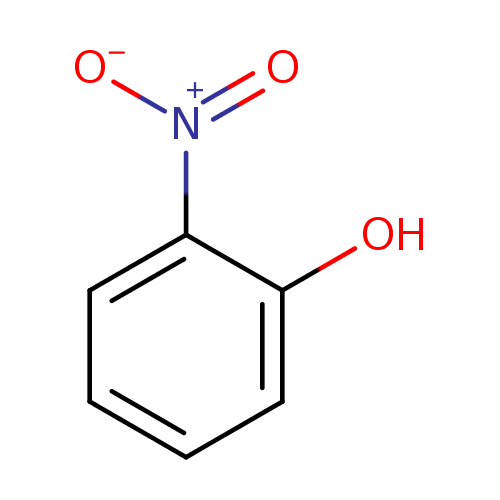
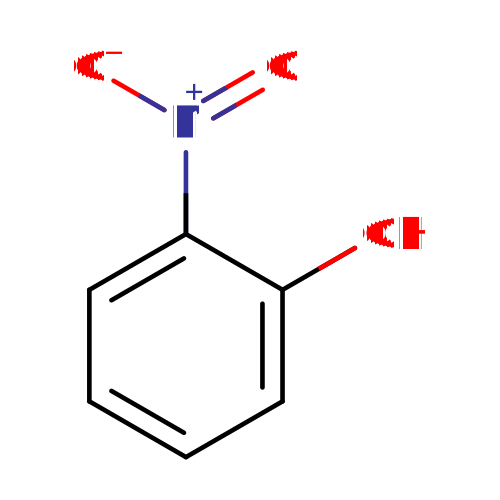
Chemical Structure
Thumb
Synonyms
ValueSource
2-HydroxynitrobenzeneChEBI
O-HydroxynitrobenzeneChEBI
O-NitrophenolChEBI
2-Nitrophenol, ammonium saltHMDB
Ortho-nitrophenolHMDB
2-Nitrophenol, sodium saltHMDB
Chemical FormulaC6H5NO3
Average Molecular Mass139.109 g/mol
Monoisotopic Mass139.027 g/mol
CAS Registry Number88-75-5
IUPAC Name2-nitrophenol
Traditional Nameo-nitrophenol
SMILESOC1=CC=CC=C1[N+]([O-])=O
InChI IdentifierInChI=1S/C6H5NO3/c8-6-4-2-1-3-5(6)7(9)10/h1-4,8H
InChI KeyIQUPABOKLQSFBK-UHFFFAOYSA-N
Chemical Taxonomy
Description belongs to the class of organic compounds known as nitrophenols. Nitrophenols are compounds containing a nitrophenol moiety, which consists of a benzene ring bearing both a hydroxyl group and a nitro group on two different ring carbon atoms.
KingdomOrganic compounds
Super ClassBenzenoids
ClassPhenols
Sub ClassNitrophenols
Direct ParentNitrophenols
Alternative Parents
Substituents
  • Nitrophenol
  • Nitrobenzene
  • Nitroaromatic compound
  • 1-hydroxy-4-unsubstituted benzenoid
  • 1-hydroxy-2-unsubstituted benzenoid
  • Monocyclic benzene moiety
  • C-nitro compound
  • Organic nitro compound
  • Organic oxoazanium
  • Allyl-type 1,3-dipolar organic compound
  • Propargyl-type 1,3-dipolar organic compound
  • Organic 1,3-dipolar compound
  • Organooxygen compound
  • Organonitrogen compound
  • Organic oxide
  • Organic nitrogen compound
  • Organic oxygen compound
  • Organopnictogen compound
  • Hydrocarbon derivative
  • Aromatic homomonocyclic compound
Molecular FrameworkAromatic homomonocyclic compounds
External Descriptors
Biological Properties
StatusDetected and Not Quantified
OriginExogenous
Cellular Locations
  • Cytoplasm
  • Extracellular
Biofluid LocationsNot Available
Tissue LocationsNot Available
PathwaysNot Available
ApplicationsNot Available
Biological RolesNot Available
Chemical RolesNot Available
Physical Properties
StateSolid
AppearanceLight yellow solid.
Experimental Properties
PropertyValue
Melting Point44.8°C
Boiling PointNot Available
Solubility2.5 mg/mL at 25°C [YALKOWSKY,SH & DANNENFELSER,RM (1992)]
Predicted Properties
PropertyValueSource
Water Solubility4.25 g/LALOGPS
logP1.91ALOGPS
logP1.61ChemAxon
logS-1.5ALOGPS
pKa (Strongest Acidic)6.43ChemAxon
pKa (Strongest Basic)-6.7ChemAxon
Physiological Charge-1ChemAxon
Hydrogen Acceptor Count3ChemAxon
Hydrogen Donor Count1ChemAxon
Polar Surface Area66.05 ŲChemAxon
Rotatable Bond Count1ChemAxon
Refractivity35.36 m³·mol⁻¹ChemAxon
Polarizability12.08 ųChemAxon
Number of Rings1ChemAxon
Bioavailability1ChemAxon
Rule of FiveYesChemAxon
Ghose FilterNoChemAxon
Veber's RuleNoChemAxon
MDDR-like RuleNoChemAxon
Spectra
Spectra
Spectrum TypeDescriptionSplash KeyView
Predicted GC-MSPredicted GC-MS Spectrum - GC-MS (Non-derivatized) - 70eV, Positivesplash10-000i-9600000000-f334730ebce29cc98fdcSpectrum
Predicted GC-MSPredicted GC-MS Spectrum - GC-MS (Non-derivatized) - 70eV, PositiveNot AvailableSpectrum
Predicted GC-MSPredicted GC-MS Spectrum - GC-MS (TMS_1_1) - 70eV, PositiveNot AvailableSpectrum
Predicted GC-MSPredicted GC-MS Spectrum - GC-MS (TBDMS_1_1) - 70eV, PositiveNot AvailableSpectrum
LC-MS/MSLC-MS/MS Spectrum - 90V, Negativesplash10-0a4i-0900000000-c41839802d48c97c72b7Spectrum
LC-MS/MSLC-MS/MS Spectrum - 75V, Negativesplash10-0a4i-0900000000-465b86a7fa9c91aea091Spectrum
LC-MS/MSLC-MS/MS Spectrum - 60V, Negativesplash10-0a4i-0900000000-ceb07f366862a609f086Spectrum
LC-MS/MSLC-MS/MS Spectrum - 45V, Negativesplash10-0a4r-0900000000-3d0f30b23eeba81f1048Spectrum
LC-MS/MSLC-MS/MS Spectrum - 15V, Negativesplash10-052r-0900000000-1da0c5d7dfec9c468340Spectrum
LC-MS/MSLC-MS/MS Spectrum - 30V, Negativesplash10-052r-0900000000-d696815345f1828530d1Spectrum
Predicted LC-MS/MSPredicted LC-MS/MS Spectrum - 10V, Positivesplash10-0006-0900000000-0e903cf94b3c53ac4aa7Spectrum
Predicted LC-MS/MSPredicted LC-MS/MS Spectrum - 20V, Positivesplash10-001i-0900000000-4ba5e7ff168121879afdSpectrum
Predicted LC-MS/MSPredicted LC-MS/MS Spectrum - 40V, Positivesplash10-01q9-4900000000-5a658d75ea75304f6bd6Spectrum
Predicted LC-MS/MSPredicted LC-MS/MS Spectrum - 10V, Negativesplash10-000i-0900000000-00733f70f7b16c0d705dSpectrum
Predicted LC-MS/MSPredicted LC-MS/MS Spectrum - 20V, Negativesplash10-000i-0900000000-05d7e7d651eeffdea56bSpectrum
Predicted LC-MS/MSPredicted LC-MS/MS Spectrum - 40V, Negativesplash10-002r-4900000000-412df114be028c848fdaSpectrum
MSMass Spectrum (Electron Ionization)splash10-000i-9400000000-b9d470aedfc9324e848bSpectrum
1D NMR1H NMR SpectrumNot AvailableSpectrum
1D NMR13C NMR SpectrumNot AvailableSpectrum
1D NMR1H NMR SpectrumNot AvailableSpectrum
1D NMR13C NMR SpectrumNot AvailableSpectrum
1D NMR1H NMR SpectrumNot AvailableSpectrum
1D NMR13C NMR SpectrumNot AvailableSpectrum
1D NMR1H NMR SpectrumNot AvailableSpectrum
1D NMR13C NMR SpectrumNot AvailableSpectrum
1D NMR1H NMR SpectrumNot AvailableSpectrum
1D NMR13C NMR SpectrumNot AvailableSpectrum
1D NMR1H NMR SpectrumNot AvailableSpectrum
1D NMR13C NMR SpectrumNot AvailableSpectrum
1D NMR1H NMR SpectrumNot AvailableSpectrum
1D NMR13C NMR SpectrumNot AvailableSpectrum
1D NMR1H NMR SpectrumNot AvailableSpectrum
1D NMR13C NMR SpectrumNot AvailableSpectrum
1D NMR1H NMR SpectrumNot AvailableSpectrum
1D NMR13C NMR SpectrumNot AvailableSpectrum
1D NMR1H NMR SpectrumNot AvailableSpectrum
1D NMR13C NMR SpectrumNot AvailableSpectrum
1D NMR1H NMR SpectrumNot AvailableSpectrum
Toxicity Profile
Route of ExposureOral (4) ; inhalation (4) ; dermal (4) ; eye contact (4).
Mechanism of ToxicityThe nitrite in nitrophenols causes the autocatalytic oxidation of oxyhemoglobin to hydrogen peroxide and methemoglobin. This elevation of methemoglobin levels is a condition known as methemoglobinemia, and is characterized by tissue hypoxia, as methemoglobin cannot bind oxygen. (1, 3)
MetabolismNitrophenol may be absorbed following ingestion, inhalation, or dermal exposure. The major metabolic route for nitrophenols is conjugation, with the resultant formation of either glucuronide or sulfate conjugates. Conjugates are more polar than the parent compounds and therefore are easier to excrete in the urine. (4)
Toxicity ValuesLD50: 334 mg/kg (Oral, Rat) (5) LD50: 378 mg/kg (Intraperitoneal, Mouse) (5) LD50: 100 mg/kg (Intravenous, Dog) (5)
Lethal DoseNot Available
Carcinogenicity (IARC Classification)No indication of carcinogenicity to humans (not listed by IARC).
Uses/Sources2-Nitrophenol is used mainly to make dyes, paint coloring, rubber chemicals, and substances that kill molds. (4)
Minimum Risk LevelNot Available
Health EffectsNitrophenols may cause methemoglobinemia. This is a disorder in which there is an abnormally high level of methemoglobin in the blood, resulting in a decrease in the amount of oxygen that can be carried to the tissues and organs. (4, 3)
SymptomsSymptoms of methemoglobinemia include shortness of breath, cyanosis, mental status changes, headache, fatigue, exercise intolerance, dizziness and loss of consciousness. Severe methemoglobinemia may cause dysrhythmias, seizures, coma and death. (3)
TreatmentMethemoglobinemia can be treated with supplemental oxygen and methylene blue 1% solution at 1-2mg/kg administered intravenously slowly over five minutes followed by an IV flush with normal saline. Methylene blue restores the iron in hemoglobin to its normal (reduced) oxygen-carrying state. (3)
Concentrations
Not Available
DrugBank IDNot Available
HMDB IDHMDB0245260
FooDB IDNot Available
Phenol Explorer IDNot Available
KNApSAcK IDNot Available
BiGG IDNot Available
BioCyc IDCPD-258
METLIN IDNot Available
PDB IDNot Available
Wikipedia LinkNitrophenol
Chemspider ID13837787
ChEBI ID16260
PubChem Compound ID6947
Kegg Compound IDC01988
YMDB IDNot Available
ECMDB IDNot Available
References
Synthesis ReferenceNot Available
MSDSNot Available
General References
1. https://www.ncbi.nlm.nih.gov/pubmed/?term=23796307
2. https://www.ncbi.nlm.nih.gov/pubmed/?term=24347320
3. Barupal DK, Fiehn O: Generating the Blood Exposome Database Using a Comprehensive Text Mining and Database Fusion Approach. Environ Health Perspect. 2019 Sep;127(9):97008. doi: 10.1289/EHP4713. Epub 2019 Sep 26.