Record Information
Version1.0
Creation Date2009-07-30 17:59:14 UTC
Update Date2026-05-14 16:45:22 UTC
Accession NumberCHEM002537
Identification
Common NameVerapamil
ClassSmall Molecule
DescriptionVerapamil is only found in individuals that have used or taken this drug. Verapamil is a calcium channel blocker that is a class IV anti-arrhythmia agent. [PubChem]Verapamil inhibits voltage-dependent calcium channels. Specifically, its effect on L-type calcium channels in the heart causes a reduction in ionotropy and chronotropy, thuis reducing heart rate and blood pressure. Verapamil's mechanism of effect in cluster headache is thought to be linked to its calcium-channel blocker effect, but which channel subtypes are involved is presently not known. [PubChem] Calcium channel antagonists can be quite toxic. In the management of poisoning, early recognition is critical. Calcium channel antagonists are frequently prescribed, and the potential for serious morbidity and mortality with over dosage is significant. Ingestion of these agents should be suspected in any patient who presents in an overdose situation with unexplained hypotension and conduction abnormalities. The potential for toxicity should be noted in patients with underlying hepatic or renal dysfunction who are receiving therapeutic doses. (3).
Contaminant Sources
  • FooDB Chemicals
  • HMDB Contaminants - Urine
  • STOFF IDENT Compounds
  • Suspected Compounds - Waste Water
  • T3DB toxins
  • ToxCast & Tox21 Chemicals
Contaminant Type
  • Amine
  • Anti-Arrhythmia Agent
  • Calcium Channel Blocker
  • Cyanide Compound
  • Drug
  • Ether
  • Food Toxin
  • Metabolite
  • Nitrile
  • Organic Compound
  • Synthetic Compound
  • Vasodilator Agent
Chemical Structure
Thumb
Synonyms
ValueSource
CP-165331VerapamilHMDB
Covera-HSHMDB
VerelanHMDB
IsoptinHMDB
D-365IproveratrilHMDB
CP-16533-1CalanHMDB
TarkaHMDB
AkilenHMDB
AnpecHMDB
Apo-verapHMDB
Arpamyl LPHMDB
BerkatensHMDB
CalanHMDB
Calan SRHMDB
CalaptinHMDB
Calaptin 240 SRHMDB
CalcanHMDB
CardiabeltinHMDB
CardiaguttHMDB
CardibeltinHMDB
CardioprotectHMDB
CaverilHMDB
CivicorHMDB
Civicor retardHMDB
CoraverHMDB
CordiloxHMDB
Cordilox SRHMDB
CorpamilHMDB
D-365HMDB
delta-365HMDB
DignoverHMDB
DilacoranHMDB
Dilacoran htaHMDB
DurasoptinHMDB
ElthonHMDB
FalicardHMDB
FinoptinHMDB
FlamonHMDB
GeanginHMDB
HartezeHMDB
HexasoptinHMDB
Hexasoptin retardHMDB
HormitolHMDB
IkacorHMDB
IkapressHMDB
InselonHMDB
IproveratrilHMDB
Isoptin retardHMDB
Isoptin SRHMDB
IsoptineHMDB
IsoptinoHMDB
IsotopinHMDB
IzoptinHMDB
JenapamilHMDB
LekoptinHMDB
LodixalHMDB
MagotironHMDB
ManidonHMDB
Manidon retardHMDB
Novapamyl LPHMDB
Novo-veramilHMDB
Nu-verapHMDB
OrmilHMDB
PraecicorHMDB
QuasarHMDB
RapamHMDB
RobatelanHMDB
SecuronHMDB
UniverHMDB
UnivexHMDB
VasolanHMDB
VasomilHMDB
VasoptenHMDB
Vera-sanoraniaHMDB
VerabetaHMDB
Veracaps SRHMDB
VeracorHMDB
VerahexalHMDB
VeralocHMDB
VeramexHMDB
VeramilHMDB
Verapamil acisHMDB
Verapamil alHMDB
Verapamil atidHMDB
Verapamil basicsHMDB
Verapamil ebeweHMDB
Verapamil HCLHMDB
Verapamil henningHMDB
Verapamil injectionHMDB
Verapamil MSDHMDB
Verapamil NMHMDB
Verapamil NM pharmaHMDB
Verapamil nordicHMDB
Verapamil PBHMDB
Verapamil rikerHMDB
Verapamil SRHMDB
Verapamil verlaHMDB
Verapamil-abzHMDB
VerapamiloHMDB
VerapamilumHMDB
VerapinHMDB
Verapress 240 SRHMDB
VerasalHMDB
VerasifarHMDB
VeratensinHMDB
VerdilacHMDB
Verelan PMHMDB
Verelan SRHMDB
VeroptinstadaHMDB
VerpamilHMDB
VetrimilHMDB
VortacHMDB
DexverapamilHMDB
Hydrochloride, verapamilHMDB
Sandoz brand OF verapamilHMDB
Verapamil hydrochlorideHMDB
Verapamil sandoz brandHMDB
Chemical FormulaC27H38N2O4
Average Molecular Mass454.602 g/mol
Monoisotopic Mass454.283 g/mol
CAS Registry Number52-53-9
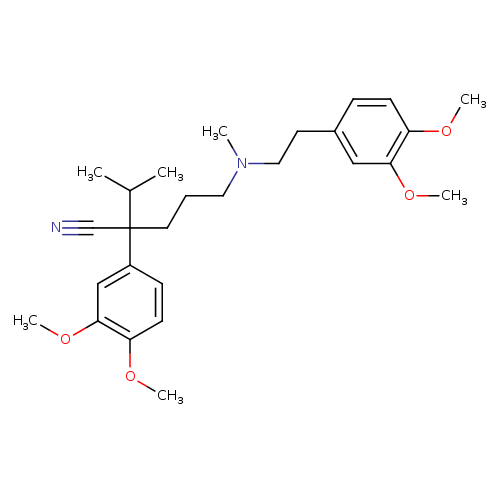
IUPAC Name2-(3,4-dimethoxyphenyl)-5-{[2-(3,4-dimethoxyphenyl)ethyl](methyl)amino}-2-(propan-2-yl)pentanenitrile
Traditional Nameveraβ
SMILESCOC1=C(OC)C=C(CCN(C)CCCC(C#N)(C(C)C)C2=CC(OC)=C(OC)C=C2)C=C1
InChI IdentifierInChI=1S/C27H38N2O4/c1-20(2)27(19-28,22-10-12-24(31-5)26(18-22)33-7)14-8-15-29(3)16-13-21-9-11-23(30-4)25(17-21)32-6/h9-12,17-18,20H,8,13-16H2,1-7H3
InChI KeySGTNSNPWRIOYBX-UHFFFAOYSA-N
Chemical Taxonomy
Description belongs to the class of organic compounds known as phenylbutylamines. Phenylbutylamines are compounds containing a phenylbutylamine moiety, which consists of a phenyl group substituted at the fourth carbon by an butan-1-amine.
KingdomOrganic compounds
Super ClassBenzenoids
ClassBenzene and substituted derivatives
Sub ClassPhenylbutylamines
Direct ParentPhenylbutylamines
Alternative Parents
Substituents
  • Phenylbutylamine
  • Dimethoxybenzene
  • O-dimethoxybenzene
  • Phenethylamine
  • Phenylpropane
  • Anisole
  • Phenol ether
  • Phenoxy compound
  • Methoxybenzene
  • Alkyl aryl ether
  • Aralkylamine
  • Tertiary aliphatic amine
  • Tertiary amine
  • Nitrile
  • Carbonitrile
  • Ether
  • Organic oxygen compound
  • Amine
  • Organic nitrogen compound
  • Organooxygen compound
  • Organonitrogen compound
  • Organopnictogen compound
  • Hydrocarbon derivative
  • Aromatic homomonocyclic compound
Molecular FrameworkAromatic homomonocyclic compounds
External Descriptors
Biological Properties
StatusDetected and Not Quantified
OriginExogenous
Cellular Locations
  • Membrane
Biofluid LocationsNot Available
Tissue Locations
  • Adipose Tissue
  • Bladder
  • Brain
  • Fibroblasts
  • Intestine
  • Kidney
  • Liver
  • Neuron
  • Pancreas
  • Placenta
  • Platelet
  • Prostate
  • Stratum Corneum
  • Testes
PathwaysNot Available
Applications
Biological Roles
Chemical Roles
Physical Properties
StateLiquid
AppearanceNot Available
Experimental Properties
PropertyValue
Melting Point< 25°C
Boiling Point243-246°C at 1.00E-02 mm Hg
Solubility4.47 mg/L
Predicted Properties
PropertyValueSource
Water Solubility0.0039 g/LALOGPS
logP5.23ALOGPS
logP5.04ChemAxon
logS-5.1ALOGPS
pKa (Strongest Basic)9.68ChemAxon
Physiological Charge1ChemAxon
Hydrogen Acceptor Count6ChemAxon
Hydrogen Donor Count0ChemAxon
Polar Surface Area63.95 ŲChemAxon
Rotatable Bond Count13ChemAxon
Refractivity132.65 m³·mol⁻¹ChemAxon
Polarizability51.7 ųChemAxon
Number of Rings2ChemAxon
Bioavailability0ChemAxon
Rule of FiveNoChemAxon
Ghose FilterNoChemAxon
Veber's RuleNoChemAxon
MDDR-like RuleNoChemAxon
Spectra
Spectra
Spectrum TypeDescriptionSplash KeyView
Predicted GC-MSPredicted GC-MS Spectrum - GC-MS (Non-derivatized) - 70eV, Positivesplash10-0cdu-4391500000-cd36ebd65bc8c7765961Spectrum
Predicted GC-MSPredicted GC-MS Spectrum - GC-MS (Non-derivatized) - 70eV, PositiveNot AvailableSpectrum
LC-MS/MSLC-MS/MS Spectrum - Quattro_QQQ 10V, Positive (Annotated)splash10-004l-0702900000-6a46ea2d5eed6d8b01ebSpectrum
LC-MS/MSLC-MS/MS Spectrum - Quattro_QQQ 25V, Positive (Annotated)splash10-0006-4109800000-80d342090a0be3344e82Spectrum
LC-MS/MSLC-MS/MS Spectrum - Quattro_QQQ 40V, Positive (Annotated)splash10-054w-0954400000-2def387c7c93ab211423Spectrum
LC-MS/MSLC-MS/MS Spectrum - LC-ESI-QQ (API3000, Applied Biosystems) 10V, Positivesplash10-0a4i-0000900000-4cde9a4b3a4f83d16afcSpectrum
LC-MS/MSLC-MS/MS Spectrum - LC-ESI-QQ (API3000, Applied Biosystems) 20V, Positivesplash10-0a4i-0000900000-980b47834e505d54a0e6Spectrum
LC-MS/MSLC-MS/MS Spectrum - LC-ESI-QQ (API3000, Applied Biosystems) 30V, Positivesplash10-066r-0902800000-ae024239c46b33917426Spectrum
LC-MS/MSLC-MS/MS Spectrum - LC-ESI-QQ (API3000, Applied Biosystems) 40V, Positivesplash10-014i-0901000000-81d1159b3102cff76218Spectrum
LC-MS/MSLC-MS/MS Spectrum - LC-ESI-QQ (API3000, Applied Biosystems) 50V, Positivesplash10-014i-0900000000-d9c344fee7b45b4030e6Spectrum
LC-MS/MSLC-MS/MS Spectrum - LC-ESI-IT (LC/MSD Trap XCT, Agilent Technologies) , Positivesplash10-0gb9-0914000000-070bdb975910e9aae99cSpectrum
LC-MS/MSLC-MS/MS Spectrum - LC-ESI-IT (LC/MSD Trap XCT, Agilent Technologies) , Positivesplash10-03di-0390000000-f41d80462c5d06c4f001Spectrum
LC-MS/MSLC-MS/MS Spectrum - LC-ESI-IT (LC/MSD Trap XCT, Agilent Technologies) , Positivesplash10-0097-2980000000-9a2ab0bcab33f7eaac6bSpectrum
LC-MS/MSLC-MS/MS Spectrum - LC-ESI-IT (LC/MSD Trap XCT, Agilent Technologies) , Positivesplash10-0uxr-0900000000-252a9989a8511cb2db80Spectrum
LC-MS/MSLC-MS/MS Spectrum - LC-ESI-IT (LC/MSD Trap XCT, Agilent Technologies) , Positivesplash10-0f79-0900000000-4fd6ca2c6c19c3bbf8f0Spectrum
LC-MS/MSLC-MS/MS Spectrum - LC-ESI-QTOF , positivesplash10-0a4i-0000900000-4365a47b2dc2f86bb272Spectrum
LC-MS/MSLC-MS/MS Spectrum - LC-ESI-QTOF , positivesplash10-0a4i-0000900000-e6a2b357160bf5b92c22Spectrum
LC-MS/MSLC-MS/MS Spectrum - LC-ESI-QTOF , positivesplash10-066r-0902400000-d8eac2ccd0a767c7e432Spectrum
LC-MS/MSLC-MS/MS Spectrum - LC-ESI-QTOF , positivesplash10-014i-0901000000-688f3c2345c5d9ccb8a5Spectrum
LC-MS/MSLC-MS/MS Spectrum - LC-ESI-QTOF , positivesplash10-014i-0900000000-cd09f8a2be876936f662Spectrum
LC-MS/MSLC-MS/MS Spectrum - LC-ESI-ITFT , positivesplash10-0uxr-0918000000-76641dd6dbc5cb05e79aSpectrum
Predicted LC-MS/MSPredicted LC-MS/MS Spectrum - 10V, Positivesplash10-0a4i-0010900000-c5883de78bb084688acbSpectrum
Predicted LC-MS/MSPredicted LC-MS/MS Spectrum - 20V, Positivesplash10-014i-0573900000-c95a634d7e2ecac924b7Spectrum
Predicted LC-MS/MSPredicted LC-MS/MS Spectrum - 40V, Positivesplash10-014i-1962200000-5e5b0f3f1481cfd4da52Spectrum
Predicted LC-MS/MSPredicted LC-MS/MS Spectrum - 10V, Negativesplash10-0udi-0000900000-44ab3d7fdbe57d5f189dSpectrum
Predicted LC-MS/MSPredicted LC-MS/MS Spectrum - 20V, Negativesplash10-0f79-0031900000-562635f25a21f2cbad9fSpectrum
Predicted LC-MS/MSPredicted LC-MS/MS Spectrum - 40V, Negativesplash10-0080-0192300000-aada67fc0f3e7f227e44Spectrum
MSMass Spectrum (Electron Ionization)splash10-0udi-3519000000-b5e0b9e0caac5cb57222Spectrum
1D NMR1H NMR SpectrumNot AvailableSpectrum
2D NMR[1H,13C] 2D NMR SpectrumNot AvailableSpectrum
Toxicity Profile
Route of ExposureOrally, 90‰ЫТ100% of Verapamil is absorbed. Intravenous.
Mechanism of ToxicityVerapamil inhibits voltage-dependent calcium channels. Specifically, its effect on L-type calcium channels in the heart causes a reduction in ionotropy and chronotropy, thuis reducing heart rate and blood pressure. Verapamil's mechanism of effect in cluster headache is thought to be linked to its calcium-channel blocker effect, but which channel subtypes are involved is presently not known.
MetabolismRoute of Elimination: Approximately 70% of an administered dose is excreted as metabolites in the urine and 16% or more in the feces within 5 days. About 3% to 4% is excreted in the urine as unchanged drug. Half Life: 2.8-7.4 hours
Toxicity ValuesLD50: 8 mg/kg (Intravenous, Mouse) (1)
Lethal DoseNot Available
Carcinogenicity (IARC Classification)No indication of carcinogenicity to humans (not listed by IARC).
Uses/SourcesDrug used for the treatment of hypertension, angina, and cluster headache prophylaxis.
Minimum Risk LevelNot Available
Health EffectsCardiovascular: angina pectoris, AV block (2° & 3°), atrioventricular dissociation, CHF, pulmonary edema, chest pain, claudication, myocardial infarction, palpitations, purpura (vasculitis), syncope. Digestive system: diarrhea, dry mouth, gastrointestinal distress, gingival hyperplasia. Hemic and lymphatic: ecchymosis or bruising. Nervous system: cerebrovascular accident, confusion, equilibrium disorders, insomnia, muscle cramps, psychotic symptoms, shakiness, somnolence, extrapyramidal symptoms. Skin: arthralgia and rash, exanthema, hair loss, hyperkeratosis, macules, sweating, urticaria, Stevens-Johnson syndrome, erythema multiforme. Special senses: blurred vision, tinnitus. Urogenital: gynecomastia, galactorrhea/hyperprolactinemia, increased urination, spotty menstruation, impotence.
SymptomsThe resultant inhibition of the contractile processes of the myocardial smooth muscle cells leads to dilation of the coronary and systemic arteries,improved oxygen delivery to the myocardial tissue, and decreased total peripheral resistance, systemic blood pressure, and afterload.
TreatmentTreatment of overdosage should be supportive. Beta-adrenergic stimulation or parenteral administration of calcium solutions may increase calcium ion flux across the slow channel and have been used effectively in treatment of deliberate overdosage with verapamil. In a few reported cases, overdose with calcium channel blockers has been associated with hypotension and bradycardia, initially refractory to atropine but becoming more responsive to this treatment when the patients received large doses (close to 1 gram/hour for more than 24 hours) of calcium chloride. Verapamil cannot be removed by hemodialysis. Clinically significant hypotensive reactions or high degree AV block should be treated with vasopressor agents or cardiac pacing, respectively. Asystole should be handled by the usual measures including cardiopulmonary resuscitation. (25)
Concentrations
Not Available
DrugBank IDDB00661
HMDB IDHMDB0001850
FooDB IDFDB022708
Phenol Explorer IDNot Available
KNApSAcK IDNot Available
BiGG IDNot Available
BioCyc IDNot Available
METLIN ID3009
PDB IDNot Available
Wikipedia LinkVerapamil
Chemspider ID2425
ChEBI ID77733
PubChem Compound ID2520
Kegg Compound IDC07188
YMDB IDNot Available
ECMDB IDNot Available
References
Synthesis Reference

Philippe Baudier, Arthur De Boeck, Jacques Fossion, “Novel galenic forms of verapamil, their preparation and medicines containing said novel galenic forms.” U.S. Patent US4859469, issued April, 1987.

MSDSLink
General References
1. Takeda H, Yamazaki Y, Akahane M, Igawa Y, Ajisawa Y, Nishizawa O: Role of the beta(3)-adrenoceptor in urine storage in the rat: comparison between the selective beta(3)-adrenoceptor agonist, CL316, 243, and various smooth muscle relaxants. J Pharmacol Exp Ther. 2000 Jun;293(3):939-45.
2. Wang YH, Jones DR, Hall SD: Differential mechanism-based inhibition of CYP3A4 and CYP3A5 by verapamil. Drug Metab Dispos. 2005 May;33(5):664-71. Epub 2005 Feb 2.
3. Byerly WG, Hartmann A, Foster DE, Tannenbaum AK: Verapamil in the treatment of maternal paroxysmal supraventricular tachycardia. Ann Emerg Med. 1991 May;20(5):552-4.
4. Miller MR, Withers R, Bhamra R, Holt DW: Verapamil and breast-feeding. Eur J Clin Pharmacol. 1986;30(1):125-6.
5. Takano A, Kusuhara H, Suhara T, Ieiri I, Morimoto T, Lee YJ, Maeda J, Ikoma Y, Ito H, Suzuki K, Sugiyama Y: Evaluation of in vivo P-glycoprotein function at the blood-brain barrier among MDR1 gene polymorphisms by using 11C-verapamil. J Nucl Med. 2006 Sep;47(9):1427-33.
6. Fakih H, MacLusky N, DeCherney A, Wallimann T, Huszar G: Enhancement of human sperm motility and velocity in vitro: effects of calcium and creatine phosphate. Fertil Steril. 1986 Nov;46(5):938-44.
7. Suzuki S, Nishimaki-Mogami T, Tamehiro N, Inoue K, Arakawa R, Abe-Dohmae S, Tanaka AR, Ueda K, Yokoyama S: Verapamil increases the apolipoprotein-mediated release of cellular cholesterol by induction of ABCA1 expression via Liver X receptor-independent mechanism. Arterioscler Thromb Vasc Biol. 2004 Mar;24(3):519-25. Epub 2004 Jan 15.
8. Glusa E: Effect of verapamil on platelet aggregation. Folia Haematol Int Mag Klin Morphol Blutforsch. 1988;115(4):469-73.
9. Ceccato A, Chiap P, Hubert P, Toussaint B, Crommen J: Automated determination of verapamil and norverapamil in human plasma with on-line coupling of dialysis to high-performance liquid chromatography and fluorometric detection. J Chromatogr A. 1996 Oct 25;750(1-2):351-60.
10. Nanni G, Panocchia N, Tacchino R, Foco M, Piccioni E, Castagneto M: Increased incidence of infection in verapamil-treated kidney transplant recipients. Transplant Proc. 2000 May;32(3):551-3.
11. Affolter H, Burkard WP, Pletscher A: Verapamil, an antagonist at 5-hydroxytryptamine receptors of human blood platelets. Eur J Pharmacol. 1985 Jan 22;108(2):157-62.
12. Rumiantsev DO, Piotrovskii VK, Riabokon' OS, Metelitsa VI: [Comparison of the verapamil concentration of human blood serum and saliva]. Farmakol Toksikol. 1987 Jan-Feb;50(1):85-9.
13. Gramatte T, Oertel R: Intestinal secretion of intravenous talinolol is inhibited by luminal R-verapamil. Clin Pharmacol Ther. 1999 Sep;66(3):239-45.
14. Hsiao P, Sasongko L, Link JM, Mankoff DA, Muzi M, Collier AC, Unadkat JD: Verapamil P-glycoprotein transport across the rat blood-brain barrier: cyclosporine, a concentration inhibition analysis, and comparison with human data. J Pharmacol Exp Ther. 2006 May;317(2):704-10. Epub 2006 Jan 13.
15. von Richter O, Greiner B, Fromm MF, Fraser R, Omari T, Barclay ML, Dent J, Somogyi AA, Eichelbaum M: Determination of in vivo absorption, metabolism, and transport of drugs by the human intestinal wall and liver with a novel perfusion technique. Clin Pharmacol Ther. 2001 Sep;70(3):217-27.
16. Narang PK, Blumhardt CL, Doran AR, Pickar D: Steady-state cerebrospinal fluid transfer of verapamil and metabolites in patients with schizophrenia. Clin Pharmacol Ther. 1988 Nov;44(5):550-7.
17. Szymanski W, Skublicki S, Jankowski A, Kotzbach R: [Pharmacokinetic investigations of verapamil used as a concomitant drug in treatment of premature labor]. Ginekol Pol. 1992 Apr;63(4):166-71.
18. Wang YH, Jones DR, Hall SD: Prediction of cytochrome P450 3A inhibition by verapamil enantiomers and their metabolites. Drug Metab Dispos. 2004 Feb;32(2):259-66.
19. Dumestre-Toulet V, Cirimele V, Gromb S, Belooussoff T, Lavault D, Ludes B, Kintz P: Last performance with VIAGRA: post-mortem identification of sildenafil and its metabolites in biological specimens including hair sample. Forensic Sci Int. 2002 Mar 28;126(1):71-6.
20. Bauer LA, Horn JR, Maxon MS, Easterling TR, Shen DD, Strandness DE Jr: Effect of metoprolol and verapamil administered separately and concurrently after single doses on liver blood flow and drug disposition. J Clin Pharmacol. 2000 May;40(5):533-43.
21. Hofer CA, Smith JK, Tenholder MF: Verapamil intoxication: a literature review of overdoses and discussion of therapeutic options. Am J Med. 1993 Oct;95(4):431-8.
22. Bellamy WT: P-glycoproteins and multidrug resistance. Annu Rev Pharmacol Toxicol. 1996;36:161-83.