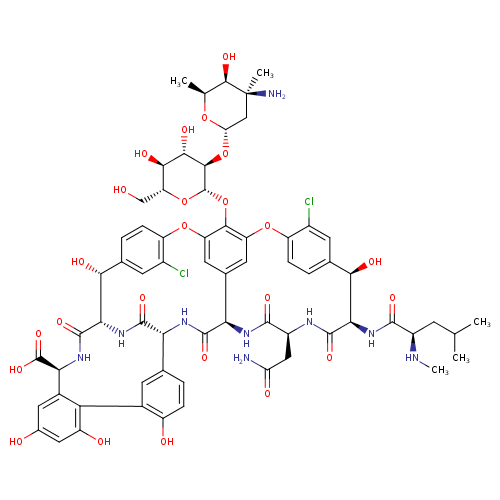
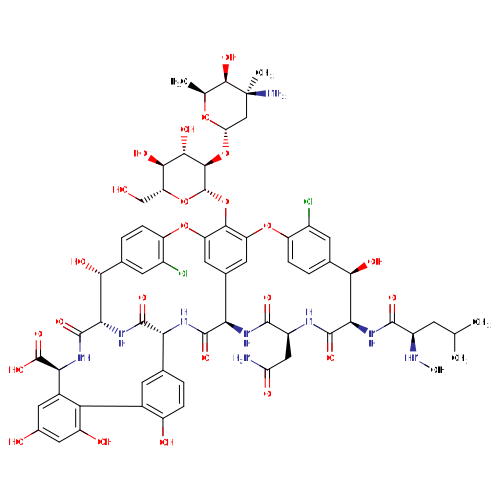
Record Information
Version1.0
Creation Date2009-07-30 17:59:13 UTC
Update Date2026-05-14 16:40:52 UTC
Accession NumberCHEM002536
Identification
Common NameVancomycin
ClassSmall Molecule
DescriptionVancomycin is only found in individuals that have used or taken this drug. It is an antibacterial obtained from Streptomyces orientalis. It is a glycopeptide related to ristocetin that inhibits bacterial cell wall assembly and is toxic to kidneys and the inner ear. [PubChem]The bactericidal action of vancomycin results primarily from inhibition of cell-wall biosynthesis. Specifically, vancomycin prevents incorporation of N-acetylmuramic acid (NAM)- and N-acetylglucosamine (NAG)-peptide subunits from being incorporated into the peptidoglycan matrix; which forms the major structural component of Gram-positive cell walls. The large hydrophilic molecule is able to form hydrogen bond interactions with the terminal D-alanyl-D-alanine moieties of the NAM/NAG-peptides. Normally this is a five-point interaction. This binding of vancomycin to the D-Ala-D-Ala prevents the incorporation of the NAM/NAG-peptide subunits into the peptidoglycan matrix. In addition, vancomycin alters bacterial-cell-membrane permeability and RNA synthesis. There is no cross-resistance between vancomycin and other antibiotics. Vancomycin is not active in vitro against gram-negative bacilli, mycobacteria, or fungi.
Contaminant Sources
  • HMDB Contaminants - Urine
  • STOFF IDENT Compounds
  • T3DB toxins
Contaminant Type
  • Amine
  • Anti-Bacterial Agent
  • Drug
  • Ether
  • Glycopeptide Antibacterial
  • Metabolite
  • Organic Compound
  • Organochloride
  • Synthetic Compound
Chemical Structure
Thumb
Synonyms
ValueSource
(1S,2R,18R,22S,25R,28R,40S)-22-(2-Amino-2-oxoethyl)-48-[2-O-(3-amino-2,3,6-trideoxy-3-methyl-alpha-L-lyxo-hexopyranosyl)-beta-D-glucopyranosyloxy]-5,15-dichloro-2,18,32,35,37-pentahydroxy-19-[(N-methyl-D-leucyl)amino]-20,23,26,42,44-pentaoxo-7,13-dioxa-21,24,27,41,43-pentaazaoctacyclo[26.14.2.2(3,6).2(14,17).1(8,12).1(29,33).0(10,25).0(34,39)]pentaconta-3,5,8(48),9,11,14,16,29(45),30,32,34,36,38,46,49-pentadecaene-40-carboxylic acidChEBI
(2.2Sp,3.5Sa,2.6Sp)-O(4.2),C(3.4):C(5.4),O(4.6):c(3.5),C(2.7)-tricyclo[N-methyl-D-leucyl-3-chloro-(R)-beta-hydroxy-D-tyrosyl-L-asparaginyl-D-2-(4-{[2-O-(3-amino-2,3,6-trideoxy-3-C-methyl-alpha-L-lyxo-hexopyranosyl)-beta-D-glucopyranosyl]oxy}phenyl)glycyl-D-2-(4-hydroxyphenyl)glycyl-3-chloro-(R)-beta-hydroxy-L-tyrosyl-L-2-(3,5-dihydroxyphenyl)glycine]ChEBI
VancocinChEBI
VancomicinChEBI
VancomicinaChEBI
VancomycineChEBI
VancomycinumChEBI
(1S,2R,18R,22S,25R,28R,40S)-22-(2-Amino-2-oxoethyl)-48-[2-O-(3-amino-2,3,6-trideoxy-3-methyl-a-L-lyxo-hexopyranosyl)-b-D-glucopyranosyloxy]-5,15-dichloro-2,18,32,35,37-pentahydroxy-19-[(N-methyl-D-leucyl)amino]-20,23,26,42,44-pentaoxo-7,13-dioxa-21,24,27,41,43-pentaazaoctacyclo[26.14.2.2(3,6).2(14,17).1(8,12).1(29,33).0(10,25).0(34,39)]pentaconta-3,5,8(48),9,11,14,16,29(45),30,32,34,36,38,46,49-pentadecaene-40-carboxylateGenerator
(1S,2R,18R,22S,25R,28R,40S)-22-(2-Amino-2-oxoethyl)-48-[2-O-(3-amino-2,3,6-trideoxy-3-methyl-a-L-lyxo-hexopyranosyl)-b-D-glucopyranosyloxy]-5,15-dichloro-2,18,32,35,37-pentahydroxy-19-[(N-methyl-D-leucyl)amino]-20,23,26,42,44-pentaoxo-7,13-dioxa-21,24,27,41,43-pentaazaoctacyclo[26.14.2.2(3,6).2(14,17).1(8,12).1(29,33).0(10,25).0(34,39)]pentaconta-3,5,8(48),9,11,14,16,29(45),30,32,34,36,38,46,49-pentadecaene-40-carboxylic acidGenerator
(1S,2R,18R,22S,25R,28R,40S)-22-(2-Amino-2-oxoethyl)-48-[2-O-(3-amino-2,3,6-trideoxy-3-methyl-alpha-L-lyxo-hexopyranosyl)-beta-D-glucopyranosyloxy]-5,15-dichloro-2,18,32,35,37-pentahydroxy-19-[(N-methyl-D-leucyl)amino]-20,23,26,42,44-pentaoxo-7,13-dioxa-21,24,27,41,43-pentaazaoctacyclo[26.14.2.2(3,6).2(14,17).1(8,12).1(29,33).0(10,25).0(34,39)]pentaconta-3,5,8(48),9,11,14,16,29(45),30,32,34,36,38,46,49-pentadecaene-40-carboxylateGenerator
(1S,2R,18R,22S,25R,28R,40S)-22-(2-Amino-2-oxoethyl)-48-[2-O-(3-amino-2,3,6-trideoxy-3-methyl-α-L-lyxo-hexopyranosyl)-β-D-glucopyranosyloxy]-5,15-dichloro-2,18,32,35,37-pentahydroxy-19-[(N-methyl-D-leucyl)amino]-20,23,26,42,44-pentaoxo-7,13-dioxa-21,24,27,41,43-pentaazaoctacyclo[26.14.2.2(3,6).2(14,17).1(8,12).1(29,33).0(10,25).0(34,39)]pentaconta-3,5,8(48),9,11,14,16,29(45),30,32,34,36,38,46,49-pentadecaene-40-carboxylateGenerator
(1S,2R,18R,22S,25R,28R,40S)-22-(2-Amino-2-oxoethyl)-48-[2-O-(3-amino-2,3,6-trideoxy-3-methyl-α-L-lyxo-hexopyranosyl)-β-D-glucopyranosyloxy]-5,15-dichloro-2,18,32,35,37-pentahydroxy-19-[(N-methyl-D-leucyl)amino]-20,23,26,42,44-pentaoxo-7,13-dioxa-21,24,27,41,43-pentaazaoctacyclo[26.14.2.2(3,6).2(14,17).1(8,12).1(29,33).0(10,25).0(34,39)]pentaconta-3,5,8(48),9,11,14,16,29(45),30,32,34,36,38,46,49-pentadecaene-40-carboxylic acidGenerator
(2.2Sp,3.5Sa,2.6Sp)-O(4.2),C(3.4):C(5.4),O(4.6):c(3.5),C(2.7)-tricyclo[N-methyl-D-leucyl-3-chloro-(R)-b-hydroxy-D-tyrosyl-L-asparaginyl-D-2-(4-{[2-O-(3-amino-2,3,6-trideoxy-3-C-methyl-a-L-lyxo-hexopyranosyl)-b-D-glucopyranosyl]oxy}phenyl)glycyl-D-2-(4-hydroxyphenyl)glycyl-3-chloro-(R)-b-hydroxy-L-tyrosyl-L-2-(3,5-dihydroxyphenyl)glycine]Generator
(2.2Sp,3.5Sa,2.6Sp)-O(4.2),C(3.4):C(5.4),O(4.6):c(3.5),C(2.7)-tricyclo[N-methyl-D-leucyl-3-chloro-(R)-β-hydroxy-D-tyrosyl-L-asparaginyl-D-2-(4-{[2-O-(3-amino-2,3,6-trideoxy-3-C-methyl-α-L-lyxo-hexopyranosyl)-β-D-glucopyranosyl]oxy}phenyl)glycyl-D-2-(4-hydroxyphenyl)glycyl-3-chloro-(R)-β-hydroxy-L-tyrosyl-L-2-(3,5-dihydroxyphenyl)glycine]Generator
Vancomycin HCLHMDB
AB-vancomycinHMDB
Azupharma brand OF vancomycin hydrochlorideHMDB
Combino brand OF vancomycin hydrochlorideHMDB
MIP brand OF vancomycin hydrochlorideHMDB
Norman brand OF vancomycin hydrochlorideHMDB
Vanco azupharmaHMDB
Vanco-saarHMDB
Vancomicina chiesiHMDB
Vancomycin lillyHMDB
Vancomycin phosphate (1:2)HMDB
Cell pharm brand OF vancomycin hydrochlorideHMDB
Chiesi brand OF vancomycin hydrochlorideHMDB
Vanco-cellHMDB
Vancomicina abbottHMDB
Vancomycin phosphate (1:2), decahydrateHMDB
Vancomycin-ratiopharmHMDB
Vancomycine dakotaHMDB
Abbott brand OF vancomycin hydrochlorideHMDB
DiatracinHMDB
Hexal brand OF vancomycin hydrochlorideHMDB
Lilly brand OF vancomycin hydrochlorideHMDB
Sulfate, vancomycinHMDB
Vancomicina normanHMDB
Dakota brand OF vancomycin hydrochlorideHMDB
Dista brand OF vancomycin hydrochlorideHMDB
Eli lilly brand OF vancomycin hydrochlorideHMDB
Hydrochloride, vancomycinHMDB
Vancocin HCLHMDB
VancocineHMDB
Vancomicina combino pharHMDB
Vancomycin hexalHMDB
Vancomycin hydrochlorideHMDB
Vancomycin sulfateHMDB
Curasan brand OF vancomycin hydrochlorideHMDB
Ratiopharm brand OF vancomycin hydrochlorideHMDB
Chemical FormulaC66H75Cl2N9O24
Average Molecular Mass1449.254 g/mol
Monoisotopic Mass1447.430 g/mol
CAS Registry Number1404-90-6
IUPAC Name(1S,2R,18R,19R,22S,25R,28R,40S)-48-{[(2S,3R,4S,5S,6R)-3-{[(2S,4S,5S,6S)-4-amino-5-hydroxy-4,6-dimethyloxan-2-yl]oxy}-4,5-dihydroxy-6-(hydroxymethyl)oxan-2-yl]oxy}-22-(carbamoylmethyl)-5,47-dichloro-2,18,32,35,37-pentahydroxy-19-[(2R)-4-methyl-2-(methylamino)pentanamido]-20,23,26,42,44-pentaoxo-7,13-dioxa-21,24,27,41,43-pentaazaoctacyclo[26.14.2.2^{3,6}.2^{14,17}.1^{8,12}.1^{29,33}.0^{10,25}.0^{34,39}]pentaconta-3,5,8,10,12(48),14,16,29(45),30,32,34,36,38,46,49-pentadecaene-40-carboxylic acid
Traditional Namevancomycin
SMILESCN[C@H](CC(C)C)C(=O)N[C@@H]1[C@H](O)C2=CC=C(OC3=C(O[C@@H]4O[C@H](CO)[C@@H](O)[C@H](O)[C@H]4O[C@H]4C[C@](C)(N)[C@H](O)[C@H](C)O4)C4=CC(=C3)[C@@H](NC(=O)[C@H](CC(N)=O)NC1=O)C(=O)N[C@@H]1C3=CC(=C(O)C=C3)C3=C(O)C=C(O)C=C3[C@H](NC(=O)[C@@H](NC1=O)[C@H](O)C1=CC(Cl)=C(O4)C=C1)C(O)=O)C(Cl)=C2
InChI IdentifierInChI=1S/C66H75Cl2N9O24/c1-23(2)12-34(71-5)58(88)76-49-51(83)26-7-10-38(32(67)14-26)97-40-16-28-17-41(55(40)101-65-56(54(86)53(85)42(22-78)99-65)100-44-21-66(4,70)57(87)24(3)96-44)98-39-11-8-27(15-33(39)68)52(84)50-63(93)75-48(64(94)95)31-18-29(79)19-37(81)45(31)30-13-25(6-9-36(30)80)46(60(90)77-50)74-61(91)47(28)73-59(89)35(20-43(69)82)72-62(49)92/h6-11,13-19,23-24,34-35,42,44,46-54,56-57,65,71,78-81,83-87H,12,20-22,70H2,1-5H3,(H2,69,82)(H,72,92)(H,73,89)(H,74,91)(H,75,93)(H,76,88)(H,77,90)(H,94,95)/t24-,34+,35-,42+,44-,46+,47+,48-,49+,50-,51+,52+,53+,54-,56+,57+,65-,66-/m0/s1
InChI KeyMYPYJXKWCTUITO-LYRMYLQWSA-N
Chemical Taxonomy
Description belongs to the class of organic compounds known as cyclic peptides. Cyclic peptides are compounds containing a cyclic moiety bearing a peptide backbone.
KingdomOrganic compounds
Super ClassOrganic acids and derivatives
ClassCarboxylic acids and derivatives
Sub ClassAmino acids, peptides, and analogues
Direct ParentCyclic peptides
Alternative Parents
Substituents
  • Aminoglycoside core
  • Cyclic alpha peptide
  • Phenolic glycoside
  • O-glycosyl compound
  • Glycosyl compound
  • Disaccharide
  • Diaryl ether
  • Alpha-amino acid or derivatives
  • 1-hydroxy-4-unsubstituted benzenoid
  • 1-hydroxy-2-unsubstituted benzenoid
  • Amino saccharide
  • Oxane
  • Benzenoid
  • Aryl chloride
  • Aryl halide
  • Cyclic carboximidic acid
  • Secondary alcohol
  • Amino acid
  • 1,2-aminoalcohol
  • Amino acid or derivatives
  • Acetal
  • Oxacycle
  • Carboximidic acid
  • Carboximidic acid derivative
  • Carboxylic acid
  • Azacycle
  • Secondary aliphatic amine
  • Organoheterocyclic compound
  • Organic 1,3-dipolar compound
  • Ether
  • Propargyl-type 1,3-dipolar organic compound
  • Monocarboxylic acid or derivatives
  • Secondary amine
  • Polyol
  • Organic oxide
  • Organopnictogen compound
  • Hydrocarbon derivative
  • Organic nitrogen compound
  • Carbonyl group
  • Primary aliphatic amine
  • Alcohol
  • Organic oxygen compound
  • Organohalogen compound
  • Organochloride
  • Organonitrogen compound
  • Organooxygen compound
  • Primary amine
  • Amine
  • Primary alcohol
  • Aromatic heteropolycyclic compound
Molecular FrameworkAromatic heteropolycyclic compounds
External Descriptors
Biological Properties
StatusDetected and Not Quantified
OriginExogenous
Cellular LocationsNot Available
Biofluid LocationsNot Available
Tissue LocationsNot Available
PathwaysNot Available
Applications
Biological Roles
Chemical RolesNot Available
Physical Properties
StateLiquid
AppearanceClear solution.
Experimental Properties
PropertyValue
Melting PointNot Available
Boiling PointNot Available
Solubility2.25e-01 g/L
Predicted Properties
PropertyValueSource
Water Solubility0.22 g/LALOGPS
logP1.11ALOGPS
logP-4.4ChemAxon
logS-3.8ALOGPS
pKa (Strongest Acidic)2.99ChemAxon
pKa (Strongest Basic)9.93ChemAxon
Physiological Charge1ChemAxon
Hydrogen Acceptor Count24ChemAxon
Hydrogen Donor Count19ChemAxon
Polar Surface Area530.49 ŲChemAxon
Rotatable Bond Count13ChemAxon
Refractivity346.61 m³·mol⁻¹ChemAxon
Polarizability138.7 ųChemAxon
Number of Rings10ChemAxon
Bioavailability0ChemAxon
Rule of FiveNoChemAxon
Ghose FilterNoChemAxon
Veber's RuleNoChemAxon
MDDR-like RuleYesChemAxon
Spectra
Spectra
Spectrum TypeDescriptionSplash KeyView
LC-MS/MSLC-MS/MS Spectrum - DI-ESI-Ion Trap , Positivesplash10-00di-2901000023-e1b4c2a4d54a44d851b1Spectrum
LC-MS/MSLC-MS/MS Spectrum - DI-ESI-Hybrid FT , Positivesplash10-00di-2901000023-e1b4c2a4d54a44d851b1Spectrum
Predicted LC-MS/MSPredicted LC-MS/MS Spectrum - 10V, Positivesplash10-0f8c-1923700000-67a86ecb329876118249Spectrum
Predicted LC-MS/MSPredicted LC-MS/MS Spectrum - 20V, Positivesplash10-0ufu-2921000000-029bb9d69d210833797cSpectrum
Predicted LC-MS/MSPredicted LC-MS/MS Spectrum - 40V, Positivesplash10-0udi-8920000000-971cf434a71ef3cbb223Spectrum
Predicted LC-MS/MSPredicted LC-MS/MS Spectrum - 10V, Negativesplash10-0h0d-2823900000-fe4b7f6b1b8574952eaaSpectrum
Predicted LC-MS/MSPredicted LC-MS/MS Spectrum - 20V, Negativesplash10-01ox-3911100000-0b893eaecbca11b8af4eSpectrum
Predicted LC-MS/MSPredicted LC-MS/MS Spectrum - 40V, Negativesplash10-03dl-3900000000-03d8e77b98241f93c67dSpectrum
Predicted LC-MS/MSPredicted LC-MS/MS Spectrum - 10V, Negativesplash10-0002-0211900000-f24779f1d821404377b6Spectrum
Predicted LC-MS/MSPredicted LC-MS/MS Spectrum - 20V, Negativesplash10-0udu-2978300000-a0525e253b6b74e02fe2Spectrum
Predicted LC-MS/MSPredicted LC-MS/MS Spectrum - 40V, Negativesplash10-03dl-9400000001-6c5351c29770dd239a4bSpectrum
Predicted LC-MS/MSPredicted LC-MS/MS Spectrum - 10V, Positivesplash10-0561-0514900000-39f639f12190a86270f2Spectrum
Predicted LC-MS/MSPredicted LC-MS/MS Spectrum - 20V, Positivesplash10-03dr-2017900000-0c61b2f71bf19d9c7d4fSpectrum
Predicted LC-MS/MSPredicted LC-MS/MS Spectrum - 40V, Positivesplash10-015c-9314000000-bf2ff9546716a688f6d5Spectrum
1D NMR13C NMR SpectrumNot AvailableSpectrum
1D NMR1H NMR SpectrumNot AvailableSpectrum
1D NMR13C NMR SpectrumNot AvailableSpectrum
1D NMR1H NMR SpectrumNot AvailableSpectrum
1D NMR13C NMR SpectrumNot AvailableSpectrum
1D NMR1H NMR SpectrumNot AvailableSpectrum
1D NMR13C NMR SpectrumNot AvailableSpectrum
1D NMR1H NMR SpectrumNot AvailableSpectrum
1D NMR13C NMR SpectrumNot AvailableSpectrum
1D NMR1H NMR SpectrumNot AvailableSpectrum
1D NMR13C NMR SpectrumNot AvailableSpectrum
1D NMR1H NMR SpectrumNot AvailableSpectrum
1D NMR13C NMR SpectrumNot AvailableSpectrum
1D NMR1H NMR SpectrumNot AvailableSpectrum
1D NMR13C NMR SpectrumNot AvailableSpectrum
1D NMR1H NMR SpectrumNot AvailableSpectrum
1D NMR13C NMR SpectrumNot AvailableSpectrum
1D NMR1H NMR SpectrumNot AvailableSpectrum
1D NMR13C NMR SpectrumNot AvailableSpectrum
1D NMR1H NMR SpectrumNot AvailableSpectrum
Toxicity Profile
Route of ExposurePoorly absorbed from gastrointestinal tract, however systemic absorption may occur following IV administration.
Mechanism of ToxicityThe bactericidal action of vancomycin results primarily from inhibition of cell-wall biosynthesis. Specifically, vancomycin prevents incorporation of N-acetylmuramic acid (NAM)- and N-acetylglucosamine (NAG)-peptide subunits from being incorporated into the peptidoglycan matrix; which forms the major structural component of Gram-positive cell walls. The large hydrophilic molecule is able to form hydrogen bond interactions with the terminal D-alanyl-D-alanine moieties of the NAM/NAG-peptides. Normally this is a five-point interaction. This binding of vancomycin to the D-Ala-D-Ala prevents the incorporation of the NAM/NAG-peptide subunits into the peptidoglycan matrix. In addition, vancomycin alters bacterial-cell-membrane permeability and RNA synthesis. There is no cross-resistance between vancomycin and other antibiotics. Vancomycin is not active in vitro against gram-negative bacilli, mycobacteria, or fungi.
MetabolismFree toxin may be removed by opsonization via the reticuloendothelial system (primarily the liver and kidneys) or it may be degraded through cellular internalization via the lysosomes. Lysosomes are membrane-enclosed organelles that contain an array of digestive enzymes, including several proteases. Route of Elimination: In the first 24 hours, about 75% of an administered dose of vancomycin is excreted in urine by glomerular filtration. Half Life: Half-life in normal renal patients is approximately 6 hours (range 4 to 11 hours). In the first 24 hours, about 75% of an administered dose of vancomycin is excreted in urine by glomerular filtration. In anephric patients, the average half-life of elimination is 7.5 days.
Toxicity ValuesLD50: 5000 mg/kg (Oral, Mouse) (1) LD50: 319 mg/kg (Intravenous, Rat) (1) LD50: 400 mg/kg (Intravenous, Mouse) (1)
Lethal DoseNot Available
Carcinogenicity (IARC Classification)No indication of carcinogenicity to humans (not listed by IARC).
Uses/SourcesVancomycin is indicated for the treatment of serious or severe infections caused by susceptible strains of methicillin-resistant (beta-lactam-resistant) staphylococci.
Minimum Risk LevelNot Available
Health EffectsRenal failure, principally manifested by increased serum creatinine or BUN concentrations, especially in patients administered large doses of vancomycin, has been reported rarely. A few dozen cases of hearing loss associated with vancomycin have been reported. Reversible neutropenia, usually starting 1 week or more after onset of therapy with vancomycin or after a total dosage of more than 25 g, has been reported for several dozen patients.
SymptomsInflammation at the injection site has been reported. During or soon after rapid infusion of vancomycin, patients may develop anaphylactoid reactions, including hypotension, wheezing, dyspnea, urticaria, or pruritus. Rapid infusion may also cause flushing of the upper body ("red neck") or pain and muscle spasm of the chest and back. These reactions usually resolve within 20 minutes but may persist for several hours. Such events are infrequent if vancomycin is given by a slow infusion over 60 minutes. In studies of normal volunteers, infusion-related events did not occur when vancomycin was administered at a rate of 10 mg/min or less.
TreatmentSupportive care is advised, with maintenance of glomerular filtration. Vancomycin is poorly removed by dialysis. (8)
Concentrations
Not Available
DrugBank IDDB00512
HMDB IDHMDB0014653
FooDB IDNot Available
Phenol Explorer IDNot Available
KNApSAcK IDC00016052
BiGG IDNot Available
BioCyc IDCPD-12245
METLIN IDNot Available
PDB IDNot Available
Wikipedia LinkVancomycin
Chemspider ID14253
ChEBI ID28001
PubChem Compound ID14969
Kegg Compound IDC06689
YMDB IDNot Available
ECMDB IDNot Available
References
Synthesis Reference
  1. Boger DL. Vancomycin, teicoplanin, and ramoplanin: synthetic and mechanistic studies. Med Res Rev. 2001 Sep;21(5):356-81. Pubmed
MSDSLink
General References
1. https://www.ncbi.nlm.nih.gov/pubmed/?term=11028184
2. https://www.ncbi.nlm.nih.gov/pubmed/?term=11408222
3. https://www.ncbi.nlm.nih.gov/pubmed/?term=11688538
4. https://www.ncbi.nlm.nih.gov/pubmed/?term=11864951
5. https://www.ncbi.nlm.nih.gov/pubmed/?term=11886013
6. https://www.ncbi.nlm.nih.gov/pubmed/?term=11980329
7. https://www.ncbi.nlm.nih.gov/pubmed/?term=12019070
8. https://www.ncbi.nlm.nih.gov/pubmed/?term=12541895
9. https://www.ncbi.nlm.nih.gov/pubmed/?term=12852813
10. https://www.ncbi.nlm.nih.gov/pubmed/?term=13370625
11. https://www.ncbi.nlm.nih.gov/pubmed/?term=13521912
12. https://www.ncbi.nlm.nih.gov/pubmed/?term=14605050
13. https://www.ncbi.nlm.nih.gov/pubmed/?term=14702667
14. https://www.ncbi.nlm.nih.gov/pubmed/?term=15047516
15. https://www.ncbi.nlm.nih.gov/pubmed/?term=15081082
16. https://www.ncbi.nlm.nih.gov/pubmed/?term=15465645
17. https://www.ncbi.nlm.nih.gov/pubmed/?term=15590714
18. https://www.ncbi.nlm.nih.gov/pubmed/?term=15792257
19. https://www.ncbi.nlm.nih.gov/pubmed/?term=16183423
20. https://www.ncbi.nlm.nih.gov/pubmed/?term=16184232
21. https://www.ncbi.nlm.nih.gov/pubmed/?term=16420976
22. https://www.ncbi.nlm.nih.gov/pubmed/?term=16596002
23. https://www.ncbi.nlm.nih.gov/pubmed/?term=16720708
24. https://www.ncbi.nlm.nih.gov/pubmed/?term=17027219
25. https://www.ncbi.nlm.nih.gov/pubmed/?term=17184835
26. https://www.ncbi.nlm.nih.gov/pubmed/?term=17299012
27. https://www.ncbi.nlm.nih.gov/pubmed/?term=17594206
28. https://www.ncbi.nlm.nih.gov/pubmed/?term=18030187
29. https://www.ncbi.nlm.nih.gov/pubmed/?term=18159039
30. https://www.ncbi.nlm.nih.gov/pubmed/?term=18162343
31. https://www.ncbi.nlm.nih.gov/pubmed/?term=18260149
32. https://www.ncbi.nlm.nih.gov/pubmed/?term=18361944
33. https://www.ncbi.nlm.nih.gov/pubmed/?term=18462092
34. https://www.ncbi.nlm.nih.gov/pubmed/?term=18582342
35. https://www.ncbi.nlm.nih.gov/pubmed/?term=18817166
36. https://www.ncbi.nlm.nih.gov/pubmed/?term=18983037
37. https://www.ncbi.nlm.nih.gov/pubmed/?term=19107100
38. https://www.ncbi.nlm.nih.gov/pubmed/?term=19830166
39. https://www.ncbi.nlm.nih.gov/pubmed/?term=20956604
40. https://www.ncbi.nlm.nih.gov/pubmed/?term=21109901
41. https://www.ncbi.nlm.nih.gov/pubmed/?term=21458937
42. https://www.ncbi.nlm.nih.gov/pubmed/?term=21466775
43. https://www.ncbi.nlm.nih.gov/pubmed/?term=21664803
44. https://www.ncbi.nlm.nih.gov/pubmed/?term=21719238
45. https://www.ncbi.nlm.nih.gov/pubmed/?term=21951032
46. https://www.ncbi.nlm.nih.gov/pubmed/?term=22011388
47. https://www.ncbi.nlm.nih.gov/pubmed/?term=22015328
48. https://www.ncbi.nlm.nih.gov/pubmed/?term=22027450
49. https://www.ncbi.nlm.nih.gov/pubmed/?term=22124537
50. # Boger DL. Vancomycin, teicoplanin, and ramoplanin: synthetic and mechanistic studies. Med Res Rev. 2001 Sep;21(5):356-81. 'Pubmed':http://www.ncbi.nlm.nih.gov/pubmed/11579438
51. Small PM, Chambers HF: Vancomycin for Staphylococcus aureus endocarditis in intravenous drug users. Antimicrob Agents Chemother. 1990 Jun;34(6):1227-31.
52. Cantu TG, Yamanaka-Yuen NA, Lietman PS: Serum vancomycin concentrations: reappraisal of their clinical value. Clin Infect Dis. 1994 Apr;18(4):533-43.
53. Schafer M, Schneider TR, Sheldrick GM: Crystal structure of vancomycin. Structure. 1996 Dec 15;4(12):1509-15.
54. Gonzalez C, Rubio M, Romero-Vivas J, Gonzalez M, Picazo JJ: Bacteremic pneumonia due to Staphylococcus aureus: A comparison of disease caused by methicillin-resistant and methicillin-susceptible organisms. Clin Infect Dis. 1999 Nov;29(5):1171-7.
55. Sivagnanam S, Deleu D: Red man syndrome. Crit Care. 2003 Apr;7(2):119-20. Epub 2002 Dec 23.
56. Levine DP: Vancomycin: a history. Clin Infect Dis. 2006 Jan 1;42 Suppl 1:S5-12.