Record Information
Version1.0
Creation Date2009-07-30 17:59:06 UTC
Update Date2026-04-03 07:55:42 UTC
Accession NumberCHEM002529
Identification
Common NamePolymyxin B Sulfate
ClassSmall Molecule
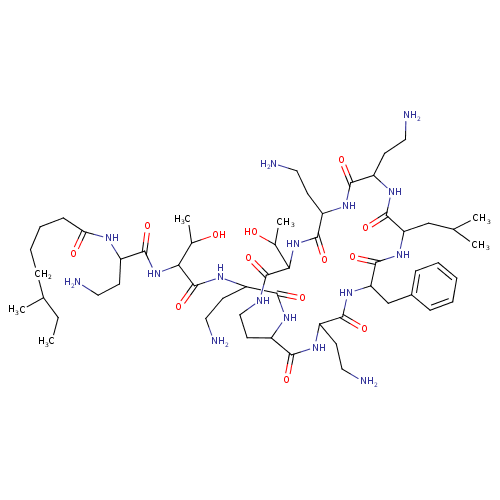
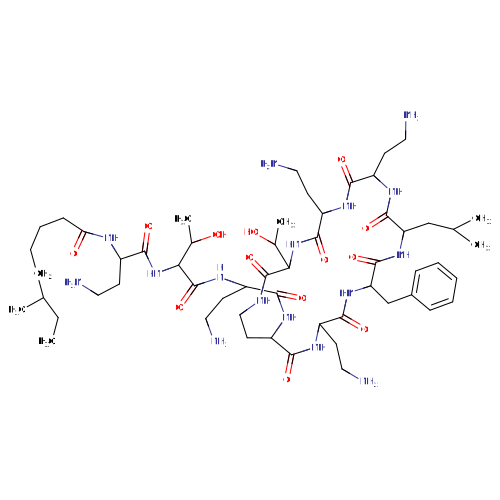
DescriptionPolymyxin B sulfate is a mixture of polymyxins B1 and B2, obtained from Bacillus polymyxa strains. They are basic polypeptides of about eight amino acids and have cationic detergent action on cell membranes. Polymyxin B is used for infections with gram-negative organisms, but may be neurotoxic and nephrotoxic. All gram-positive bacteria, fungi, and the gram-negative cocci, N. gonorrhea and N. menigitidis, are resistant. It is appropriate for treatment of infections of the urinary tract, meninges, and blood stream, caused by susceptible strains of Pseudomonas aeruginosa.
Contaminant Sources
  • HMDB Contaminants - Urine
  • STOFF IDENT Compounds
  • T3DB toxins
Contaminant Type
  • Amide
  • Amine
  • Anti-Bacterial Agent
  • Drug
  • Metabolite
  • Organic Compound
  • Synthetic Compound
Chemical Structure
Thumb
Synonyms
ValueSource
Polymixin b sulfateHMDB
Polymixin b sulphateHMDB
Polymyxin b sulfate saltHMDB
Polymyxin b sulphateHMDB, Generator
Polymyxin b sulphate saltHMDB
Sulfate, polymyxin bMeSH, HMDB
Polymyxin bMeSH, HMDB
N-[3-Amino-1-({1-[(3-amino-1-{[6,9,18-tris(2-aminoethyl)-15-benzyl-2,5,8,11,14,17,20-heptahydroxy-3-(1-hydroxyethyl)-12-(2-methylpropyl)-1,4,7,10,13,16,19-heptaazacyclotricosa-1,4,7,10,13,16,19-heptaen-21-yl]-C-hydroxycarbonimidoyl}propyl)-C-hydroxycarbonimidoyl]-2-hydroxypropyl}-C-hydroxycarbonimidoyl)propyl]-6-methyloctanimidateGenerator, HMDB
AerosporinMeSH, HMDB
Polymyxin b sulfateMeSH
Polymyxin b sulfuric acidGenerator
Polymyxin b sulphuric acidGenerator
Chemical FormulaC56H98N16O13
Average Molecular Mass1203.477 g/mol
Monoisotopic Mass1202.750 g/mol
CAS Registry Number1405-20-5
IUPAC NameN-[3-amino-1-({1-[(3-amino-1-{[6,9,18-tris(2-aminoethyl)-15-benzyl-3-(1-hydroxyethyl)-12-(2-methylpropyl)-2,5,8,11,14,17,20-heptaoxo-1,4,7,10,13,16,19-heptaazacyclotricosan-21-yl]carbamoyl}propyl)carbamoyl]-2-hydroxypropyl}carbamoyl)propyl]-6-methyloctanamide
Traditional Namepolymyxin B sulfate
SMILESCCC(C)CCCCC(=O)NC(CCN)C(=O)NC(C(C)O)C(=O)NC(CCN)C(=O)NC1CCNC(=O)C(NC(=O)C(CCN)NC(=O)C(CCN)NC(=O)C(CC(C)C)NC(=O)C(CC2=CC=CC=C2)NC(=O)C(CCN)NC1=O)C(C)O
InChI IdentifierInChI=1S/C56H98N16O13/c1-7-32(4)13-11-12-16-44(75)63-36(17-23-57)51(80)72-46(34(6)74)56(85)68-39(20-26-60)48(77)67-41-22-28-62-55(84)45(33(5)73)71-52(81)40(21-27-61)65-47(76)37(18-24-58)66-53(82)42(29-31(2)3)69-54(83)43(30-35-14-9-8-10-15-35)70-49(78)38(19-25-59)64-50(41)79/h8-10,14-15,31-34,36-43,45-46,73-74H,7,11-13,16-30,57-61H2,1-6H3,(H,62,84)(H,63,75)(H,64,79)(H,65,76)(H,66,82)(H,67,77)(H,68,85)(H,69,83)(H,70,78)(H,71,81)(H,72,80)
InChI KeyWQVJHHACXVLGBL-UHFFFAOYSA-N
Chemical Taxonomy
Description belongs to the class of organic compounds known as polypeptides. These are peptides containing ten or more amino acid residues.
KingdomOrganic compounds
Super ClassOrganic Polymers
ClassPolypeptides
Sub ClassNot Available
Direct ParentPolypeptides
Alternative Parents
Substituents
  • Polypeptide
  • Cyclic alpha peptide
  • Macrolactam
  • N-acyl-alpha amino acid or derivatives
  • Alpha-amino acid amide
  • N-substituted-alpha-amino acid
  • Alpha-amino acid or derivatives
  • Monocyclic benzene moiety
  • Fatty amide
  • N-acyl-amine
  • Fatty acyl
  • Benzenoid
  • Secondary carboxylic acid amide
  • Secondary alcohol
  • Amino acid or derivatives
  • Carboxamide group
  • Lactam
  • Organoheterocyclic compound
  • Azacycle
  • Carboxylic acid derivative
  • Organic nitrogen compound
  • Organic oxide
  • Organopnictogen compound
  • Amine
  • Carbonyl group
  • Alcohol
  • Organonitrogen compound
  • Organooxygen compound
  • Primary amine
  • Organic oxygen compound
  • Hydrocarbon derivative
  • Primary aliphatic amine
  • Aromatic heteromonocyclic compound
Molecular FrameworkAromatic heteromonocyclic compounds
External DescriptorsNot Available
Biological Properties
StatusDetected and Not Quantified
OriginExogenous
Cellular Locations
  • Cytoplasm
  • Extracellular
Biofluid LocationsNot Available
Tissue LocationsNot Available
PathwaysNot Available
ApplicationsNot Available
Biological RolesNot Available
Chemical RolesNot Available
Physical Properties
StateSolid
AppearanceWhite powder.
Experimental Properties
PropertyValue
Melting PointNot Available
Boiling PointNot Available
Solubility25 mg/mL
Predicted Properties
PropertyValueSource
Water Solubility0.074 g/LALOGPS
logP-0.89ALOGPS
logP-7.2ChemAxon
logS-4.2ALOGPS
pKa (Strongest Acidic)11.57ChemAxon
pKa (Strongest Basic)10.23ChemAxon
Physiological Charge5ChemAxon
Hydrogen Acceptor Count18ChemAxon
Hydrogen Donor Count18ChemAxon
Polar Surface Area490.66 ŲChemAxon
Rotatable Bond Count29ChemAxon
Refractivity313.22 m³·mol⁻¹ChemAxon
Polarizability129.71 ųChemAxon
Number of Rings2ChemAxon
Bioavailability0ChemAxon
Rule of FiveNoChemAxon
Ghose FilterNoChemAxon
Veber's RuleNoChemAxon
MDDR-like RuleNoChemAxon
Spectra
Spectra
Spectrum TypeDescriptionSplash KeyView
Predicted LC-MS/MSPredicted LC-MS/MS Spectrum - 10V, Positivesplash10-014r-0900000000-2fc106a8849095860948Spectrum
Predicted LC-MS/MSPredicted LC-MS/MS Spectrum - 20V, Positivesplash10-014j-4910000111-09aa17c0c5e9e1d3a251Spectrum
Predicted LC-MS/MSPredicted LC-MS/MS Spectrum - 40V, Positivesplash10-00di-9420000000-50618abf83d40012137dSpectrum
Predicted LC-MS/MSPredicted LC-MS/MS Spectrum - 10V, Negativesplash10-1159-0941000000-9241d7871d46b3a90d91Spectrum
Predicted LC-MS/MSPredicted LC-MS/MS Spectrum - 20V, Negativesplash10-0bu9-1910000111-2dc8c378fec3170a9d1cSpectrum
Predicted LC-MS/MSPredicted LC-MS/MS Spectrum - 40V, Negativesplash10-08fu-5921000300-2f55ebc350da3657d7e3Spectrum
Predicted LC-MS/MSPredicted LC-MS/MS Spectrum - 10V, Positivesplash10-0udr-2590000000-5b17104b7709c3465894Spectrum
Predicted LC-MS/MSPredicted LC-MS/MS Spectrum - 20V, Positivesplash10-0fri-1920000010-5f45af1d0f0e081ca1ceSpectrum
Predicted LC-MS/MSPredicted LC-MS/MS Spectrum - 40V, Positivesplash10-00di-9420000000-67757bce91a0fadb3044Spectrum
Predicted LC-MS/MSPredicted LC-MS/MS Spectrum - 10V, Negativesplash10-0udi-0090000000-47b6f40976ca4be0e87cSpectrum
Predicted LC-MS/MSPredicted LC-MS/MS Spectrum - 20V, Negativesplash10-0fdo-6931100016-e4ef6ce119c6e64a028aSpectrum
Predicted LC-MS/MSPredicted LC-MS/MS Spectrum - 40V, Negativesplash10-0007-9510000120-71306b33c0302f309ff9Spectrum
1D NMR13C NMR SpectrumNot AvailableSpectrum
1D NMR1H NMR SpectrumNot AvailableSpectrum
1D NMR13C NMR SpectrumNot AvailableSpectrum
1D NMR1H NMR SpectrumNot AvailableSpectrum
1D NMR13C NMR SpectrumNot AvailableSpectrum
1D NMR1H NMR SpectrumNot AvailableSpectrum
1D NMR13C NMR SpectrumNot AvailableSpectrum
1D NMR1H NMR SpectrumNot AvailableSpectrum
1D NMR13C NMR SpectrumNot AvailableSpectrum
1D NMR1H NMR SpectrumNot AvailableSpectrum
1D NMR13C NMR SpectrumNot AvailableSpectrum
1D NMR1H NMR SpectrumNot AvailableSpectrum
1D NMR13C NMR SpectrumNot AvailableSpectrum
1D NMR1H NMR SpectrumNot AvailableSpectrum
1D NMR13C NMR SpectrumNot AvailableSpectrum
1D NMR1H NMR SpectrumNot AvailableSpectrum
1D NMR13C NMR SpectrumNot AvailableSpectrum
1D NMR1H NMR SpectrumNot AvailableSpectrum
1D NMR13C NMR SpectrumNot AvailableSpectrum
1D NMR1H NMR SpectrumNot AvailableSpectrum
Toxicity Profile
Route of ExposureEye contact; parenteral (intrathecal, intramuscular injection, intravenous drip). Not absorbed from the normal alimentary tract.
Mechanism of ToxicityPolymyxin B sulfate has a bactericidal action against almost all gram-negative bacilli except the Proteus group. Polymyxin B sulfate interacts with the lipopolysaccharide of the cytoplasmic outer membrane of Gram-negative bacteria, altering membrane permeability and causing cell death. It does not need to enter the cell.
Metabolism Route of Elimination: The drug is excreted slowly by the kidneys.
Toxicity ValuesNot Available
Lethal DoseNot Available
Carcinogenicity (IARC Classification)No indication of carcinogenicity to humans (not listed by IARC).
Uses/SourcesUsed in the treatment of infections of the urinary tract, meninges, and bloodstream caused by susceptible strains of Pseudomonas aeruginosa. It may also be used topically and subconjunctivally in the treatment of infections of the eye caused by susceptible strains of Ps. aeruginosa. (3)
Minimum Risk LevelNot Available
Health EffectsNot Available
SymptomsFacial flushing, dizziness progressing to ataxia, drowsiness, peripheral paresthesias (circumoral and stocking glove), apnea due to concurrent use of curariform muscle relaxants, other neurotoxic drugs or inadvertent overdosage, and signs of meningeal irritation with intrathecal administration, e.g., fever, headache, stiff neck and increased cell count and protein cerebrospinal fluid. Other reactions occasionally reported: Drug fever, urticarial rash, pain (severe) at intramuscular injection sites, and thrombophlebitis at intravenous injection sites. (3)

TreatmentNot Available
Concentrations
Not Available
DrugBank IDDB00781
HMDB IDHMDB0256682
FooDB IDNot Available
Phenol Explorer IDNot Available
KNApSAcK IDNot Available
BiGG IDNot Available
BioCyc IDNot Available
METLIN IDNot Available
PDB IDNot Available
Wikipedia LinkPolymyxin B
Chemspider ID4702
ChEBI IDNot Available
PubChem Compound ID4868
Kegg Compound IDNot Available
YMDB IDNot Available
ECMDB IDNot Available
References
Synthesis ReferenceNot Available
MSDSLink
General ReferencesNot Available