Record Information
Version1.0
Creation Date2009-07-30 17:59:02 UTC
Update Date2026-03-25 19:47:03 UTC
Accession NumberCHEM002525
Identification
Common Name1,1-Dimethylbiguanide
ClassSmall Molecule
DescriptionMetformin is the most popular anti-diabetic drug in the United States and one of the most prescribed drugs in the country overall, with nearly 35 million prescriptions filled in 2006 for generic metformin alone. Metformin is a biguanide antihyperglycemic agent used for treating non-insulin-dependent diabetes mellitus (NIDDM). It improves glycemic control by decreasing hepatic glucose production, decreasing glucose absorption and increasing insulin-mediated glucose uptake. Metformin is the only oral antihyperglycemic agent that is not associated with weight gain. Metformin may induce weight loss and is the drug of choice for obese NIDDM patients. When used alone, metformin does not cause hypoglycemia; however, it may potentiate the hypoglycemic effects of sulfonylureas and insulin. Its main side effects are dyspepsia, nausea and diarrhea. Dose titration and/or use of smaller divided doses may decrease side effects. Metformin should be avoided in those with severely compromised renal function (creatinine clearance < 30 ml/min), acute/decompensated heart failure, severe liver disease and for 48 hours after the use of iodinated contrast dyes due to the risk of lactic acidosis. Lower doses should be used in the elderly and those with decreased renal function. Metformin decreases fasting plasma glucose, postprandial blood glucose and glycosolated hemoglobin (HbA1c) levels, which are reflective of the last 8-10 weeks of glucose control. Metformin may also have a positive effect on lipid levels. In 2012, a combination tablet of linagliptin plus metformin hydrochloride was marketed under the name Jentadueto for use in patients when treatment with both linagliptin and metformin is appropriate.
Contaminant Sources
  • FooDB Chemicals
  • STOFF IDENT Compounds
  • Suspected Compounds
  • Suspected Compounds - Waste Water
  • Suspected Compounds – Schymanski Project
  • T3DB toxins
  • ToxCast & Tox21 Chemicals
Contaminant Type
  • Amide
  • Amine
  • Antidiabetic Agent
  • Drug
  • Food Toxin
  • Hypoglycemic Agent
  • Metabolite
  • Organic Compound
  • Synthetic Compound
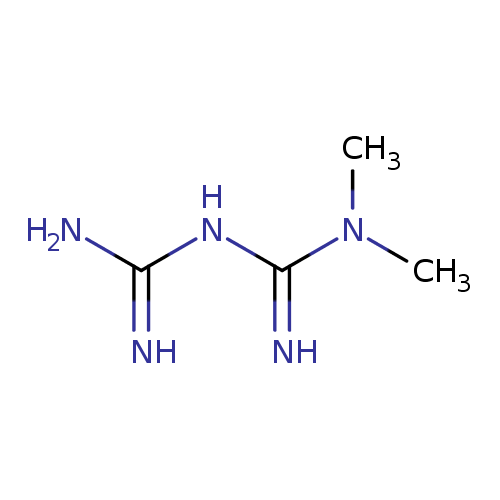
Chemical Structure
Thumb
Synonyms
ValueSource
DimethylbiguanideChEBI
DimethyldiguanideChEBI
LA 6023ChEBI
LA-6023ChEBI
MetforminaChEBI
MetformineChEBI
MetforminumChEBI
N,N-DimethylbiguanideChEBI
N,N-DimethyldiguanideChEBI
N,N-DimethylguanylguanidineChEBI
N,N-Dimethylimidodicarbonimidic diamideChEBI
N(1),N(1)-DimethylbiguanideChEBI
1,1-Dimethyl biguanideHMDB
DiabefagosHMDB
DiabexHMDB
DiaforminHMDB
DianbenHMDB
DMBGHMDB
FortametHMDB
GlucophageHMDB, MeSH
GlumetzaHMDB
MeguanHMDB
MetforminHMDB
MetiguanideHMDB
N1,N1-DimethylbiguanideHMDB
ObimetHMDB
RiometHMDB
DimethylbiguanidineMeSH, HMDB
DimethylguanylguanidineMeSH, HMDB
Metformin HCLMeSH, HMDB
HCL, MetforminMeSH, HMDB
Hydrochloride, metforminMeSH, HMDB
Metformin hydrochlorideMeSH, HMDB
1,1-DimethylbiguanideChEBI
Chemical FormulaC4H11N5
Average Molecular Mass129.164 g/mol
Monoisotopic Mass129.101 g/mol
CAS Registry Number657-24-9
IUPAC Name1-carbamimidamido-N,N-dimethylmethanimidamide
Traditional Namemetformin
SMILESCN(C)C(=N)NC(N)=N
InChI IdentifierInChI=1S/C4H11N5/c1-9(2)4(7)8-3(5)6/h1-2H3,(H5,5,6,7,8)
InChI KeyXZWYZXLIPXDOLR-UHFFFAOYSA-N
Chemical Taxonomy
Description belongs to the class of organic compounds known as biguanides. These are organic compounds containing two N-linked guanidines.
KingdomOrganic compounds
Super ClassOrganic nitrogen compounds
ClassOrganonitrogen compounds
Sub ClassGuanidines
Direct ParentBiguanides
Alternative Parents
Substituents
  • Biguanide
  • Organic 1,3-dipolar compound
  • Propargyl-type 1,3-dipolar organic compound
  • Carboximidamide
  • Organopnictogen compound
  • Hydrocarbon derivative
  • Imine
  • Aliphatic acyclic compound
Molecular FrameworkAliphatic acyclic compounds
External Descriptors
Biological Properties
StatusDetected and Not Quantified
OriginExogenous
Cellular Locations
  • Cytoplasm
  • Extracellular
Biofluid LocationsNot Available
Tissue Locations
  • Erythrocyte
  • Liver
  • Muscle
  • Skeletal Muscle
PathwaysNot Available
Applications
Biological RolesNot Available
Chemical RolesNot Available
Physical Properties
StateSolid
AppearanceWhite powder.
Experimental Properties
PropertyValue
Melting Point223-226°C
Boiling PointNot Available
SolubilityFreely soluble as HCl salt
Predicted Properties
PropertyValueSource
Water Solubility1.38 g/LALOGPS
logP-1.8ALOGPS
logP-0.92ChemAxon
logS-2ALOGPS
pKa (Strongest Basic)12.33ChemAxon
Physiological Charge2ChemAxon
Hydrogen Acceptor Count5ChemAxon
Hydrogen Donor Count4ChemAxon
Polar Surface Area88.99 ŲChemAxon
Rotatable Bond Count0ChemAxon
Refractivity56.64 m³·mol⁻¹ChemAxon
Polarizability13.43 ųChemAxon
Number of Rings0ChemAxon
Bioavailability1ChemAxon
Rule of FiveYesChemAxon
Ghose FilterNoChemAxon
Veber's RuleNoChemAxon
MDDR-like RuleNoChemAxon
Spectra
Spectra
Spectrum TypeDescriptionSplash KeyView
Predicted GC-MSPredicted GC-MS Spectrum - GC-MS (Non-derivatized) - 70eV, Positivesplash10-0006-9100000000-4cf43a0a5a8d4db19a46Spectrum
Predicted GC-MSPredicted GC-MS Spectrum - GC-MS (Non-derivatized) - 70eV, PositiveNot AvailableSpectrum
LC-MS/MSLC-MS/MS Spectrum - Quattro_QQQ 10V, Positive (Annotated)splash10-001i-0900000000-9046e2aa0408a0396007Spectrum
LC-MS/MSLC-MS/MS Spectrum - Quattro_QQQ 25V, Positive (Annotated)splash10-01qi-9700000000-a6b98d87cc840a082179Spectrum
LC-MS/MSLC-MS/MS Spectrum - Quattro_QQQ 40V, Positive (Annotated)splash10-00dr-9000000000-8e80f301bad045540477Spectrum
LC-MS/MSLC-MS/MS Spectrum - LC-ESI-QQ (API3000, Applied Biosystems) 10V, Positivesplash10-001i-0900000000-bd8aed328c944acd1270Spectrum
LC-MS/MSLC-MS/MS Spectrum - LC-ESI-QQ (API3000, Applied Biosystems) 20V, Positivesplash10-03l9-9300000000-3d585674ffe84238e5bfSpectrum
LC-MS/MSLC-MS/MS Spectrum - LC-ESI-QQ (API3000, Applied Biosystems) 30V, Positivesplash10-00di-9000000000-ee68820579ebe4d31082Spectrum
LC-MS/MSLC-MS/MS Spectrum - LC-ESI-QQ (API3000, Applied Biosystems) 40V, Positivesplash10-00di-9000000000-4312e7e5e1b0dd9ef936Spectrum
LC-MS/MSLC-MS/MS Spectrum - LC-ESI-QQ (API3000, Applied Biosystems) 50V, Positivesplash10-00di-9000000000-053d63fe09a95fc1d544Spectrum
LC-MS/MSLC-MS/MS Spectrum - LC-ESI-QTOF , positivesplash10-0229-9100000000-7fe999a9d1aaae3bbe53Spectrum
LC-MS/MSLC-MS/MS Spectrum - LC-ESI-QTOF , positivesplash10-001i-0900000000-c235cd5d0dda3f3c28d9Spectrum
LC-MS/MSLC-MS/MS Spectrum - LC-ESI-QTOF , positivesplash10-001i-0900000000-0fa445716bfc24131a75Spectrum
LC-MS/MSLC-MS/MS Spectrum - LC-ESI-ITFT , positivesplash10-001i-3900000000-dee37da326e6f0b2c56aSpectrum
LC-MS/MSLC-MS/MS Spectrum - LC-ESI-ITFT , positivesplash10-001i-0900000000-45bd1f8c6d2dc4f38944Spectrum
LC-MS/MSLC-MS/MS Spectrum - LC-ESI-ITFT , positivesplash10-001i-1900000000-38f3dedb5c19900cdefbSpectrum
LC-MS/MSLC-MS/MS Spectrum - LC-ESI-ITFT , positivesplash10-001i-7900000000-bf5d1092aa372c303d61Spectrum
LC-MS/MSLC-MS/MS Spectrum - LC-ESI-ITFT , positivesplash10-03l9-9300000000-06a99f0dff4b41a23cfaSpectrum
LC-MS/MSLC-MS/MS Spectrum - LC-ESI-ITFT , positivesplash10-022i-9100000000-811c9e7cf8b30b27c0f2Spectrum
LC-MS/MSLC-MS/MS Spectrum - LC-ESI-ITFT , positivesplash10-00di-9000000000-d34b9b3ab9eb78317ebaSpectrum
LC-MS/MSLC-MS/MS Spectrum - LC-ESI-ITFT , positivesplash10-001i-0900000000-4d53ac0f7dfaf860e784Spectrum
Predicted LC-MS/MSPredicted LC-MS/MS Spectrum - 10V, Positivesplash10-001i-6900000000-03a99ea4f96636a6d5e2Spectrum
Predicted LC-MS/MSPredicted LC-MS/MS Spectrum - 20V, Positivesplash10-0079-9000000000-24ee057ec9505ccf8d3dSpectrum
Predicted LC-MS/MSPredicted LC-MS/MS Spectrum - 40V, Positivesplash10-0229-9000000000-bc7faff99aaa83f5e600Spectrum
Predicted LC-MS/MSPredicted LC-MS/MS Spectrum - 10V, Negativesplash10-000i-9300000000-e145cf58ec0f6be503abSpectrum
Predicted LC-MS/MSPredicted LC-MS/MS Spectrum - 20V, Negativesplash10-000i-9100000000-0cc6d6ceac8192964ee4Spectrum
Predicted LC-MS/MSPredicted LC-MS/MS Spectrum - 40V, Negativesplash10-0006-9000000000-f47eab8fa0fd4177cfddSpectrum
1D NMR1H NMR SpectrumNot AvailableSpectrum
1D NMR13C NMR SpectrumNot AvailableSpectrum
1D NMR1H NMR SpectrumNot AvailableSpectrum
1D NMR13C NMR SpectrumNot AvailableSpectrum
1D NMR1H NMR SpectrumNot AvailableSpectrum
1D NMR13C NMR SpectrumNot AvailableSpectrum
1D NMR1H NMR SpectrumNot AvailableSpectrum
1D NMR13C NMR SpectrumNot AvailableSpectrum
1D NMR1H NMR SpectrumNot AvailableSpectrum
1D NMR13C NMR SpectrumNot AvailableSpectrum
1D NMR1H NMR SpectrumNot AvailableSpectrum
1D NMR13C NMR SpectrumNot AvailableSpectrum
1D NMR1H NMR SpectrumNot AvailableSpectrum
1D NMR13C NMR SpectrumNot AvailableSpectrum
1D NMR1H NMR SpectrumNot AvailableSpectrum
1D NMR13C NMR SpectrumNot AvailableSpectrum
1D NMR1H NMR SpectrumNot AvailableSpectrum
1D NMR13C NMR SpectrumNot AvailableSpectrum
1D NMR1H NMR SpectrumNot AvailableSpectrum
1D NMR13C NMR SpectrumNot AvailableSpectrum
1D NMR1H NMR SpectrumNot AvailableSpectrum
2D NMR[1H,13C] 2D NMR SpectrumNot AvailableSpectrum
Toxicity Profile
Route of ExposureAbsorbed over 6 hours, bioavailability is 50 to 60% under fasting conditions. Administration with food decreases and delays absorption. Some evidence indicates that the level of absorption is not dose-related, suggesting that absorption occurs through a saturable process. Limited data from animal and human cell cultures indicate that absorption occurs through a passive, non-saturable process, possibly involving a paracellular route. Peak action occurs 3 hours after oral administration.
Mechanism of ToxicityMetformin's mechanisms of action differ from other classes of oral antihyperglycemic agents. Metformin decreases blood glucose levels by decreasing hepatic glucose production, decreasing intestinal absorption of glucose, and improving insulin sensitivity by increasing peripheral glucose uptake and utilization. These effects are mediated by the initial activation by metformin of AMP-activated protein kinase (AMPK), a liver enzyme that plays an important role in insulin signaling, whole body energy balance, and the metabolism of glucose and fats. Activation of AMPK is required for metformin's inhibitory effect on the production of glucose by liver cells. Increased peripheral utilization of glucose may be due to improved insulin binding to insulin receptors. Metformin administration also increases AMPK activity in skeletal muscle. AMPK is known to cause GLUT4 deployment to the plasma membrane, resulting in insulin-independent glucose uptake. The rare side effect, lactic acidosis, is thought to be caused by decreased liver uptake of serum lactate, one of the substrates of gluconeogenesis. In those with healthy renal function, the slight excess is simply cleared. However, those with severe renal impairment may accumulate clinically significant serum lactic acid levels. Other conditions that may precipitate lactic acidosis include severe hepatic disease and acute/decompensated heart failure.
MetabolismMetformin is not metabolized. Route of Elimination: Intravenous single-dose studies in normal subjects demonstrate that metformin is excreted unchanged in the urine and does not undergo hepatic metabolism (no metabolites have been identified in humans) nor biliary excretion. Approximately 90% of the drug is eliminated in 24 hours in those with healthy renal function. Renal clearance of metformin is approximately 3.5 times that of creatinine clearance, indicating the tubular secretion is the primary mode of metformin elimination. Half Life: 6.2 hours. Duration of action is 8-12 hours.
Toxicity ValuesAcute oral toxicity (LD50): 350 mg/kg [Rabbit].
Lethal DoseNot Available
Carcinogenicity (IARC Classification)No indication of carcinogenicity to humans (not listed by IARC).
Uses/SourcesFor use as an adjunct to diet and exercise in adult patients (18 years and older) with NIDDM. May also be used for the management of metabolic and reproductive abnormalities associated with polycystic ovary syndrome (PCOS). Jentadueto is for the treatment of patients when both linagliptin and metformin is appropriate.
Minimum Risk LevelNot Available
Health EffectsNot Available
SymptomsAcute oral toxicity (LD50): 350 mg/kg [Rabbit]. It would be expected that adverse reactions of a more intense character including epigastric discomfort, nausea, and vomiting followed by diarrhea, drowsiness, weakness, dizziness, malaise and headache might be seen.
TreatmentNot Available
Concentrations
StatusValueUnitSample LocationReference
DrugBank IDDB00331
HMDB IDHMDB0001921
FooDB IDFDB022739
Phenol Explorer IDNot Available
KNApSAcK IDNot Available
BiGG IDNot Available
BioCyc IDNot Available
METLIN ID6390
PDB IDNot Available
Wikipedia LinkMetformin
Chemspider ID3949
ChEBI ID6801
PubChem Compound ID4091
Kegg Compound IDC07151
YMDB IDNot Available
ECMDB IDNot Available
References
Synthesis Reference

Jorn Moeckel, Rolf-Dieter Gabel, Heinrich Woog, “Pharmaceutical preparation containing metformin and a process for producing it.” U.S. Patent US5955106, issued October, 1991.

MSDSLink
General References
1. https://www.ncbi.nlm.nih.gov/pubmed/?term=10900588
2. https://www.ncbi.nlm.nih.gov/pubmed/?term=10983737
3. https://www.ncbi.nlm.nih.gov/pubmed/?term=10999803
4. https://www.ncbi.nlm.nih.gov/pubmed/?term=11012555
5. https://www.ncbi.nlm.nih.gov/pubmed/?term=11126815
6. https://www.ncbi.nlm.nih.gov/pubmed/?term=11192132
7. https://www.ncbi.nlm.nih.gov/pubmed/?term=11257323
8. https://www.ncbi.nlm.nih.gov/pubmed/?term=11544610
9. https://www.ncbi.nlm.nih.gov/pubmed/?term=11772907
10. https://www.ncbi.nlm.nih.gov/pubmed/?term=12086935
11. https://www.ncbi.nlm.nih.gov/pubmed/?term=12406042
12. https://www.ncbi.nlm.nih.gov/pubmed/?term=12436333
13. https://www.ncbi.nlm.nih.gov/pubmed/?term=12630933
14. https://www.ncbi.nlm.nih.gov/pubmed/?term=12909816
15. https://www.ncbi.nlm.nih.gov/pubmed/?term=15261814
16. https://www.ncbi.nlm.nih.gov/pubmed/?term=15606381
17. https://www.ncbi.nlm.nih.gov/pubmed/?term=15650645
18. https://www.ncbi.nlm.nih.gov/pubmed/?term=15717887
19. https://www.ncbi.nlm.nih.gov/pubmed/?term=15932841
20. https://www.ncbi.nlm.nih.gov/pubmed/?term=16294070
21. https://www.ncbi.nlm.nih.gov/pubmed/?term=16520442
22. https://www.ncbi.nlm.nih.gov/pubmed/?term=16941277
23. https://www.ncbi.nlm.nih.gov/pubmed/?term=17062558
24. https://www.ncbi.nlm.nih.gov/pubmed/?term=18212742
25. https://www.ncbi.nlm.nih.gov/pubmed/?term=18608522
26. https://www.ncbi.nlm.nih.gov/pubmed/?term=24428821
27. https://www.ncbi.nlm.nih.gov/pubmed/?term=28919040
28. https://www.ncbi.nlm.nih.gov/pubmed/?term=31208831
29. https://www.ncbi.nlm.nih.gov/pubmed/?term=33191721
30. Seale FG 4th, Robinson RD, Neal GS: Association of metformin and pregnancy in the polycystic ovary syndrome. A report of three cases. J Reprod Med. 2000 Jun;45(6):507-10.
31. Briggs GG, Ambrose PJ, Nageotte MP, Padilla G, Wan S: Excretion of metformin into breast milk and the effect on nursing infants. Obstet Gynecol. 2005 Jun;105(6):1437-41.
32. De Jager J, Kooy A, Lehert P, Bets D, Wulffele MG, Teerlink T, Scheffer PG, Schalkwijk CG, Donker AJ, Stehouwer CD: Effects of short-term treatment with metformin on markers of endothelial function and inflammatory activity in type 2 diabetes mellitus: a randomized, placebo-controlled trial. J Intern Med. 2005 Jan;257(1):100-9.
33. Mughal MA, Jan M, Maheri WM, Memon MY, Ali M: The effect of metformin on glycemic control, serum lipids and lipoproteins in diet alone and sulfonylurea-treated type 2 diabetic patients with sub-optimal metabolic control. J Pak Med Assoc. 2000 Nov;50(11):381-6.
34. Einhorn D, Rendell M, Rosenzweig J, Egan JW, Mathisen AL, Schneider RL: Pioglitazone hydrochloride in combination with metformin in the treatment of type 2 diabetes mellitus: a randomized, placebo-controlled study. The Pioglitazone 027 Study Group. Clin Ther. 2000 Dec;22(12):1395-409.
35. Robert F, Fendri S, Hary L, Lacroix C, Andrejak M, Lalau JD: Kinetics of plasma and erythrocyte metformin after acute administration in healthy subjects. Diabetes Metab. 2003 Jun;29(3):279-83.
36. Radziuk J, Pye S: Hepatic glucose uptake, gluconeogenesis and the regulation of glycogen synthesis. Diabetes Metab Res Rev. 2001 Jul-Aug;17(4):250-72.
37. Morin-Papunen LC, Vauhkonen I, Koivunen RM, Ruokonen A, Martikainen HK, Tapanainen JS: Endocrine and metabolic effects of metformin versus ethinyl estradiol-cyproterone acetate in obese women with polycystic ovary syndrome: a randomized study. J Clin Endocrinol Metab. 2000 Sep;85(9):3161-8.
38. Musi N, Hirshman MF, Nygren J, Svanfeldt M, Bavenholm P, Rooyackers O, Zhou G, Williamson JM, Ljunqvist O, Efendic S, Moller DE, Thorell A, Goodyear LJ: Metformin increases AMP-activated protein kinase activity in skeletal muscle of subjects with type 2 diabetes. Diabetes. 2002 Jul;51(7):2074-81.
39. Marathe PH, Wen Y, Norton J, Greene DS, Barbhaiya RH, Wilding IR: Effect of altered gastric emptying and gastrointestinal motility on metformin absorption. Br J Clin Pharmacol. 2000 Oct;50(4):325-32.
40. Gore DC, Wolf SE, Sanford A, Herndon DN, Wolfe RR: Influence of metformin on glucose intolerance and muscle catabolism following severe burn injury. Ann Surg. 2005 Feb;241(2):334-42.
41. Gillies PS, Dunn CJ: Pioglitazone. Drugs. 2000 Aug;60(2):333-43; discussion 344-5.
42. Hale TW, Kristensen JH, Hackett LP, Kohan R, Ilett KF: Transfer of metformin into human milk. Diabetologia. 2002 Nov;45(11):1509-14. Epub 2002 Sep 25.
43. Lalau JD, Lacroix C: Measurement of metformin concentration in erythrocytes: clinical implications. Diabetes Obes Metab. 2003 Mar;5(2):93-8.
44. Kouki T, Takasu N, Nakachi A, Tamanaha T, Komiya I, Tawata M: Low-dose metformin improves hyperglycaemia related to myotonic dystrophy. Diabet Med. 2005 Mar;22(3):346-7.
45. Magalhaes FO, Gouveia LM, Torquato MT, Paccola GM, Piccinato CE, Foss MC: Metformin increases blood flow and forearm glucose uptake in a group of non-obese type 2 diabetes patients. Horm Metab Res. 2006 Aug;38(8):513-7.
46. Gore DC, Herndon DN, Wolfe RR: Comparison of peripheral metabolic effects of insulin and metformin following severe burn injury. J Trauma. 2005 Aug;59(2):316-22; discussion 322-3.
47. Bridger T, MacDonald S, Baltzer F, Rodd C: Randomized placebo-controlled trial of metformin for adolescents with polycystic ovary syndrome. Arch Pediatr Adolesc Med. 2006 Mar;160(3):241-6.
48. Amador-Licona N, Guizar-Mendoza J, Vargas E, Sanchez-Camargo G, Zamora-Mata L: The short-term effect of a switch from glibenclamide to metformin on blood pressure and microalbuminuria in patients with type 2 diabetes mellitus. Arch Med Res. 2000 Nov-Dec;31(6):571-5.
49. Carter D, Howlett HC, Wiernsperger NF, Bailey C: Effects of metformin on bile salt transport by monolayers of human intestinal Caco-2 cells. Diabetes Obes Metab. 2002 Nov;4(6):424-7.