Record Information
Version1.0
Creation Date2009-07-30 17:58:49 UTC
Update Date2026-05-14 16:23:58 UTC
Accession NumberCHEM002512
Identification
Common NameCyclosporin
ClassSmall Molecule
DescriptionA cyclic undecapeptide from an extract of soil fungi. It is a powerful immunosupressant with a specific action on T-lymphocytes. It is used for the prophylaxis of graft rejection in organ and tissue transplantation. Cyclosporine is produced as a metabolite by the fungus species Cordyceps militaris. (From Martindale, The Extra Pharmacopoeia, 30th ed).
Contaminant Sources
  • IARC Carcinogens Group 1
  • T3DB toxins
  • ToxCast & Tox21 Chemicals
Contaminant Type
  • Amide
  • Amine
  • Antifungal Agent
  • Antirheumatic Agent
  • Dermatologic Agent
  • Drug
  • Enzyme Inhibitor
  • Fungal Toxin
  • Human Neurotoxin
  • Immunomodulatory Agent
  • Immunosuppressive Agent
  • Natural Compound
  • Organic Compound
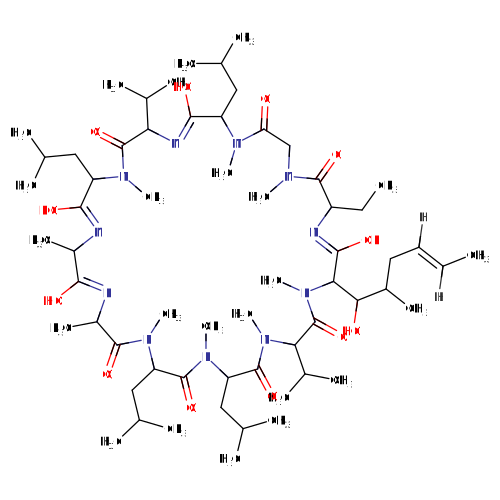
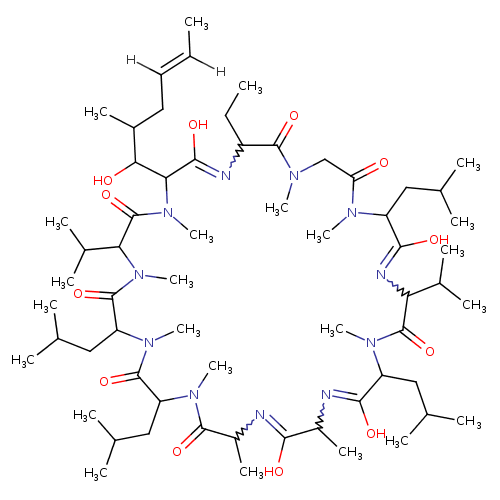
Chemical Structure
Thumb
Synonyms
ValueSource
CiclosporinKegg
CyclosporineKegg
GengrafKegg
NeoralKegg
RestasisKegg
SandimmuneKegg
CsANeoralMeSH
CsA neoralMeSH
CsA-neoralMeSH
CyA NOFMeSH
Cyclosporine aMeSH
SandimmunMeSH
CyA-NOFMeSH
CyclosporinMeSH
Sandimmun neoralMeSH
Chemical FormulaC62H111N11O12
Average Molecular Mass1202.611 g/mol
Monoisotopic Mass1201.841 g/mol
CAS Registry Number59865-13-3
IUPAC Name(3S,6S,9S,12R,15S,18S,21S,24S,30S,33S)-30-ethyl-33-[(1R,2R,4E)-1-hydroxy-2-methylhex-4-en-1-yl]-1,4,7,10,12,15,19,25,28-nonamethyl-6,9,18,24-tetrakis(2-methylpropyl)-3,21-bis(propan-2-yl)-1,4,7,10,13,16,19,22,25,28,31-undecaazacyclotritriacontan-2,5,8,11,14,17,20,23,26,29,32-undecone
Traditional Name30-ethyl-14,17,23,32-tetrahydroxy-33-[(4E)-1-hydroxy-2-methylhex-4-en-1-yl]-3,21-diisopropyl-1,4,7,10,12,15,19,25,28-nonamethyl-6,9,18,24-tetrakis(2-methylpropyl)-1,4,7,10,13,16,19,22,25,28,31-undecaazacyclotritriaconta-13,16,22,31-tetraene-2,5,8,11,20,26,29-heptone
SMILES[H]\C(C)=C(\[H])CC(C)C(O)C1N(C)C(=O)C(C(C)C)N(C)C(=O)C(CC(C)C)N(C)C(=O)C(CC(C)C)N(C)C(=O)C(C)N=C(O)C(C)N=C(O)C(CC(C)C)N(C)C(=O)C(N=C(O)C(CC(C)C)N(C)C(=O)CN(C)C(=O)C(CC)N=C1O)C(C)C
InChI IdentifierInChI=1S/C62H111N11O12/c1-25-27-28-40(15)52(75)51-56(79)65-43(26-2)58(81)67(18)33-48(74)68(19)44(29-34(3)4)55(78)66-49(38(11)12)61(84)69(20)45(30-35(5)6)54(77)63-41(16)53(76)64-42(17)57(80)70(21)46(31-36(7)8)59(82)71(22)47(32-37(9)10)60(83)72(23)50(39(13)14)62(85)73(51)24/h25,27,34-47,49-52,75H,26,28-33H2,1-24H3,(H,63,77)(H,64,76)(H,65,79)(H,66,78)/b27-25+
InChI KeyPMATZTZNYRCHOR-IMVLJIQESA-N
Chemical Taxonomy
Description belongs to the class of organic compounds known as cyclosporins. These are cyclic depsipeptides containing the cyclosporin backbone.
KingdomOrganic compounds
Super ClassOrganic acids and derivatives
ClassPeptidomimetics
Sub ClassPeptoid-peptide hybrids
Direct ParentCyclosporins
Alternative Parents
Substituents
  • Cyclosporin-backbone
  • Alpha-oligopeptide
  • Macrolactam
  • Alpha-amino acid or derivatives
  • Tertiary carboxylic acid amide
  • Carboxamide group
  • Lactam
  • Secondary alcohol
  • Secondary carboxylic acid amide
  • Carboxylic acid derivative
  • Azacycle
  • Organoheterocyclic compound
  • Organonitrogen compound
  • Hydrocarbon derivative
  • Organic oxide
  • Organopnictogen compound
  • Alcohol
  • Organic oxygen compound
  • Carbonyl group
  • Organooxygen compound
  • Organic nitrogen compound
  • Aliphatic heteromonocyclic compound
Molecular FrameworkAliphatic heteromonocyclic compounds
External Descriptors
  • Non-ribosomal peptide/polyketide hybrids (C05086 )
  • Non-ribosomal peptide/polyketide hybrids (LMPK14000003 )
Biological Properties
StatusDetected and Not Quantified
OriginExogenous
Cellular Locations
  • Membrane
Biofluid LocationsNot Available
Tissue LocationsNot Available
PathwaysNot Available
Applications
Biological Roles
Chemical Roles
Physical Properties
StateSolid
AppearanceWhite powder.
Experimental Properties
PropertyValue
Melting Point148-151°C
Boiling PointNot Available
SolubilityNot Available
Predicted Properties
PropertyValueSource
Water Solubility0.0058 g/LALOGPS
logP4.37ALOGPS
logP6.92ChemAxon
logS-5.3ALOGPS
pKa (Strongest Acidic)3.69ChemAxon
pKa (Strongest Basic)1.94ChemAxon
Physiological Charge0ChemAxon
Hydrogen Acceptor Count16ChemAxon
Hydrogen Donor Count5ChemAxon
Polar Surface Area292.76 ŲChemAxon
Rotatable Bond Count15ChemAxon
Refractivity329.23 m³·mol⁻¹ChemAxon
Polarizability131.92 ųChemAxon
Number of Rings1ChemAxon
Bioavailability0ChemAxon
Rule of FiveNoChemAxon
Ghose FilterNoChemAxon
Veber's RuleNoChemAxon
MDDR-like RuleNoChemAxon
Spectra
SpectraNot Available
Toxicity Profile
Route of ExposureThe absorption of cyclosporine from the gastrointestinal tract is incomplete and variable. The extent of absorption is dependent on the individual patient, the patient population, and the formulation. The absolute bioavailability of cyclosproine administered as Sandimmune™ is dependent on the patient population, estimated to be less than 10% in liver transplant patients and as great as 89% in some renal transplant patients. Compared to an intravenous infusion, the absolute bioavailability of the oral solution is approximately 30% based upon the results in 2 patients. The cyclosporine capsules and oral solution are bioequivalent. The time of peak blood concentrations (Tmax) following oral administration of cyclosporine [modified] ranged from 1.5 - 2.0 hours.
Mechanism of ToxicityCyclosporine binds to cyclophilin. The complex then inhibits calcineurin which is normally responsible for activating transcription of interleukin 2. Cyclosporine also inhibits lymphokine production and interleukin release. In ophthalmic applications, the precise mechanism of action is not known. Cyclosporine emulsion is thought to act as a partial immunomodulator in patients whose tear production is presumed to be suppressed due to ocular inflammation associated with keratoconjunctivitis sicca.
MetabolismHepatic, extensively metabolized by the cytochrome P450 3A enzyme system in the liver. It is also metabolized in the gastrointestinal tract and kidney to a lesser degree. The metabolites are significantly less potent than the parent compound. The major metabolites (M1, M9, and M4N) result from oxidation at the 1-beta, 9-gamma, and 4-N-demethylated positions, respectively. Route of Elimination: Elimination is primarily biliary with only 6% of the dose (parent drug and metabolites) excreted in the urine. Only 0.1% of the dose is excreted in the urine as unchanged drug. Half Life: Biphasic and variable, approximately 7 hours (range 7 to 19 hours) in children and approximately 19 hours (range 10 to 27 hours) in adults.
Toxicity ValuesThe oral LD50 is 2329 mg/kg in mice, 1480 mg/kg in rats, and > 1000 mg/kg in rabbits. The I.V. LD50 is 148 mg/kg in mice, 104 mg/kg in rats, and 46 mg/kg in rabbits.
Lethal DoseNot Available
Carcinogenicity (IARC Classification)1, carcinogenic to humans. (3)
Uses/SourcesFor treatment of transplant (kidney, liver, and heart) rejection, rheumatoid arthritis, severe psoriasis.
Minimum Risk LevelNot Available
Health EffectsNot Available
SymptomsThe oral LD50 is 2329 mg/kg in mice, 1480 mg/kg in rats, and > 1000 mg/kg in rabbits. The I.V. LD50 is 148 mg/kg in mice, 104 mg/kg in rats, and 46 mg/kg in rabbits.
TreatmentNot Available
Concentrations
Not Available
DrugBank IDNot Available
HMDB IDNot Available
FooDB IDNot Available
Phenol Explorer IDNot Available
KNApSAcK IDC00001517
BiGG IDNot Available
BioCyc IDNot Available
METLIN IDNot Available
PDB IDNot Available
Wikipedia LinkCiclosporin
Chemspider IDNot Available
ChEBI IDNot Available
PubChem Compound ID5280754
Kegg Compound IDC05086
YMDB IDNot Available
ECMDB IDNot Available
References
Synthesis Reference

Hans Dietl, “Pharmaceutical preparation containing cyclosporine(s) for intravenous administration and a process for its production.” U.S. Patent US5527537, issued October, 1990.

MSDSNot Available
General ReferencesNot Available