Record Information
Version1.0
Creation Date2009-07-30 17:58:37 UTC
Update Date2026-04-13 20:39:34 UTC
Accession NumberCHEM002504
Identification
Common NameMethyldopa
ClassSmall Molecule
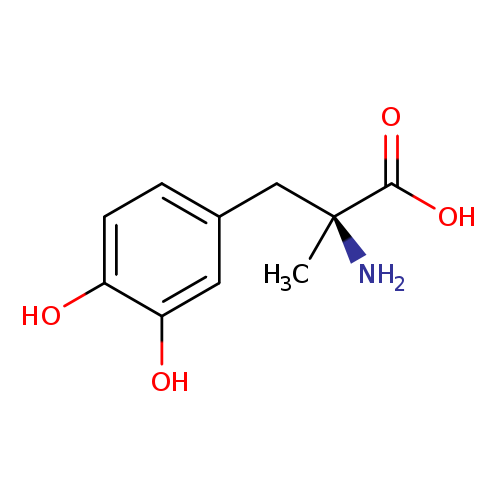
DescriptionMethyldopa or alpha-methyldopa (brand names Aldomet, Apo-Methyldopa, Dopamet, Novomedopa) is a centrally-acting adrenergic antihypertensive medication. Its use is now deprecated following introduction of alternative safer classes of agents. However it continues to have a role in otherwise difficult to treat hypertension and gestational hypertension (formerly known as pregnancy-induced hypertension). Methyldopa is an aromatic-amino-acid decarboxylase inhibitor in animals and in man. Only methyldopa, the L-isomer of alpha-methyldopa, has the ability to inhibit dopa decarboxylase and to deplete animal tissues of norepinephrine. In man the antihypertensive activity appears to be due solely to the L-isomer. About twice the dose of the racemate (DL-alpha-methyldopa) is required for equal antihypertensive effect. Methyldopa has no direct effect on cardiac function and usually does not reduce glomerular filtration rate, renal blood flow, or filtration fraction. Cardiac output usually is maintained without cardiac acceleration. In some patients the heart rate is slowed. Normal or elevated plasma renin activity may decrease in the course of methyldopa therapy. Methyldopa reduces both supine and standing blood pressure. Methyldopa usually produces highly effective lowering of the supine pressure with infrequent symptomatic postural hypotension. Exercise hypotension and diurnal blood pressure variations rarely occur. Methyldopa, in its active metabolite form, is a central alpha-2 receptor agonist. Using methyldopa leads to alpha-2 receptor-negative feedback to sympathetic nervous system (SNS) (centrally and peripherally), allowing peripheral sympathetic nervous system tone to decrease. Such activity leads to a decrease in total peripheral resistance (TPR) and cardiac output. When introduced it was a mainstay of antihypertensive therapy, but its use has declined, with increased use of other safer classes of agents. One of its important present-day uses is in the management of pregnancy-induced hypertension, as it is relatively safe in pregnancy compared to other antihypertensive drugs (Wikipedia).
Contaminant Sources
  • FooDB Chemicals
  • HMDB Contaminants - Urine
  • STOFF IDENT Compounds
  • T3DB toxins
  • ToxCast & Tox21 Chemicals
Contaminant Type
  • Adrenergic alpha-2 Receptor Agonist
  • Adrenergic alpha-Agonist
  • Amine
  • Antihypertensive Agent
  • Drug
  • Food Toxin
  • Metabolite
  • Organic Compound
  • Sympatholytic
  • Synthetic Compound
Chemical Structure
Thumb
Synonyms
ValueSource
(2S)-2-Amino-3-(3,4-dihydroxyphenyl)-2-methylpropanoic acidChEBI
(S)-(-)-alpha-MethyldopaChEBI
3-Hydroxy-alpha-methyl-L-tyrosineChEBI
Alpha MedopaChEBI
alpha-Methyl dopaChEBI
alpha-Methyl-beta-(3,4-dihydroxyphenyl)-L-alanineChEBI
alpha-Methyl-L-3,4-dihydroxyphenylalanineChEBI
alpha-MethyldihydroxyphenylalanineChEBI
alpha-MethyldopaChEBI
AlphamethyldopaChEBI
AMDChEBI
L(-)-beta-(3,4-Dihydroxyphenyl)-alpha-methylalanineChEBI
L-(-)-3-(3,4-Dihydroxyphenyl)-2-methylalanineChEBI
L-(-)-alpha-Methyl-beta-(3,4-dihydroxyphenyl)alanineChEBI
L-(alpha-MD)ChEBI
L-2-Amino-2-methyl-3-(3,4-dihydroxyphenyl)propionic acidChEBI
L-3-(3,4-Dihydroxyphenyl)-2-methylalanineChEBI
L-alpha-Methyl-3,4-dihydroxyphenylalanineChEBI
L-alpha-MethyldopaChEBI
L-Methyl dopaChEBI
Levo-3-(3,4-dihydroxyphenyl)-2-methylalanineChEBI
Methyl-L-dopaChEBI
Methyldopa anhydrousChEBI
MethyldopumChEBI
MetildopaChEBI
AldometKegg
(2S)-2-Amino-3-(3,4-dihydroxyphenyl)-2-methylpropanoateGenerator
(S)-(-)-a-MethyldopaGenerator
(S)-(-)-Α-methyldopaGenerator
3-Hydroxy-a-methyl-L-tyrosineGenerator
3-Hydroxy-α-methyl-L-tyrosineGenerator
a MedopaGenerator
Α medopaGenerator
a-Methyl dopaGenerator
Α-methyl dopaGenerator
a-Methyl-b-(3,4-dihydroxyphenyl)-L-alanineGenerator
Α-methyl-β-(3,4-dihydroxyphenyl)-L-alanineGenerator
a-Methyl-L-3,4-dihydroxyphenylalanineGenerator
Α-methyl-L-3,4-dihydroxyphenylalanineGenerator
a-MethyldihydroxyphenylalanineGenerator
Α-methyldihydroxyphenylalanineGenerator
a-MethyldopaGenerator
Α-methyldopaGenerator
L(-)-b-(3,4-Dihydroxyphenyl)-a-methylalanineGenerator
L(-)-Β-(3,4-dihydroxyphenyl)-α-methylalanineGenerator
L-(-)-a-Methyl-b-(3,4-dihydroxyphenyl)alanineGenerator
L-(-)-Α-methyl-β-(3,4-dihydroxyphenyl)alanineGenerator
L-(a-MD)Generator
L-(Α-MD)Generator
L-2-Amino-2-methyl-3-(3,4-dihydroxyphenyl)propionateGenerator
L-a-Methyl-3,4-dihydroxyphenylalanineGenerator
L-Α-methyl-3,4-dihydroxyphenylalanineGenerator
L-a-MethyldopaGenerator
L-Α-methyldopaGenerator
(-)-a-MethyldopaHMDB
(-)-alpha-MethyldopaHMDB
(-)-MethyldopaHMDB
2-Methyl-3-(3,4-dihydroxyphenyl)alanineHMDB
3,4-Dihydroxy-2-methylphenylalanine (acd/name 4.0)HMDB
a-Methyl-L-dopaHMDB, Generator
Aldoclor-150HMDB
Aldoclor-250HMDB
AldometilHMDB
Aldoril 15HMDB
Aldoril 25HMDB
Aldoril D30HMDB
Aldoril D50HMDB
alpha-Methyl-L-dopaHMDB, MeSH
apo Methyldopa tab 125MGHMDB
apo Methyldopa tab 250MGHMDB
apo Methyldopa tab 500MGHMDB
apo-MethyldopaHMDB, MeSH
Bayer 1440 LHMDB
BaypresolHMDB
BecantaHMDB
DopametHMDB, MeSH
DopamethyperpaxHMDB
DopatecHMDB
DopegytHMDB, MeSH
GrospiskHMDB
HyperpaxHMDB
HypolagHMDB
L(-)-a-MethylalanineHMDB
L(-)-alpha-MethylalanineHMDB
L-(-)-3-(3,4-Dihydroxyphenyl)-2-methyl-alanineHMDB
L-(-)-a-Methyl-a-methyl-aldominHMDB
L-(-)-alpha-Methyl-alpha-methyl-aldominHMDB
L-a-Methyl-(3, 4-dihydroxyphenyl)alanineHMDB
L-alpha-Methyl-(3, 4-dihydroxyphenyl)alanineHMDB
MedometHMDB
MedopaHMDB
MedopalHMDB
MedoprenHMDB
MethoplainHMDB
Methyldopa 125 tab 125MGHMDB
Methyldopa 250 tabHMDB
Methyldopa 500 tab 500MGHMDB
MethyldopateHMDB, MeSH
Methyldopate HCLHMDB
novo-Medopa tab 125MGHMDB
novo-Medopa tab 250MGHMDB
novo-Medopa tab 500MGHMDB
NovomedopaHMDB
Nu-medopaHMDB, MeSH
Nu-medopa tab 125MGHMDB
Nu-medopa tab 250MGHMDB
Nu-medopa tab 500MGHMDB
PresinolHMDB
PresolisinHMDB
SedometilHMDB
SembrinaHMDB, MeSH
Alphapharm brand OF methyldopaMeSH, HMDB
Apotex brand OF methyldopaMeSH, HMDB
Merck brand OF methyldopaMeSH, HMDB
Nu pharm brand OF methyldopaMeSH, HMDB
DopergitMeSH, HMDB
HydopaMeSH, HMDB
Merck sharp and dohme brand OF methyldopaMeSH, HMDB
Methyldopa orion brandMeSH, HMDB
Nu-pharm brand OF methyldopaMeSH, HMDB
Orion brand OF methyldopaMeSH, HMDB
Rhône poulenc rorer brand OF methyldopaMeSH, HMDB
Rhône-poulenc rorer brand OF methyldopaMeSH, HMDB
DopegitMeSH, HMDB
Methyldopa apotex brandMeSH, HMDB
Methyldopa biopat brandMeSH, HMDB
Methyldopa clonmel brandMeSH, HMDB
Methyldopa merck brandMeSH, HMDB
Nu medopaMeSH, HMDB
alpha Methyl L dopaMeSH, HMDB
alpha MethyldopaMeSH, HMDB
apo MethyldopaMeSH, HMDB
Biopat brand OF methyldopaMeSH, HMDB
Cahill may roberts brand OF methyldopaMeSH, HMDB
Clonmel brand OF methyldopaMeSH, HMDB
MeldopaMeSH, HMDB
Methyldopa alphapharm brandMeSH, HMDB
Methyldopa nu-pharm brandMeSH, HMDB
MethyldopaChEBI
Α-methyl-L-dopaGenerator, HMDB
Chemical FormulaC10H13NO4
Average Molecular Mass211.215 g/mol
Monoisotopic Mass211.084 g/mol
CAS Registry Number555-29-3
IUPAC Name(2S)-2-amino-3-(3,4-dihydroxyphenyl)-2-methylpropanoic acid
Traditional Namemethyldopa
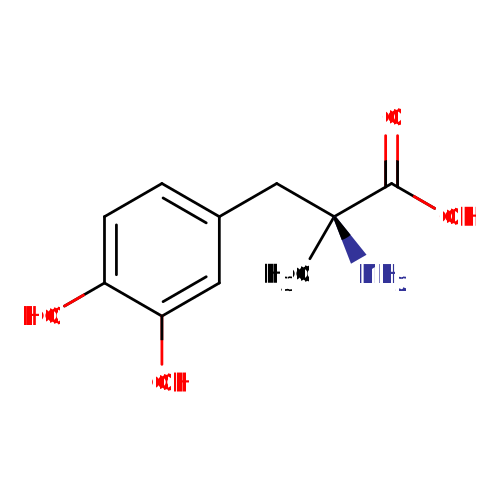
SMILESC[C@](N)(CC1=CC=C(O)C(O)=C1)C(O)=O
InChI IdentifierInChI=1S/C10H13NO4/c1-10(11,9(14)15)5-6-2-3-7(12)8(13)4-6/h2-4,12-13H,5,11H2,1H3,(H,14,15)/t10-/m0/s1
InChI KeyCJCSPKMFHVPWAR-JTQLQIEISA-N
Chemical Taxonomy
Description belongs to the class of organic compounds known as phenylpropanoic acids. Phenylpropanoic acids are compounds with a structure containing a benzene ring conjugated to a propanoic acid.
KingdomOrganic compounds
Super ClassPhenylpropanoids and polyketides
ClassPhenylpropanoic acids
Sub ClassNot Available
Direct ParentPhenylpropanoic acids
Alternative Parents
Substituents
  • 3-phenylpropanoic-acid
  • Alpha-amino acid
  • D-alpha-amino acid
  • Alpha-amino acid or derivatives
  • Amphetamine or derivatives
  • Phenylpropane
  • Catechol
  • 1-hydroxy-2-unsubstituted benzenoid
  • Aralkylamine
  • 1-hydroxy-4-unsubstituted benzenoid
  • Phenol
  • Monocyclic benzene moiety
  • Benzenoid
  • Amino acid
  • Amino acid or derivatives
  • Carboxylic acid derivative
  • Monocarboxylic acid or derivatives
  • Carboxylic acid
  • Organic nitrogen compound
  • Primary aliphatic amine
  • Organonitrogen compound
  • Organooxygen compound
  • Primary amine
  • Carbonyl group
  • Hydrocarbon derivative
  • Organic oxide
  • Organopnictogen compound
  • Amine
  • Organic oxygen compound
  • Aromatic homomonocyclic compound
Molecular FrameworkAromatic homomonocyclic compounds
External Descriptors
Biological Properties
StatusDetected and Not Quantified
OriginExogenous
Cellular Locations
  • Cytoplasm
  • Extracellular
Biofluid LocationsNot Available
Tissue LocationsNot Available
PathwaysNot Available
Applications
Biological Roles
Chemical RolesNot Available
Physical Properties
StateSolid
AppearanceWhite powder.
Experimental Properties
PropertyValue
Melting Point300°C
Boiling PointNot Available
Solubility10mg/mL at 25°C
Predicted Properties
PropertyValueSource
Water Solubility2.26 g/LALOGPS
logP-2ALOGPS
logP-1.4ChemAxon
logS-2ALOGPS
pKa (Strongest Acidic)1.73ChemAxon
pKa (Strongest Basic)9.85ChemAxon
Physiological Charge0ChemAxon
Hydrogen Acceptor Count5ChemAxon
Hydrogen Donor Count4ChemAxon
Polar Surface Area103.78 ŲChemAxon
Rotatable Bond Count3ChemAxon
Refractivity53.79 m³·mol⁻¹ChemAxon
Polarizability20.73 ųChemAxon
Number of Rings1ChemAxon
Bioavailability1ChemAxon
Rule of FiveYesChemAxon
Ghose FilterNoChemAxon
Veber's RuleNoChemAxon
MDDR-like RuleNoChemAxon
Spectra
Spectra
Spectrum TypeDescriptionSplash KeyView
GC-MSGC-MS Spectrum - GC-EI-TOF (Non-derivatized)splash10-001i-0690000000-f54d986a8144f4a79b82Spectrum
Predicted GC-MSPredicted GC-MS Spectrum - GC-MS (Non-derivatized) - 70eV, Positivesplash10-00xu-4900000000-739bef9b92ae61fa3997Spectrum
Predicted GC-MSPredicted GC-MS Spectrum - GC-MS (3 TMS) - 70eV, Positivesplash10-03l3-6719300000-8507376d6ae27047f468Spectrum
Predicted GC-MSPredicted GC-MS Spectrum - GC-MS (Non-derivatized) - 70eV, PositiveNot AvailableSpectrum
LC-MS/MSLC-MS/MS Spectrum - LC-ESI-qTof , Positivesplash10-0g5i-2900000000-2d1c0ec9ad93e208b620Spectrum
LC-MS/MSLC-MS/MS Spectrum - , positivesplash10-0g5i-2900000000-2d1c0ec9ad93e208b620Spectrum
LC-MS/MSLC-MS/MS Spectrum - 15V, Negativesplash10-01p2-3940000000-04fec0e15e79c768fdc7Spectrum
LC-MS/MSLC-MS/MS Spectrum - 30V, Negativesplash10-0002-2910000000-5ab87bad3301cc12d671Spectrum
LC-MS/MSLC-MS/MS Spectrum - 90V, Positivesplash10-0wmi-5900000000-8d84c2b3f8d906813668Spectrum
LC-MS/MSLC-MS/MS Spectrum - 75V, Positivesplash10-0ik9-2900000000-f0762b6c346fb34404e5Spectrum
LC-MS/MSLC-MS/MS Spectrum - 15V, Positivesplash10-014s-0910000000-ef3d681f544c504b6f07Spectrum
LC-MS/MSLC-MS/MS Spectrum - 30V, Positivesplash10-014r-0900000000-a11a3fc0536274091e7cSpectrum
LC-MS/MSLC-MS/MS Spectrum - 60V, Positivesplash10-03y0-0900000000-20bad18343ec957bca95Spectrum
LC-MS/MSLC-MS/MS Spectrum - 45V, Positivesplash10-014r-0900000000-2a78e6a20d8599caab2bSpectrum
LC-MS/MSLC-MS/MS Spectrum - 15V, Positivesplash10-014s-0910000000-db2e7c58eec2a2e9f25eSpectrum
LC-MS/MSLC-MS/MS Spectrum - 60V, Positivesplash10-03y0-0900000000-4ee772845ee32a944db1Spectrum
LC-MS/MSLC-MS/MS Spectrum - 60V, Positivesplash10-0002-1900000000-3efdf92a8af6e42965e2Spectrum
LC-MS/MSLC-MS/MS Spectrum - 60V, Negativesplash10-0002-1900000000-4ba9f4555cda937d3883Spectrum
LC-MS/MSLC-MS/MS Spectrum - 45V, Negativesplash10-006t-1900000000-aa6c8ce94351767534b1Spectrum
LC-MS/MSLC-MS/MS Spectrum - 75V, Negativesplash10-0002-0900000000-cdcf4d0d2fe21483aac5Spectrum
Predicted LC-MS/MSPredicted LC-MS/MS Spectrum - 10V, Positivesplash10-014i-0910000000-3bfdb36173438fdd8a17Spectrum
Predicted LC-MS/MSPredicted LC-MS/MS Spectrum - 20V, Positivesplash10-014i-0900000000-9b6b615025e3da8f5450Spectrum
Predicted LC-MS/MSPredicted LC-MS/MS Spectrum - 40V, Positivesplash10-0600-4900000000-34dc05f00879ecc053bfSpectrum
Predicted LC-MS/MSPredicted LC-MS/MS Spectrum - 10V, Positivesplash10-014i-0910000000-3bfdb36173438fdd8a17Spectrum
Predicted LC-MS/MSPredicted LC-MS/MS Spectrum - 20V, Positivesplash10-014i-0900000000-9b6b615025e3da8f5450Spectrum
Predicted LC-MS/MSPredicted LC-MS/MS Spectrum - 40V, Positivesplash10-0600-4900000000-34dc05f00879ecc053bfSpectrum
Predicted LC-MS/MSPredicted LC-MS/MS Spectrum - 10V, Negativesplash10-03di-4290000000-cdd2c737cabf0ee44d1fSpectrum
Predicted LC-MS/MSPredicted LC-MS/MS Spectrum - 20V, Negativesplash10-000i-9410000000-d1fa6c265dd8ca539a0eSpectrum
Predicted LC-MS/MSPredicted LC-MS/MS Spectrum - 40V, Negativesplash10-007d-6900000000-56bdd61262b97efe050bSpectrum
1D NMR1H NMR SpectrumNot AvailableSpectrum
1D NMR13C NMR SpectrumNot AvailableSpectrum
1D NMR1H NMR SpectrumNot AvailableSpectrum
1D NMR13C NMR SpectrumNot AvailableSpectrum
1D NMR1H NMR SpectrumNot AvailableSpectrum
1D NMR13C NMR SpectrumNot AvailableSpectrum
1D NMR1H NMR SpectrumNot AvailableSpectrum
1D NMR13C NMR SpectrumNot AvailableSpectrum
1D NMR1H NMR SpectrumNot AvailableSpectrum
1D NMR13C NMR SpectrumNot AvailableSpectrum
1D NMR1H NMR SpectrumNot AvailableSpectrum
1D NMR13C NMR SpectrumNot AvailableSpectrum
1D NMR1H NMR SpectrumNot AvailableSpectrum
1D NMR13C NMR SpectrumNot AvailableSpectrum
1D NMR1H NMR SpectrumNot AvailableSpectrum
1D NMR13C NMR SpectrumNot AvailableSpectrum
1D NMR1H NMR SpectrumNot AvailableSpectrum
1D NMR13C NMR SpectrumNot AvailableSpectrum
1D NMR1H NMR SpectrumNot AvailableSpectrum
1D NMR13C NMR SpectrumNot AvailableSpectrum
Toxicity Profile
Route of ExposureOral
Mechanism of ToxicityAlthough the mechanism of action has yet to be conclusively demonstrated, the antihypertensive effect of methyldopa probably is due to its metabolism to alpha-methylnorepinephrine, which then lowers arterial pressure by stimulation of central inhibitory alpha-adrenergic receptors, false neurotransmission, and/or reduction of plasma renin activity. Methyldopa has been shown to cause a net reduction in the tissue concentration of serotonin, dopamine, norepinephrine, and epinephrine.
MetabolismHepatic, extensively metabolized. The known urinary metabolites are: a-methyldopa mono-0-sulfate; 3-0-methyl-a-methyldopa; 3,4-dihydroxyphenylacetone; a-methyldopamine; 3-0-methyl-a-methyldopamine and their conjugates.
Toxicity ValuesLD50: > 1.5 g/kg( oral, mouse) LD50: > 1.5 g/kg( oral, rat)
Lethal DoseNot Available
Carcinogenicity (IARC Classification)No indication of carcinogenicity to humans (not listed by IARC).
Uses/SourcesNot Available
Minimum Risk LevelNot Available
Health EffectsNot Available
SymptomsSymptoms of overdose include bloating, constipation, diarrhea, dizziness, extreme drowsiness, gas, light-headedness, nausea, severely low blood pressure, slow heartbeat, vomiting, and weakness.
TreatmentNot Available
Concentrations
Not Available
DrugBank IDDB00968
HMDB IDHMDB0011754
FooDB IDFDB028425
Phenol Explorer IDNot Available
KNApSAcK IDC00040542
BiGG IDNot Available
BioCyc IDALPHA-METHYLDOPA
METLIN IDNot Available
PDB IDNot Available
Wikipedia LinkMethyldopa
Chemspider ID35562
ChEBI ID61058
PubChem Compound ID38853
Kegg Compound IDC07194
YMDB IDNot Available
ECMDB IDNot Available
References
Synthesis Reference

DrugSyn.org

MSDSLink
General References
1. https://www.ncbi.nlm.nih.gov/pubmed/?term=10576686
2. https://www.ncbi.nlm.nih.gov/pubmed/?term=11901210
3. https://www.ncbi.nlm.nih.gov/pubmed/?term=29438107
4. https://www.ncbi.nlm.nih.gov/pubmed/?term=8301021
5. Iyer KS, Thampuran RV: Beta blockade and anticonvulsant activity of propranolol. Indian J Physiol Pharmacol. 1978 Jul-Sep;22(3):293-6.