Record Information
Version1.0
Creation Date2009-07-30 17:58:36 UTC
Update Date2026-03-31 17:35:01 UTC
Accession NumberCHEM002502
Identification
Common NameAlbendazole
ClassSmall Molecule
DescriptionAlbendazole is only found in individuals that have used or taken this drug. It is a benzimidazole broad-spectrum anthelmintic structurally related to mebendazole that is effective against many diseases. (From Martindale, The Extra Pharmacopoeia, 30th ed, p38). Albendazole causes degenerative alterations in the tegument and intestinal cells of the worm by binding to the colchicine-sensitive site of tubulin, thus inhibiting its polymerization or assembly into microtubules. The loss of the cytoplasmic microtubules leads to impaired uptake of glucose by the larval and adult stages of the susceptible parasites, and depletes their glycogen stores. Degenerative changes in the endoplasmic reticulum, the mitochondria of the germinal layer, and the subsequent release of lysosomes result in decreased production of adenosine triphosphate (ATP), which is the energy required for the survival of the helminth. Due to diminished energy production, the parasite is immobilized and eventually dies.
Contaminant Sources
  • EAFUS Chemicals
  • HMDB Contaminants - Urine
  • STOFF IDENT Compounds
  • Suspected Compounds
  • T3DB toxins
  • ToxCast & Tox21 Chemicals
Contaminant Type
  • Amine
  • Anthelmintic
  • Anticestodal Agent
  • Antiprotozoal Agent
  • Drug
  • Ester
  • Ether
  • Metabolite
  • Organic Compound
  • Synthetic Compound
  • Tubulin Modulator
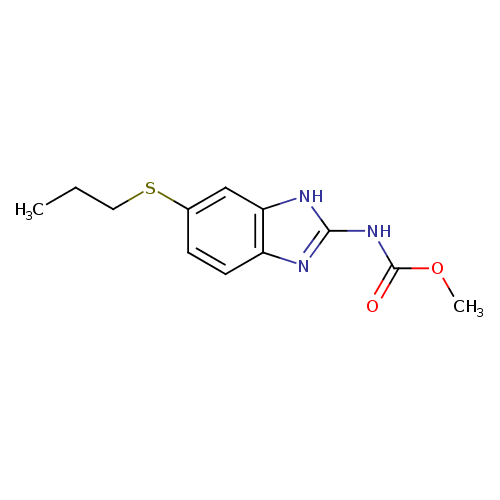
Chemical Structure
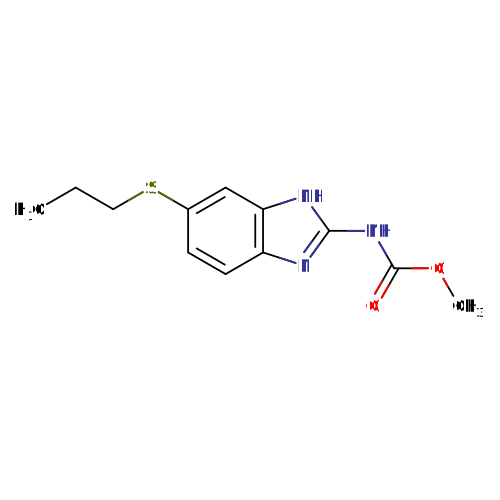
Thumb
Synonyms
ValueSource
(5-(Propylthio)-1H-benzimidazol-2-yl)carbamic acid methyl esterChEBI
5-(Propylthio)-2-carbomethoxyaminobenzimidazoleChEBI
AlbenzaChEBI
EskazoleChEBI
O-Methyl N-(5-(propylthio)-2-benzimidazolyl)carbamateChEBI
ProftrilChEBI
ValbazenChEBI
ZentelChEBI
(5-(Propylthio)-1H-benzimidazol-2-yl)carbamate methyl esterGenerator
O-Methyl N-(5-(propylthio)-2-benzimidazolyl)carbamic acidGenerator
Albendazole armstrong brandHMDB
Albendazole diba brandHMDB
Albendazole pfizer brandHMDB
AlbendoralHMDB
Armstrong brand OF albendazoleHMDB
SK And F62979HMDB
Albendazole sanicoopa brandHMDB
Albendazole valdecasas brandHMDB
BendaparHMDB
DigezanolHMDB
EndoplusHMDB
Fustery brand OF albendazoleHMDB
Hormona brand OF albendazoleHMDB
Liferpal brand OF albendazoleHMDB
LurdexHMDB
Mediamix V disthelmHMDB
MetiazolHMDB
Monohydrochloride, albendazoleHMDB
SK And F-62979HMDB
Sanicoopa brand OF albendazoleHMDB
Albendazole fustery brandHMDB
GascopHMDB
Noé-socopharm brand OF albendazoleHMDB
Pfizer brand OF albendazoleHMDB
SmithKline beecham brand OF albendazoleHMDB
V Disthelm, mediamixHMDB
Albendazole hormona brandHMDB
Albendazole liferpal brandHMDB
Albendazole monohydrochlorideHMDB
Albendazole noé-socopharm brandHMDB
BilutacHMDB
Diba brand OF albendazoleHMDB
DisthelmHMDB
Disthelm, mediamix VHMDB
Noé socopharm brand OF albendazoleHMDB
SK And F 62979HMDB
Valdecasas brand OF albendazoleHMDB
AndazolMeSH
Chemical FormulaC12H15N3O2S
Average Molecular Mass265.331 g/mol
Monoisotopic Mass265.088 g/mol
CAS Registry Number54965-21-8
IUPAC Namemethyl N-[6-(propylsulfanyl)-1H-1,3-benzodiazol-2-yl]carbamate
Traditional Namealbendazol
SMILESCCCSC1=CC2=C(C=C1)N=C(NC(=O)OC)N2
InChI IdentifierInChI=1S/C12H15N3O2S/c1-3-6-18-8-4-5-9-10(7-8)14-11(13-9)15-12(16)17-2/h4-5,7H,3,6H2,1-2H3,(H2,13,14,15,16)
InChI KeyHXHWSAZORRCQMX-UHFFFAOYSA-N
Chemical Taxonomy
Description belongs to the class of organic compounds known as 2-benzimidazolylcarbamic acid esters. These are aromatic heteropolycyclic compounds that contain a carbamic acid ester group, which is N-linked to the C2-atom of a benzimidazole moiety.
KingdomOrganic compounds
Super ClassOrganoheterocyclic compounds
ClassBenzimidazoles
Sub Class2-benzimidazolylcarbamic acid esters
Direct Parent2-benzimidazolylcarbamic acid esters
Alternative Parents
Substituents
  • 2-benzimidazolylcarbamic acid ester
  • Aryl thioether
  • Thiophenol ether
  • Alkylarylthioether
  • Benzenoid
  • Azole
  • Imidazole
  • Carbamic acid ester
  • Heteroaromatic compound
  • Carbonic acid derivative
  • Thioether
  • Azacycle
  • Sulfenyl compound
  • Organic nitrogen compound
  • Hydrocarbon derivative
  • Organic oxide
  • Organosulfur compound
  • Organooxygen compound
  • Organonitrogen compound
  • Organopnictogen compound
  • Organic oxygen compound
  • Carbonyl group
  • Aromatic heteropolycyclic compound
Molecular FrameworkAromatic heteropolycyclic compounds
External Descriptors
Biological Properties
StatusDetected and Not Quantified
OriginExogenous
Cellular Locations
  • Cytoplasm
  • Extracellular
  • Membrane
Biofluid LocationsNot Available
Tissue LocationsNot Available
PathwaysNot Available
Applications
Biological Roles
Chemical RolesNot Available
Physical Properties
StateSolid
AppearanceWhite to off-white.
Experimental Properties
PropertyValue
Melting Point208-210°C
Boiling PointNot Available
SolubilityPractically insoluble
Predicted Properties
PropertyValueSource
Water Solubility0.023 g/LALOGPS
logP3.22ALOGPS
logP3.2ChemAxon
logS-4.1ALOGPS
pKa (Strongest Acidic)9.51ChemAxon
pKa (Strongest Basic)4.27ChemAxon
Physiological Charge0ChemAxon
Hydrogen Acceptor Count3ChemAxon
Hydrogen Donor Count2ChemAxon
Polar Surface Area67.01 ŲChemAxon
Rotatable Bond Count5ChemAxon
Refractivity73.01 m³·mol⁻¹ChemAxon
Polarizability29.3 ųChemAxon
Number of Rings2ChemAxon
Bioavailability1ChemAxon
Rule of FiveYesChemAxon
Ghose FilterYesChemAxon
Veber's RuleNoChemAxon
MDDR-like RuleNoChemAxon
Spectra
Spectra
Spectrum TypeDescriptionSplash KeyView
GC-MSGC-MS Spectrum - GC-EI-TOF (Non-derivatized)splash10-0zg0-1469000000-46c2b274ef14c131df22Spectrum
GC-MSGC-MS Spectrum - GC-EI-TOF (Non-derivatized)splash10-00dl-2920000000-8bfa1e52a364c2e1f3acSpectrum
GC-MSGC-MS Spectrum - GC-EI-TOF (Non-derivatized)splash10-0zg0-1469000000-46c2b274ef14c131df22Spectrum
GC-MSGC-MS Spectrum - GC-EI-TOF (Non-derivatized)splash10-00dl-2920000000-8bfa1e52a364c2e1f3acSpectrum
Predicted GC-MSPredicted GC-MS Spectrum - GC-MS (Non-derivatized) - 70eV, Positivesplash10-00vl-3960000000-6405beb97aaf7baeef1eSpectrum
Predicted GC-MSPredicted GC-MS Spectrum - GC-MS (Non-derivatized) - 70eV, PositiveNot AvailableSpectrum
LC-MS/MSLC-MS/MS Spectrum - LC-ESI-QFT , negativesplash10-01q9-0090000000-672ce5296af7aee8b705Spectrum
LC-MS/MSLC-MS/MS Spectrum - LC-ESI-QFT , negativesplash10-001i-0390000000-5714d326ce05257dd82dSpectrum
LC-MS/MSLC-MS/MS Spectrum - LC-ESI-QFT , negativesplash10-000i-0910000000-e659044fe535a4187c4cSpectrum
LC-MS/MSLC-MS/MS Spectrum - LC-ESI-QFT , negativesplash10-000i-0900000000-a1c7141f3f860d69dca2Spectrum
LC-MS/MSLC-MS/MS Spectrum - LC-ESI-QFT , negativesplash10-000i-0900000000-96ae063a35ee4fe53390Spectrum
LC-MS/MSLC-MS/MS Spectrum - LC-ESI-QFT , negativesplash10-052r-2900000000-6103a7173b7b7689ee52Spectrum
LC-MS/MSLC-MS/MS Spectrum - LC-ESI-QFT , negativesplash10-0a4i-9600000000-7a4cee3070ee6f08b2cbSpectrum
LC-MS/MSLC-MS/MS Spectrum - LC-ESI-QFT , negativesplash10-0a4i-9200000000-109010056dd851a50ae4Spectrum
LC-MS/MSLC-MS/MS Spectrum - LC-ESI-QFT , negativesplash10-0a4i-9000000000-9f06e0952a63ae1312b3Spectrum
LC-MS/MSLC-MS/MS Spectrum - LC-ESI-QFT , negativesplash10-001r-0790000000-8ba2b09e2eefe111496fSpectrum
LC-MS/MSLC-MS/MS Spectrum - LC-ESI-QTOF , positivesplash10-001i-0290000000-db0e07ed437380dd7f56Spectrum
LC-MS/MSLC-MS/MS Spectrum - LC-ESI-QTOF , positivesplash10-0006-0910000000-80dd825626a5009e8924Spectrum
LC-MS/MSLC-MS/MS Spectrum - LC-ESI-QTOF , positivesplash10-052f-0900000000-ea3849a4ab993b24b4f0Spectrum
LC-MS/MSLC-MS/MS Spectrum - LC-ESI-QFT , positivesplash10-014i-0090000000-fe82219d2c01efc3494dSpectrum
LC-MS/MSLC-MS/MS Spectrum - LC-ESI-QFT , positivesplash10-00lr-0090000000-6d1f652e7ecf943d7400Spectrum
LC-MS/MSLC-MS/MS Spectrum - LC-ESI-QFT , positivesplash10-001i-0190000000-ab8f5993bbc5ebfcb04cSpectrum
LC-MS/MSLC-MS/MS Spectrum - LC-ESI-QFT , positivesplash10-000x-0950000000-0c5ca5956802aa312e11Spectrum
LC-MS/MSLC-MS/MS Spectrum - LC-ESI-QFT , positivesplash10-0006-0900000000-02e757b669a99db25608Spectrum
LC-MS/MSLC-MS/MS Spectrum - LC-ESI-QFT , positivesplash10-052f-0900000000-bef5aa7a328477b1c279Spectrum
Predicted LC-MS/MSPredicted LC-MS/MS Spectrum - 10V, Positivesplash10-0uxr-1190000000-b3b5e0c1c81c186e0323Spectrum
Predicted LC-MS/MSPredicted LC-MS/MS Spectrum - 20V, Positivesplash10-0a6u-6390000000-49710f98d2607932e74dSpectrum
Predicted LC-MS/MSPredicted LC-MS/MS Spectrum - 40V, Positivesplash10-01vo-6920000000-f7a76ee929303af68012Spectrum
Predicted LC-MS/MSPredicted LC-MS/MS Spectrum - 10V, Negativesplash10-06si-5390000000-662c83573e8207d72065Spectrum
Predicted LC-MS/MSPredicted LC-MS/MS Spectrum - 20V, Negativesplash10-0a4i-5960000000-7fffbfea1f1e67fdbb9cSpectrum
Predicted LC-MS/MSPredicted LC-MS/MS Spectrum - 40V, Negativesplash10-01rx-9610000000-014e3ec45924170b49d0Spectrum
1D NMR1H NMR SpectrumNot AvailableSpectrum
1D NMR13C NMR SpectrumNot AvailableSpectrum
Toxicity Profile
Route of ExposurePoorly absorbed from the gastrointestinal tract due to its low aqueous solubility. Oral bioavailability appears to be enhanced when coadministered with a fatty meal (estimated fat content 40 g)
Mechanism of ToxicityAlbendazole causes degenerative alterations in the tegument and intestinal cells of the worm by binding to the colchicine-sensitive site of tubulin, thus inhibiting its polymerization or assembly into microtubules. The loss of the cytoplasmic microtubules leads to impaired uptake of glucose by the larval and adult stages of the susceptible parasites, and depletes their glycogen stores. Degenerative changes in the endoplasmic reticulum, the mitochondria of the germinal layer, and the subsequent release of lysosomes result in decreased production of adenosine triphosphate (ATP), which is the energy required for the survival of the helminth. Due to diminished energy production, the parasite is immobilized and eventually dies.
MetabolismHepatic. Rapidly converted in the liver to the primary metabolite, albendazole sulfoxide, which is further metabolized to albendazole sulfone and other primary oxidative metabolites that have been identified in human urine. Route of Elimination: Albendazole is rapidly converted in the liver to the primary metabolite, albendazole sulfoxide, which is further metabolized to albendazole sulfone and other primary oxidative metabolites that have been identified in human urine. Urinary excretion of albendazole sulfoxide is a minor elimination pathway with less than 1% of the dose recovered in the urine. Biliary elimination presumably accounts for a portion of the elimination as evidenced by biliary concentrations of albendazole sulfoxide similar to those achieved in plasma. Half Life: Terminal elimination half-life ranges from 8 to 12 hours (single dose, 400mg).
Toxicity ValuesLD50: 1500 mg/kg (oral,mouse). [MSDS]
Lethal DoseNot Available
Carcinogenicity (IARC Classification)No indication of carcinogenicity to humans (not listed by IARC).
Uses/SourcesFor the treatment of parenchymal neurocysticercosis due to active lesions caused by larval forms of the pork tapeworm, Taenia solium and for the treatment of cystic hydatid disease of the liver, lung, and peritoneum, caused by the larval form of the dog tapeworm, Echinococcus granulosus.
Minimum Risk LevelNot Available
Health EffectsNot Available
SymptomsSymptoms of overdose include elevated liver enzymes, headaches, hair loss, low levels of white blood cells (neutropenia), fever, and itching.
TreatmentNot Available
Concentrations
Not Available
DrugBank IDDB00518
HMDB IDHMDB0014659
FooDB IDNot Available
Phenol Explorer IDNot Available
KNApSAcK IDNot Available
BiGG IDNot Available
BioCyc IDALBENDAZOLE
METLIN IDNot Available
PDB IDNot Available
Wikipedia LinkAlbendazole
Chemspider ID1998
ChEBI ID16664
PubChem Compound ID2082
Kegg Compound IDC01779
YMDB IDNot Available
ECMDB IDM2MDB005651
References
Synthesis Reference

Gyurik, R.J. and Theodorides, VJ.; US. Patent 3,915,986; October 28,1975; assigned to
Smith Kline Corp.

MSDSLink
General References
1. https://www.ncbi.nlm.nih.gov/pubmed/?term=22152396
2. https://www.ncbi.nlm.nih.gov/pubmed/?term=24403707
3. https://www.ncbi.nlm.nih.gov/pubmed/?term=24411094
4. Haque A, Hollister WS, Willcox A, Canning EU: The antimicrosporidial activity of albendazole. J Invertebr Pathol. 1993 Sep;62(2):171-7.
5. Oxberry ME, Reynoldson JA, Thompson RC: The binding and distribution of albendazole and its principal metabolites in Giardia duodenalis. J Vet Pharmacol Ther. 2000 Jun;23(3):113-20.
6. Ramirez T, Benitez-Bribiesca L, Ostrosky-Wegman P, Herrera LA: In vitro effects of albendazole and its metabolites on the cell proliferation kinetics and micronuclei frequency of stimulated human lymphocytes. Arch Med Res. 2001 Mar-Apr;32(2):119-22.
7. Molina AJ, Merino G, Prieto JG, Real R, Mendoza G, Alvarez AI: Absorption and metabolism of albendazole after intestinal ischemia/reperfusion. Eur J Pharm Sci. 2007 May;31(1):16-24. Epub 2007 Feb 6.