Record Information
Version1.0
Creation Date2009-07-30 17:58:35 UTC
Update Date2026-04-03 20:26:53 UTC
Accession NumberCHEM002501
Identification
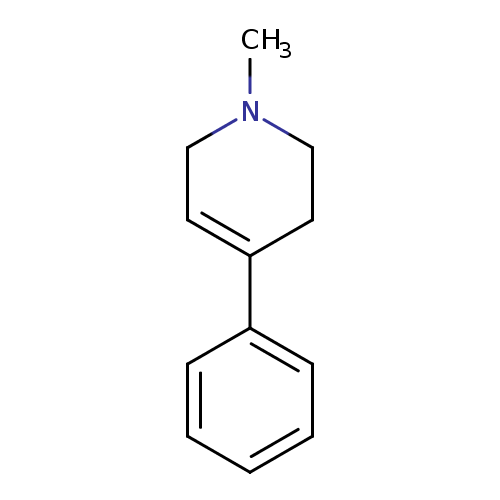
Common Name1-Methyl-4-phenyl-1,2,3,6-tetrahydropyridine
ClassSmall Molecule
Description1-methyl-4-phenyl-1,2,3,6-tetrahydropyridine (MPTP) is a neurotoxin that causes permanent symptoms of Parkinson's disease by killing certain neurons in the substantia nigra of the brain. While MPTP itself does not have opioid effects, it is related to MPPP, a synthetic opioid drug with effects similar to those of heroin and morphine. MPTP can be accidentally produced during the illicit manufacture of MPPP, and that is how its Parkinson-inducing effects were first discovered. MPTP is used to recreate and study the Parkinson's disease in experimental animal models. (2)
Contaminant Sources
  • T3DB toxins
Contaminant Type
  • Amine
  • Industrial Precursor/Intermediate
  • Industrial/Workplace Toxin
  • Organic Compound
  • Synthetic Compound
Chemical Structure
Thumb
Synonyms
ValueSource
MPTPChEBI
N-Methyl-4-phenyl-1,2,3,6-tetrahydropyridineMeSH
Chemical FormulaC12H15N
Average Molecular Mass173.254 g/mol
Monoisotopic Mass173.120 g/mol
CAS Registry Number28289-54-5
IUPAC Name1-methyl-4-phenyl-1,2,3,6-tetrahydropyridine
Traditional NameMPTP
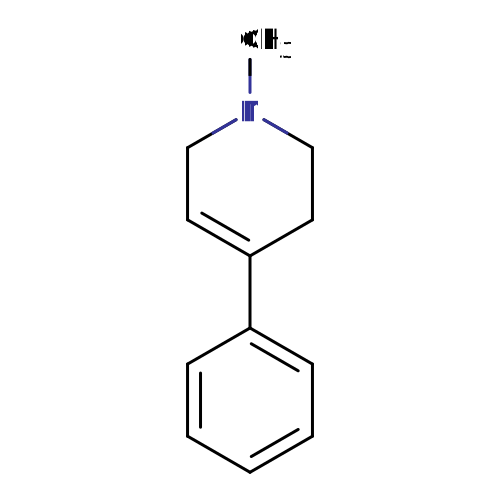
SMILESCN1CCC(=CC1)C1=CC=CC=C1
InChI IdentifierInChI=1S/C12H15N/c1-13-9-7-12(8-10-13)11-5-3-2-4-6-11/h2-7H,8-10H2,1H3
InChI KeyPLRACCBDVIHHLZ-UHFFFAOYSA-N
Chemical Taxonomy
Description belongs to the class of organic compounds known as hydropyridines. Hydropyridines are compounds containing a hydrogenated pyridine ring (i.e. containing less than the maximum number of double bonds.).
KingdomOrganic compounds
Super ClassOrganoheterocyclic compounds
ClassPyridines and derivatives
Sub ClassHydropyridines
Direct ParentHydropyridines
Alternative Parents
Substituents
  • Benzenoid
  • Hydropyridine
  • Monocyclic benzene moiety
  • Tertiary aliphatic amine
  • Tertiary amine
  • Azacycle
  • Organic nitrogen compound
  • Organopnictogen compound
  • Hydrocarbon derivative
  • Organonitrogen compound
  • Amine
  • Aromatic heteromonocyclic compound
Molecular FrameworkAromatic heteromonocyclic compounds
External Descriptors
Biological Properties
StatusDetected and Not Quantified
OriginExogenous
Cellular Locations
  • Membrane
Biofluid LocationsNot Available
Tissue LocationsNot Available
PathwaysNot Available
ApplicationsNot Available
Biological Roles
Chemical RolesNot Available
Physical Properties
StateSolid
AppearanceWhite powder.
Experimental Properties
PropertyValue
Melting Point40-42°C
Boiling Point85-90 °C (at 0.8 mm Hg)
SolubilityNot Available
Predicted Properties
PropertyValueSource
Water Solubility6.42 g/LALOGPS
logP2.69ALOGPS
logP2.35ChemAxon
logS-1.4ALOGPS
pKa (Strongest Basic)8.54ChemAxon
Physiological Charge1ChemAxon
Hydrogen Acceptor Count1ChemAxon
Hydrogen Donor Count0ChemAxon
Polar Surface Area3.24 ŲChemAxon
Rotatable Bond Count1ChemAxon
Refractivity57.47 m³·mol⁻¹ChemAxon
Polarizability21.02 ųChemAxon
Number of Rings2ChemAxon
Bioavailability1ChemAxon
Rule of FiveYesChemAxon
Ghose FilterYesChemAxon
Veber's RuleYesChemAxon
MDDR-like RuleNoChemAxon
Spectra
Spectra
Spectrum TypeDescriptionSplash KeyView
Predicted GC-MSPredicted GC-MS Spectrum - GC-MS (Non-derivatized) - 70eV, Positivesplash10-0lk9-1900000000-36d037be627c16feb3bdSpectrum
Predicted GC-MSPredicted GC-MS Spectrum - GC-MS (Non-derivatized) - 70eV, PositiveNot AvailableSpectrum
Predicted LC-MS/MSPredicted LC-MS/MS Spectrum - 10V, Positivesplash10-00di-0900000000-e201fc2a2d42013379aaSpectrum
Predicted LC-MS/MSPredicted LC-MS/MS Spectrum - 20V, Positivesplash10-00di-2900000000-99d91f9b67fcd6f34a76Spectrum
Predicted LC-MS/MSPredicted LC-MS/MS Spectrum - 40V, Positivesplash10-0gb9-8900000000-099735f9e4fb38becc8fSpectrum
Predicted LC-MS/MSPredicted LC-MS/MS Spectrum - 10V, Negativesplash10-00di-0900000000-d4230bc243608beca34fSpectrum
Predicted LC-MS/MSPredicted LC-MS/MS Spectrum - 20V, Negativesplash10-00di-0900000000-f32b038842a79e5b2695Spectrum
Predicted LC-MS/MSPredicted LC-MS/MS Spectrum - 40V, Negativesplash10-05dl-5900000000-3b4830d260c28b17374cSpectrum
Predicted LC-MS/MSPredicted LC-MS/MS Spectrum - 10V, Positivesplash10-00di-0900000000-56283bf2270bbd4df094Spectrum
Predicted LC-MS/MSPredicted LC-MS/MS Spectrum - 20V, Positivesplash10-00di-0900000000-cbb4be820600db09287eSpectrum
Predicted LC-MS/MSPredicted LC-MS/MS Spectrum - 40V, Positivesplash10-014i-2900000000-a1f874d4dde6dfbe3b2cSpectrum
Predicted LC-MS/MSPredicted LC-MS/MS Spectrum - 10V, Negativesplash10-00di-0900000000-7883e6701106e8531b78Spectrum
Predicted LC-MS/MSPredicted LC-MS/MS Spectrum - 20V, Negativesplash10-00di-0900000000-7ffdbc080be1d9a7b5b6Spectrum
Predicted LC-MS/MSPredicted LC-MS/MS Spectrum - 40V, Negativesplash10-00di-0900000000-396c4310a7b5ec601e1aSpectrum
1D NMR13C NMR SpectrumNot AvailableSpectrum
1D NMR1H NMR SpectrumNot AvailableSpectrum
1D NMR13C NMR SpectrumNot AvailableSpectrum
1D NMR1H NMR SpectrumNot AvailableSpectrum
1D NMR13C NMR SpectrumNot AvailableSpectrum
1D NMR1H NMR SpectrumNot AvailableSpectrum
1D NMR13C NMR SpectrumNot AvailableSpectrum
1D NMR1H NMR SpectrumNot AvailableSpectrum
1D NMR13C NMR SpectrumNot AvailableSpectrum
1D NMR1H NMR SpectrumNot AvailableSpectrum
1D NMR13C NMR SpectrumNot AvailableSpectrum
1D NMR1H NMR SpectrumNot AvailableSpectrum
1D NMR13C NMR SpectrumNot AvailableSpectrum
1D NMR1H NMR SpectrumNot AvailableSpectrum
1D NMR13C NMR SpectrumNot AvailableSpectrum
1D NMR1H NMR SpectrumNot AvailableSpectrum
1D NMR13C NMR SpectrumNot AvailableSpectrum
1D NMR1H NMR SpectrumNot AvailableSpectrum
1D NMR13C NMR SpectrumNot AvailableSpectrum
1D NMR1H NMR SpectrumNot AvailableSpectrum
Toxicity Profile
Route of ExposureNot Available
Mechanism of ToxicityMPTP itself is not toxic, and as a lipophilic compound can cross the blood-brain barrier. Once inside the brain, MPTP is metabolized into the toxic cation 1-methyl-4-phenylpyridinium (MPP+) by the enzyme MAO-B of glial cells. MPP+ primarily kills dopamine-producing neurons in a part of the brain called the pars compacta of the substantia nigra. MPP+ interferes with complex I of the electron transport chain, a component of mitochondrial metabolism, which leads to cell death and causes the buildup of free radicals, toxic molecules that contribute further to cell destruction. (2)
MetabolismIn the brain, MPTP is metabolized into the toxic cation 1-methyl-4-phenylpyridinium (MPP+) by the enzyme MAO-B of glial cells. (2)
Toxicity ValuesLD50: 54 mg/kg (Subcutaneous, Mouse) (1)
Lethal DoseNot Available
Carcinogenicity (IARC Classification)No indication of carcinogenicity to humans (not listed by IARC).
Uses/Sources1-methyl-4-phenyl-1,2,3,6-tetrahydropyridine (MPTP) is a neurotoxin that causes permanent symptoms of Parkinson's disease by killing certain neurons in the substantia nigra of the brain. MPTP can be accidentally produced during the illicit manufacture of MPPP, and that is how its Parkinson-inducing effects were first discovered. MPTP is used to recreate and study the Parkinson's disease in experimental animal models.
Minimum Risk LevelNot Available
Health EffectsNot Available
SymptomsNot Available
TreatmentBecause MPTP itself is not directly harmful, toxic effects of acute MPTP poisoning can be mitigated by the administration of monoamine oxidase inhibitors (MAOIs) such as selegiline. MAOIs prevent the metabolism of MPTP to MPP+ by inhibiting the action of MAO-B, minimizing toxicity and preventing neural death. (2)
Concentrations
Not Available
DrugBank IDNot Available
HMDB IDNot Available
FooDB IDNot Available
Phenol Explorer IDNot Available
KNApSAcK IDNot Available
BiGG IDNot Available
BioCyc IDNot Available
METLIN IDNot Available
PDB IDNot Available
Wikipedia LinkMPTP
Chemspider ID1346
ChEBI ID17963
PubChem Compound ID1388
Kegg Compound IDC04599
YMDB IDNot Available
ECMDB IDNot Available
References
Synthesis ReferenceNot Available
MSDSNot Available
General References
1. https://www.ncbi.nlm.nih.gov/pubmed/?term=21798732
2. https://www.ncbi.nlm.nih.gov/pubmed/?term=21830164
3. https://www.ncbi.nlm.nih.gov/pubmed/?term=22393538
4. https://www.ncbi.nlm.nih.gov/pubmed/?term=23296790