Record Information
Version1.0
Creation Date2009-07-30 17:58:31 UTC
Update Date2026-04-03 06:53:04 UTC
Accession NumberCHEM002495
Identification
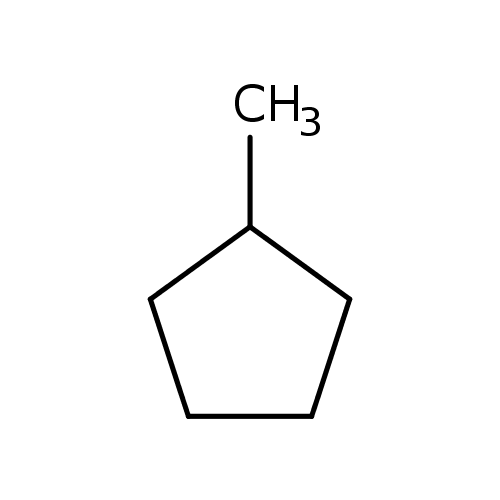
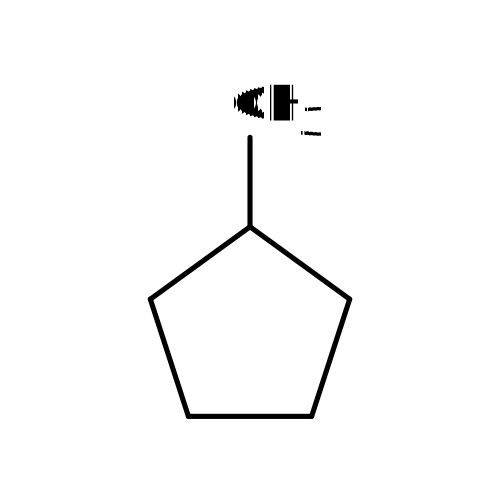
Common NameMethylcyclopentane
ClassSmall Molecule
DescriptionMethylcyclopentane is isolated from Helianthus annuus (sunflower) Methylcyclopentane belongs to the family of Cycloalkanes. These are alkanes containing one or more rings of carbon atoms.
Contaminant Sources
  • FooDB Chemicals
  • HPV EPA Chemicals
  • T3DB toxins
  • ToxCast & Tox21 Chemicals
Contaminant Type
  • Food Toxin
  • Gasoline Additive/Component
  • Household Toxin
  • Industrial/Workplace Toxin
  • Metabolite
  • Natural Compound
  • Organic Compound
Chemical Structure
Thumb
Synonyms
ValueSource
Methyl cyclopentaneChEBI
Methyl-cyclopentaneChEBI
MethylpentamethyleneChEBI
Chemical FormulaC6H12
Average Molecular Mass84.160 g/mol
Monoisotopic Mass84.094 g/mol
CAS Registry Number96-37-7
IUPAC Namemethylcyclopentane
Traditional Namemethylcyclopentane
SMILESCC1CCCC1
InChI IdentifierInChI=1S/C6H12/c1-6-4-2-3-5-6/h6H,2-5H2,1H3
InChI KeyGDOPTJXRTPNYNR-UHFFFAOYSA-N
Chemical Taxonomy
Description belongs to the class of organic compounds known as cycloalkanes. These are saturated monocyclic hydrocarbons (with or without side chains).
KingdomOrganic compounds
Super ClassHydrocarbons
ClassSaturated hydrocarbons
Sub ClassCycloalkanes
Direct ParentCycloalkanes
Alternative ParentsNot Available
Substituents
  • Cycloalkane
  • Aliphatic homomonocyclic compound
Molecular FrameworkAliphatic homomonocyclic compounds
External DescriptorsNot Available
Biological Properties
StatusDetected and Not Quantified
OriginExogenous
Cellular Locations
  • Membrane
Biofluid LocationsNot Available
Tissue LocationsNot Available
PathwaysNot Available
ApplicationsNot Available
Biological RolesNot Available
Chemical RolesNot Available
Physical Properties
StateLiquid
AppearanceNot Available
Experimental Properties
PropertyValue
Melting Point-139.8°C
Boiling PointNot Available
Solubility0.042 mg/mL at 25°C [MCAULIFFE,C (1966)]
Predicted Properties
PropertyValueSource
Water Solubility0.049 g/LALOGPS
logP3.15ALOGPS
logP2.51ChemAxon
logS-3.2ALOGPS
Physiological Charge0ChemAxon
Hydrogen Acceptor Count0ChemAxon
Hydrogen Donor Count0ChemAxon
Polar Surface Area0 ŲChemAxon
Rotatable Bond Count0ChemAxon
Refractivity27.55 m³·mol⁻¹ChemAxon
Polarizability11.15 ųChemAxon
Number of Rings1ChemAxon
Bioavailability1ChemAxon
Rule of FiveYesChemAxon
Ghose FilterNoChemAxon
Veber's RuleYesChemAxon
MDDR-like RuleNoChemAxon
Spectra
Spectra
Spectrum TypeDescriptionSplash KeyView
GC-MSGC-MS Spectrum - EI-B (Non-derivatized)splash10-0a4l-9000000000-f36947d92a09565016adSpectrum
GC-MSGC-MS Spectrum - CI-B (Non-derivatized)splash10-001i-9000000000-89652fbd27509594b619Spectrum
GC-MSGC-MS Spectrum - EI-B (Non-derivatized)splash10-0a4l-9000000000-f36947d92a09565016adSpectrum
GC-MSGC-MS Spectrum - CI-B (Non-derivatized)splash10-001i-9000000000-89652fbd27509594b619Spectrum
Predicted GC-MSPredicted GC-MS Spectrum - GC-MS (Non-derivatized) - 70eV, Positivesplash10-069u-9000000000-f20228dae0dda76bc567Spectrum
Predicted GC-MSPredicted GC-MS Spectrum - GC-MS (Non-derivatized) - 70eV, PositiveNot AvailableSpectrum
Predicted LC-MS/MSPredicted LC-MS/MS Spectrum - 10V, Positivesplash10-000i-9000000000-32d4c2667ea3fb16d0dfSpectrum
Predicted LC-MS/MSPredicted LC-MS/MS Spectrum - 20V, Positivesplash10-000i-9000000000-d818a8aa9bf254dadac5Spectrum
Predicted LC-MS/MSPredicted LC-MS/MS Spectrum - 40V, Positivesplash10-0a4l-9000000000-df6a147e653036178f26Spectrum
Predicted LC-MS/MSPredicted LC-MS/MS Spectrum - 10V, Negativesplash10-001i-9000000000-6d1754df5318b34cabe2Spectrum
Predicted LC-MS/MSPredicted LC-MS/MS Spectrum - 20V, Negativesplash10-001i-9000000000-6d1754df5318b34cabe2Spectrum
Predicted LC-MS/MSPredicted LC-MS/MS Spectrum - 40V, Negativesplash10-00lr-9000000000-f8ed5bb4f934bc89073fSpectrum
Predicted LC-MS/MSPredicted LC-MS/MS Spectrum - 10V, Positivesplash10-0a4r-9000000000-79a23acab097b8c24d75Spectrum
Predicted LC-MS/MSPredicted LC-MS/MS Spectrum - 20V, Positivesplash10-0a4l-9000000000-deb6f40b714e47a3d132Spectrum
Predicted LC-MS/MSPredicted LC-MS/MS Spectrum - 40V, Positivesplash10-0006-9000000000-87fe95b8405e28cf90fcSpectrum
Predicted LC-MS/MSPredicted LC-MS/MS Spectrum - 10V, Negativesplash10-001i-9000000000-1fe2685b7f3004ca04a3Spectrum
Predicted LC-MS/MSPredicted LC-MS/MS Spectrum - 20V, Negativesplash10-001i-9000000000-386a19febdb8857d4e22Spectrum
Predicted LC-MS/MSPredicted LC-MS/MS Spectrum - 40V, Negativesplash10-001i-9000000000-bea98e26b5e568f76238Spectrum
MSMass Spectrum (Electron Ionization)splash10-0a4l-9000000000-e94ad8098b4b70c9d748Spectrum
1D NMR1H NMR SpectrumNot AvailableSpectrum
1D NMR13C NMR SpectrumNot AvailableSpectrum
Toxicity Profile
Route of ExposureOral (21) ; inhalation (21) ; dermal (21)
Mechanism of ToxicityPetroleum distillates are central nervous system depressants and cause pulmonary damage. (2)
MetabolismVolatile hydrocarbons are absorbed mainly through the lungs, and may also enter the body after ingestion via aspiration. (2)
Toxicity ValuesNot Available
Lethal DoseNot Available
Carcinogenicity (IARC Classification)Methylcyclopentane is found in gasoline, which is possibly carcinogenic to humans (Group 2B). (20)
Uses/SourcesMethylcyclopentane is a component of gasoline.
Minimum Risk LevelNot Available
Health EffectsPetroleum distillates are aspiration hazards and may cause pulmonary damage, central nervous system depression, and cardiac effects such as cardiac arrhythmias. They may also affect the blood, immune system, liver, and kidney. (2, 22)
SymptomsPetroleum distillate poisoning may cause nausea, vomiting, cough, pulmonary irritation progressing to pulmonary edema, bloody sputum, and bronchial pneumonia. At high amounts, central nervous system depression may also occur, with symptoms such as weakness, dizziness, slow and shallow respiration, unconsciousness, and convulsions. Petroleum distillates are also irritating to the skin. (1)
TreatmentTreatment is mainly symptomatic and supportive. Gastric lavage, emesis, and the administration of activated charcoal should be avoided, as vomiting increases the risk of aspiration. (2)
Concentrations
Not Available
DrugBank IDNot Available
HMDB IDHMDB0031542
FooDB IDFDB008152
Phenol Explorer IDNot Available
KNApSAcK IDNot Available
BiGG IDNot Available
BioCyc IDNot Available
METLIN IDNot Available
PDB IDNot Available
Wikipedia LinkMethylcyclopentane
Chemspider ID7024
ChEBI ID88429
PubChem Compound ID7296
Kegg Compound IDNot Available
YMDB IDNot Available
ECMDB IDNot Available
References
Synthesis ReferenceNot Available
MSDSNot Available
General References
1. https://www.ncbi.nlm.nih.gov/pubmed/?term=15081979
2. https://www.ncbi.nlm.nih.gov/pubmed/?term=15474966
3. https://www.ncbi.nlm.nih.gov/pubmed/?term=16045361
4. https://www.ncbi.nlm.nih.gov/pubmed/?term=17228898
5. https://www.ncbi.nlm.nih.gov/pubmed/?term=17898511
6. https://www.ncbi.nlm.nih.gov/pubmed/?term=17993253
7. https://www.ncbi.nlm.nih.gov/pubmed/?term=18105955
8. https://www.ncbi.nlm.nih.gov/pubmed/?term=18492346
9. https://www.ncbi.nlm.nih.gov/pubmed/?term=19334733
10. https://www.ncbi.nlm.nih.gov/pubmed/?term=19743389
11. https://www.ncbi.nlm.nih.gov/pubmed/?term=21329330
12. https://www.ncbi.nlm.nih.gov/pubmed/?term=21775152
13. https://www.ncbi.nlm.nih.gov/pubmed/?term=22542255
14. https://www.ncbi.nlm.nih.gov/pubmed/?term=22578783
15. https://www.ncbi.nlm.nih.gov/pubmed/?term=22829453
16. https://www.ncbi.nlm.nih.gov/pubmed/?term=24239891
17. https://www.ncbi.nlm.nih.gov/pubmed/?term=24421258
18. https://www.ncbi.nlm.nih.gov/pubmed/?term=24773533
19. https://www.ncbi.nlm.nih.gov/pubmed/?term=7251182
20. Sprengnether MM, Demerjian KL, Dransfield TJ, Clarke JS, Anderson JG, Donahue NM: Rate constants of nine C6-C9 alkanes with OH from 230 to 379 K: chemical tracers for [OH]. J Phys Chem A. 2009 Apr 30;113(17):5030-8. doi: 10.1021/jp810412m.
21. Anderson RS, Huang L, Iannone R, Rudolph J: Measurements of the 12C/13C kinetic isotope effects in the gas-phase reactions of light alkanes with chlorine atoms. J Phys Chem A. 2007 Jan 25;111(3):495-504.
22. de Blas M, Navazo M, Alonso L, Durana N, Gomez MC, Iza J: Simultaneous indoor and outdoor on-line hourly monitoring of atmospheric volatile organic compounds in an urban building. The role of inside and outside sources. Sci Total Environ. 2012 Jun 1;426:327-35. doi: 10.1016/j.scitotenv.2012.04.003. Epub 2012 Apr 26.
23. Fischader G, Roder-Stolinski C, Wichmann G, Nieber K, Lehmann I: Release of MCP-1 and IL-8 from lung epithelial cells exposed to volatile organic compounds. Toxicol In Vitro. 2008 Mar;22(2):359-66. Epub 2007 Oct 5.
24. Wu Z, Lifka J, Ondruschka B: Aquasonolysis of selected cyclic C(6)H(x) hydrocarbons. Ultrason Sonochem. 2004 May;11(3-4):187-90.
25. Davis AC, Tangprasertchai N, Francisco JS: Hydrogen migrations in alkylcycloalkyl radicals: implications for chain-branching reactions in fuels. Chemistry. 2012 Sep 3;18(36):11296-305. doi: 10.1002/chem.201103517. Epub 2012 Jul 24.
26. Overett MJ, Blann K, Bollmann A, Dixon JT, Haasbroek D, Killian E, Maumela H, McGuinness DS, Morgan DH: Mechanistic investigations of the ethylene tetramerisation reaction. J Am Chem Soc. 2005 Aug 3;127(30):10723-30.
27. Yoshida T: Approach to estimation of absorption of aliphatic hydrocarbons diffusing from interior materials in an automobile cabin by inhalation toxicokinetic analysis in rats. J Appl Toxicol. 2010 Jan;30(1):42-52. doi: 10.1002/jat.1470.
28. Wu Z, Lifka J, Ondruschka B: Benzene formation during aquasonolysis of selected cyclic C6Hx hydrocarbons. Ultrason Sonochem. 2005 Jan;12(1-2):133-6.
29. Zhang L, Feng L, Jia Q, Xu J, Wang R, Wang Z, Wu Y, Li Y: Effects of beta-glucosidase hydrolyzed products of harpagide and harpagoside on cyclooxygenase-2 (COX-2) in vitro. Bioorg Med Chem. 2011 Aug 15;19(16):4882-6. doi: 10.1016/j.bmc.2011.06.069. Epub 2011 Jun 29.
30. Zimniak A: Electron ionization-induced fragmentation of R2N2Fe2(CO)6 complexes with distinct geometries of the tetrahedral core: investigation of mu-1,2-(1,2-diaza-3-methylcyclopentane)diylbis(tricarbonyliron) and bis(mu2-acetophenoniminato)bis(tricarbonyliron). J Mass Spectrom. 2002 Nov;37(11):1145-51.
31. Lee JW, Lu H, Moudrakovski IL, Ratcliffe CI, Ohmura R, Alavi S, Ripmeester JA: 13C NMR studies of hydrocarbon guests in synthetic structure H gas hydrates: experiment and computation. J Phys Chem A. 2011 Mar 10;115(9):1650-7. doi: 10.1021/jp1118184. Epub 2011 Feb 17.
32. Sari O, Roy V, Balzarini J, Snoeck R, Andrei G, Agrofoglio LA: Synthesis and antiviral evaluation of C5-substituted-(1,3-diyne)-2'-deoxyuridines. Eur J Med Chem. 2012 Jul;53:220-8. doi: 10.1016/j.ejmech.2012.04.001. Epub 2012 Apr 21.
33. Moustafa NE: Gas chromatographic analysis of petroleum associated condensate oil with simultaneous determination of some characteristic physical parameters. J Chromatogr Sci. 2008 May-Jun;46(5):388-91.
34. Iwahashi M, Kasahara Y: Effects of molecular size and structure on self-diffusion coefficient and viscosity for saturated hydrocarbons having six carbon atoms. J Oleo Sci. 2007;56(8):443-8.
35. Tripp JC, Schiesser CH, Curran DP: Stereochemistry of hexenyl radical cyclizations with tert-butyl and related large groups: substituent and temperature effects. J Am Chem Soc. 2005 Apr 20;127(15):5518-27.
36. Chakrapani H, Liu C, Widenhoefer RA: Enantioselective cyclization/hydrosilylation of 1,6-enynes catalyzed by a cationic rhodium bis(phosphine) complex. Org Lett. 2003 Jan 23;5(2):157-9.
37. Yannai, Shmuel. (2004) Dictionary of food compounds with CD-ROM: Additives, flavors, and ingredients. Boca Raton: Chapman & Hall/CRC.