Record Information
Version1.0
Creation Date2009-07-30 17:58:25 UTC
Update Date2026-03-26 19:37:27 UTC
Accession NumberCHEM002483
Identification
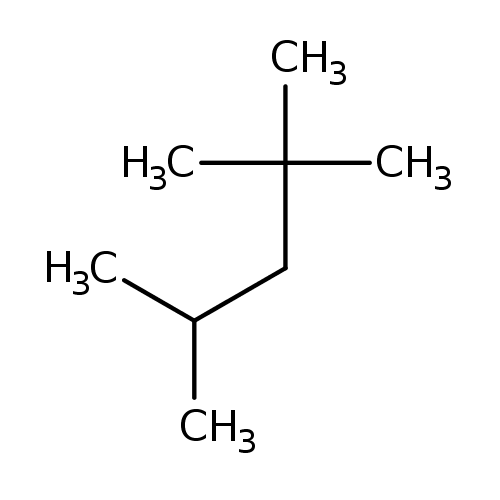
Common Name2,2,4-Trimethylpentane
ClassSmall Molecule
Description2,2,4-Trimethylpentane is a hydrocarbon and one of the isomers of octane. Octanes may be found in gasoline. (5)
Contaminant Sources
  • Clean Air Act Chemicals
  • HPV EPA Chemicals
  • OECD HPV Chemicals
  • STOFF IDENT Compounds
  • T3DB toxins
  • ToxCast & Tox21 Chemicals
Contaminant Type
  • Gasoline Additive/Component
  • Industrial/Workplace Toxin
  • Organic Compound
  • Pollutant
  • Synthetic Compound
Chemical Structure
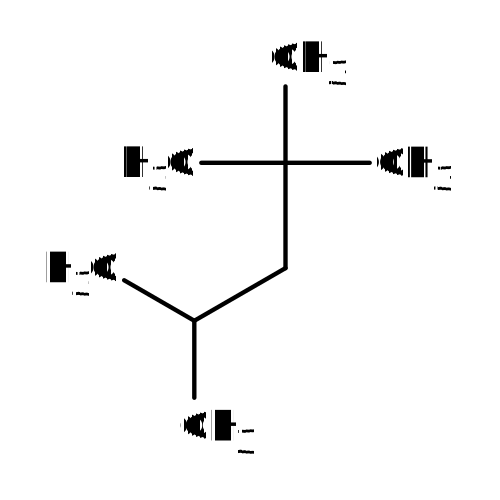
Thumb
Synonyms
ValueSource
(CH3)2chch2c(CH3)3ChEBI
Iso-octaneChEBI
IsobutyltrimethylmethaneChEBI
IsooctaneMeSH
Chemical FormulaC8H18
Average Molecular Mass114.229 g/mol
Monoisotopic Mass114.141 g/mol
CAS Registry Number540-84-1
IUPAC Name2,2,4-trimethylpentane
Traditional Nameisooctane
SMILESCC(C)CC(C)(C)C
InChI IdentifierInChI=1S/C8H18/c1-7(2)6-8(3,4)5/h7H,6H2,1-5H3
InChI KeyNHTMVDHEPJAVLT-UHFFFAOYSA-N
Chemical Taxonomy
Description belongs to the class of organic compounds known as branched alkanes. These are acyclic branched hydrocarbons having the general formula CnH2n+2.
KingdomOrganic compounds
Super ClassHydrocarbons
ClassSaturated hydrocarbons
Sub ClassAlkanes
Direct ParentBranched alkanes
Alternative ParentsNot Available
Substituents
  • Branched alkane
  • Aliphatic acyclic compound
Molecular FrameworkAliphatic acyclic compounds
External Descriptors
Biological Properties
StatusDetected and Not Quantified
OriginExogenous
Cellular Locations
  • Membrane
Biofluid LocationsNot Available
Tissue LocationsNot Available
PathwaysNot Available
Applications
Biological Roles
Chemical Roles
Physical Properties
StateLiquid
AppearanceColorless liquid.
Experimental Properties
PropertyValue
Melting Point-107.3°C
Boiling PointNot Available
Solubility0.00244 mg/mL at 25°C [YALKOWSKY,SH & DANNENFELSER,RM (1992)]
Predicted Properties
PropertyValueSource
Water Solubility0.0083 g/LALOGPS
logP4.49ALOGPS
logP3.56ChemAxon
logS-4.1ALOGPS
Physiological Charge0ChemAxon
Hydrogen Acceptor Count0ChemAxon
Hydrogen Donor Count0ChemAxon
Polar Surface Area0 ŲChemAxon
Rotatable Bond Count2ChemAxon
Refractivity38.38 m³·mol⁻¹ChemAxon
Polarizability15.66 ųChemAxon
Number of Rings0ChemAxon
Bioavailability1ChemAxon
Rule of FiveYesChemAxon
Ghose FilterNoChemAxon
Veber's RuleYesChemAxon
MDDR-like RuleNoChemAxon
Spectra
Spectra
Spectrum TypeDescriptionSplash KeyView
Predicted GC-MSPredicted GC-MS Spectrum - GC-MS (Non-derivatized) - 70eV, Positivesplash10-052f-9000000000-65e84c840b2a17a18d99Spectrum
Predicted GC-MSPredicted GC-MS Spectrum - GC-MS (Non-derivatized) - 70eV, PositiveNot AvailableSpectrum
Predicted LC-MS/MSPredicted LC-MS/MS Spectrum - 10V, Positivesplash10-014i-1900000000-df9c4228348c0e60b3f7Spectrum
Predicted LC-MS/MSPredicted LC-MS/MS Spectrum - 20V, Positivesplash10-014i-3900000000-5ed02e962691f66db928Spectrum
Predicted LC-MS/MSPredicted LC-MS/MS Spectrum - 40V, Positivesplash10-0535-9100000000-af8307b1fd7610d90d06Spectrum
Predicted LC-MS/MSPredicted LC-MS/MS Spectrum - 10V, Negativesplash10-03di-0900000000-6c2521ef3e59b3971ff7Spectrum
Predicted LC-MS/MSPredicted LC-MS/MS Spectrum - 20V, Negativesplash10-03di-0900000000-13e99ac19c0edb2650bbSpectrum
Predicted LC-MS/MSPredicted LC-MS/MS Spectrum - 40V, Negativesplash10-01ot-9400000000-ba54ddd5172bbd0c6b0cSpectrum
Predicted LC-MS/MSPredicted LC-MS/MS Spectrum - 10V, Positivesplash10-0a4i-9100000000-a44cda83dadb2ef5e219Spectrum
Predicted LC-MS/MSPredicted LC-MS/MS Spectrum - 20V, Positivesplash10-0a4i-9000000000-676359e5663d0f064512Spectrum
Predicted LC-MS/MSPredicted LC-MS/MS Spectrum - 40V, Positivesplash10-052f-9000000000-a1867ea2ac238d797eafSpectrum
Predicted LC-MS/MSPredicted LC-MS/MS Spectrum - 10V, Negativesplash10-03di-0900000000-e85376f8875d5d8518a4Spectrum
Predicted LC-MS/MSPredicted LC-MS/MS Spectrum - 20V, Negativesplash10-03di-0900000000-5ce0855e0a2d6a0dca8fSpectrum
Predicted LC-MS/MSPredicted LC-MS/MS Spectrum - 40V, Negativesplash10-03di-4900000000-efd4594924a365acbe63Spectrum
MSMass Spectrum (Electron Ionization)splash10-0a4i-9000000000-f08ccc9324e967cfe09dSpectrum
1D NMR1H NMR SpectrumNot AvailableSpectrum
1D NMR13C NMR SpectrumNot AvailableSpectrum
Toxicity Profile
Route of ExposureOral (4) ; inhalation (4) ; dermal (4)
Mechanism of ToxicityPetroleum distillates are central nervous system depressants and cause pulmonary damage. (2)
MetabolismVolatile hydrocarbons are absorbed mainly through the lungs, and may also enter the body after ingestion via aspiration. (2)
Toxicity ValuesNot Available
Lethal DoseNot Available
Carcinogenicity (IARC Classification)2,2,4-Trimethylpentane is found in gasoline, which is possibly carcinogenic to humans (Group 2B). (3)
Uses/SourcesOctanes may be found in gasoline. (5)
Minimum Risk LevelNot Available
Health EffectsPetroleum distillates are aspiration hazards and may cause pulmonary damage, central nervous system depression, and cardiac effects such as cardiac arrhythmias. They may also affect the blood, immune system, liver, and kidney. (2, 6)
SymptomsPetroleum distillate poisoning may cause nausea, vomiting, cough, pulmonary irritation progressing to pulmonary edema, bloody sputum, and bronchial pneumonia. At high amounts, central nervous system depression may also occur, with symptoms such as weakness, dizziness, slow and shallow respiration, unconsciousness, and convulsions. Petroleum distillates are also irritating to the skin. (1)
TreatmentTreatment is mainly symptomatic and supportive. Gastric lavage, emesis, and the administration of activated charcoal should be avoided, as vomiting increases the risk of aspiration. (2)
Concentrations
Not Available
DrugBank IDNot Available
HMDB IDHMDB0245342
FooDB IDNot Available
Phenol Explorer IDNot Available
KNApSAcK IDNot Available
BiGG IDNot Available
BioCyc IDNot Available
METLIN IDNot Available
PDB IDNot Available
Wikipedia LinkIsooctane
Chemspider ID10445
ChEBI ID62805
PubChem Compound IDNot Available
Kegg Compound IDNot Available
YMDB IDNot Available
ECMDB IDNot Available
References
Synthesis ReferenceNot Available
MSDSNot Available
General References
1. https://www.ncbi.nlm.nih.gov/pubmed/?term=23234386