Record Information
Version1.0
Creation Date2009-07-30 17:58:19 UTC
Update Date2026-04-04 19:09:43 UTC
Accession NumberCHEM002471
Identification
Common Name3-Methylheptane
ClassSmall Molecule
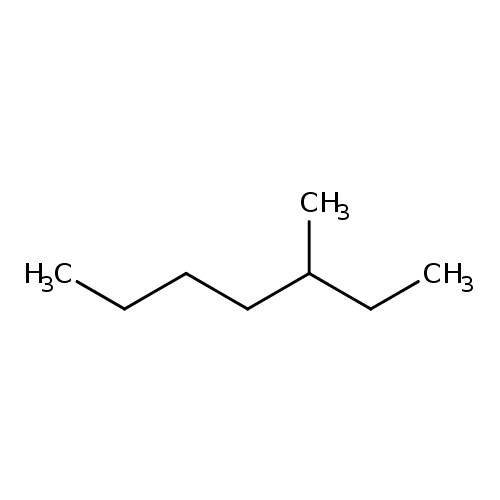
Description3-Methylheptane is found in herbs and spices. 3-Methylheptane is a constituent of Cicer arietinum (chickpea), Jasminum sambac (Arabian jasmine) and other plant species 3-Methylheptane is a branched alkane isomeric to octane. Its structural formula is CH3CH2CH(CH3)CH2CH2CH2CH3. It has one stereocenter. 3-Methylheptane belongs to the family of Acyclic Alkanes. These are acyclic hydrocarbons consisting only of n carbon atoms and m hydrogen atoms where m=2*n + 2.
Contaminant Sources
  • FooDB Chemicals
  • HMDB Contaminants - Feces
  • T3DB toxins
Contaminant Type
  • Food Toxin
  • Gasoline Additive/Component
  • Industrial/Workplace Toxin
  • Metabolite
  • Natural Compound
  • Organic Compound
  • Plant Toxin
Chemical Structure
Thumb
Synonyms
ValueSource
2-EthylhexaneHMDB
3-Methyl-(S)-heptaneHMDB
3-Methyl-heptaneHMDB
Chemical FormulaC8H18
Average Molecular Mass114.229 g/mol
Monoisotopic Mass114.141 g/mol
CAS Registry Number589-81-1
IUPAC Name3-methylheptane
Traditional Name3-methylheptane
SMILESCCCCC(C)CC
InChI IdentifierInChI=1S/C8H18/c1-4-6-7-8(3)5-2/h8H,4-7H2,1-3H3
InChI KeyLAIUFBWHERIJIH-UHFFFAOYSA-N
Chemical Taxonomy
Description belongs to the class of organic compounds known as branched alkanes. These are acyclic branched hydrocarbons having the general formula CnH2n+2.
KingdomOrganic compounds
Super ClassHydrocarbons
ClassSaturated hydrocarbons
Sub ClassAlkanes
Direct ParentBranched alkanes
Alternative ParentsNot Available
Substituents
  • Branched alkane
  • Aliphatic acyclic compound
Molecular FrameworkAliphatic acyclic compounds
External Descriptors
Biological Properties
StatusDetected and Not Quantified
OriginExogenous
Cellular Locations
  • Membrane
Biofluid LocationsNot Available
Tissue LocationsNot Available
PathwaysNot Available
ApplicationsNot Available
Biological RolesNot Available
Chemical RolesNot Available
Physical Properties
StateLiquid
AppearanceColorless liquid.
Experimental Properties
PropertyValue
Melting Point-100°C
Boiling PointNot Available
Solubility0.000792 mg/mL at 25°C
Predicted Properties
PropertyValueSource
Water Solubility0.0047 g/LALOGPS
logP4.82ALOGPS
logP3.86ChemAxon
logS-4.4ALOGPS
Physiological Charge0ChemAxon
Hydrogen Acceptor Count0ChemAxon
Hydrogen Donor Count0ChemAxon
Polar Surface Area0 ŲChemAxon
Rotatable Bond Count4ChemAxon
Refractivity38.56 m³·mol⁻¹ChemAxon
Polarizability16.07 ųChemAxon
Number of Rings0ChemAxon
Bioavailability1ChemAxon
Rule of FiveYesChemAxon
Ghose FilterNoChemAxon
Veber's RuleYesChemAxon
MDDR-like RuleNoChemAxon
Spectra
Spectra
Spectrum TypeDescriptionSplash KeyView
GC-MSGC-MS Spectrum - CI-B (Non-derivatized)splash10-08fr-9600000000-b6f5cb1d2e616b01ee93Spectrum
Predicted GC-MSPredicted GC-MS Spectrum - GC-MS (Non-derivatized) - 70eV, Positivesplash10-0a4v-9000000000-315960b02095f85df58dSpectrum
Predicted GC-MSPredicted GC-MS Spectrum - GC-MS (Non-derivatized) - 70eV, PositiveNot AvailableSpectrum
Predicted LC-MS/MSPredicted LC-MS/MS Spectrum - 10V, Positivesplash10-014i-1900000000-aad653cdbaacc5cc80feSpectrum
Predicted LC-MS/MSPredicted LC-MS/MS Spectrum - 20V, Positivesplash10-014i-8900000000-65e884dd87ae895787d8Spectrum
Predicted LC-MS/MSPredicted LC-MS/MS Spectrum - 40V, Positivesplash10-052f-9000000000-afc71085d822759a47e3Spectrum
Predicted LC-MS/MSPredicted LC-MS/MS Spectrum - 10V, Negativesplash10-03di-0900000000-de4ccc0beb543af81ccaSpectrum
Predicted LC-MS/MSPredicted LC-MS/MS Spectrum - 20V, Negativesplash10-03di-0900000000-e120b0e33aff30653b86Spectrum
Predicted LC-MS/MSPredicted LC-MS/MS Spectrum - 40V, Negativesplash10-06r5-9200000000-ae2442b8e5fbc60ebd14Spectrum
Predicted LC-MS/MSPredicted LC-MS/MS Spectrum - 10V, Positivesplash10-0a4l-9000000000-0c5c5b0123b201a01ecfSpectrum
Predicted LC-MS/MSPredicted LC-MS/MS Spectrum - 20V, Positivesplash10-0a4i-9000000000-81d877324c583035662aSpectrum
Predicted LC-MS/MSPredicted LC-MS/MS Spectrum - 40V, Positivesplash10-0006-9000000000-0c5a8e790f719bdc4d6fSpectrum
Predicted LC-MS/MSPredicted LC-MS/MS Spectrum - 10V, Negativesplash10-03di-0900000000-e85376f8875d5d8518a4Spectrum
Predicted LC-MS/MSPredicted LC-MS/MS Spectrum - 20V, Negativesplash10-03di-0900000000-7f4fa004fea60c3d18b7Spectrum
Predicted LC-MS/MSPredicted LC-MS/MS Spectrum - 40V, Negativesplash10-08fs-9400000000-eccdf5aa63e74c4c86a2Spectrum
MSMass Spectrum (Electron Ionization)splash10-052f-9000000000-822b8f417f18da81f07fSpectrum
1D NMR1H NMR SpectrumNot AvailableSpectrum
1D NMR13C NMR SpectrumNot AvailableSpectrum
Toxicity Profile
Route of ExposureOral (3) ; inhalation (3) ; dermal (3)
Mechanism of ToxicityPetroleum distillates are central nervous system depressants and cause pulmonary damage. (2)
MetabolismVolatile hydrocarbons are absorbed mainly through the lungs, and may also enter the body after ingestion via aspiration. (2)
Toxicity ValuesNot Available
Lethal DoseNot Available
Carcinogenicity (IARC Classification)No indication of carcinogenicity to humans (not listed by IARC).
Uses/SourcesOctanes may be found in gasoline. (4)
Minimum Risk LevelNot Available
Health EffectsPetroleum distillates are aspiration hazards and may cause pulmonary damage, central nervous system depression, and cardiac effects such as cardiac arrhythmias. They may also affect the blood, immune system, liver, and kidney. (2, 5)
SymptomsPetroleum distillate poisoning may cause nausea, vomiting, cough, pulmonary irritation progressing to pulmonary edema, bloody sputum, and bronchial pneumonia. At high amounts, central nervous system depression may also occur, with symptoms such as weakness, dizziness, slow and shallow respiration, unconsciousness, and convulsions. Petroleum distillates are also irritating to the skin. (1)
TreatmentTreatment is mainly symptomatic and supportive. Gastric lavage, emesis, and the administration of activated charcoal should be avoided, as vomiting increases the risk of aspiration. (2)
Concentrations
Not Available
DrugBank IDNot Available
HMDB IDHMDB0031583
FooDB IDFDB008209
Phenol Explorer IDNot Available
KNApSAcK IDNot Available
BiGG IDNot Available
BioCyc IDNot Available
METLIN IDNot Available
PDB IDNot Available
Wikipedia Link3-Methylheptane
Chemspider ID11035
ChEBI ID35547
PubChem Compound ID11519
Kegg Compound IDNot Available
YMDB IDNot Available
ECMDB IDNot Available
References
Synthesis ReferenceNot Available
MSDSNot Available
General References
1. Yannai, Shmuel. (2004) Dictionary of food compounds with CD-ROM: Additives, flavors, and ingredients. Boca Raton: Chapman & Hall/CRC.