Record Information
Version1.0
Creation Date2009-07-30 17:58:15 UTC
Update Date2026-04-03 07:41:19 UTC
Accession NumberCHEM002462
Identification
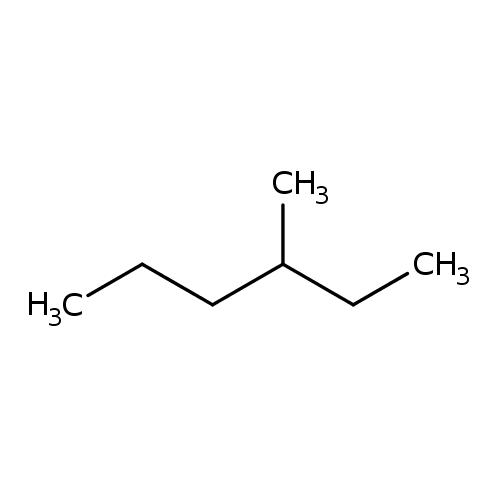
Common Name3-Methylhexane
ClassSmall Molecule
Description3-Methylhexane is a hydrocarbon and one of the isomers of heptane. Heptanes may be found in gasoline and are widely used as solvents. They are also sold as fuel for outdoor stoves. (3)
Contaminant Sources
  • T3DB toxins
  • ToxCast & Tox21 Chemicals
Contaminant Type
  • Gasoline Additive/Component
  • Household Toxin
  • Industrial/Workplace Toxin
  • Organic Compound
  • Solvent
  • Synthetic Compound
Chemical Structure
Thumb
Synonyms
ValueSource
2-EthylpentaneChEBI
3-Methyl-hexaneHMDB
Chemical FormulaC7H16
Average Molecular Mass100.202 g/mol
Monoisotopic Mass100.125 g/mol
CAS Registry Number589-34-4
IUPAC Name3-methylhexane
Traditional Name3-methylhexane
SMILESCCCC(C)CC
InChI IdentifierInChI=1S/C7H16/c1-4-6-7(3)5-2/h7H,4-6H2,1-3H3
InChI KeyVLJXXKKOSFGPHI-UHFFFAOYSA-N
Chemical Taxonomy
Description belongs to the class of organic compounds known as branched alkanes. These are acyclic branched hydrocarbons having the general formula CnH2n+2.
KingdomOrganic compounds
Super ClassHydrocarbons
ClassSaturated hydrocarbons
Sub ClassAlkanes
Direct ParentBranched alkanes
Alternative ParentsNot Available
Substituents
  • Branched alkane
  • Aliphatic acyclic compound
Molecular FrameworkAliphatic acyclic compounds
External DescriptorsNot Available
Biological Properties
StatusDetected and Not Quantified
OriginExogenous
Cellular Locations
  • Membrane
Biofluid LocationsNot Available
Tissue LocationsNot Available
PathwaysNot Available
ApplicationsNot Available
Biological RolesNot Available
Chemical RolesNot Available
Physical Properties
StateLiquid
AppearanceColorless liquid.
Experimental Properties
PropertyValue
Melting Point-119°C
Boiling PointNot Available
Solubility0.00495 mg/mL at 25°C [YALKOWSKY,SH & DANNENFELSER,RM (1992)]
Predicted Properties
PropertyValueSource
Water Solubility0.012 g/LALOGPS
logP4.18ALOGPS
logP3.42ChemAxon
logS-3.9ALOGPS
Physiological Charge0ChemAxon
Hydrogen Acceptor Count0ChemAxon
Hydrogen Donor Count0ChemAxon
Polar Surface Area0 ŲChemAxon
Rotatable Bond Count3ChemAxon
Refractivity33.96 m³·mol⁻¹ChemAxon
Polarizability14.02 ųChemAxon
Number of Rings0ChemAxon
Bioavailability1ChemAxon
Rule of FiveYesChemAxon
Ghose FilterNoChemAxon
Veber's RuleYesChemAxon
MDDR-like RuleNoChemAxon
Spectra
Spectra
Spectrum TypeDescriptionSplash KeyView
Predicted GC-MSPredicted GC-MS Spectrum - GC-MS (Non-derivatized) - 70eV, Positivesplash10-05i3-9000000000-bd615d457aad2fd46be6Spectrum
Predicted GC-MSPredicted GC-MS Spectrum - GC-MS (Non-derivatized) - 70eV, PositiveNot AvailableSpectrum
Predicted LC-MS/MSPredicted LC-MS/MS Spectrum - 10V, Positivesplash10-0udi-1900000000-5255fb2293b2a2e1882cSpectrum
Predicted LC-MS/MSPredicted LC-MS/MS Spectrum - 20V, Positivesplash10-0udi-4900000000-70af065b799973002936Spectrum
Predicted LC-MS/MSPredicted LC-MS/MS Spectrum - 40V, Positivesplash10-0a4l-9000000000-b5bbadab7e003812209dSpectrum
Predicted LC-MS/MSPredicted LC-MS/MS Spectrum - 10V, Negativesplash10-0002-9000000000-26a47f728c33c4333d1aSpectrum
Predicted LC-MS/MSPredicted LC-MS/MS Spectrum - 20V, Negativesplash10-0002-9000000000-a6fbaa7215b46cb60a20Spectrum
Predicted LC-MS/MSPredicted LC-MS/MS Spectrum - 40V, Negativesplash10-05o1-9000000000-bae34641107f0b34ff40Spectrum
Predicted LC-MS/MSPredicted LC-MS/MS Spectrum - 10V, Positivesplash10-0zml-9400000000-1a78e73279256f209ee0Spectrum
Predicted LC-MS/MSPredicted LC-MS/MS Spectrum - 20V, Positivesplash10-052f-9000000000-6e40c6ebdde64d3f97d0Spectrum
Predicted LC-MS/MSPredicted LC-MS/MS Spectrum - 40V, Positivesplash10-052f-9000000000-c986c70f56c2648739d3Spectrum
Predicted LC-MS/MSPredicted LC-MS/MS Spectrum - 10V, Negativesplash10-0002-9000000000-80e849e93a9e1a130719Spectrum
Predicted LC-MS/MSPredicted LC-MS/MS Spectrum - 20V, Negativesplash10-0002-9000000000-07296f7689475b23e23bSpectrum
Predicted LC-MS/MSPredicted LC-MS/MS Spectrum - 40V, Negativesplash10-0002-9000000000-0d6ad2d36e899c598887Spectrum
MSMass Spectrum (Electron Ionization)splash10-0596-9000000000-0c8619dc5bd110eb5561Spectrum
1D NMR1H NMR SpectrumNot AvailableSpectrum
1D NMR13C NMR SpectrumNot AvailableSpectrum
Toxicity Profile
Route of ExposureOral (2) ; inhalation (2) ; dermal (2)
Mechanism of ToxicityPetroleum distillates are central nervous system depressants and cause pulmonary damage. (1)
MetabolismVolatile hydrocarbons are absorbed mainly through the lungs, and may also enter the body after ingestion via aspiration. (1)
Toxicity ValuesNot Available
Lethal DoseNot Available
Carcinogenicity (IARC Classification)No indication of carcinogenicity to humans (not listed by IARC).
Uses/SourcesHeptanes may be found in gasoline and are widely used as solvents. They are also sold as fuel for outdoor stoves. (3)
Minimum Risk LevelNot Available
Health EffectsPetroleum distillates are aspiration hazards and may cause pulmonary damage, central nervous system depression, and cardiac effects such as cardiac arrhythmias. They may also affect the blood, immune system, liver, and kidney. (1, 4)
SymptomsHeptane affects the central nervous system and may cause lightheadedness, giddiness, stupor, vertigo, incoordination, loss of appetite, nausea, and unconsciousness. Direct skin contact with heptane may cause pain, burning, and itching. (5)
TreatmentTreatment is mainly symptomatic and supportive. Gastric lavage, emesis, and the administration of activated charcoal should be avoided, as vomiting increases the risk of aspiration. (1)
Concentrations
Not Available
DrugBank IDNot Available
HMDB IDHMDB0245932
FooDB IDNot Available
Phenol Explorer IDNot Available
KNApSAcK IDC00050708
BiGG IDNot Available
BioCyc IDNot Available
METLIN IDNot Available
PDB IDNot Available
Wikipedia Link3-Methylhexane
Chemspider ID11023
ChEBI ID143848
PubChem Compound ID11507
Kegg Compound IDNot Available
YMDB IDNot Available
ECMDB IDNot Available
References
Synthesis ReferenceNot Available
MSDSNot Available
General References
1. https://www.ncbi.nlm.nih.gov/pubmed/?term=25500329
2. https://www.ncbi.nlm.nih.gov/pubmed/?term=25523187
3. https://www.ncbi.nlm.nih.gov/pubmed/?term=26646671
4. https://www.ncbi.nlm.nih.gov/pubmed/?term=30912423
5.
6. Barupal DK, Fiehn O: Generating the Blood Exposome Database Using a Comprehensive Text Mining and Database Fusion Approach. Environ Health Perspect. 2019 Sep;127(9):97008. doi: 10.1289/EHP4713. Epub 2019 Sep 26.