Record Information
Version1.0
Creation Date2009-07-30 17:56:36 UTC
Update Date2026-03-31 21:46:37 UTC
Accession NumberCHEM002450
Identification
Common Name2-Methoxy-4-propylphenol
ClassSmall Molecule
Description2-Methoxy-4-propylphenol is a flavouring ingredient 2-Methoxy-4-propylphenol belongs to the family of Methoxyphenols and Derivatives. These are compounds containing a methoxy group attached to the benzene ring of a phenol moiety.
Contaminant Sources
  • EAFUS Chemicals
  • FooDB Chemicals
  • T3DB toxins
  • ToxCast & Tox21 Chemicals
Contaminant Type
  • Ether
  • Food Toxin
  • Fragrance Toxin
  • Household Toxin
  • Lachrymator
  • Metabolite
  • Organic Compound
  • Synthetic Compound
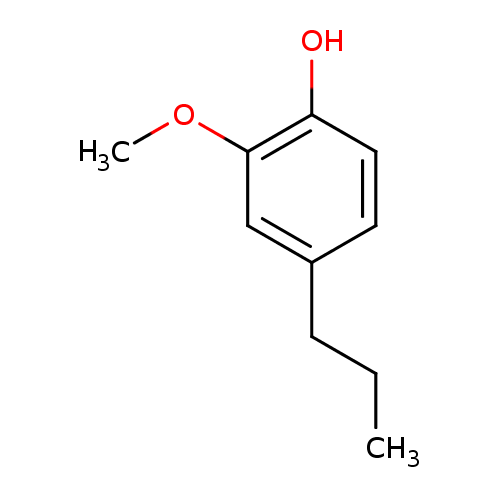
Chemical Structure
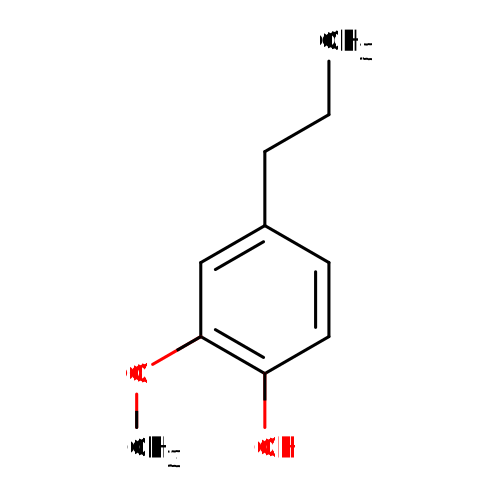
Thumb
Synonyms
ValueSource
(4-Hydroxy-3-methoxyphenyl)propaneHMDB
1-(4-Hydroxy-3-methoxyphenyl)propaneHMDB
1-Propyl-3-methoxy-4-hydroxybenzeneHMDB
2-Methoxy-4-(1-propyl)phenolHMDB
2-Methoxy-4-N-propylphenolHMDB
2-Methoxy-4-propyl-phenolHMDB
2-Methoxy-4-propylphenol (P-propylguaiacol)HMDB
2-Methoxy-4-propylphenol, 9ciHMDB
4-Hydroxy-3-methoxypropylbenzeneHMDB
4-Propyl-2-methoxyphenolHMDB
4-Propyl-2-methoxyphenol (4-propylguaiacol)HMDB
4-Propyl-guaiacolHMDB
4-Propyl-O-methoxyphenolHMDB
4-PropylguaiacolHMDB
5-Propyl-O-hydroxyanisoleHMDB
CerulignolHMDB
CoerulignolHMDB
DihydroeugenolHMDB
Eugenol dihydroHMDB
GuaiacylpropaneHMDB
P-N-PropylguaiacolHMDB
P-PropylguaiacolHMDB
Phenol, 4-propyl, 2-methoxyHMDB
PropylguaiacolHMDB
Chemical FormulaC10H14O2
Average Molecular Mass166.217 g/mol
Monoisotopic Mass166.099 g/mol
CAS Registry Number2785-87-7
IUPAC Name2-methoxy-4-propylphenol
Traditional Namephenol, 2-methoxy-4-propyl-
SMILESCCCC1=CC(OC)=C(O)C=C1
InChI IdentifierInChI=1S/C10H14O2/c1-3-4-8-5-6-9(11)10(7-8)12-2/h5-7,11H,3-4H2,1-2H3
InChI KeyPXIKRTCSSLJURC-UHFFFAOYSA-N
Chemical Taxonomy
Description belongs to the class of organic compounds known as methoxyphenols. Methoxyphenols are compounds containing a methoxy group attached to the benzene ring of a phenol moiety.
KingdomOrganic compounds
Super ClassBenzenoids
ClassPhenols
Sub ClassMethoxyphenols
Direct ParentMethoxyphenols
Alternative Parents
Substituents
  • Methoxyphenol
  • Phenylpropane
  • Phenoxy compound
  • Methoxybenzene
  • Phenol ether
  • Anisole
  • 1-hydroxy-2-unsubstituted benzenoid
  • Alkyl aryl ether
  • Monocyclic benzene moiety
  • Ether
  • Organic oxygen compound
  • Hydrocarbon derivative
  • Organooxygen compound
  • Aromatic homomonocyclic compound
Molecular FrameworkAromatic homomonocyclic compounds
External DescriptorsNot Available
Biological Properties
StatusDetected and Not Quantified
OriginExogenous
Cellular Locations
  • Membrane
Biofluid LocationsNot Available
Tissue LocationsNot Available
PathwaysNot Available
ApplicationsNot Available
Biological RolesNot Available
Chemical RolesNot Available
Physical Properties
StateLiquid
AppearanceColorless clear liquid (3).
Experimental Properties
PropertyValue
Melting PointNot Available
Boiling PointNot Available
SolubilityNot Available
Predicted Properties
PropertyValueSource
Water Solubility0.89 g/LALOGPS
logP2.87ALOGPS
logP2.91ChemAxon
logS-2.3ALOGPS
pKa (Strongest Acidic)10.29ChemAxon
pKa (Strongest Basic)-4.9ChemAxon
Physiological Charge0ChemAxon
Hydrogen Acceptor Count2ChemAxon
Hydrogen Donor Count1ChemAxon
Polar Surface Area29.46 ŲChemAxon
Rotatable Bond Count3ChemAxon
Refractivity48.75 m³·mol⁻¹ChemAxon
Polarizability18.78 ųChemAxon
Number of Rings1ChemAxon
Bioavailability1ChemAxon
Rule of FiveYesChemAxon
Ghose FilterYesChemAxon
Veber's RuleYesChemAxon
MDDR-like RuleNoChemAxon
Spectra
Spectra
Spectrum TypeDescriptionSplash KeyView
Predicted GC-MSPredicted GC-MS Spectrum - GC-MS (Non-derivatized) - 70eV, Positivesplash10-0f9i-2900000000-51ab1f04188439c1f663Spectrum
Predicted GC-MSPredicted GC-MS Spectrum - GC-MS (1 TMS) - 70eV, Positivesplash10-00di-8690000000-12ed44035d829a9f7ff4Spectrum
Predicted GC-MSPredicted GC-MS Spectrum - GC-MS (Non-derivatized) - 70eV, PositiveNot AvailableSpectrum
Predicted LC-MS/MSPredicted LC-MS/MS Spectrum - 10V, Positivesplash10-014i-0900000000-646bc22bdc72fdc8df59Spectrum
Predicted LC-MS/MSPredicted LC-MS/MS Spectrum - 20V, Positivesplash10-014i-2900000000-60aaf34920a151b1ce53Spectrum
Predicted LC-MS/MSPredicted LC-MS/MS Spectrum - 40V, Positivesplash10-0f6x-9200000000-bb7502bb9a8701783095Spectrum
Predicted LC-MS/MSPredicted LC-MS/MS Spectrum - 10V, Negativesplash10-014i-0900000000-397c386607b8c61e83b4Spectrum
Predicted LC-MS/MSPredicted LC-MS/MS Spectrum - 20V, Negativesplash10-014i-0900000000-a72a438f24be53c7f640Spectrum
Predicted LC-MS/MSPredicted LC-MS/MS Spectrum - 40V, Negativesplash10-05mn-4900000000-c92b92d205fe2182af19Spectrum
Predicted LC-MS/MSPredicted LC-MS/MS Spectrum - 10V, Negativesplash10-014i-0900000000-349584a3f625d5b5807fSpectrum
Predicted LC-MS/MSPredicted LC-MS/MS Spectrum - 20V, Negativesplash10-014i-0900000000-93843d8e2b9d8bf8ec66Spectrum
Predicted LC-MS/MSPredicted LC-MS/MS Spectrum - 40V, Negativesplash10-06dl-9600000000-470288177a1f018791d9Spectrum
Predicted LC-MS/MSPredicted LC-MS/MS Spectrum - 10V, Positivesplash10-014i-0900000000-516a0ffed3b219171b90Spectrum
Predicted LC-MS/MSPredicted LC-MS/MS Spectrum - 20V, Positivesplash10-016v-5900000000-b4131d503f35ea146386Spectrum
Predicted LC-MS/MSPredicted LC-MS/MS Spectrum - 40V, Positivesplash10-005c-9100000000-0fc7a6cb0cf0bac4a906Spectrum
MSMass Spectrum (Electron Ionization)splash10-000i-7900000000-972dcdcdab5502fe481aSpectrum
Toxicity Profile
Route of ExposureDermal (3, 1) ; eye contact (3, 1) ; inhalation (3, 1) ; oral (3, 1)
Mechanism of ToxicityDihydroeugenol may cause allergic contact dermatitis via two different mechanisms: The poison ivy and the phenolic radical mechanisms (1).
MetabolismNot Available
Toxicity ValuesLD50: 2000.00 mg/kg (Oral, Mouse) (3) LD50: 2600.00 mg/kg (Oral, Rat) (3) LD50: 310.00 mg/kg (Dermal, Rabbit) (3)
Lethal DoseNot Available
Carcinogenicity (IARC Classification)No indication of carcinogenicity (not listed by IARC). (2)
Uses/SourcesUsed as flavoring and fragrance ingredient (3).
Minimum Risk LevelNot Available
Health EffectsDermatitis (1).
SymptomsChoking, drowsiness, and respiratory disruptions after inhalation; irritation, and reddening of the eyes; skin irritation; queasiness, and stomach aches following ingestion(3).
TreatmentTreat symptomatically and supportively. Do not induce vomiting. (4)
Concentrations
Not Available
DrugBank IDNot Available
HMDB IDHMDB0032135
FooDB IDFDB008859
Phenol Explorer IDNot Available
KNApSAcK IDNot Available
BiGG IDNot Available
BioCyc IDNot Available
METLIN IDNot Available
PDB IDNot Available
Wikipedia LinkNot Available
Chemspider ID16763
ChEBI IDNot Available
PubChem Compound ID17739
Kegg Compound IDNot Available
YMDB IDYMDB15989
ECMDB IDNot Available
References
Synthesis ReferenceNot Available
MSDSNot Available
General References
1. Yannai, Shmuel. (2004) Dictionary of food compounds with CD-ROM: Additives, flavors, and ingredients. Boca Raton: Chapman & Hall/CRC.