Record Information
Version1.0
Creation Date2009-07-30 17:56:29 UTC
Update Date2026-03-27 00:45:33 UTC
Accession NumberCHEM002448
Identification
Common NameEthyl acrylate
ClassSmall Molecule
DescriptionEthyl acrylate is found in pineapple. Ethyl acrylate is a flavouring ingredient Although there are some reports claiming that ethyl acrylate is a carcinogen, major respected bodies regard the evidence of human carcinogenicity as weak and/or inconsistent. The International Agency for Research on Cancer stated, Overall evaluation, Ethyl acrylate is possibly carcinogenic to humans (Group 2B). The United States Environmental Protection Agency (EPA) states, Human studies on occupational exposure to ethyl acrylate… have suggested a relationship between exposure to the chemical(s) and colorectal cancer, but the evidence is conflicting and inconclusive. In a study by the National Toxicology Program (NTP), increased incidences of squamous cell papillomas and carcinomas of the forestomach were observed in rats and mice exposed via gavage (experimentally placing the chemical in the stomach). However, the NTP recently determined that these data were not relevant to human carcinogenicity and removed ethyl acrylate from its list of carcinogens. (Occupational exposure generally involves exposure that occurs regularly, over an extended period of time). Ethyl acrylate is an organic compound primarily used in the preparation of various polymers. It is a clear liquid with an acrid penetrating odor. The human nose is capable of detecting this odor at a thousand times lower concentration then is considered harmful if continuously exposed for some period of time.
Contaminant Sources
  • Clean Air Act Chemicals
  • EAFUS Chemicals
  • FooDB Chemicals
  • HPV EPA Chemicals
  • IARC Carcinogens Group 2B
  • IARC Carcinogens Group 3
  • OECD HPV Chemicals
  • STOFF IDENT Compounds
  • T3DB toxins
  • ToxCast & Tox21 Chemicals
Contaminant Type
  • Ester
  • Ether
  • Food Toxin
  • Fragrance Toxin
  • Household Toxin
  • Industrial/Workplace Toxin
  • Metabolite
  • Natural Compound
  • Organic Compound
  • Plant Toxin
  • Pollutant
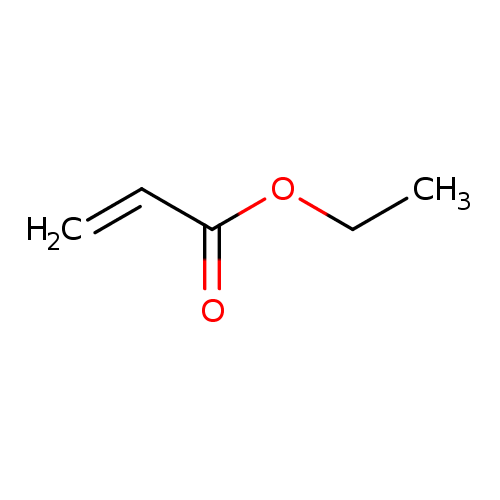
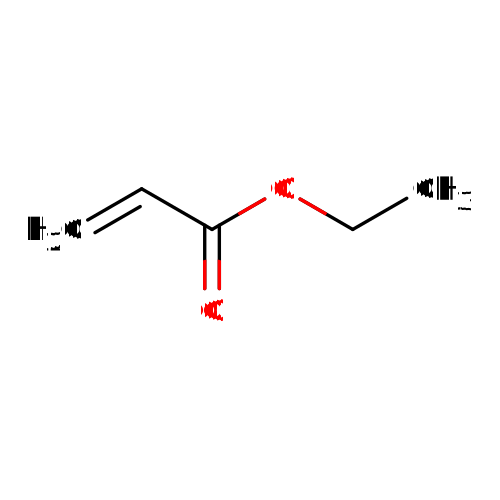
Chemical Structure
Thumb
Synonyms
ValueSource
Ethyl acrylic acidGenerator
2-Propenoic acid ethyl esterHMDB
2-Propenoic acid, ethyl esterHMDB
2-Propenoic acid, ethyl ester, homopolymerHMDB
Acrylic acid ethyl esterHMDB, MeSH
Acrylic acid, ethyl esterHMDB
Acrylic acid, ethyl ester (inhibited)HMDB
AethylacrylatHMDB
Akrylanem etyluHMDB
Carboset 511HMDB
CH2=chcooc2h5HMDB
EthoxycarbonylethyleneHMDB
Ethyl 2-propenoateHMDB
Ethyl 2-propenoate, homopolymerHMDB
Ethyl acrylate (inhibited)HMDB
Ethyl acrylate homopolymerHMDB
Ethyl acrylate polymerHMDB
Ethyl acrylate, inhibitedHMDB
Ethyl ester OF 2-propenoic acidHMDB
Ethyl propenoateHMDB
Ethyl propenoate, inhibitedHMDB
EthylacrylaatHMDB
EthylakrylatHMDB
Ethylester kyseliny akryloveHMDB
Etil acrilatoHMDB
EtilacrilatuluiHMDB
Etilacrilatului(roumanian)HMDB
FEMA 2418HMDB
Poly(acrylic acid, ethyl ester)HMDB
Poly(ethyl acrylate)HMDB
PolyethylacrylateHMDB
Propenoic acid,ethyl ester (ethylacrylate)HMDB
Ethyl 2E-propenoic acidGenerator
Ethyl acrylateMeSH
Chemical FormulaC5H8O2
Average Molecular Mass100.116 g/mol
Monoisotopic Mass100.052 g/mol
CAS Registry Number140-88-5
IUPAC Nameethyl prop-2-enoate
Traditional Nameethyl acrylate
SMILESCCOC(=O)C=C
InChI IdentifierInChI=1S/C5H8O2/c1-3-5(6)7-4-2/h3H,1,4H2,2H3
InChI KeyJIGUQPWFLRLWPJ-UHFFFAOYSA-N
Chemical Taxonomy
Description belongs to the class of organic compounds known as acrylic acid esters. These are organic compounds containing and ester acrylic acid (CH2=CHC(=O)OH).
KingdomOrganic compounds
Super ClassOrganic acids and derivatives
ClassCarboxylic acids and derivatives
Sub ClassAcrylic acids and derivatives
Direct ParentAcrylic acid esters
Alternative Parents
Substituents
  • Acrylic acid ester
  • Alpha,beta-unsaturated carboxylic ester
  • Enoate ester
  • Carboxylic acid ester
  • Monocarboxylic acid or derivatives
  • Organic oxygen compound
  • Organic oxide
  • Hydrocarbon derivative
  • Organooxygen compound
  • Carbonyl group
  • Aliphatic acyclic compound
Molecular FrameworkAliphatic acyclic compounds
External Descriptors
Biological Properties
StatusDetected and Not Quantified
OriginExogenous
Cellular Locations
  • Cytoplasm
  • Extracellular
Biofluid LocationsNot Available
Tissue LocationsNot Available
PathwaysNot Available
ApplicationsNot Available
Biological RolesNot Available
Chemical RolesNot Available
Physical Properties
StateLiquid
AppearanceClear liquid (12).
Experimental Properties
PropertyValue
Melting Point-71.2°C
Boiling Point99.4°C (210.9°F)
Solubility15 mg/mL at 25°C
Predicted Properties
PropertyValueSource
Water Solubility38.8 g/LALOGPS
logP1.24ALOGPS
logP1.27ChemAxon
logS-0.41ALOGPS
pKa (Strongest Basic)-6.8ChemAxon
Physiological Charge0ChemAxon
Hydrogen Acceptor Count1ChemAxon
Hydrogen Donor Count0ChemAxon
Polar Surface Area26.3 ŲChemAxon
Rotatable Bond Count3ChemAxon
Refractivity26.81 m³·mol⁻¹ChemAxon
Polarizability10.5 ųChemAxon
Number of Rings0ChemAxon
Bioavailability1ChemAxon
Rule of FiveYesChemAxon
Ghose FilterNoChemAxon
Veber's RuleYesChemAxon
MDDR-like RuleNoChemAxon
Spectra
Spectra
Spectrum TypeDescriptionSplash KeyView
GC-MSGC-MS Spectrum - EI-B (Non-derivatized)splash10-0a4i-9000000000-8762b44567cd7afeb692Spectrum
GC-MSGC-MS Spectrum - EI-B (Non-derivatized)splash10-0a6r-9000000000-25b2b71f04040f0959ddSpectrum
GC-MSGC-MS Spectrum - EI-B (Non-derivatized)splash10-0a4i-9000000000-9fb2ce6a8c6e827cca22Spectrum
GC-MSGC-MS Spectrum - EI-B (Non-derivatized)splash10-0a4i-9000000000-96cab8193fbae26c0e12Spectrum
GC-MSGC-MS Spectrum - EI-B (Non-derivatized)splash10-0a4i-9000000000-8762b44567cd7afeb692Spectrum
GC-MSGC-MS Spectrum - EI-B (Non-derivatized)splash10-0a6r-9000000000-25b2b71f04040f0959ddSpectrum
GC-MSGC-MS Spectrum - EI-B (Non-derivatized)splash10-0a4i-9000000000-9fb2ce6a8c6e827cca22Spectrum
GC-MSGC-MS Spectrum - EI-B (Non-derivatized)splash10-0a4i-9000000000-96cab8193fbae26c0e12Spectrum
Predicted GC-MSPredicted GC-MS Spectrum - GC-MS (Non-derivatized) - 70eV, Positivesplash10-0a6r-9000000000-b44a167f27a11982ce88Spectrum
Predicted GC-MSPredicted GC-MS Spectrum - GC-MS (Non-derivatized) - 70eV, PositiveNot AvailableSpectrum
Predicted LC-MS/MSPredicted LC-MS/MS Spectrum - 10V, Positivesplash10-0udi-6900000000-afe7a2cd2b3f23523df8Spectrum
Predicted LC-MS/MSPredicted LC-MS/MS Spectrum - 20V, Positivesplash10-0a4i-9200000000-b2987d0fef61f6de593eSpectrum
Predicted LC-MS/MSPredicted LC-MS/MS Spectrum - 40V, Positivesplash10-0a4i-9000000000-63a2abd18e012c3564b2Spectrum
Predicted LC-MS/MSPredicted LC-MS/MS Spectrum - 10V, Negativesplash10-0f6t-9000000000-b878ab9b418ac14be652Spectrum
Predicted LC-MS/MSPredicted LC-MS/MS Spectrum - 20V, Negativesplash10-0udj-9000000000-75144951146aefa9cb6cSpectrum
Predicted LC-MS/MSPredicted LC-MS/MS Spectrum - 40V, Negativesplash10-0udi-9000000000-e6c22ca53e8d3d79f0b3Spectrum
Predicted LC-MS/MSPredicted LC-MS/MS Spectrum - 10V, Positivesplash10-0a4i-9000000000-47264722dae793143c2bSpectrum
Predicted LC-MS/MSPredicted LC-MS/MS Spectrum - 20V, Positivesplash10-0a4r-9000000000-7bd873751816c51e989fSpectrum
Predicted LC-MS/MSPredicted LC-MS/MS Spectrum - 40V, Positivesplash10-0a4i-9000000000-55bfb6f6731ad493ad1dSpectrum
Predicted LC-MS/MSPredicted LC-MS/MS Spectrum - 10V, Negativesplash10-00di-9000000000-6636b98068f5d8e94960Spectrum
Predicted LC-MS/MSPredicted LC-MS/MS Spectrum - 20V, Negativesplash10-0fk9-9000000000-e0f16a81ce309da5b9a7Spectrum
Predicted LC-MS/MSPredicted LC-MS/MS Spectrum - 40V, Negativesplash10-00di-9000000000-e973a9ae833442ead826Spectrum
MSMass Spectrum (Electron Ionization)splash10-0a4i-9000000000-200bb2f29d9c1c5820c7Spectrum
1D NMR1H NMR SpectrumNot AvailableSpectrum
1D NMR13C NMR SpectrumNot AvailableSpectrum
1D NMR1H NMR SpectrumNot AvailableSpectrum
1D NMR13C NMR SpectrumNot AvailableSpectrum
1D NMR1H NMR SpectrumNot AvailableSpectrum
1D NMR13C NMR SpectrumNot AvailableSpectrum
1D NMR1H NMR SpectrumNot AvailableSpectrum
1D NMR13C NMR SpectrumNot AvailableSpectrum
1D NMR1H NMR SpectrumNot AvailableSpectrum
1D NMR13C NMR SpectrumNot AvailableSpectrum
1D NMR1H NMR SpectrumNot AvailableSpectrum
1D NMR13C NMR SpectrumNot AvailableSpectrum
1D NMR1H NMR SpectrumNot AvailableSpectrum
1D NMR13C NMR SpectrumNot AvailableSpectrum
1D NMR1H NMR SpectrumNot AvailableSpectrum
1D NMR13C NMR SpectrumNot AvailableSpectrum
1D NMR1H NMR SpectrumNot AvailableSpectrum
1D NMR13C NMR SpectrumNot AvailableSpectrum
1D NMR1H NMR SpectrumNot AvailableSpectrum
1D NMR13C NMR SpectrumNot AvailableSpectrum
1D NMR1H NMR SpectrumNot AvailableSpectrum
1D NMR13C NMR SpectrumNot AvailableSpectrum
Toxicity Profile
Route of ExposureInhalation (12) ; oral (12) ; dermal (12) ; eye contact (12).
Mechanism of ToxicityEthyl acrylate causes gastric lesions depending upon upon the rate of chemical delivery to stomach tissue as a result of interaction of the parent molecule or metabolites (other than hydrolysis products), with subcellular sites in stomach tissue (5).
MetabolismEthyl acrylate is hydrolized to acrylic acid in liver, kidney, and lung homogenates. It is suggested to bind to glutathione spontaneaoulsy and after catalysis by liver glutathione-S-transferase. The major metabolites of ethyl acrylate are mercapturic acids od ethyl acrylate and acrylic acid. Three metabolites were identified in a study: 3-hydroxypropionic acid and two mercapturic acids. N-Acetyl-S-(2-carboxyethyl)cysteine arises by glutathione conjugation of acrylic acid, while N-acetyl-S-(2-carboxyethyl)cysteine ethyl ester derives from the conjugation of intact ethyl acrylate.(1, 3, 4).
Toxicity ValuesLD50: 760-1020 mg/kg (Oral, Rat) (13) LC50: 1000-2000 ppm over 4 hours (Inhalation, Rat) (11)
Lethal DoseNot Available
Carcinogenicity (IARC Classification)2B, possibly carcinogenic to humans. (6)
Uses/SourcesEthyl acrylate is used in the production of polymers including resins, plastics, rubber, and denture material (7).
Minimum Risk LevelNot Available
Health EffectsThickened forestomach mucosa, forestomach inflammation and lesions, and abdominal adhesions; swelling of renal tubules and the liver, minor lesions on the liver and lung, and increased kidney weight may result from poisoning (9).
SymptomsLethargy and convulsions may occur if vapors are inhaled in high concentrations. Ethyl acrylate is irritating to the mucous membranes of the gastrointestinal tract and respiratory system. Prolonged exposure may produce drowsiness, headache and nausea . Iching of the skin and the face can also occur (14, 12).
TreatmentFor eye contamination, flush eyes immediately with water. Irrigate each eye continuously with normal saline during transport. Do not use emetics. For ingestion, rinse mouth and administer 5 ml/kg up to 200 ml of water for dilution if the patient can swallow, has a strong gag reflex, and does not drool. Administer activated charcoal. (2)
Concentrations
Not Available
DrugBank IDNot Available
HMDB IDHMDB0033978
FooDB IDFDB012210
Phenol Explorer IDNot Available
KNApSAcK IDNot Available
BiGG IDNot Available
BioCyc IDNot Available
METLIN IDNot Available
PDB IDNot Available
Wikipedia LinkEthyl acrylate
Chemspider ID8490
ChEBI IDNot Available
PubChem Compound ID8821
Kegg Compound IDC19238
YMDB IDNot Available
ECMDB IDNot Available
References
Synthesis ReferenceNot Available
MSDSLink
General References
1. Yannai, Shmuel. (2004) Dictionary of food compounds with CD-ROM: Additives, flavors, and ingredients. Boca Raton: Chapman & Hall/CRC.