Record Information
Version1.0
Creation Date2009-07-23 18:26:15 UTC
Update Date2026-05-14 16:58:42 UTC
Accession NumberCHEM002432
Identification
Common NameTubocurarine
ClassSmall Molecule
DescriptionTubocurarine is only found in individuals that have used or taken this drug. It is a neuromuscular blocker and active ingredient in curare; plant based alkaloid of Menispermaceae. [PubChem]Tubocurarine, the chief alkaloid in tobacco products, binds stereo-selectively to nicotinic-cholinergic receptors at the autonomic ganglia, in the adrenal medulla, at neuromuscular junctions, and in the brain. Two types of central nervous system effects are believed to be the basis of Tubocurarine's positively reinforcing properties. A stimulating effect is exerted mainly in the cortex via the locus ceruleus and a reward effect is exerted in the limbic system. At low doses the stimulant effects predominate while at high doses the reward effects predominate. Intermittent intravenous administration of Tubocurarine activates neurohormonal pathways, releasing acetylcholine, norepinephrine, dopamine, serotonin, vasopressin, beta-endorphin, growth hormone, and ACTH.
Contaminant Sources
  • HMDB Contaminants - Urine
  • STOFF IDENT Compounds
  • T3DB toxins
Contaminant Type
  • Amine
  • Drug
  • Ether
  • Metabolite
  • Muscle Relaxant, Skeletal
  • Natural Compound
  • Neuromuscular Nondepolarizing Agent
  • Nicotinic Antagonist
  • Organic Compound
  • Plant Toxin
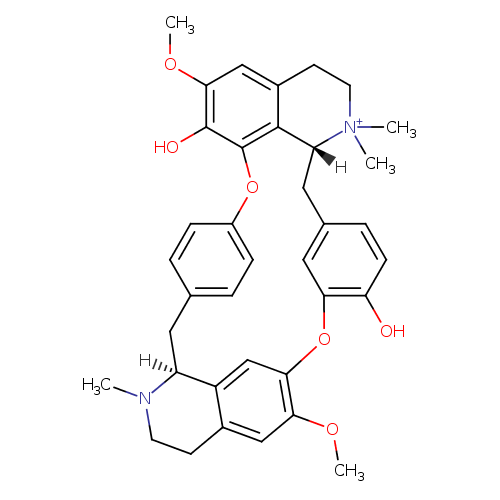
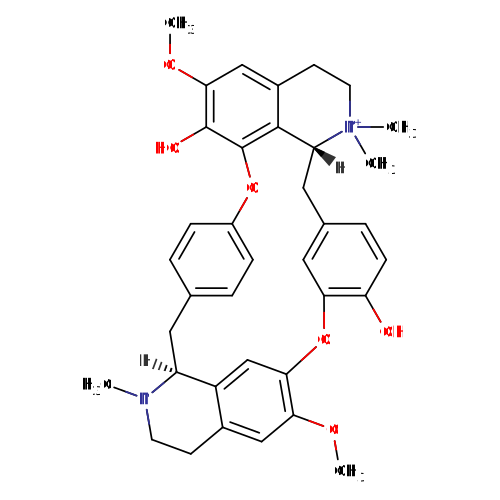
Chemical Structure
Thumb
Synonyms
ValueSource
(+)-TubocurarineChEBI
7',12'-Dihydroxy-6,6'-dimethoxy-2,2',2'-trimethyltubocuraraniumChEBI
D-TubocurarineChEBI
TubocurarinChEBI
D-Tubocurarine chlorideHMDB
Isoquinoline alkaloidHMDB
Tubocurarine chlorideHMDB
TubocurarinumHMDB
D-TubocurareHMDB
TubocurareHMDB
Chemical FormulaC37H41N2O6
Average Molecular Mass609.731 g/mol
Monoisotopic Mass609.296 g/mol
CAS Registry Number6989-98-6
IUPAC Name(1S,16R)-9,21-dihydroxy-10,25-dimethoxy-15,15,30-trimethyl-7,23-dioxa-15,30-diazaheptacyclo[22.6.2.2^{3,6}.1^{8,12}.1^{18,22}.0^{27,31}.0^{16,34}]hexatriaconta-3,5,8(34),9,11,18(33),19,21,24,26,31,35-dodecaen-15-ium
Traditional Nametubocurarine
SMILES[H][C@@]12CC3=CC=C(OC4=C5C(CC[N+](C)(C)[C@]5([H])CC5=CC(OC6=C(OC)C=C(CCN1C)C2=C6)=C(O)C=C5)=CC(OC)=C4O)C=C3
InChI IdentifierInChI=1S/C37H40N2O6/c1-38-14-12-24-19-32(42-4)33-21-27(24)28(38)16-22-6-9-26(10-7-22)44-37-35-25(20-34(43-5)36(37)41)13-15-39(2,3)29(35)17-23-8-11-30(40)31(18-23)45-33/h6-11,18-21,28-29H,12-17H2,1-5H3,(H-,40,41)/p+1/t28-,29+/m0/s1
InChI KeyJFJZZMVDLULRGK-URLMMPGGSA-O
Chemical Taxonomy
Description belongs to the class of organic compounds known as diarylethers. These are organic compounds containing the dialkyl ether functional group, with the formula ROR', where R and R' are aryl groups.
KingdomOrganic compounds
Super ClassOrganic oxygen compounds
ClassOrganooxygen compounds
Sub ClassEthers
Direct ParentDiarylethers
Alternative Parents
Substituents
  • Diaryl ether
  • Tetrahydroisoquinoline
  • Anisole
  • Alkyl aryl ether
  • 1-hydroxy-2-unsubstituted benzenoid
  • Aralkylamine
  • Benzenoid
  • Tetraalkylammonium salt
  • Quaternary ammonium salt
  • Tertiary amine
  • Tertiary aliphatic amine
  • Oxacycle
  • Azacycle
  • Organoheterocyclic compound
  • Amine
  • Organic nitrogen compound
  • Organonitrogen compound
  • Hydrocarbon derivative
  • Organopnictogen compound
  • Organic salt
  • Organic cation
  • Aromatic heteropolycyclic compound
Molecular FrameworkAromatic heteropolycyclic compounds
External Descriptors
Biological Properties
StatusDetected and Not Quantified
OriginExogenous
Cellular Locations
  • Cytoplasm
  • Membrane
Biofluid LocationsNot Available
Tissue LocationsNot Available
PathwaysNot Available
Applications
Biological Roles
Chemical RolesNot Available
Physical Properties
StateSolid
AppearanceWhite powder.
Experimental Properties
PropertyValue
Melting PointNot Available
Boiling PointNot Available
Solubility3.23e-04 g/L
Predicted Properties
PropertyValueSource
Water Solubility0.00032 g/LALOGPS
logP3.12ALOGPS
logP3.14ChemAxon
logS-6.3ALOGPS
pKa (Strongest Acidic)6.45ChemAxon
pKa (Strongest Basic)8.12ChemAxon
Physiological Charge1ChemAxon
Hydrogen Acceptor Count5ChemAxon
Hydrogen Donor Count2ChemAxon
Polar Surface Area80.62 ŲChemAxon
Rotatable Bond Count2ChemAxon
Refractivity187.06 m³·mol⁻¹ChemAxon
Polarizability66.41 ųChemAxon
Number of Rings7ChemAxon
Bioavailability1ChemAxon
Rule of FiveNoChemAxon
Ghose FilterNoChemAxon
Veber's RuleNoChemAxon
MDDR-like RuleNoChemAxon
Spectra
Spectra
Spectrum TypeDescriptionSplash KeyView
Predicted GC-MSPredicted GC-MS Spectrum - GC-MS (Non-derivatized) - 70eV, Positivesplash10-052f-0000091000-3781da48d16d597964ccSpectrum
Predicted GC-MSPredicted GC-MS Spectrum - GC-MS (1 TMS) - 70eV, Positivesplash10-01bi-0000009000-cf3870f9fb70af6daa94Spectrum
Predicted GC-MSPredicted GC-MS Spectrum - GC-MS (TMS_1_2) - 70eV, PositiveNot AvailableSpectrum
Predicted GC-MSPredicted GC-MS Spectrum - GC-MS (TMS_2_1) - 70eV, PositiveNot AvailableSpectrum
Predicted GC-MSPredicted GC-MS Spectrum - GC-MS (TBDMS_1_1) - 70eV, PositiveNot AvailableSpectrum
Predicted GC-MSPredicted GC-MS Spectrum - GC-MS (TBDMS_1_2) - 70eV, PositiveNot AvailableSpectrum
Predicted GC-MSPredicted GC-MS Spectrum - GC-MS (TBDMS_2_1) - 70eV, PositiveNot AvailableSpectrum
Predicted GC-MSPredicted GC-MS Spectrum - GC-MS ("Tubocurarine,1TMS,#1" TMS) - 70eV, PositiveNot AvailableSpectrum
LC-MS/MSLC-MS/MS Spectrum - Linear Ion Trap , positivesplash10-03di-0000090000-3b12a16109f25ee30930Spectrum
LC-MS/MSLC-MS/MS Spectrum - Linear Ion Trap , positivesplash10-03di-0000090000-7ed720c5e8c5ce8facd3Spectrum
Predicted LC-MS/MSPredicted LC-MS/MS Spectrum - 10V, Positivesplash10-0a59-0000089000-ac5f8d663869b48af1f0Spectrum
Predicted LC-MS/MSPredicted LC-MS/MS Spectrum - 20V, Positivesplash10-0560-0000091000-b985ecd4a2b2ff4197d8Spectrum
Predicted LC-MS/MSPredicted LC-MS/MS Spectrum - 40V, Positivesplash10-0fk9-0000090000-ae66666801b8fb874ed4Spectrum
Toxicity Profile
Route of ExposureInjection (sting/bite) (2)
Mechanism of ToxicityTubocurarine is a cholinesterase or acetylcholinesterase (AChE) inhibitor. A cholinesterase inhibitor (or 'anticholinesterase') suppresses the action of acetylcholinesterase. Because of its essential function, chemicals that interfere with the action of acetylcholinesterase are potent neurotoxins, causing excessive salivation and eye-watering in low doses, followed by muscle spasms and ultimately death. Nerve gases and many substances used in insecticides have been shown to act by binding a serine in the active site of acetylcholine esterase, inhibiting the enzyme completely. Acetylcholine esterase breaks down the neurotransmitter acetylcholine, which is released at nerve and muscle junctions, in order to allow the muscle or organ to relax. The result of acetylcholine esterase inhibition is that acetylcholine builds up and continues to act so that any nerve impulses are continually transmitted and muscle contractions do not stop. Among the most common acetylcholinesterase inhibitors are phosphorus-based compounds, which are designed to bind to the active site of the enzyme. The structural requirements are a phosphorus atom bearing two lipophilic groups, a leaving group (such as a halide or thiocyanate), and a terminal oxygen.
Metabolism Half Life: 1-2 hours
Toxicity ValuesNot Available
Lethal DoseNot Available
Carcinogenicity (IARC Classification)No indication of carcinogenicity to humans (not listed by IARC).
Uses/SourcesTubocurarine is a type of curare, a plant toxin known for its use as paralyzing arrow poison by South American indigenous people. It can be extracted from a variety of plants, including Strychnos toxifera and Chondrodendron tomentosum. (2)
Minimum Risk LevelNot Available
Health EffectsAcute exposure to cholinesterase inhibitors can cause a cholinergic crisis characterized by severe nausea/vomiting, salivation, sweating, bradycardia, hypotension, collapse, and convulsions. Increasing muscle weakness is a possibility and may result in death if respiratory muscles are involved. Accumulation of ACh at motor nerves causes overstimulation of nicotinic expression at the neuromuscular junction. When this occurs symptoms such as muscle weakness, fatigue, muscle cramps, fasciculation, and paralysis can be seen. When there is an accumulation of ACh at autonomic ganglia this causes overstimulation of nicotinic expression in the sympathetic system. Symptoms associated with this are hypertension, and hypoglycemia. Overstimulation of nicotinic acetylcholine receptors in the central nervous system, due to accumulation of ACh, results in anxiety, headache, convulsions, ataxia, depression of respiration and circulation, tremor, general weakness, and potentially coma. When there is expression of muscarinic overstimulation due to excess acetylcholine at muscarinic acetylcholine receptors symptoms of visual disturbances, tightness in chest, wheezing due to bronchoconstriction, increased bronchial secretions, increased salivation, lacrimation, sweating, peristalsis, and urination can occur. Certain reproductive effects in fertility, growth, and development for males and females have been linked specifically to organophosphate pesticide exposure. Most of the research on reproductive effects has been conducted on farmers working with pesticides and insecticdes in rural areas. In females menstrual cycle disturbances, longer pregnancies, spontaneous abortions, stillbirths, and some developmental effects in offspring have been linked to organophosphate pesticide exposure. Prenatal exposure has been linked to impaired fetal growth and development. Neurotoxic effects have also been linked to poisoning with OP pesticides causing four neurotoxic effects in humans: cholinergic syndrome, intermediate syndrome, organophosphate-induced delayed polyneuropathy (OPIDP), and chronic organophosphate-induced neuropsychiatric disorder (COPIND). These syndromes result after acute and chronic exposure to OP pesticides.
SymptomsCurare is a muscle relaxant and thus causes paraylsis. (2)
TreatmentIf the compound has been ingested, rapid gastric lavage should be performed using 5% sodium bicarbonate. For skin contact, the skin should be washed with soap and water. If the compound has entered the eyes, they should be washed with large quantities of isotonic saline or water. In serious cases, atropine and/or pralidoxime should be administered. Anti-cholinergic drugs work to counteract the effects of excess acetylcholine and reactivate AChE. Atropine can be used as an antidote in conjunction with pralidoxime or other pyridinium oximes (such as trimedoxime or obidoxime), though the use of '-oximes' has been found to be of no benefit, or possibly harmful, in at least two meta-analyses. Atropine is a muscarinic antagonist, and thus blocks the action of acetylcholine peripherally.
Concentrations
Not Available
DrugBank IDDB01199
HMDB IDHMDB0015330
FooDB IDNot Available
Phenol Explorer IDNot Available
KNApSAcK IDC00001927
BiGG IDNot Available
BioCyc IDNot Available
METLIN IDNot Available
PDB IDNot Available
Wikipedia LinkTubocurarine_chloride
Chemspider ID5778
ChEBI ID9774
PubChem Compound ID6000
Kegg Compound IDC07547
YMDB IDNot Available
ECMDB IDNot Available
References
Synthesis ReferenceNot Available
MSDSLink
General References
1. Youssef SA, Ramadan A, Afifi NA, Aziz MD: Influence of sodium taurocholate on the potency and duration of action of some neuromuscular blocking agents. Dtsch Tierarztl Wochenschr. 1991 Jun;98(6):213-6.
2. https://www.ncbi.nlm.nih.gov/pubmed/?term=2215478
3. https://www.ncbi.nlm.nih.gov/pubmed/?term=6196640
4. https://www.ncbi.nlm.nih.gov/pubmed/?term=7911306
5. https://www.ncbi.nlm.nih.gov/pubmed/?term=8166227