Record Information
Version1.0
Creation Date2009-07-23 18:26:10 UTC
Update Date2026-05-14 17:25:23 UTC
Accession NumberCHEM002424
Identification
Common NameSwainsonine
ClassSmall Molecule
DescriptionSwainsonine is a plant toxin found in locoweed (families Fabaceae, Oxytropis, Astragalus and Swainsona) and some fungi (Metarhizium anisopliae, Rizoctonia leguminicola). It has been known to cause a potentially lethal central nervous system condition in livestock known as locoism and is a significant cause of economic losses in livestock industries. Along with slaframine, the other biologially active compound of R. leguminicola, it may contribute to a condition called "slobbers syndrome" in livestock that has ingested contaminated feed. (4, 1)
Contaminant Sources
  • T3DB toxins
  • ToxCast & Tox21 Chemicals
Contaminant Type
  • Amine
  • Fungal Toxin
  • Mycotoxin
  • Natural Compound
  • Organic Compound
  • PFAS
  • Phytotoxin
  • Plant Toxin
Chemical Structure
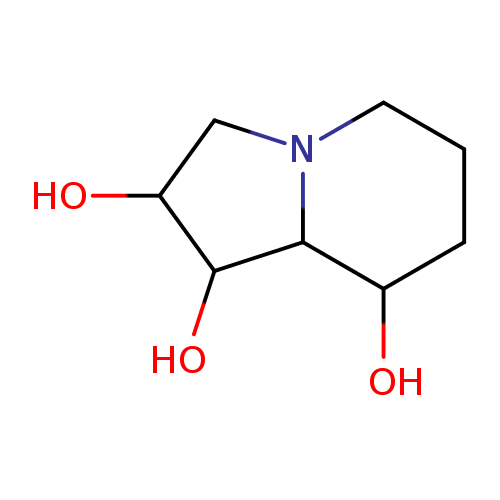
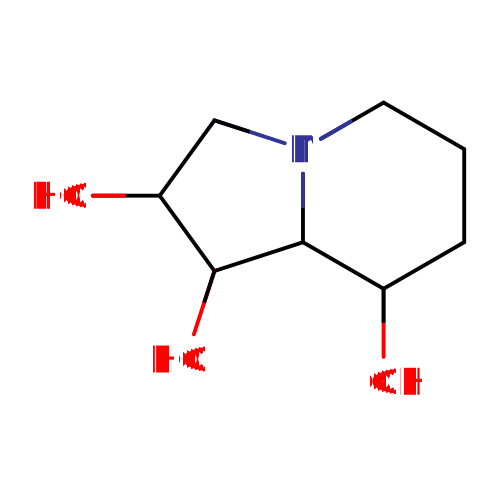
Thumb
SynonymsNot Available
Chemical FormulaC8H15NO3
Average Molecular Mass173.210 g/mol
Monoisotopic Mass173.105 g/mol
CAS Registry Number72741-87-8
IUPAC Name(1S,2R,8R,8aR)-octahydroindolizine-1,2,8-triol
Traditional Nameoctahydroindolizine-1,2,8-triol
SMILESOC1CN2CCCC(O)C2C1O
InChI IdentifierInChI=1S/C8H15NO3/c10-5-2-1-3-9-4-6(11)8(12)7(5)9/h5-8,10-12H,1-4H2
InChI KeyFXUAIOOAOAVCGD-UHFFFAOYSA-N
Chemical Taxonomy
Description belongs to the class of organic compounds known as indolizidines. These are polycyclic compounds containing an indolizidine, which is a bicyclic heterocycle containing a saturated six-member ring fused to a saturated five-member ring, one of the bridging atoms being nitrogen.
KingdomOrganic compounds
Super ClassOrganoheterocyclic compounds
ClassIndolizidines
Sub ClassNot Available
Direct ParentIndolizidines
Alternative Parents
Substituents
  • Indolizidine
  • Piperidine
  • N-alkylpyrrolidine
  • Pyrrolidine
  • Tertiary aliphatic amine
  • Tertiary amine
  • Secondary alcohol
  • 1,2-aminoalcohol
  • Azacycle
  • Polyol
  • Hydrocarbon derivative
  • Alcohol
  • Organooxygen compound
  • Organonitrogen compound
  • Organic nitrogen compound
  • Amine
  • Organopnictogen compound
  • Organic oxygen compound
  • Aliphatic heteropolycyclic compound
Molecular FrameworkAliphatic heteropolycyclic compounds
External DescriptorsNot Available
Biological Properties
StatusDetected and Not Quantified
OriginExogenous
Cellular Locations
  • Cytoplasm
  • Extracellular
Biofluid LocationsNot Available
Tissue LocationsNot Available
PathwaysNot Available
Applications
Biological Roles
Chemical Roles
Physical Properties
StateSolid
AppearanceWhite powder.
Experimental Properties
PropertyValue
Melting Point143-144°C
Boiling PointNot Available
SolubilityNot Available
Predicted Properties
PropertyValueSource
Water Solubility1320 g/LALOGPS
logP-1.5ALOGPS
logP-1.4ChemAxon
logS0.88ALOGPS
pKa (Strongest Acidic)13.28ChemAxon
pKa (Strongest Basic)9.47ChemAxon
Physiological Charge1ChemAxon
Hydrogen Acceptor Count4ChemAxon
Hydrogen Donor Count3ChemAxon
Polar Surface Area63.93 ŲChemAxon
Rotatable Bond Count0ChemAxon
Refractivity43.12 m³·mol⁻¹ChemAxon
Polarizability18.11 ųChemAxon
Number of Rings2ChemAxon
Bioavailability1ChemAxon
Rule of FiveYesChemAxon
Ghose FilterNoChemAxon
Veber's RuleNoChemAxon
MDDR-like RuleNoChemAxon
Spectra
Spectra
Spectrum TypeDescriptionSplash KeyView
Predicted GC-MSPredicted GC-MS Spectrum - GC-MS (Non-derivatized) - 70eV, Positivesplash10-0006-3900000000-fa3ee98b35bc18156458Spectrum
Predicted GC-MSPredicted GC-MS Spectrum - GC-MS (Non-derivatized) - 70eV, PositiveNot AvailableSpectrum
Predicted LC-MS/MSPredicted LC-MS/MS Spectrum - 10V, Positivesplash10-0ab9-0900000000-af27f13c36318fe110f3Spectrum
Predicted LC-MS/MSPredicted LC-MS/MS Spectrum - 20V, Positivesplash10-052r-1900000000-afb1adf231f02c9bee97Spectrum
Predicted LC-MS/MSPredicted LC-MS/MS Spectrum - 40V, Positivesplash10-000i-4900000000-f18b9efbfeac2f00516cSpectrum
Predicted LC-MS/MSPredicted LC-MS/MS Spectrum - 10V, Negativesplash10-00di-0900000000-5fcf910ef2eee1aaeab5Spectrum
Predicted LC-MS/MSPredicted LC-MS/MS Spectrum - 20V, Negativesplash10-0uk9-1900000000-a4f22679f524611c0d78Spectrum
Predicted LC-MS/MSPredicted LC-MS/MS Spectrum - 40V, Negativesplash10-0006-9000000000-8c00652a95cc25a8acbbSpectrum
Predicted LC-MS/MSPredicted LC-MS/MS Spectrum - 10V, Positivesplash10-05fr-0900000000-e9dac584c857b5760ac3Spectrum
Predicted LC-MS/MSPredicted LC-MS/MS Spectrum - 20V, Positivesplash10-059i-0900000000-66417828119342afecdfSpectrum
Predicted LC-MS/MSPredicted LC-MS/MS Spectrum - 40V, Positivesplash10-001l-9100000000-0f56b431ab6b0a7547cdSpectrum
Predicted LC-MS/MSPredicted LC-MS/MS Spectrum - 10V, Negativesplash10-00di-0900000000-f31ec28dc8af4da87110Spectrum
Predicted LC-MS/MSPredicted LC-MS/MS Spectrum - 20V, Negativesplash10-00di-1900000000-0166941b80b892d623eeSpectrum
Predicted LC-MS/MSPredicted LC-MS/MS Spectrum - 40V, Negativesplash10-00kf-9500000000-bd83df587f7d40c8015bSpectrum
1D NMR13C NMR SpectrumNot AvailableSpectrum
1D NMR1H NMR SpectrumNot AvailableSpectrum
1D NMR13C NMR SpectrumNot AvailableSpectrum
1D NMR1H NMR SpectrumNot AvailableSpectrum
1D NMR13C NMR SpectrumNot AvailableSpectrum
1D NMR1H NMR SpectrumNot AvailableSpectrum
1D NMR13C NMR SpectrumNot AvailableSpectrum
1D NMR1H NMR SpectrumNot AvailableSpectrum
1D NMR13C NMR SpectrumNot AvailableSpectrum
1D NMR1H NMR SpectrumNot AvailableSpectrum
1D NMR13C NMR SpectrumNot AvailableSpectrum
1D NMR1H NMR SpectrumNot AvailableSpectrum
1D NMR13C NMR SpectrumNot AvailableSpectrum
1D NMR1H NMR SpectrumNot AvailableSpectrum
1D NMR13C NMR SpectrumNot AvailableSpectrum
1D NMR1H NMR SpectrumNot AvailableSpectrum
1D NMR13C NMR SpectrumNot AvailableSpectrum
Toxicity Profile
Route of ExposureOral, dermal, inhalation, and parenteral (contaminated drugs). (3)
Mechanism of ToxicitySwainsonine inhibits the activity of glycoside hydrolases, especially N-linked glycosylation. Inhibition of Golgi mannosidase II and other alpha-mannosidases causes the accumulation of atypical hybrid glycoproteins and oligosaccarides because the proper processing cannot occur. This also results in intracellular vacuolization. (4, 1, 2)
MetabolismNot Available
Toxicity ValuesNot Available
Lethal DoseNot Available
Carcinogenicity (IARC Classification)No indication of carcinogenicity to humans (not listed by IARC).
Uses/SourcesSwainsonine is a plant toxin found in locoweed (families Fabaceae, Oxytropis, Astragalus and Swainsona) and some fungi (Metarhizium anisopliae, Rizoctonia leguminicola). (4, 1)
Minimum Risk LevelNot Available
Health EffectsSwainsonine causes a variety of neurological disorders, including locoism and "slobbers syndrome" in livestock. In man it causes a lysosomal storage disease, biochemically and morphologically similar to mannosidosis. It is also an appetite suppressant. (4, 1, 2)
SymptomsSymptoms of locoism include staggering gait, depression, muscular incoordination, staring, nervousness, hyperexcitability, loss of appetite, and reproductive alterations such as abortion and birth defects. The major symptom of "slobbers syndrome" is profuse salivation. Other symptoms include diarrhea, lacrimation, stiff joints, frequent urination, tremors, spontaneous abortion, labored breathing, loss of appetite, bloat, and possibly death. Swainsonine also causes vacuolation of most tissues. (6, 1, 2)
TreatmentNot Available
Concentrations
Not Available
DrugBank IDNot Available
HMDB IDHMDB0258641
FooDB IDNot Available
Phenol Explorer IDNot Available
KNApSAcK IDC00002075
BiGG IDNot Available
BioCyc IDNot Available
METLIN IDNot Available
PDB IDNot Available
Wikipedia LinkSwainsonine
Chemspider ID5170
ChEBI IDNot Available
PubChem Compound ID5363
Kegg Compound IDNot Available
YMDB IDNot Available
ECMDB IDNot Available
References
Synthesis Reference

William H. Pearson, Erik J. Hembre, “Method for preparing swainsonine.” U.S. Patent US5919952, issued December, 1986.

MSDSNot Available
General ReferencesNot Available