Record Information
Version1.0
Creation Date2009-07-21 20:29:00 UTC
Update Date2026-03-27 02:10:22 UTC
Accession NumberCHEM002411
Identification
Common NameMethsuximide
ClassSmall Molecule
DescriptionMethsuximide is only found in individuals that have used or taken this drug. It is an anticonvulsant medication. It is sold by Pfizer under the name Petinutin. [Wikipedia] Binds to T-type voltage sensitive calcium channels. Voltage-sensitive calcium channels (VSCC) mediate the entry of calcium ions into excitable cells and are also involved in a variety of calcium-dependent processes, including muscle contraction, hormone or neurotransmitter release, gene expression, cell motility, cell division and cell death. The isoform alpha-1G gives rise to T-type calcium currents. T-type calcium channels belong to the low-voltage activated (LVA) group and are strongly blocked by mibefradil. A particularity of this type of channels is an opening at quite negative potentials and a voltage-dependent inactivation. T-type channels serve pacemaking functions in both central neurons and cardiac nodal cells and support calcium signaling in secretory cells and vascular smooth muscle. They may also be involved in the modulation of firing patterns of neurons which is important for information processing as well as in cell growth processes.
Contaminant Sources
  • HMDB Contaminants - Urine
  • STOFF IDENT Compounds
  • T3DB toxins
  • ToxCast & Tox21 Chemicals
Contaminant Type
  • Amide
  • Amine
  • Anticonvulsant
  • Drug
  • Metabolite
  • Organic Compound
  • Succinimide
  • Synthetic Compound
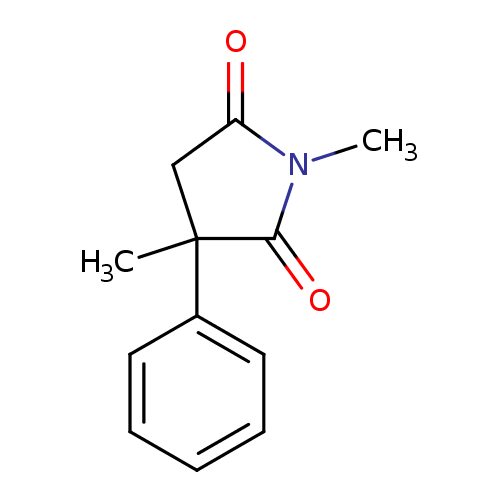
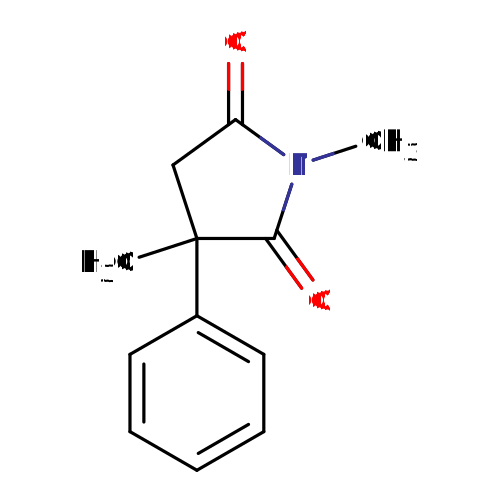
Chemical Structure
Thumb
Synonyms
ValueSource
MesuximideKegg
CelontinKegg
(RS)-1,3-Dimethyl-3-phenyl-2,5-pyrrolidindionHMDB
1,3-Dimethyl-3-phenyl-2,5-dioxopyrrolidineHMDB
1,3-Dimethyl-3-phenyl-2,5-pyrrolidinedioneHMDB
1,3-Dimethyl-3-phenyl-pyrrolidin-2,5-dioneHMDB
1,3-Dimethyl-3-phenylsuccinimideHMDB
alpha-Methyl-alpha-phenyl N-methyl succinimideHMDB
alpha-MethylphensuximideHMDB
MethsuximidHMDB
MetosuccimmideHMDB
MetsuccimideHMDB
N,2-Dimethyl-2-phenylsuccinimideHMDB
N-Methyl-alpha-methyl-alpha-phenylsuccinimideHMDB
Pfizer brand OF methsuximideHMDB
Methsuximide, (+)-isomerHMDB
Warner-lambert brand OF methsuximideHMDB
MesuximidHMDB
Parke david brand OF methsuximideHMDB
Methsuximide, (-)-isomerHMDB
PetinutinHMDB
Methsuximide, (+-)-isomerHMDB
Chemical FormulaC12H13NO2
Average Molecular Mass203.237 g/mol
Monoisotopic Mass203.095 g/mol
CAS Registry Number77-41-8
IUPAC Name1,3-dimethyl-3-phenylpyrrolidine-2,5-dione
Traditional Namemethsuximide
SMILESCN1C(=O)CC(C)(C1=O)C1=CC=CC=C1
InChI IdentifierInChI=1S/C12H13NO2/c1-12(9-6-4-3-5-7-9)8-10(14)13(2)11(12)15/h3-7H,8H2,1-2H3
InChI KeyAJXPJJZHWIXJCJ-UHFFFAOYSA-N
Chemical Taxonomy
Description belongs to the class of organic compounds known as phenylpyrrolidines. These are polycyclic aromatic compounds containing a benzene ring linked to a pyrrolidine ring through a CC or CN bond. Pyrrolidine is a five-membered saturated aliphatic heterocycle with one nitrogen atom and four carbon atoms.
KingdomOrganic compounds
Super ClassOrganoheterocyclic compounds
ClassPyrrolidines
Sub ClassPhenylpyrrolidines
Direct ParentPhenylpyrrolidines
Alternative Parents
Substituents
  • 3-phenylpyrrolidine
  • Monocyclic benzene moiety
  • Carboxylic acid imide, n-substituted
  • Pyrrolidone
  • 2-pyrrolidone
  • N-alkylpyrrolidine
  • Benzenoid
  • Carboxylic acid imide
  • Dicarboximide
  • Pyrrole
  • Lactam
  • Carboxylic acid derivative
  • Azacycle
  • Carbonyl group
  • Organopnictogen compound
  • Organooxygen compound
  • Organonitrogen compound
  • Organic oxygen compound
  • Organic nitrogen compound
  • Organic oxide
  • Hydrocarbon derivative
  • Aromatic heteromonocyclic compound
Molecular FrameworkAromatic heteromonocyclic compounds
External DescriptorsNot Available
Biological Properties
StatusDetected and Not Quantified
OriginExogenous
Cellular Locations
  • Cytoplasm
  • Extracellular
  • Membrane
Biofluid LocationsNot Available
Tissue LocationsNot Available
PathwaysNot Available
ApplicationsNot Available
Biological RolesNot Available
Chemical RolesNot Available
Physical Properties
StateSolid
AppearanceWhite powder.
Experimental Properties
PropertyValue
Melting Point52.5°C
Boiling Point121.5°C at 1.00E-01 mm Hg
Solubility2.13e+00 g/L
Predicted Properties
PropertyValueSource
Water Solubility2.13 g/LALOGPS
logP1.46ALOGPS
logP1.46ChemAxon
logS-2ALOGPS
pKa (Strongest Acidic)19.03ChemAxon
pKa (Strongest Basic)-7.2ChemAxon
Physiological Charge0ChemAxon
Hydrogen Acceptor Count2ChemAxon
Hydrogen Donor Count0ChemAxon
Polar Surface Area37.38 ŲChemAxon
Rotatable Bond Count1ChemAxon
Refractivity56.35 m³·mol⁻¹ChemAxon
Polarizability21.4 ųChemAxon
Number of Rings2ChemAxon
Bioavailability1ChemAxon
Rule of FiveYesChemAxon
Ghose FilterYesChemAxon
Veber's RuleYesChemAxon
MDDR-like RuleNoChemAxon
Spectra
Spectra
Spectrum TypeDescriptionSplash KeyView
GC-MSGC-MS Spectrum - EI-B (Non-derivatized)splash10-014i-3910000000-9cae394b5b94a483c401Spectrum
GC-MSGC-MS Spectrum - CI-B (Non-derivatized)splash10-0udi-0090000000-31b6e0b0429306f0d6daSpectrum
GC-MSGC-MS Spectrum - CI-B (Non-derivatized)splash10-0udi-0490000000-37eb2b7cfbb3d8b42e97Spectrum
GC-MSGC-MS Spectrum - EI-B (Non-derivatized)splash10-014i-3910000000-9cae394b5b94a483c401Spectrum
GC-MSGC-MS Spectrum - CI-B (Non-derivatized)splash10-0udi-0090000000-31b6e0b0429306f0d6daSpectrum
GC-MSGC-MS Spectrum - CI-B (Non-derivatized)splash10-0udi-0490000000-37eb2b7cfbb3d8b42e97Spectrum
Predicted GC-MSPredicted GC-MS Spectrum - GC-MS (Non-derivatized) - 70eV, Positivesplash10-0uxr-0900000000-e0b7a163d2486262e40aSpectrum
Predicted GC-MSPredicted GC-MS Spectrum - GC-MS (Non-derivatized) - 70eV, PositiveNot AvailableSpectrum
LC-MS/MSLC-MS/MS Spectrum - LC-ESI-QFT , positivesplash10-0udi-0390000000-00d729cf9e85b7d75068Spectrum
LC-MS/MSLC-MS/MS Spectrum - LC-ESI-QFT , positivesplash10-0udi-1690000000-0a263ad37a0831b81fb3Spectrum
LC-MS/MSLC-MS/MS Spectrum - LC-ESI-QFT , positivesplash10-014i-4910000000-eb0a383017c0566e6a11Spectrum
LC-MS/MSLC-MS/MS Spectrum - LC-ESI-QFT , positivesplash10-014l-9800000000-5df2aae06682d9488eefSpectrum
LC-MS/MSLC-MS/MS Spectrum - LC-ESI-QFT , positivesplash10-05mo-9400000000-6de622fc3efce00a0b34Spectrum
LC-MS/MSLC-MS/MS Spectrum - LC-ESI-QFT , positivesplash10-052f-9300000000-1e2faae8b516a3fc7ad5Spectrum
LC-MS/MSLC-MS/MS Spectrum - 45V, Positivesplash10-014i-4910000000-3edaee012b8d0ab6ababSpectrum
LC-MS/MSLC-MS/MS Spectrum - 15V, Positivesplash10-0udi-0290000000-7e1ec4ffc809d1b17f69Spectrum
LC-MS/MSLC-MS/MS Spectrum - 30V, Positivesplash10-0udi-1690000000-634173d911d8c9526bdaSpectrum
LC-MS/MSLC-MS/MS Spectrum - 60V, Positivesplash10-014l-9800000000-fe9ec2e272ddfa852102Spectrum
LC-MS/MSLC-MS/MS Spectrum - 75V, Positivesplash10-05mo-9400000000-0014609b9f8d422ac9b1Spectrum
LC-MS/MSLC-MS/MS Spectrum - 90V, Positivesplash10-052f-9200000000-4e2b70d601f365fae12eSpectrum
Predicted LC-MS/MSPredicted LC-MS/MS Spectrum - 10V, Positivesplash10-0udi-0090000000-7bd86034fa816a0243c3Spectrum
Predicted LC-MS/MSPredicted LC-MS/MS Spectrum - 20V, Positivesplash10-0udi-0190000000-4ce7c75dd0aecca4396fSpectrum
Predicted LC-MS/MSPredicted LC-MS/MS Spectrum - 40V, Positivesplash10-0ufr-9600000000-bf46c29670f52d82e8abSpectrum
Predicted LC-MS/MSPredicted LC-MS/MS Spectrum - 10V, Negativesplash10-0udi-0090000000-e3773732d15693b117d9Spectrum
Predicted LC-MS/MSPredicted LC-MS/MS Spectrum - 20V, Negativesplash10-0udi-1190000000-d519c86bfcc321cacfa4Spectrum
Predicted LC-MS/MSPredicted LC-MS/MS Spectrum - 40V, Negativesplash10-0udi-6900000000-7c462fe20661937889fdSpectrum
Predicted LC-MS/MSPredicted LC-MS/MS Spectrum - 10V, Positivesplash10-0udi-0090000000-b81b75e675178531e9bbSpectrum
Predicted LC-MS/MSPredicted LC-MS/MS Spectrum - 20V, Positivesplash10-0udi-1960000000-8ff948008064ff6c3bf3Spectrum
Predicted LC-MS/MSPredicted LC-MS/MS Spectrum - 40V, Positivesplash10-014l-8900000000-b05d83746feabe3e2ce4Spectrum
Predicted LC-MS/MSPredicted LC-MS/MS Spectrum - 10V, Negativesplash10-0udi-0090000000-341f1e0a28e483a04bd3Spectrum
Predicted LC-MS/MSPredicted LC-MS/MS Spectrum - 20V, Negativesplash10-0ufr-6920000000-366e7547f18799baaf74Spectrum
Predicted LC-MS/MSPredicted LC-MS/MS Spectrum - 40V, Negativesplash10-004i-9100000000-675b081ad6d6943d7c75Spectrum
MSMass Spectrum (Electron Ionization)splash10-014i-4910000000-aa3742fc04cdbcda351fSpectrum
1D NMR1H NMR SpectrumNot AvailableSpectrum
1D NMR13C NMR SpectrumNot AvailableSpectrum
1D NMR1H NMR SpectrumNot AvailableSpectrum
1D NMR13C NMR SpectrumNot AvailableSpectrum
1D NMR1H NMR SpectrumNot AvailableSpectrum
1D NMR13C NMR SpectrumNot AvailableSpectrum
1D NMR1H NMR SpectrumNot AvailableSpectrum
1D NMR13C NMR SpectrumNot AvailableSpectrum
1D NMR1H NMR SpectrumNot AvailableSpectrum
1D NMR13C NMR SpectrumNot AvailableSpectrum
1D NMR1H NMR SpectrumNot AvailableSpectrum
1D NMR13C NMR SpectrumNot AvailableSpectrum
1D NMR1H NMR SpectrumNot AvailableSpectrum
1D NMR13C NMR SpectrumNot AvailableSpectrum
1D NMR1H NMR SpectrumNot AvailableSpectrum
1D NMR13C NMR SpectrumNot AvailableSpectrum
1D NMR1H NMR SpectrumNot AvailableSpectrum
1D NMR13C NMR SpectrumNot AvailableSpectrum
1D NMR1H NMR SpectrumNot AvailableSpectrum
1D NMR13C NMR SpectrumNot AvailableSpectrum
Toxicity Profile
Route of ExposureOral
Mechanism of ToxicityMethsuximide suppresses the paroxysmal three cycle per second spike and wave activity associated with lapses of consciousness which is common in absence (petit mal) seizures. The frequency of epileptiform attacks is reduced, apparently by depression of the motor cortex and elevation of the threshold of the central nervous system to convulsive stimuli.
Metabolism Half Life: 1.4-2.6 hours for mesuximide and 28-38 hours for the active metabolite.
Toxicity ValuesNot Available
Lethal DoseNot Available
Carcinogenicity (IARC Classification)No indication of carcinogenicity to humans (not listed by IARC).
Uses/SourcesFor the control of absence (petit mal) seizures that are refractory to other drugs.
Minimum Risk LevelNot Available
Health EffectsMay cause a potentially dangerous rash that may develop into Stevens Johnson syndrome, an extremely rare but potentially fatal skin disease.
SymptomsAcute overdoses may produce nausea, vomiting, and CNS depression including coma with respiratory depression. Levels greater than 40 µg/mL have caused toxicity and coma has been seen at levels of 150 µg/mL.
TreatmentTreatment should include emesis (unless the patient is or could rapidly become obtunded, comatose, or convulsing) or gastric lavage, activated charcoal, cathartics, and general supportive measures. Charcoal hemoperfusion may be useful in removing the N-desmethyl metabolite of methsuximide. Forced diuresis and exchange transfusions are ineffective. (3)
Concentrations
Not Available
DrugBank IDDB05246
HMDB IDHMDB0015611
FooDB IDNot Available
Phenol Explorer IDNot Available
KNApSAcK IDNot Available
BiGG IDNot Available
BioCyc IDNot Available
METLIN IDNot Available
PDB IDNot Available
Wikipedia LinkMesuximide
Chemspider ID6231
ChEBI ID131857
PubChem Compound ID6476
Kegg Compound IDNot Available
YMDB IDNot Available
ECMDB IDNot Available
References
Synthesis ReferenceNot Available
MSDSNot Available
General References
1. Besag FM, Berry DJ, Pool F: Methsuximide lowers lamotrigine blood levels: A pharmacokinetic antiepileptic drug interaction. Epilepsia. 2000 May;41(5):624-7.
2. Hurst DL: Methsuximide therapy of juvenile myoclonic epilepsy. Seizure. 1996 Mar;5(1):47-50.