Record Information
Version1.0
Creation Date2009-07-21 20:28:51 UTC
Update Date2026-05-14 17:08:57 UTC
Accession NumberCHEM002396
Identification
Common NameBromazepam
ClassSmall Molecule
DescriptionBromazepam is only found in individuals that have used or taken this drug. It is one of the benzodiazepines that is used in the treatment of anxiety disorders. [PubChem] It is a Schedule IV drug in the U.S. and Canada and under the Convention on Psychotropic Substances.Bromazepam binds to the GABA receptor GABAA, causing a conformational change and increasing inhibitory effects of GABA. Other neurotransmitters are not influenced.
Contaminant Sources
  • HMDB Contaminants - Urine
  • STOFF IDENT Compounds
  • Suspected Compounds
  • T3DB toxins
Contaminant Type
  • Amide
  • Amine
  • Anti-Anxiety Agent
  • Benzodiazepine
  • Bromide Compound
  • Drug
  • GABA Modulator
  • Human Neurotoxin
  • Hypnotic and Sedative
  • Metabolite
  • Organic Compound
  • Organobromide
  • Synthetic Compound
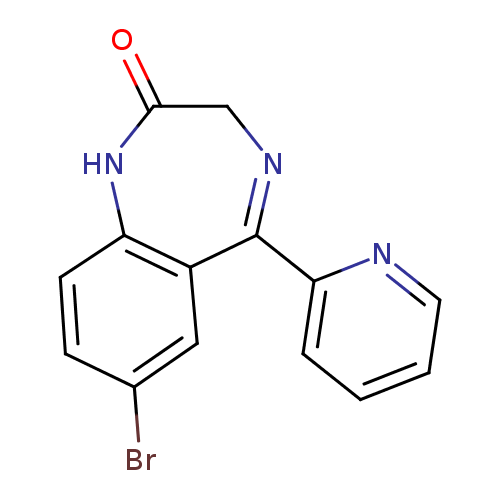
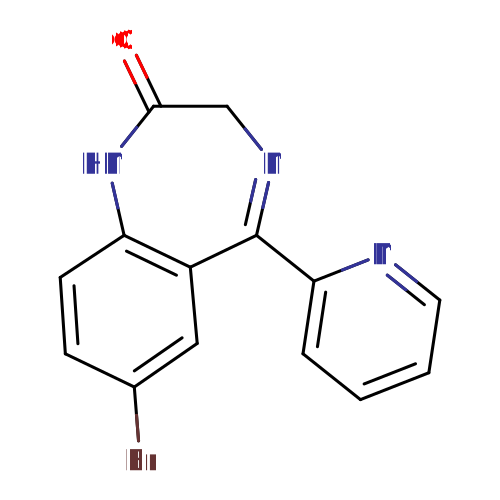
Chemical Structure
Thumb
Synonyms
ValueSource
LectopamKegg
7-Bromo-5-(2-pyridyl)-3H-1,4-benzodiaxepin-2(1H)-oneHMDB
7-Bromo-5-(2-pyridyl)-3H-1,4-benzodiazepin-2(1H)-oneHMDB
1a Brand OF bromazepamHMDB
Bromazepam lichtenstein brandHMDB
Bromazepam betaHMDB
Heumann brand OF bromazepamHMDB
LexatinHMDB
Betapharm brand OF bromazepamHMDB
Apo-bromazepamHMDB
Apotex brand OF bromazepamHMDB
Bromaz 1a pharmaHMDB
Hexal brand OF bromazepamHMDB
CT-Arzneimittel brand OF bromazepamHMDB
DurazanilHMDB
Aliud brand OF bromazepamHMDB
Apo bromazepamHMDB
Bromazepam heumannHMDB
Bromazepam ratiopharmHMDB
Bromazepam-neuraxpharmHMDB
Bromazepam-ratiopharmHMDB
Gen-bromazepamHMDB
LexomilHMDB
LexotanHMDB
Roche brand OF bromazepamHMDB
Neuraxpharm brand OF bromazepamHMDB
Ratiopharm brand OF bromazepamHMDB
AnxyrexHMDB
BromaLichHMDB
BromazanilHMDB
Bromazepam alHMDB
Bromazepam roche brandHMDB
Gen bromazepamHMDB
Genpharm brand OF bromazepamHMDB
Irex brand OF bromazepamHMDB
LexotanilHMDB
Lichtenstein brand OF bromazepamHMDB
Merck dura brand OF bromazepamHMDB
Bromazep von CTHMDB
CT Arzneimittel brand OF bromazepamHMDB
Beta, BromazepamHMDB
Bromazepam neuraxpharmHMDB
Von CT, bromazepHMDB
Chemical FormulaC14H10BrN3O
Average Molecular Mass316.153 g/mol
Monoisotopic Mass315.001 g/mol
CAS Registry Number1812-30-2
IUPAC Name7-bromo-5-(pyridin-2-yl)-2,3-dihydro-1H-1,4-benzodiazepin-2-one
Traditional Namebromazepam
SMILESBrC1=CC2=C(NC(=O)CN=C2C2=CC=CC=N2)C=C1
InChI IdentifierInChI=1S/C14H10BrN3O/c15-9-4-5-11-10(7-9)14(17-8-13(19)18-11)12-3-1-2-6-16-12/h1-7H,8H2,(H,18,19)
InChI KeyVMIYHDSEFNYJSL-UHFFFAOYSA-N
Chemical Taxonomy
Description belongs to the class of organic compounds known as 1,4-benzodiazepines. These are organic compounds containing a benzene ring fused to a 1,4-azepine.
KingdomOrganic compounds
Super ClassOrganoheterocyclic compounds
ClassBenzodiazepines
Sub Class1,4-benzodiazepines
Direct Parent1,4-benzodiazepines
Alternative Parents
Substituents
  • 1,4-benzodiazepine
  • Alpha-amino acid or derivatives
  • Aryl bromide
  • Aryl halide
  • Pyridine
  • Benzenoid
  • Heteroaromatic compound
  • Carboxamide group
  • Ketimine
  • Lactam
  • Secondary carboxylic acid amide
  • Carboxylic acid derivative
  • Azacycle
  • Organic 1,3-dipolar compound
  • Propargyl-type 1,3-dipolar organic compound
  • Organobromide
  • Organohalogen compound
  • Hydrocarbon derivative
  • Imine
  • Organic nitrogen compound
  • Organic oxide
  • Carbonyl group
  • Organonitrogen compound
  • Organooxygen compound
  • Organic oxygen compound
  • Organopnictogen compound
  • Aromatic heteropolycyclic compound
Molecular FrameworkAromatic heteropolycyclic compounds
External DescriptorsNot Available
Biological Properties
StatusDetected and Not Quantified
OriginExogenous
Cellular Locations
  • Membrane
Biofluid LocationsNot Available
Tissue LocationsNot Available
PathwaysNot Available
ApplicationsNot Available
Biological RolesNot Available
Chemical RolesNot Available
Physical Properties
StateSolid
AppearanceWhite powder.
Experimental Properties
PropertyValue
Melting PointNot Available
Boiling PointNot Available
Solubility3.99e-02 g/L
Predicted Properties
PropertyValueSource
Water Solubility0.04 g/LALOGPS
logP2.09ALOGPS
logP2.54ChemAxon
logS-3.9ALOGPS
pKa (Strongest Acidic)12.24ChemAxon
pKa (Strongest Basic)2.68ChemAxon
Physiological Charge0ChemAxon
Hydrogen Acceptor Count3ChemAxon
Hydrogen Donor Count1ChemAxon
Polar Surface Area54.35 ŲChemAxon
Rotatable Bond Count1ChemAxon
Refractivity76.99 m³·mol⁻¹ChemAxon
Polarizability28.11 ųChemAxon
Number of Rings3ChemAxon
Bioavailability1ChemAxon
Rule of FiveYesChemAxon
Ghose FilterYesChemAxon
Veber's RuleNoChemAxon
MDDR-like RuleNoChemAxon
Spectra
Spectra
Spectrum TypeDescriptionSplash KeyView
Predicted GC-MSPredicted GC-MS Spectrum - GC-MS (Non-derivatized) - 70eV, Positivesplash10-000i-0091000000-cf3c3fba2d2e801551b1Spectrum
Predicted GC-MSPredicted GC-MS Spectrum - GC-MS (Non-derivatized) - 70eV, PositiveNot AvailableSpectrum
LC-MS/MSLC-MS/MS Spectrum - LC-ESI-QFT , negativesplash10-03di-0049000000-67c4bd48b889caf68ca3Spectrum
LC-MS/MSLC-MS/MS Spectrum - LC-ESI-QFT , negativesplash10-000i-0090000000-8d6819f4db99e73f4dbeSpectrum
LC-MS/MSLC-MS/MS Spectrum - LC-ESI-QFT , negativesplash10-002r-6090000000-f5e0ef1096bea72d5c89Spectrum
LC-MS/MSLC-MS/MS Spectrum - LC-ESI-QFT , negativesplash10-004i-9010000000-19864d6c0a50c513bb18Spectrum
LC-MS/MSLC-MS/MS Spectrum - LC-ESI-QFT , negativesplash10-004i-9000000000-59557fda51a0ea2c63d7Spectrum
LC-MS/MSLC-MS/MS Spectrum - LC-ESI-QFT , negativesplash10-004i-9000000000-6b0acd4d149e1fb20f9aSpectrum
LC-MS/MSLC-MS/MS Spectrum - LC-ESI-QTOF , positivesplash10-014i-0379000000-14ceeb34a706f6a12f41Spectrum
LC-MS/MSLC-MS/MS Spectrum - LC-ESI-QFT , positivesplash10-014i-0009000000-09662342e908d558048eSpectrum
LC-MS/MSLC-MS/MS Spectrum - LC-ESI-QFT , positivesplash10-014i-0029000000-4b93291583996cb3cbdaSpectrum
LC-MS/MSLC-MS/MS Spectrum - LC-ESI-QFT , positivesplash10-05o0-0492000000-035f589c482b481c5152Spectrum
LC-MS/MSLC-MS/MS Spectrum - LC-ESI-QFT , positivesplash10-053r-1890000000-1997ad0374625359f483Spectrum
LC-MS/MSLC-MS/MS Spectrum - LC-ESI-QFT , positivesplash10-053r-1960000000-4f105348e7e7804313ceSpectrum
LC-MS/MSLC-MS/MS Spectrum - LC-ESI-QFT , positivesplash10-053r-1930000000-b0f688a41f88a133b74bSpectrum
LC-MS/MSLC-MS/MS Spectrum - LC-ESI-QFT , positivesplash10-0f89-1910000000-c0dd1d47a44a292c87b6Spectrum
LC-MS/MSLC-MS/MS Spectrum - LC-ESI-QFT , positivesplash10-0fb9-2900000000-706d4c35cde468a8387dSpectrum
LC-MS/MSLC-MS/MS Spectrum - LC-ESI-QFT , positivesplash10-004i-6900000000-85795e315602b7e61a6bSpectrum
Predicted LC-MS/MSPredicted LC-MS/MS Spectrum - 10V, Positivesplash10-014i-0019000000-9838285fc2c3cd651ac2Spectrum
Predicted LC-MS/MSPredicted LC-MS/MS Spectrum - 20V, Positivesplash10-014r-0096000000-280bb1a170e2f078b4e0Spectrum
Predicted LC-MS/MSPredicted LC-MS/MS Spectrum - 40V, Positivesplash10-000i-2090000000-b45001feb54839adf307Spectrum
Predicted LC-MS/MSPredicted LC-MS/MS Spectrum - 10V, Negativesplash10-03di-0009000000-f5383e2ca907102396d1Spectrum
Predicted LC-MS/MSPredicted LC-MS/MS Spectrum - 20V, Negativesplash10-03di-0029000000-68359119cecb7b2899e1Spectrum
Predicted LC-MS/MSPredicted LC-MS/MS Spectrum - 40V, Negativesplash10-001i-2191000000-ee5f9b155d34898671dcSpectrum
MSMass Spectrum (Electron Ionization)splash10-00n0-9463000000-abe7fdab778f08fe18c4Spectrum
Toxicity Profile
Route of ExposureBioavailability is 84% following oral administration. The time to peak plasma level is 1 - 4 hours. Bromazepam is generally well absorbed after oral administration.
Mechanism of ToxicityBromazepam binds to the GABA receptor GABAA, causing a conformational change and increasing inhibitory effects of GABA. Other neurotransmitters are not influenced.
MetabolismHepatically, via oxidative pathways (via an enzyme belonging to the Cytochrome P450 family of enzymes). One of the main metabolites is 3-hydroxybromazepam. It is pharmacologically active and the half life is similar to that of the parent compound. Route of Elimination: Urine (69%), as metabolites Half Life: 10-20 hours
Toxicity ValuesNot Available
Lethal DoseNot Available
Carcinogenicity (IARC Classification)No indication of carcinogenicity to humans (not listed by IARC).
Uses/SourcesFor the short-term treatment of insomnia, short-term treatment of anxiety or panic attacks, if a benzodiazepine is required, and the alleviation of the symptoms of alcohol- and opiate-withdrawal.
Minimum Risk LevelNot Available
Health EffectsThey cause slurred speech, disorientation and "drunken" behavior. They are physically and psychologically addictive.
SymptomsNot Available
TreatmentGeneral supportive measures should be employed, along with intravenous fluids, and an adequate airway maintained. Hypotension may be combated by the use of norepinephrine or metaraminol. Dialysis is of limited value. Flumazenil (Anexate) is a competitive benzodiazepine receptor antagonist that can be used as an antidote for benzodiazepine overdose. In particular, flumazenil is very effective at reversing the CNS depression associated with benzodiazepines but is less effective at reversing respiratory depression. Its use, however, is controversial as it has numerous contraindications. It is contraindicated in patients who are on long-term benzodiazepines, those who have ingested a substance that lowers the seizure threshold, or in patients who have tachycardia or a history of seizures. As a general rule, medical observation and supportive care are the mainstay of treatment of benzodiazepine overdose. Although benzodiazepines are absorbed by activated charcoal, gastric decontamination with activated charcoal is not beneficial in pure benzodiazepine overdose as the risk of adverse effects often outweigh any potential benefit from the procedure. It is recommended only if benzodiazepines have been taken in combination with other drugs that may benefit from decontamination. Gastric lavage (stomach pumping) or whole bowel irrigation are also not recommended.
Concentrations
Not Available
DrugBank IDDB01558
HMDB IDHMDB0015511
FooDB IDNot Available
Phenol Explorer IDNot Available
KNApSAcK IDNot Available
BiGG IDNot Available
BioCyc IDNot Available
METLIN IDNot Available
PDB IDNot Available
Wikipedia LinkBromazepam
Chemspider ID2347
ChEBI ID116960
PubChem Compound ID2441
Kegg Compound IDNot Available
YMDB IDNot Available
ECMDB IDNot Available
References
Synthesis ReferenceNot Available
MSDSNot Available
General References
1. Oelschlager H: [Chemical and pharmacologic aspects of benzodiazepines]. Schweiz Rundsch Med Prax. 1989 Jul 4;78(27-28):766-72.
2. Ochs HR, Greenblatt DJ, Friedman H, Burstein ES, Locniskar A, Harmatz JS, Shader RI: Bromazepam pharmacokinetics: influence of age, gender, oral contraceptives, cimetidine, and propranolol. Clin Pharmacol Ther. 1987 May;41(5):562-70.
3. van Harten J: Overview of the pharmacokinetics of fluvoxamine. Clin Pharmacokinet. 1995;29 Suppl 1:1-9.
4. Oda M, Kotegawa T, Tsutsumi K, Ohtani Y, Kuwatani K, Nakano S: The effect of itraconazole on the pharmacokinetics and pharmacodynamics of bromazepam in healthy volunteers. Eur J Clin Pharmacol. 2003 Nov;59(8-9):615-9. Epub 2003 Sep 27.