Record Information
Version1.0
Creation Date2009-07-21 20:28:51 UTC
Update Date2026-05-14 17:08:00 UTC
Accession NumberCHEM002395
Identification
Common NameFlunitrazepam
ClassSmall Molecule
DescriptionA benzodiazepine with pharmacologic actions similar to those of diazepam that can cause anterograde amnesia. Some reports indicate that it is used as a date rape drug and suggest that it may precipitate violent behavior. The United States Government has banned the importation of this drug. [PubChem]
Contaminant Sources
  • HMDB Contaminants - Urine
  • STOFF IDENT Compounds
  • Suspected Compounds
  • T3DB toxins
Contaminant Type
  • Amide
  • Amine
  • Anti-Anxiety Agent
  • Benzodiazepine
  • Drug
  • GABA Modulator
  • Human Neurotoxin
  • Hypnotic and Sedative
  • Metabolite
  • Organic Compound
  • Organofluoride
  • Synthetic Compound
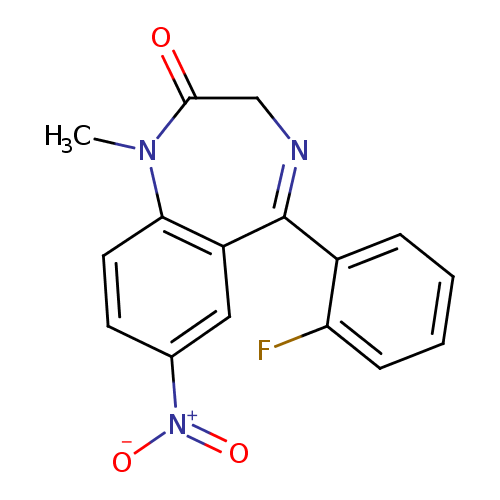
Chemical Structure
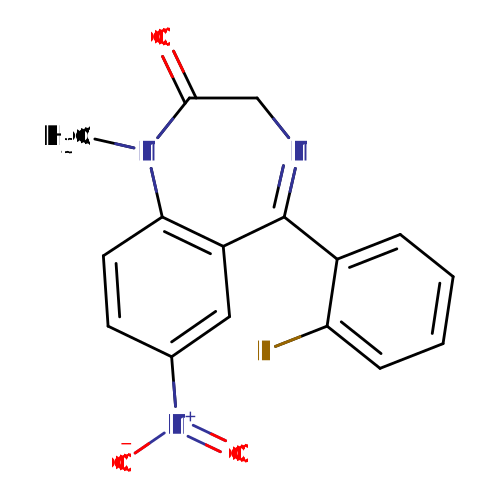
Thumb
Synonyms
ValueSource
1,3-Dihydro-5-(O-fluorophenyl)-1-methyl-7-nitro-2H-1,4-benzodiazepin-2-oneChEBI
1-Methyl-7-nitro-5-(2-fluorophenyl)-3H-1,4-benzodiazepin-2(1H)-oneChEBI
5-(O-Fluorophenyl)-1,3-dihydro-1-methyl-7-nitro-2H-1,4-benzodiazepin-2-oneChEBI
FlunidazepamChEBI
FluninocChEBI
FlunipamChEBI
FlunitaChEBI
FlunitrazepamumChEBI
FluridrazepamChEBI
FluscandChEBI
HipnosedonChEBI
HypnodormChEBI
HypnorChEBI
NarcozepChEBI
PrimumChEBI
RO 5-4200ChEBI
RO-5-4200ChEBI
RO-54200ChEBI
RO54200ChEBI
RohypnolChEBI
RoipnolChEBI
SileceChEBI
ValseraChEBI
1a Brand OF flunitrazepamHMDB
Flunitrazepam ratiopharmHMDB
Flunitrazepam-tevaHMDB
Flunitrazepam-neuraxpharmHMDB
Hexal brand OF flunitrazepamHMDB
Roche brand OF flunitrazepamHMDB
Neuraxpharm brand OF flunitrazepamHMDB
Ratiopharm brand OF flunitrazepamHMDB
Fluni 1a pharmaHMDB
CT Arzneimittel brand OF flunitrazepamHMDB
FlunimerckHMDB
Flunitrazepam tevaHMDB
Flunitrazepam neuraxpharmHMDB
Flunitrazepam-ratiopharmHMDB
RohipnolHMDB
Teva brand OF flunitrazepamHMDB
Betapharm brand OF flunitrazepamHMDB
FlunibetaHMDB
Merck dura brand OF flunitrazepamHMDB
CT-Arzneimittel brand OF flunitrazepamHMDB
Flunizep von CTHMDB
Von CT, flunizepHMDB
Chemical FormulaC16H12FN3O3
Average Molecular Mass313.283 g/mol
Monoisotopic Mass313.086 g/mol
CAS Registry Number1622-62-4
IUPAC Name5-(2-fluorophenyl)-1-methyl-7-nitro-2,3-dihydro-1H-1,4-benzodiazepin-2-one
Traditional Nameflunitrazepam
SMILESCN1C2=C(C=C(C=C2)[N+]([O-])=O)C(=NCC1=O)C1=CC=CC=C1F
InChI IdentifierInChI=1S/C16H12FN3O3/c1-19-14-7-6-10(20(22)23)8-12(14)16(18-9-15(19)21)11-4-2-3-5-13(11)17/h2-8H,9H2,1H3
InChI KeyPPTYJKAXVCCBDU-UHFFFAOYSA-N
Chemical Taxonomy
Description belongs to the class of organic compounds known as 1,4-benzodiazepines. These are organic compounds containing a benzene ring fused to a 1,4-azepine.
KingdomOrganic compounds
Super ClassOrganoheterocyclic compounds
ClassBenzodiazepines
Sub Class1,4-benzodiazepines
Direct Parent1,4-benzodiazepines
Alternative Parents
Substituents
  • 1,4-benzodiazepine
  • Alpha-amino acid or derivatives
  • Nitroaromatic compound
  • Fluorobenzene
  • Halobenzene
  • Aryl fluoride
  • Aryl halide
  • Monocyclic benzene moiety
  • Benzenoid
  • Tertiary carboxylic acid amide
  • Organic nitro compound
  • Carboxamide group
  • Ketimine
  • Lactam
  • C-nitro compound
  • Azacycle
  • Organic 1,3-dipolar compound
  • Carboxylic acid derivative
  • Propargyl-type 1,3-dipolar organic compound
  • Allyl-type 1,3-dipolar organic compound
  • Organic oxoazanium
  • Organopnictogen compound
  • Imine
  • Organic nitrogen compound
  • Hydrocarbon derivative
  • Organic oxide
  • Organic oxygen compound
  • Organooxygen compound
  • Organohalogen compound
  • Carbonyl group
  • Organofluoride
  • Organonitrogen compound
  • Aromatic heteropolycyclic compound
Molecular FrameworkAromatic heteropolycyclic compounds
External DescriptorsNot Available
Biological Properties
StatusDetected and Not Quantified
OriginExogenous
Cellular Locations
  • Cytoplasm
  • Membrane
Biofluid LocationsNot Available
Tissue LocationsNot Available
PathwaysNot Available
ApplicationsNot Available
Biological RolesNot Available
Chemical RolesNot Available
Physical Properties
StateSolid
AppearanceWhite powder.
Experimental Properties
PropertyValue
Melting Point166-167°C
Boiling PointNot Available
Solubility8.58e-03 g/L
Predicted Properties
PropertyValueSource
Water Solubility0.0086 g/LALOGPS
logP2.2ALOGPS
logP2.55ChemAxon
logS-4.6ALOGPS
pKa (Strongest Basic)1.7ChemAxon
Physiological Charge0ChemAxon
Hydrogen Acceptor Count4ChemAxon
Hydrogen Donor Count0ChemAxon
Polar Surface Area78.49 ŲChemAxon
Rotatable Bond Count2ChemAxon
Refractivity82.55 m³·mol⁻¹ChemAxon
Polarizability29.6 ųChemAxon
Number of Rings3ChemAxon
Bioavailability1ChemAxon
Rule of FiveYesChemAxon
Ghose FilterYesChemAxon
Veber's RuleNoChemAxon
MDDR-like RuleNoChemAxon
Spectra
Spectra
Spectrum TypeDescriptionSplash KeyView
Predicted GC-MSPredicted GC-MS Spectrum - GC-MS (Non-derivatized) - 70eV, Positivesplash10-03du-2191000000-6d65c6a7646264996d7cSpectrum
Predicted GC-MSPredicted GC-MS Spectrum - GC-MS (Non-derivatized) - 70eV, PositiveNot AvailableSpectrum
LC-MS/MSLC-MS/MS Spectrum - LC-ESI-QTOF , positivesplash10-03di-0009000000-d3cdbd0e6db0ff7d3658Spectrum
LC-MS/MSLC-MS/MS Spectrum - LC-ESI-QTOF , positivesplash10-02t9-0098000000-ed4fc29ca5e103e7e7acSpectrum
LC-MS/MSLC-MS/MS Spectrum - LC-ESI-QTOF , positivesplash10-014i-0292000000-910e58767edf9829ae76Spectrum
LC-MS/MSLC-MS/MS Spectrum - LC-ESI-QTOF , positivesplash10-000i-0590000000-f32a6119c0a1af4b09f1Spectrum
LC-MS/MSLC-MS/MS Spectrum - LC-ESI-QFT , positivesplash10-03di-0009000000-0917b69ebd96bce7d228Spectrum
LC-MS/MSLC-MS/MS Spectrum - LC-ESI-QFT , positivesplash10-03di-0009000000-52198b26a21902b1164dSpectrum
LC-MS/MSLC-MS/MS Spectrum - LC-ESI-QFT , positivesplash10-02t9-0095000000-6905e6ef41a999c5c6bbSpectrum
LC-MS/MSLC-MS/MS Spectrum - LC-ESI-QFT , positivesplash10-014r-0291000000-05daa60855227774f98aSpectrum
LC-MS/MSLC-MS/MS Spectrum - LC-ESI-QFT , positivesplash10-01p9-0590000000-1dc724d4ffca2a0dcc87Spectrum
LC-MS/MSLC-MS/MS Spectrum - LC-ESI-QFT , positivesplash10-0230-0970000000-c801330e64d95e44fce8Spectrum
LC-MS/MSLC-MS/MS Spectrum - LC-ESI-QFT , positivesplash10-00si-1920000000-6d855cf670784a504122Spectrum
LC-MS/MSLC-MS/MS Spectrum - LC-ESI-QFT , positivesplash10-001i-2910000000-ab0a5646c93755d78538Spectrum
LC-MS/MSLC-MS/MS Spectrum - LC-ESI-QFT , positivesplash10-0gx0-3900000000-0e0998c190e076f40d1bSpectrum
LC-MS/MSLC-MS/MS Spectrum - 30V, Positivesplash10-02t9-0089000000-cd60ffdaaa581557c2e0Spectrum
LC-MS/MSLC-MS/MS Spectrum - 75V, Positivesplash10-01p9-0590000000-2d293fa78f79ead8809dSpectrum
LC-MS/MSLC-MS/MS Spectrum - 60V, Positivesplash10-014r-0191000000-8795ce46cab22c3d13f3Spectrum
LC-MS/MSLC-MS/MS Spectrum - 15V, Positivesplash10-03di-0009000000-0917b69ebd96bce7d228Spectrum
LC-MS/MSLC-MS/MS Spectrum - 90V, Positivesplash10-0230-0970000000-36b73fbbe050671180caSpectrum
LC-MS/MSLC-MS/MS Spectrum - 50V, Positivesplash10-000i-0590000000-2edbc58a7f6027ae8785Spectrum
Predicted LC-MS/MSPredicted LC-MS/MS Spectrum - 10V, Positivesplash10-03di-0009000000-93aa3b8655f147913878Spectrum
Predicted LC-MS/MSPredicted LC-MS/MS Spectrum - 20V, Positivesplash10-03di-0039000000-2c09292b786206e62c27Spectrum
Predicted LC-MS/MSPredicted LC-MS/MS Spectrum - 40V, Positivesplash10-07vl-3922000000-a46dddc6a35eee14faf9Spectrum
Predicted LC-MS/MSPredicted LC-MS/MS Spectrum - 10V, Negativesplash10-03di-0009000000-de2d40c51a7b8e4bb054Spectrum
Predicted LC-MS/MSPredicted LC-MS/MS Spectrum - 20V, Negativesplash10-03di-0009000000-d6e19246eb2e60003f64Spectrum
Predicted LC-MS/MSPredicted LC-MS/MS Spectrum - 40V, Negativesplash10-0a4i-9001000000-8593a33f1e3dc94a81c5Spectrum
MSMass Spectrum (Electron Ionization)splash10-01p9-2393000000-5d873203e4acf1211838Spectrum
Toxicity Profile
Route of Exposure50% (suppository) and 64-77% (oral)
Mechanism of ToxicityBenzodiazepines bind nonspecifically to benzodiazepine receptors BNZ1, which mediates sleep, and BNZ2, which affects affects muscle relaxation, anticonvulsant activity, motor coordination, and memory. As benzodiazepine receptors are thought to be coupled to gamma-aminobutyric acid-A (GABAA) receptors, this enhances the effects of GABA by increasing GABA affinity for the GABA receptor. Binding of the inhibitory neurotransmitter GABA to the site opens the chloride channel, resulting in a hyperpolarized cell membrane that prevents further excitation of the cell.
MetabolismHepatic. Half Life: 18-26 hours
Toxicity ValuesNot Available
Lethal DoseNot Available
Carcinogenicity (IARC Classification)No indication of carcinogenicity to humans (not listed by IARC).
Uses/SourcesFor short-term treatment of severe insomnias, that are not responsive to other hypnotics. Not approved by the FDA in the U.S. In the U.K. it is used (and available only by private prescription) in some hospitals to sedate patients undergoing colonoscopy. In Norway, flunitrazepam is available as a prescription drug to treat insomnia under the brand name Flunipam 1 mg. [Wikipedia]
Minimum Risk LevelNot Available
Health EffectsThey cause slurred speech, disorientation and "drunken" behavior. They are physically and psychologically addictive.
SymptomsSymptoms of overdose include confusion, coma, impaired coordination, sleepiness, and slowed reaction time.
TreatmentGeneral supportive measures should be employed, along with intravenous fluids, and an adequate airway maintained. Hypotension may be combated by the use of norepinephrine or metaraminol. Dialysis is of limited value. Flumazenil (Anexate) is a competitive benzodiazepine receptor antagonist that can be used as an antidote for benzodiazepine overdose. In particular, flumazenil is very effective at reversing the CNS depression associated with benzodiazepines but is less effective at reversing respiratory depression. Its use, however, is controversial as it has numerous contraindications. It is contraindicated in patients who are on long-term benzodiazepines, those who have ingested a substance that lowers the seizure threshold, or in patients who have tachycardia or a history of seizures. As a general rule, medical observation and supportive care are the mainstay of treatment of benzodiazepine overdose. Although benzodiazepines are absorbed by activated charcoal, gastric decontamination with activated charcoal is not beneficial in pure benzodiazepine overdose as the risk of adverse effects often outweigh any potential benefit from the procedure. It is recommended only if benzodiazepines have been taken in combination with other drugs that may benefit from decontamination. Gastric lavage (stomach pumping) or whole bowel irrigation are also not recommended.
Concentrations
Not Available
DrugBank IDDB01544
HMDB IDHMDB0015510
FooDB IDNot Available
Phenol Explorer IDNot Available
KNApSAcK IDNot Available
BiGG IDNot Available
BioCyc IDNot Available
METLIN IDNot Available
PDB IDNot Available
Wikipedia LinkFlunitrazepam
Chemspider ID3263
ChEBI ID111715
PubChem Compound ID3380
Kegg Compound IDNot Available
YMDB IDNot Available
ECMDB IDNot Available
References
Synthesis Reference

Kariss, J. and Newmark, H.L.; U.S. Patent 3,116,203; December 31, 1963; assigned to Hoffmann-la Roche Inc.
 Kariss, J. and Newmark, H.L.; US. Patent 3,123,529; March 3,1964; assigned to Hoffmann-La Roche Inc. 
Keiler, O., Steiger, N. and Sternbach, L.H.; U.S. Patent 3,203,990; August 31, 1965; assigned to Hoffmann-La Roche Inc.

MSDSNot Available
General References
1. Oelschlager H: [Chemical and pharmacologic aspects of benzodiazepines]. Schweiz Rundsch Med Prax. 1989 Jul 4;78(27-28):766-72.
2. Rickels K: The clinical use of hypnotics: indications for use and the need for a variety of hypnotics. Acta Psychiatr Scand Suppl. 1986;332:132-41.
3. Robertson MD, Drummer OH: Postmortem drug metabolism by bacteria. J Forensic Sci. 1995 May;40(3):382-6.
4. Usami N, Yamamoto T, Shintani S, Ishikura S, Higaki Y, Katagiri Y, Hara A: Substrate specificity of human 3(20)alpha-hydroxysteroid dehydrogenase for neurosteroids and its inhibition by benzodiazepines. Biol Pharm Bull. 2002 Apr;25(4):441-5.
5. Tokunaga S, Takeda Y, Shinomiya K, Hirase M, Kamei C: Effects of some H1-antagonists on the sleep-wake cycle in sleep-disturbed rats. J Pharmacol Sci. 2007 Feb;103(2):201-6. Epub 2007 Feb 8.
6. https://www.ncbi.nlm.nih.gov/pubmed/?term=11393809
7. https://www.ncbi.nlm.nih.gov/pubmed/?term=17889
8. https://www.ncbi.nlm.nih.gov/pubmed/?term=18070
9. https://www.ncbi.nlm.nih.gov/pubmed/?term=19839
10. https://www.ncbi.nlm.nih.gov/pubmed/?term=23506
11. https://www.ncbi.nlm.nih.gov/pubmed/?term=23971077
12. https://www.ncbi.nlm.nih.gov/pubmed/?term=25467462
13. https://www.ncbi.nlm.nih.gov/pubmed/?term=25895512
14. https://www.ncbi.nlm.nih.gov/pubmed/?term=26990972
15. https://www.ncbi.nlm.nih.gov/pubmed/?term=27143233
16. https://www.ncbi.nlm.nih.gov/pubmed/?term=27747877
17. https://www.ncbi.nlm.nih.gov/pubmed/?term=27778423
18. https://www.ncbi.nlm.nih.gov/pubmed/?term=28403803
19. https://www.ncbi.nlm.nih.gov/pubmed/?term=29657737
20. https://www.ncbi.nlm.nih.gov/pubmed/?term=29713800
21. https://www.ncbi.nlm.nih.gov/pubmed/?term=30870640
22. https://www.ncbi.nlm.nih.gov/pubmed/?term=31233253
23. https://www.ncbi.nlm.nih.gov/pubmed/?term=31512527
24. https://www.ncbi.nlm.nih.gov/pubmed/?term=31679602
25. https://www.ncbi.nlm.nih.gov/pubmed/?term=862358