Record Information
Version1.0
Creation Date2009-07-21 20:28:42 UTC
Update Date2026-05-14 16:58:57 UTC
Accession NumberCHEM002382
Identification
Common NameL-Dopa
ClassSmall Molecule
DescriptionL-Dopa is used for the treatment of Parkinsonian disorders and Dopa-Responsive Dystonia and is usually given with agents that inhibit its conversion to dopamine outside of the central nervous system. Peripheral tissue conversion may be the mechanism of the adverse effects of levodopa. It is standard clinical practice to co-administer a peripheral DOPA decarboxylase inhibitor - carbidopa or benserazide - and often a catechol-O-methyl transferase (COMT) inhibitor, to prevent synthesis of dopamine in peripheral tissue. The naturally occurring form of dihydroxyphenylalanine and the immediate precursor of dopamine. Unlike dopamine itself, it can be taken orally and crosses the blood-brain barrier. It is rapidly taken up by dopaminergic neurons and converted to dopamine. It is used for the treatment of parkinsonian disorders and is usually given with agents that inhibit its conversion to dopamine outside of the central nervous system. [PubChem] L-Dopa is the naturally occurring form of dihydroxyphenylalanine and the immediate precursor of dopamine. Unlike dopamine itself, L-Dopa can be taken orally and crosses the blood-brain barrier. It is rapidly taken up by dopaminergic neurons and converted to dopamine. In particular, it is metabolized to dopamine by aromatic L-amino acid decarboxylase. Pyridoxal phosphate (vitamin B6) is a required cofactor for this decarboxylation, and may be administered along with levodopa, usually as pyridoxine.
Contaminant Sources
  • FooDB Chemicals
  • HMDB Contaminants - Urine
  • STOFF IDENT Compounds
  • Suspected Compounds - Waste Water
  • T3DB toxins
  • ToxCast & Tox21 Chemicals
Contaminant Type
  • Amine
  • Antidyskinetic
  • Antiparkinson Agent
  • Dopamine Agent
  • Drug
  • Food Toxin
  • Metabolite
  • Natural Compound
  • Organic Compound
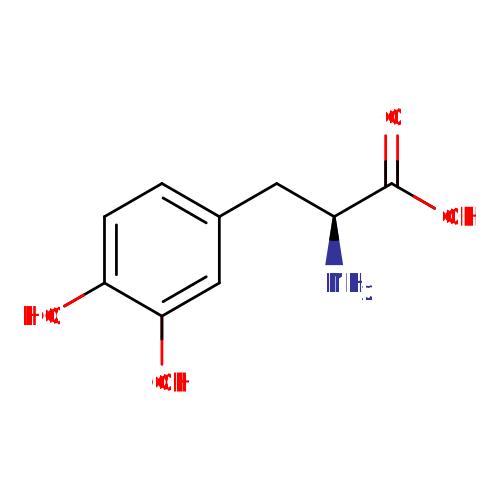
Chemical Structure
Thumb
Synonyms
ValueSource
(-)-3-(3,4-Dihydroxyphenyl)-L-alanineChEBI
(-)-DopaChEBI
3,4-Dihydroxy-L-phenylalanineChEBI
3,4-DIHYDROXYPHENYLALANINEChEBI
3-Hydroxy-L-tyrosineChEBI
beta-(3,4-Dihydroxyphenyl)-L-alanineChEBI
beta-(3,4-Dihydroxyphenyl)alanineChEBI
Dihydroxy-L-phenylalanineChEBI
DoparChEBI
L-beta-(3,4-Dihydroxyphenyl)alanineChEBI
LevodopaChEBI
LevodopumChEBI
b-(3,4-Dihydroxyphenyl)-L-alanineGenerator
Β-(3,4-dihydroxyphenyl)-L-alanineGenerator
b-(3,4-Dihydroxyphenyl)alanineGenerator
Β-(3,4-dihydroxyphenyl)alanineGenerator
L-b-(3,4-Dihydroxyphenyl)alanineGenerator
L-Β-(3,4-dihydroxyphenyl)alanineGenerator
(2S)-2-Amino-3-(3,4-dihydroxyphenyl)propanoateHMDB
(2S)-2-Amino-3-(3,4-dihydroxyphenyl)propanoic acidHMDB
3,4-Dihydroxyphenyl-L-alanineHMDB
3-(3,4-Dihydroxyphenyl)-L-alanineHMDB
b-(3,4-Dihydroxyphenyl)-a-L-alanineHMDB
BendopaHMDB
beta-(3,4-Dihydroxyphenyl)-alpha-L-alanineHMDB
CidandopaHMDB
DihydroxyphenylalanineHMDB
DopaflexHMDB
DopaidanHMDB
DopalHMDB
DopalinaHMDB
DoparkineHMDB
DoparlHMDB
DopasolHMDB
DopastonHMDB
DopastoneHMDB
DopastralHMDB
DopicarHMDB
DoprinHMDB
EldopalHMDB
EldoparHMDB
EldopatecHMDB
EurodopaHMDB
Helfo-dopaHMDB
InsulaminaHMDB
L-(-)-DopaHMDB
L-3-(3,4-Dihydroxyphenyl)-alanineHMDB
L-4-5-DihydroxyphenylalanineHMDB
L-b-(3,4-Dihydroxyphenyl)-a-alanineHMDB
L-beta-(3,4-Dihydroxyphenyl)-alpha-alanineHMDB
L-DihydroxyphenylalanineHMDB
LaradopaHMDB
LarodopaHMDB
LedopaHMDB
LevedopaHMDB
LevopaHMDB
MaipedopaHMDB
PardaHMDB
PardopaHMDB
ProdopaHMDB
SyndopaHMDB
VeldopaHMDB
WeldopaHMDB
3 Hydroxy L tyrosineHMDB
Roche brand OF levodopaHMDB
L 3,4 DihydroxyphenylalanineHMDB
L-3,4-DihydroxyphenylalanineHMDB
Medphano brand OF levodopaHMDB
L DopaHMDB
Roberts brand OF levodopaHMDB
Chemical FormulaC9H11NO4
Average Molecular Mass197.188 g/mol
Monoisotopic Mass197.069 g/mol
CAS Registry Number59-92-7
IUPAC Name(2S)-2-amino-3-(3,4-dihydroxyphenyl)propanoic acid
Traditional Namelevodopa
SMILESN[C@@H](CC1=CC(O)=C(O)C=C1)C(O)=O
InChI IdentifierInChI=1S/C9H11NO4/c10-6(9(13)14)3-5-1-2-7(11)8(12)4-5/h1-2,4,6,11-12H,3,10H2,(H,13,14)/t6-/m0/s1
InChI KeyWTDRDQBEARUVNC-LURJTMIESA-N
Chemical Taxonomy
Description belongs to the class of organic compounds known as tyrosine and derivatives. Tyrosine and derivatives are compounds containing tyrosine or a derivative thereof resulting from reaction of tyrosine at the amino group or the carboxy group, or from the replacement of any hydrogen of glycine by a heteroatom.
KingdomOrganic compounds
Super ClassOrganic acids and derivatives
ClassCarboxylic acids and derivatives
Sub ClassAmino acids, peptides, and analogues
Direct ParentTyrosine and derivatives
Alternative Parents
Substituents
  • Tyrosine or derivatives
  • Phenylalanine or derivatives
  • 3-phenylpropanoic-acid
  • Alpha-amino acid
  • Amphetamine or derivatives
  • L-alpha-amino acid
  • Catechol
  • 1-hydroxy-4-unsubstituted benzenoid
  • Aralkylamine
  • 1-hydroxy-2-unsubstituted benzenoid
  • Phenol
  • Monocyclic benzene moiety
  • Benzenoid
  • Amino acid
  • Carboxylic acid
  • Monocarboxylic acid or derivatives
  • Organic oxide
  • Organooxygen compound
  • Organonitrogen compound
  • Primary amine
  • Primary aliphatic amine
  • Organic nitrogen compound
  • Organic oxygen compound
  • Carbonyl group
  • Hydrocarbon derivative
  • Organopnictogen compound
  • Amine
  • Aromatic homomonocyclic compound
Molecular FrameworkAromatic homomonocyclic compounds
External Descriptors
Biological Properties
StatusDetected and Not Quantified
OriginEndogenous
Cellular Locations
  • Cytoplasm
  • Extracellular
Biofluid LocationsNot Available
Tissue Locations
  • Adrenal Medulla
  • Bladder
  • Brain
  • Epidermis
  • Intestine
  • Muscle
  • Nerve Cells
  • Neuron
  • Placenta
  • Platelet
  • Prostate
  • Striatum
Pathways
NameSMPDB LinkKEGG Link
Tryptophan MetabolismSMP00063 map00380
Catecholamine BiosynthesisSMP00012 map00350
Tyrosine MetabolismSMP00006 map00350
Aromatic L-Aminoacid Decarboxylase DeficiencySMP00170 Not Available
Applications
Biological Roles
Chemical RolesNot Available
Physical Properties
StateSolid
AppearanceWhite powder.
Experimental Properties
PropertyValue
Melting Point284-285°C
Boiling PointNot Available
Solubility5000 mg/L (at 20°C)
Predicted Properties
PropertyValueSource
logP-1.8ChemAxon
pKa (Strongest Acidic)1.65ChemAxon
pKa (Strongest Basic)9.06ChemAxon
Physiological Charge0ChemAxon
Hydrogen Acceptor Count5ChemAxon
Hydrogen Donor Count4ChemAxon
Polar Surface Area103.78 ŲChemAxon
Rotatable Bond Count3ChemAxon
Refractivity49.08 m³·mol⁻¹ChemAxon
Polarizability18.91 ųChemAxon
Number of Rings1ChemAxon
Bioavailability1ChemAxon
Rule of FiveYesChemAxon
Ghose FilterNoChemAxon
Veber's RuleNoChemAxon
MDDR-like RuleNoChemAxon
Spectra
Spectra
Spectrum TypeDescriptionSplash KeyView
GC-MSGC-MS Spectrum - GC-EI-TOF (Pegasus III TOF-MS system, Leco; GC 6890, Agilent Technologies) (4 TMS)splash10-014i-0790000000-b2f7f063a2c8197c7eddSpectrum
GC-MSGC-MS Spectrum - GC-EI-TOF (Pegasus III TOF-MS system, Leco; GC 6890, Agilent Technologies) (Non-derivatized)splash10-014i-0690000000-622497b3104c6082a45dSpectrum
GC-MSGC-MS Spectrum - GC-EI-TOF (Pegasus III TOF-MS system, Leco; GC 6890, Agilent Technologies) (4 TMS)splash10-00xr-9350000000-b0cc4636931d2de64d81Spectrum
GC-MSGC-MS Spectrum - GC-MS (4 TMS)splash10-014i-0590000000-4474e81e4226bb4e1d4cSpectrum
GC-MSGC-MS Spectrum - GC-EI-TOF (Non-derivatized)splash10-014i-0790000000-b2f7f063a2c8197c7eddSpectrum
GC-MSGC-MS Spectrum - GC-EI-TOF (Non-derivatized)splash10-014i-0690000000-622497b3104c6082a45dSpectrum
GC-MSGC-MS Spectrum - GC-EI-TOF (Non-derivatized)splash10-00xr-9350000000-b0cc4636931d2de64d81Spectrum
GC-MSGC-MS Spectrum - GC-MS (Non-derivatized)splash10-014i-0590000000-4474e81e4226bb4e1d4cSpectrum
GC-MSGC-MS Spectrum - GC-EI-TOF (Non-derivatized)splash10-014i-1890000000-646d209fa1943582a336Spectrum
GC-MSGC-MS Spectrum - GC-EI-TOF (Non-derivatized)splash10-014i-0690000000-720ed87e98a0d9f1721dSpectrum
Predicted GC-MSPredicted GC-MS Spectrum - GC-MS (Non-derivatized) - 70eV, Positivesplash10-0fk9-3900000000-266d9baeda773fe1fb22Spectrum
Predicted GC-MSPredicted GC-MS Spectrum - GC-MS (3 TMS) - 70eV, Positivesplash10-0002-4193000000-8c76bf85d8a897e9403cSpectrum
Predicted GC-MSPredicted GC-MS Spectrum - GC-MS (Non-derivatized) - 70eV, PositiveNot AvailableSpectrum
Predicted GC-MSPredicted GC-MS Spectrum - GC-MS (TMS_1_1) - 70eV, PositiveNot AvailableSpectrum
Predicted GC-MSPredicted GC-MS Spectrum - GC-MS (TMS_1_2) - 70eV, PositiveNot AvailableSpectrum
Predicted GC-MSPredicted GC-MS Spectrum - GC-MS (TMS_1_3) - 70eV, PositiveNot AvailableSpectrum
Predicted GC-MSPredicted GC-MS Spectrum - GC-MS (TMS_1_4) - 70eV, PositiveNot AvailableSpectrum
Predicted GC-MSPredicted GC-MS Spectrum - GC-MS (TMS_2_1) - 70eV, PositiveNot AvailableSpectrum
Predicted GC-MSPredicted GC-MS Spectrum - GC-MS (TMS_2_2) - 70eV, PositiveNot AvailableSpectrum
Predicted GC-MSPredicted GC-MS Spectrum - GC-MS (TMS_2_3) - 70eV, PositiveNot AvailableSpectrum
Predicted GC-MSPredicted GC-MS Spectrum - GC-MS (TMS_2_4) - 70eV, PositiveNot AvailableSpectrum
Predicted GC-MSPredicted GC-MS Spectrum - GC-MS (TMS_2_5) - 70eV, PositiveNot AvailableSpectrum
Predicted GC-MSPredicted GC-MS Spectrum - GC-MS (TMS_2_6) - 70eV, PositiveNot AvailableSpectrum
Predicted GC-MSPredicted GC-MS Spectrum - GC-MS (TMS_2_7) - 70eV, PositiveNot AvailableSpectrum
Predicted GC-MSPredicted GC-MS Spectrum - GC-MS (TMS_3_2) - 70eV, PositiveNot AvailableSpectrum
LC-MS/MSLC-MS/MS Spectrum - Quattro_QQQ 10V, Positive (Annotated)splash10-0uea-0900000000-8eb71aa0cc8622f097a2Spectrum
LC-MS/MSLC-MS/MS Spectrum - Quattro_QQQ 25V, Positive (Annotated)splash10-0a59-2900000000-bf63b9b719959b82b543Spectrum
LC-MS/MSLC-MS/MS Spectrum - Quattro_QQQ 40V, Positive (Annotated)splash10-056r-9300000000-a78b0b31dd33fe8479a7Spectrum
LC-MS/MSLC-MS/MS Spectrum - LC-ESI-ITFT (LTQ Orbitrap XL, Thermo Scientfic) , Positivesplash10-0f6t-0911000000-15affa616923dfb9c45aSpectrum
LC-MS/MSLC-MS/MS Spectrum - LC-ESI-ITFT (LTQ Orbitrap XL, Thermo Scientfic) , Positivesplash10-000i-0900000000-22d8267801d0eb0b73c2Spectrum
LC-MS/MSLC-MS/MS Spectrum - LC-ESI-ITFT (LTQ Orbitrap XL, Thermo Scientfic) , Positivesplash10-001i-0900000000-2c310034a1a871502b4cSpectrum
LC-MS/MSLC-MS/MS Spectrum - LC-ESI-ITFT (LTQ Orbitrap XL, Thermo Scientfic) , Positivesplash10-0udi-0900000000-5e6020c952f741531fcbSpectrum
LC-MS/MSLC-MS/MS Spectrum - LC-ESI-ITFT (LTQ Orbitrap XL, Thermo Scientfic) , Positivesplash10-0007-0970100000-49594dae82ce73e734e6Spectrum
LC-MS/MSLC-MS/MS Spectrum - LC-ESI-ITFT (LTQ Orbitrap XL, Thermo Scientfic) , Positivesplash10-001i-0900000000-2183a68f58b951f3f1c7Spectrum
LC-MS/MSLC-MS/MS Spectrum - LC-ESI-ITFT (LTQ Orbitrap XL, Thermo Scientfic) , Positivesplash10-03di-0900000000-0030db588fbd92c5b761Spectrum
LC-MS/MSLC-MS/MS Spectrum - LC-ESI-ITFT (LTQ Orbitrap XL, Thermo Scientfic) , Positivesplash10-0006-0090000000-544615463a975baae9e4Spectrum
LC-MS/MSLC-MS/MS Spectrum - LC-ESI-ITFT (LTQ Orbitrap XL, Thermo Scientfic) , Negativesplash10-0002-0729111000-0a20b01f58fff8ad7ef0Spectrum
LC-MS/MSLC-MS/MS Spectrum - LC-ESI-ITFT (LTQ Orbitrap XL, Thermo Scientfic) , Negativesplash10-004i-0900000000-c8095a31ed4b3dbbc646Spectrum
LC-MS/MSLC-MS/MS Spectrum - LC-ESI-ITFT (LTQ Orbitrap XL, Thermo Scientfic) , Negativesplash10-03di-0190000000-41515cba3a6929721859Spectrum
LC-MS/MSLC-MS/MS Spectrum - LC-ESI-ITFT (LTQ Orbitrap XL, Thermo Scientfic) , Negativesplash10-0002-0900000000-8074c509ef5bae1129fcSpectrum
LC-MS/MSLC-MS/MS Spectrum - LC-ESI-ITFT (LTQ Orbitrap XL, Thermo Scientfic) , Negativesplash10-0006-0502193020-497bfad7ba247159ca00Spectrum
LC-MS/MSLC-MS/MS Spectrum - LC-ESI-ITFT (LTQ Orbitrap XL, Thermo Scientfic) , Negativesplash10-004i-0900000000-0b0d4b6dcb7f1fa24e1aSpectrum
LC-MS/MSLC-MS/MS Spectrum - LC-ESI-ITFT (LTQ Orbitrap XL, Thermo Scientfic) , Negativesplash10-004i-0029800000-05f40324c8c1fec7963aSpectrum
LC-MS/MSLC-MS/MS Spectrum - LC-ESI-ITFT (LTQ Orbitrap XL, Thermo Scientfic) , Negativesplash10-0006-0000090000-c0cd80185ce47b30e5feSpectrum
LC-MS/MSLC-MS/MS Spectrum - LC-ESI-QTOF (UPLC Q-Tof Premier, Waters) , Positivesplash10-0002-0900000000-df116b84981cf4a1371aSpectrum
LC-MS/MSLC-MS/MS Spectrum - LC-ESI-QTOF (UPLC Q-Tof Premier, Waters) 30V, Positivesplash10-0f6t-0900000000-1c1c39a8880442ea18dfSpectrum
Predicted LC-MS/MSPredicted LC-MS/MS Spectrum - 10V, Positivesplash10-0udj-0900000000-cf54b26df05181b0d2fcSpectrum
Predicted LC-MS/MSPredicted LC-MS/MS Spectrum - 20V, Positivesplash10-0udi-0900000000-d506f2673b114b8e38d2Spectrum
Predicted LC-MS/MSPredicted LC-MS/MS Spectrum - 40V, Positivesplash10-00di-8900000000-1699873cb7650f62b5bcSpectrum
Predicted LC-MS/MSPredicted LC-MS/MS Spectrum - 10V, Negativesplash10-0002-0900000000-a0d81bfc4868b0d1cbf9Spectrum
1D NMR1H NMR SpectrumNot AvailableSpectrum
1D NMR13C NMR SpectrumNot AvailableSpectrum
1D NMR1H NMR SpectrumNot AvailableSpectrum
1D NMR13C NMR SpectrumNot AvailableSpectrum
1D NMR1H NMR SpectrumNot AvailableSpectrum
1D NMR13C NMR SpectrumNot AvailableSpectrum
1D NMR1H NMR SpectrumNot AvailableSpectrum
1D NMR13C NMR SpectrumNot AvailableSpectrum
1D NMR1H NMR SpectrumNot AvailableSpectrum
1D NMR13C NMR SpectrumNot AvailableSpectrum
1D NMR1H NMR SpectrumNot AvailableSpectrum
1D NMR13C NMR SpectrumNot AvailableSpectrum
1D NMR1H NMR SpectrumNot AvailableSpectrum
1D NMR13C NMR SpectrumNot AvailableSpectrum
1D NMR1H NMR SpectrumNot AvailableSpectrum
1D NMR13C NMR SpectrumNot AvailableSpectrum
1D NMR1H NMR SpectrumNot AvailableSpectrum
1D NMR13C NMR SpectrumNot AvailableSpectrum
1D NMR1H NMR SpectrumNot AvailableSpectrum
1D NMR13C NMR SpectrumNot AvailableSpectrum
2D NMR[1H,13C] 2D NMR SpectrumNot AvailableSpectrum
Toxicity Profile
Route of ExposureLevodopa is rapidly absorbed from the proximal small intestine by the large neutral amino acid (LNAA) transport carrier system.
Mechanism of ToxicityStriatal dopamine levels in symptomatic Parkinson's disease are decreased by 60 to 80%, striatal dopaminergic neurotransmission may be enhanced by exogenous supplementation of dopamine through administration of dopamine's precursor, levodopa. A small percentage of each levodopa dose crosses the blood-brain barrier and is decarboxylated to dopamine. This newly formed dopamine then is available to stimulate dopaminergic receptors, thus compensating for the depleted supply of endogenous dopamine.
Metabolism95% of an administered oral dose of levodopa is pre-systemically decarboxylated to dopamine by the L-aromatic amino acid decarboxylase (AAAD) enzyme in the stomach, lumen of the intestine, kidney, and liver. Levodopa also may be methoxylated by the hepatic catechol-O-methyltransferase (COMT) enzyme system to 3-O-methyldopa (3-OMD), which cannot be converted to central dopamine. Half Life: 50 to 90 minutes
Toxicity ValuesLD50: 2363 mg/kg (Oral, Mouse) (1) LD50: 609 mg/kg (Oral, Rabbit) (1) LD50: 1780 mg/kg (Oral, Rat) (1)
Lethal DoseNot Available
Carcinogenicity (IARC Classification)No indication of carcinogenicity to humans (not listed by IARC).
Uses/SourcesFor the treatment of idiopathic Parkinson's disease (Paralysis Agitans), postencephalitic parkinsonism, symptomatic parkinsonism which may follow injury to the nervous system by carbon monoxide intoxication, and manganese intoxication.
Minimum Risk LevelNot Available
Health EffectsNot Available
SymptomsNot Available
TreatmentHospitalization is advised, and general supportive measures should be employed, along with immediate gastric lavage and repeated doses of charcoal over time. This may hasten the elimination of entacapone in particular, by decreasing its absorption/reabsorption from the GI tract. Intravenous fluids should be administered judiciously and an adequate airway maintained. The adequacy of the respiratory, circulatory and renal systems should be carefully monitored and appropriate supportive measures employed. Electrocardiographic monitoring should be instituted and the patient carefully observed for the development of arrhythmias; if required, appropriate antiarrhythmic therapy should be given. The possibility that the patient may have taken other drugs, increasing the risk of drug interactions (especially catechol-structured drugs) should be taken into consideration. Hemodialysis or hemoperfusion is unlikely to reduce entacapone levels due to its high binding to plasma proteins. (23)
Concentrations
Not Available
DrugBank IDDB01235
HMDB IDHMDB0000181
FooDB IDFDB000567
Phenol Explorer IDNot Available
KNApSAcK IDC00001357
BiGG ID34719
BioCyc IDL-DIHYDROXY-PHENYLALANINE
METLIN ID42
PDB IDNot Available
Wikipedia LinkLevodopa
Chemspider ID5824
ChEBI ID15765
PubChem Compound ID6047
Kegg Compound IDC00355
YMDB IDNot Available
ECMDB IDECMDB23839
References
Synthesis Reference

Vincenzo Cannata, Giancarlo Tamerlani, Mauro Morotti, “Process for the synthesis of the levodopa.” U.S. Patent US4962223, issued December, 1986.

MSDSLink
General References
1. Haneda, Katsuji; Watanabe, Shiro; Takeda, Isao. Synthesis ofL-3,4-dihydroxyphenylalanine from L-tyrosine by microorganisms. Applied Microbiology (1971), 22(4), 721-2.
2. Haneda, Katsuji; Watanabe, Shiro; Takeda, Isao. Synthesis ofL-3,4-dihydroxyphenylalanine from L-tyrosine by microorganisms. Applied Microbiology (1971), 22(4), 721-2.
3. Cools R: Dopaminergic modulation of cognitive function-implications for L-DOPA treatment in Parkinson's disease. Neurosci Biobehav Rev. 2006;30(1):1-23. Epub 2005 Jun 1.
4. de Jong AP, Kok RM, Cramers CA, Wadman SK, Haan E: A new method for the determination of L-dopa and 3-O-methyldopa in plasma and cerebrospinal fluid using gas chromatography and electron capture negative ion mass spectrometry. Clin Chim Acta. 1988 Jan 15;171(1):49-61.
5. Dutton J, Copeland LG, Playfer JR, Roberts NB: Measuring L-dopa in plasma and urine to monitor therapy of elderly patients with Parkinson disease treated with L-dopa and a dopa decarboxylase inhibitor. Clin Chem. 1993 Apr;39(4):629-34.
6. Mercuri NB, Bernardi G: The 'magic' of L-dopa: why is it the gold standard Parkinson's disease therapy? Trends Pharmacol Sci. 2005 Jul;26(7):341-4.
7. Goldstein DS, Hahn SH, Holmes C, Tifft C, Harvey-White J, Milstien S, Kaufman S: Monoaminergic effects of folinic acid, L-DOPA, and 5-hydroxytryptophan in dihydropteridine reductase deficiency. J Neurochem. 1995 Jun;64(6):2810-3.
8. Kagedal B, Pettersson A: Liquid-chromatographic determination of 5-S-L-cysteinyl-L-dopa with electrochemical detection in urine prepurified with a phenylboronate affinity gel. Clin Chem. 1983 Dec;29(12):2031-4.
9. Dousa MK, Weinshilboum RM, Muenter MD, Offord KP, Decker PA, Tyce GM: L-DOPA biotransformation: correlations of dosage, erythrocyte catechol O-methyltransferase and platelet SULT1A3 activities with metabolic pathways in Parkinsonian patients. J Neural Transm (Vienna). 2003 Aug;110(8):899-910.
10. Di Stefano A, Mosciatti B, Cingolani GM, Giorgioni G, Ricciutelli M, Cacciatore I, Sozio P, Claudi F: Dimeric L-dopa derivatives as potential prodrugs. Bioorg Med Chem Lett. 2001 Apr 23;11(8):1085-8.
11. Tada K, Kudo T, Kishimoto Y: Effects of L-dopa or dopamine on human decidual prostaglandin synthesis. Acta Med Okayama. 1991 Oct;45(5):333-8.
12. Crivellato E, Damiani D, Mallardi F: Comparison between the L-DOPA histofluorescence procedure and the indirect immunofluorescence with anti-T6 and -HLA-DR monoclonal antibodies in visualizing Langerhans cells of human epidermis. Acta Histochem. 1990;88(1):59-64.
13. Michel H, Solere M, Granier P, Cauvet G, Bali JP, Pons F, Bellet-Hermann H: Treatment of cirrhotic hepatic encephalopathy with L-dopa. A controlled trial. Gastroenterology. 1980 Aug;79(2):207-11.
14. Streifler M, Avrami E, Rabey JM: L-dopa and the secretion of sebum in Parkinsonian patients. Eur Neurol. 1980;19(1):43-8.
15. Hyland K, Clayton PT: Aromatic L-amino acid decarboxylase deficiency: diagnostic methodology. Clin Chem. 1992 Dec;38(12):2405-10.
16. Vassiliou AG, Vassilacopoulou D, Fragoulis EG: Purification of an endogenous inhibitor of L-Dopa decarboxylase activity from human serum. Neurochem Res. 2005 May;30(5):641-9.
17. Goldstein DS, Eisenhofer G, Kopin IJ: Sources and significance of plasma levels of catechols and their metabolites in humans. J Pharmacol Exp Ther. 2003 Jun;305(3):800-11. Epub 2003 Mar 20.
18. Chalimoniuk M, Stepien A: Influence of the therapy with pergolide mesylate plus L-DOPA and with L-DOPA alone on serum cGMP level in PD patients. Pol J Pharmacol. 2004 Sep-Oct;56(5):647-50.
19. Blandini F, Nappi G, Fancellu R, Mangiagalli A, Samuele A, Riboldazzi G, Calandrella D, Pacchetti C, Bono G, Martignoni E: Modifications of plasma and platelet levels of L-DOPA and its direct metabolites during treatment with tolcapone or entacapone in patients with Parkinson's disease. J Neural Transm (Vienna). 2003 Aug;110(8):911-22.
20. Shen H, Kannari K, Yamato H, Arai A, Matsunaga M: Effects of benserazide on L-DOPA-derived extracellular dopamine levels and aromatic L-amino acid decarboxylase activity in the striatum of 6-hydroxydopamine-lesioned rats. Tohoku J Exp Med. 2003 Mar;199(3):149-59.
21. Kageyama T, Nakamura M, Matsuo A, Yamasaki Y, Takakura Y, Hashida M, Kanai Y, Naito M, Tsuruo T, Minato N, Shimohama S: The 4F2hc/LAT1 complex transports L-DOPA across the blood-brain barrier. Brain Res. 2000 Oct 6;879(1-2):115-21.
22. Pinho MJ, Serrao MP, Gomes P, Hopfer U, Jose PA, Soares-da-Silva P: Over-expression of renal LAT1 and LAT2 and enhanced L-DOPA uptake in SHR immortalized renal proximal tubular cells. Kidney Int. 2004 Jul;66(1):216-26.
23. https://www.ncbi.nlm.nih.gov/pubmed/?term=18690870
24. https://www.ncbi.nlm.nih.gov/pubmed/?term=22491024
25. https://www.ncbi.nlm.nih.gov/pubmed/?term=22592937
26. https://www.ncbi.nlm.nih.gov/pubmed/?term=23038403
27. https://www.ncbi.nlm.nih.gov/pubmed/?term=23127496
28. https://www.ncbi.nlm.nih.gov/pubmed/?term=23196068
29. https://www.ncbi.nlm.nih.gov/pubmed/?term=23206800
30. https://www.ncbi.nlm.nih.gov/pubmed/?term=23211937
31. https://www.ncbi.nlm.nih.gov/pubmed/?term=23357114
32. https://www.ncbi.nlm.nih.gov/pubmed/?term=23389842
33. https://www.ncbi.nlm.nih.gov/pubmed/?term=23389938
34. https://www.ncbi.nlm.nih.gov/pubmed/?term=23390548
35. https://www.ncbi.nlm.nih.gov/pubmed/?term=29438107
36. https://www.ncbi.nlm.nih.gov/pubmed/?term=8301021