Record Information
Version1.0
Creation Date2009-07-21 20:28:38 UTC
Update Date2026-05-14 16:58:43 UTC
Accession NumberCHEM002377
Identification
Common NameMitoxantrone
ClassSmall Molecule
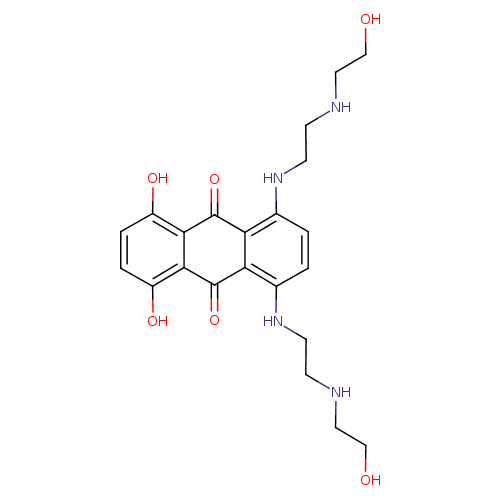
DescriptionMitoxantrone is only found in individuals that have used or taken this drug. It is an anthracenedione-derived antineoplastic agent. Mitoxantrone, a DNA-reactive agent that intercalates into deoxyribonucleic acid (DNA) through hydrogen bonding, causes crosslinks and strand breaks. Mitoxantrone also interferes with ribonucleic acid (RNA) and is a potent inhibitor of topoisomerase II, an enzyme responsible for uncoiling and repairing damaged DNA. It has a cytocidal effect on both proliferating and nonproliferating cultured human cells, suggesting lack of cell cycle phase specificity.
Contaminant Sources
  • HMDB Contaminants - Urine
  • HPV EPA Chemicals
  • IARC Carcinogens Group 2B
  • STOFF IDENT Compounds
  • T3DB toxins
Contaminant Type
  • Amide
  • Amine
  • Analgesic
  • Antineoplastic Agent
  • Drug
  • Ester
  • Human Neurotoxin
  • Metabolite
  • Organic Compound
  • Synthetic Compound
Chemical Structure
Thumb
Synonyms
ValueSource
1,4-DIHYDROXY-5,8-bis({2-[(2-hydroxyethyl)amino]ethyl}amino)-9,10-anthracenedioneChEBI
MitoxantronaChEBI
MitoxantronumChEBI
MisostolKegg
MitoxanthroneHMDB
MitoxantronHMDB
ASTA medica brand OF mitoxantrone hydrochlorideHMDB
RalenovaHMDB
Wyeth brand OF mitoxantrone hydrochlorideHMDB
AHP brand OF mitoxantrone hydrochlorideHMDB
Acetate, mitoxantroneHMDB
Lederle brand OF mitoxantrone hydrochlorideHMDB
MitozantroneHMDB
NovantronHMDB
Baxter oncology brand OF mitoxantrone hydrochlorideHMDB
Columbia brand OF mitoxantrone hydrochlorideHMDB
Hydrochloride, mitoxantroneHMDB
Mitoxantrone acetateHMDB
NovantroneHMDB
OnkotroneHMDB
PralifanHMDB
Amgen brand OF mitoxantrone hydrochlorideHMDB
DHAQHMDB
Inibsa brand OF mitoxantrone hydrochlorideHMDB
Mitoxantrone hydrochlorideHMDB
MitroxoneHMDB
Chemical FormulaC22H28N4O6
Average Molecular Mass444.481 g/mol
Monoisotopic Mass444.201 g/mol
CAS Registry Number65271-80-9
IUPAC Name1,4-dihydroxy-5,8-bis({2-[(2-hydroxyethyl)amino]ethyl}amino)-9,10-dihydroanthracene-9,10-dione
Traditional Namemitoxantrone
SMILESOCCNCCNC1=C2C(=O)C3=C(O)C=CC(O)=C3C(=O)C2=C(NCCNCCO)C=C1
InChI IdentifierInChI=1S/C22H28N4O6/c27-11-9-23-5-7-25-13-1-2-14(26-8-6-24-10-12-28)18-17(13)21(31)19-15(29)3-4-16(30)20(19)22(18)32/h1-4,23-30H,5-12H2
InChI KeyKKZJGLLVHKMTCM-UHFFFAOYSA-N
Chemical Taxonomy
Description belongs to the class of organic compounds known as anthraquinones. These are organic compounds containing either anthracene-9,10-quinone, 1,4-anthraquinone, or 1,2-anthraquinone.
KingdomOrganic compounds
Super ClassBenzenoids
ClassAnthracenes
Sub ClassAnthraquinones
Direct ParentAnthraquinones
Alternative Parents
Substituents
  • 9,10-anthraquinone
  • Anthraquinone
  • Aryl ketone
  • 1-hydroxy-2-unsubstituted benzenoid
  • Secondary aliphatic/aromatic amine
  • Vinylogous acid
  • Vinylogous amide
  • 1,2-aminoalcohol
  • Ketone
  • Secondary amine
  • Secondary aliphatic amine
  • Alkanolamine
  • Organic oxide
  • Organopnictogen compound
  • Primary alcohol
  • Organooxygen compound
  • Organonitrogen compound
  • Organic oxygen compound
  • Organic nitrogen compound
  • Amine
  • Alcohol
  • Hydrocarbon derivative
  • Aromatic homopolycyclic compound
Molecular FrameworkAromatic homopolycyclic compounds
External Descriptors
Biological Properties
StatusDetected and Not Quantified
OriginExogenous
Cellular Locations
  • Cytoplasm
  • Extracellular
  • Membrane
Biofluid LocationsNot Available
Tissue LocationsNot Available
PathwaysNot Available
Applications
Biological Roles
Chemical RolesNot Available
Physical Properties
StateLiquid
AppearanceNot Available
Experimental Properties
PropertyValue
Melting PointNot Available
Boiling PointNot Available
Solubility7.34e-01 g/L
Predicted Properties
PropertyValueSource
Water Solubility0.73 g/LALOGPS
logP0.91ALOGPS
logP1.19ChemAxon
logS-2.8ALOGPS
pKa (Strongest Acidic)9.78ChemAxon
pKa (Strongest Basic)9.08ChemAxon
Physiological Charge2ChemAxon
Hydrogen Acceptor Count10ChemAxon
Hydrogen Donor Count8ChemAxon
Polar Surface Area163.18 ŲChemAxon
Rotatable Bond Count12ChemAxon
Refractivity123.53 m³·mol⁻¹ChemAxon
Polarizability48.49 ųChemAxon
Number of Rings3ChemAxon
Bioavailability0ChemAxon
Rule of FiveNoChemAxon
Ghose FilterYesChemAxon
Veber's RuleNoChemAxon
MDDR-like RuleYesChemAxon
Spectra
Spectra
Spectrum TypeDescriptionSplash KeyView
Predicted GC-MSPredicted GC-MS Spectrum - GC-MS (Non-derivatized) - 70eV, Positivesplash10-03k9-4008900000-031c3e5b5c6fbec57bdcSpectrum
Predicted GC-MSPredicted GC-MS Spectrum - GC-MS (3 TMS) - 70eV, Positivesplash10-052b-3100094000-753b733851babd16586eSpectrum
Predicted GC-MSPredicted GC-MS Spectrum - GC-MS (Non-derivatized) - 70eV, PositiveNot AvailableSpectrum
LC-MS/MSLC-MS/MS Spectrum - LC-ESI-qTof , Positivesplash10-0a4j-0394000000-5f26812f41567533fe71Spectrum
LC-MS/MSLC-MS/MS Spectrum - , positivesplash10-0002-0012900000-147e3b4eed2bd9c29e51Spectrum
LC-MS/MSLC-MS/MS Spectrum - , positivesplash10-0a4j-0394000000-5f26812f41567533fe71Spectrum
Predicted LC-MS/MSPredicted LC-MS/MS Spectrum - 10V, Positivesplash10-0002-3003900000-9c369ecea59cd969c230Spectrum
Predicted LC-MS/MSPredicted LC-MS/MS Spectrum - 20V, Positivesplash10-000i-9004200000-d4db7c5244eae35ee957Spectrum
Predicted LC-MS/MSPredicted LC-MS/MS Spectrum - 40V, Positivesplash10-000m-9023000000-a3182f5d9afc8da8c7bcSpectrum
Predicted LC-MS/MSPredicted LC-MS/MS Spectrum - 10V, Negativesplash10-0006-1001900000-a08d98fc5346d9d02409Spectrum
Predicted LC-MS/MSPredicted LC-MS/MS Spectrum - 20V, Negativesplash10-002f-4015900000-de9bc44a9432611d1ba2Spectrum
Predicted LC-MS/MSPredicted LC-MS/MS Spectrum - 40V, Negativesplash10-03dl-9214200000-bbad802d490cbc39d94dSpectrum
Predicted LC-MS/MSPredicted LC-MS/MS Spectrum - 10V, Positivesplash10-0002-0000900000-9872ce7cd43051fb4999Spectrum
Predicted LC-MS/MSPredicted LC-MS/MS Spectrum - 20V, Positivesplash10-000t-0007900000-f6154c5a82d91a893f26Spectrum
Predicted LC-MS/MSPredicted LC-MS/MS Spectrum - 40V, Positivesplash10-00dr-7019000000-8870a13752c5782dc6adSpectrum
Predicted LC-MS/MSPredicted LC-MS/MS Spectrum - 10V, Negativesplash10-0006-0000900000-1d51c2d6aecce92b7f20Spectrum
Predicted LC-MS/MSPredicted LC-MS/MS Spectrum - 20V, Negativesplash10-0006-0004900000-386f03ecb86d1b84ef6dSpectrum
Predicted LC-MS/MSPredicted LC-MS/MS Spectrum - 40V, Negativesplash10-00rb-0049000000-4e3c4122979a10d299c2Spectrum
Toxicity Profile
Route of ExposureIntravenous injection. Poorly absorbed following oral administration.
Mechanism of ToxicityMitoxantrone, a DNA-reactive agent that intercalates into deoxyribonucleic acid (DNA) through hydrogen bonding, causes crosslinks and strand breaks. Mitoxantrone also interferes with ribonucleic acid (RNA) and is a potent inhibitor of topoisomerase II, an enzyme responsible for uncoiling and repairing damaged DNA. It has a cytocidal effect on both proliferating and nonproliferating cultured human cells, suggesting lack of cell cycle phase specificity.
MetabolismHepatic Half Life: 75 hours
Toxicity ValuesNot Available
Lethal DoseNot Available
Carcinogenicity (IARC Classification)2B, possibly carcinogenic to humans. (2)
Uses/SourcesFor the treatment of secondary (chronic) progressive, progressive relapsing, or worsening relapsing-remitting multiple sclerosis. Mitoxantrone is an Anthracenedione (not an anthracycline) antineoplastic agent.
Minimum Risk LevelNot Available
Health EffectsCardiomyopathy is a particularly concerning effect as it is irreversible. [Wikipedia]
SymptomsSevere leukopenia with infection.
TreatmentNot Available
Concentrations
Not Available
DrugBank IDDB01204
HMDB IDHMDB0015335
FooDB IDNot Available
Phenol Explorer IDNot Available
KNApSAcK IDNot Available
BiGG IDNot Available
BioCyc IDNot Available
METLIN IDNot Available
PDB IDMIX
Wikipedia LinkMitoxantrone
Chemspider ID4067
ChEBI ID50729
PubChem Compound ID4212
Kegg Compound IDC11195
YMDB IDNot Available
ECMDB IDNot Available
References
Synthesis Reference

DrugSyn.org

MSDSLink
General References
1. Fox EJ: Management of worsening multiple sclerosis with mitoxantrone: a review. Clin Ther. 2006 Apr;28(4):461-74.