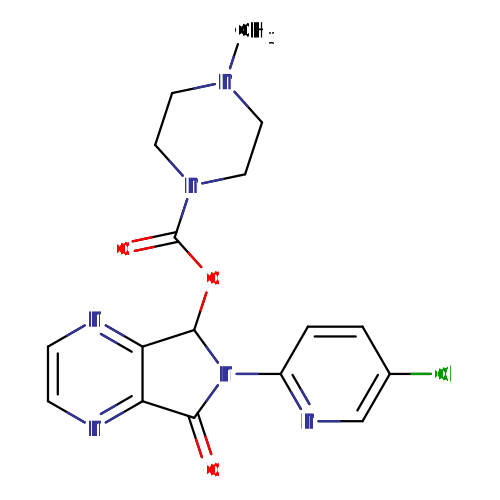
Record Information
Version1.0
Creation Date2009-07-21 20:28:36 UTC
Update Date2026-03-31 19:06:59 UTC
Accession NumberCHEM002373
Identification
Common NameZopiclone
ClassSmall Molecule
DescriptionZopiclone is only found in individuals that have used or taken this drug. It is a novel hypnotic agent used in the treatment of insomnia. Its mechanism of action is based on modulating benzodiazepine receptors. In addition to zopiclone's benzodiazepine pharmacological properties it also has some barbiturate like properties. Zopiclone exerts its action by binding on the benzodiazepine receptor complex and modulation of the GABABZ receptor chloride channel macromolecular complex. Both zopiclone and benzodiazepines act indiscriminately at the benzodiazepine binding site on α1, α2, α3 and α5 GABAA containing receptors as full agonists causing an enhancement of the inhibitory actions of GABA to produce the therapeutic (hypnotic and anxiolytic) and adverse effects of zopiclone.
Contaminant Sources
  • HMDB Contaminants - Urine
  • STOFF IDENT Compounds
  • T3DB toxins
Contaminant Type
  • Amide
  • Amine
  • Drug
  • Ester
  • Ether
  • Hypnotic and Sedative
  • Metabolite
  • Organic Compound
  • Organochloride
  • Synthetic Compound
Chemical Structure
Thumb
Synonyms
ValueSource
(+-)-ZopicloneChEBI
6-(5-Chloro-2-pyridinyl)-7-oxo-6,7-dihydro-5H-pyrrolo[3,4-b]pyrazin-5-yl 4-methyl-1-piperazinecarboxylateChEBI
ZopiclonaChEBI
ZopiclonumChEBI
AmobanKegg
6-(5-Chloro-2-pyridinyl)-7-oxo-6,7-dihydro-5H-pyrrolo[3,4-b]pyrazin-5-yl 4-methyl-1-piperazinecarboxylic acidGenerator
LimovanHMDB
Nu-zopicloneHMDB
ZilezeHMDB
ZimovaneHMDB
ZopicalmHMDB
Zopiclon alHMDB
Zopiclon stadaHMDB
Zopiclon tadHMDB
Zopiclon-tevaHMDB
Zopiclon-neuraxpharmHMDB
ZorcloneHMDB
Ratio-zopicloneHMDB
SiatenHMDB
SomnosanHMDB
XimovanHMDB
Zopiclon azuHMDB
Zopiclon abzHMDB
ZopicloduraHMDB
RhovaneHMDB
ZimocloneHMDB
Zopiclon betaHMDB
ZopitanHMDB
6-(5-Chloro-2-pyridyl)-6,7-dihydro- 7-oxo-5H-pyrrolo(3,4-b)pyrazin-5-yl 4-methyl-1- piperazinecarboxylateHMDB
ImovaneHMDB
OptidormHMDB
ZopHMDB
Zopi-purenHMDB
ZopicalmaHMDB
Zopiclon-ratiopharmHMDB
Zopiclon von CTHMDB
Chemical FormulaC17H17ClN6O3
Average Molecular Mass388.808 g/mol
Monoisotopic Mass388.105 g/mol
CAS Registry Number43200-80-2
IUPAC Name6-(5-chloropyridin-2-yl)-7-oxo-5H,6H,7H-pyrrolo[3,4-b]pyrazin-5-yl 4-methylpiperazine-1-carboxylate
Traditional Namezopiclone
SMILESCN1CCN(CC1)C(=O)OC1N(C(=O)C2=NC=CN=C12)C1=NC=C(Cl)C=C1
InChI IdentifierInChI=1S/C17H17ClN6O3/c1-22-6-8-23(9-7-22)17(26)27-16-14-13(19-4-5-20-14)15(25)24(16)12-3-2-11(18)10-21-12/h2-5,10,16H,6-9H2,1H3
InChI KeyGBBSUAFBMRNDJC-UHFFFAOYSA-N
Chemical Taxonomy
Description belongs to the class of organic compounds known as thienothiazines. These are heterocyclic compounds containing a thiophene ring fused to a thiazine. Thiophene is 5-membered ring consisting of four carbon atoms and one sulfur atom. Thiazine is a 6-membered ring consisting of four carbon, one nitrogen and one sulfur atoms.
KingdomOrganic compounds
Super ClassOrganoheterocyclic compounds
ClassThienothiazines
Sub ClassNot Available
Direct ParentThienothiazines
Alternative Parents
Substituents
  • Thienothiazine
  • 2,3,5-trisubstituted thiophene
  • Aralkylamine
  • Ortho-thiazine
  • Organosulfonic acid amide
  • Organic sulfonic acid or derivatives
  • Organosulfonic acid or derivatives
  • Sulfonyl
  • Heteroaromatic compound
  • Aminosulfonyl compound
  • Thiophene
  • Dialkyl ether
  • Secondary aliphatic amine
  • Ether
  • Secondary amine
  • Azacycle
  • Organic nitrogen compound
  • Organosulfur compound
  • Organooxygen compound
  • Organonitrogen compound
  • Organic oxygen compound
  • Organopnictogen compound
  • Organic oxide
  • Hydrocarbon derivative
  • Amine
  • Aromatic heteropolycyclic compound
Molecular FrameworkAromatic heteropolycyclic compounds
External Descriptors
Biological Properties
StatusDetected and Not Quantified
OriginExogenous
Cellular Locations
  • Cytoplasm
  • Extracellular
  • Membrane
Biofluid LocationsNot Available
Tissue LocationsNot Available
PathwaysNot Available
Applications
Biological RolesNot Available
Chemical RolesNot Available
Physical Properties
StateSolid
AppearanceWhite powder.
Experimental Properties
PropertyValue
Melting Point178°C
Boiling PointNot Available
Solubility0.151 mg/mL at 25°C
Predicted Properties
PropertyValueSource
Water Solubility0.88 g/LALOGPS
logP0.97ALOGPS
logP0.52ChemAxon
logS-2.6ALOGPS
pKa (Strongest Acidic)8.04ChemAxon
pKa (Strongest Basic)6.86ChemAxon
Physiological Charge1ChemAxon
Hydrogen Acceptor Count6ChemAxon
Hydrogen Donor Count0ChemAxon
Polar Surface Area91.76 ŲChemAxon
Rotatable Bond Count3ChemAxon
Refractivity95.89 m³·mol⁻¹ChemAxon
Polarizability38.22 ųChemAxon
Number of Rings4ChemAxon
Bioavailability1ChemAxon
Rule of FiveYesChemAxon
Ghose FilterYesChemAxon
Veber's RuleNoChemAxon
MDDR-like RuleNoChemAxon
Spectra
Spectra
Spectrum TypeDescriptionSplash KeyView
Predicted GC-MSPredicted GC-MS Spectrum - GC-MS (Non-derivatized) - 70eV, Positivesplash10-05bb-9212000000-b3e4c2874ff86d2544e1Spectrum
Predicted GC-MSPredicted GC-MS Spectrum - GC-MS (Non-derivatized) - 70eV, PositiveNot AvailableSpectrum
LC-MS/MSLC-MS/MS Spectrum - LC-ESI-QTOF , positivesplash10-00kb-0090000000-9d80e08080f406848221Spectrum
LC-MS/MSLC-MS/MS Spectrum - LC-ESI-QFT , positivesplash10-0002-0092000000-977d45f9a516242be80fSpectrum
LC-MS/MSLC-MS/MS Spectrum - LC-ESI-QFT , positivesplash10-0002-0090000000-397a508c11f66c161327Spectrum
LC-MS/MSLC-MS/MS Spectrum - LC-ESI-QFT , positivesplash10-014j-0090000000-abc6a676659114a83d08Spectrum
LC-MS/MSLC-MS/MS Spectrum - LC-ESI-QFT , positivesplash10-014i-0790000000-74d7c73e854e61700433Spectrum
LC-MS/MSLC-MS/MS Spectrum - LC-ESI-QFT , positivesplash10-00lr-0920000000-2c17f6282d1031cb4d50Spectrum
LC-MS/MSLC-MS/MS Spectrum - LC-ESI-QFT , positivesplash10-001i-0900000000-c0f92aba9374337ff737Spectrum
LC-MS/MSLC-MS/MS Spectrum - LC-ESI-QFT , positivesplash10-003r-5900000000-46755df8b5cfb7f46bf9Spectrum
LC-MS/MSLC-MS/MS Spectrum - LC-ESI-QFT , positivesplash10-004i-9300000000-091d5434bc674d5bf9a4Spectrum
LC-MS/MSLC-MS/MS Spectrum - LC-ESI-QFT , positivesplash10-004i-9000000000-87365fa01fb0854897caSpectrum
LC-MS/MSLC-MS/MS Spectrum - 45V, Positivesplash10-014j-0090000000-10c3fa2d80a8abbefd55Spectrum
LC-MS/MSLC-MS/MS Spectrum - 30V, Positivesplash10-0002-0090000000-1867bce03fb895923cebSpectrum
LC-MS/MSLC-MS/MS Spectrum - 60V, Positivesplash10-014i-0790000000-462830e768acf8704d81Spectrum
LC-MS/MSLC-MS/MS Spectrum - 75V, Positivesplash10-00lr-0920000000-6c00112af341c07aba1bSpectrum
LC-MS/MSLC-MS/MS Spectrum - 15V, Positivesplash10-0002-0092000000-b9948d590c2d56a477e8Spectrum
LC-MS/MSLC-MS/MS Spectrum - -1V, Positivesplash10-00kb-0090000000-66a3d681838796c245d3Spectrum
Predicted LC-MS/MSPredicted LC-MS/MS Spectrum - 10V, Positivesplash10-000i-0009000000-58198ad5b8e6fb5075fcSpectrum
Predicted LC-MS/MSPredicted LC-MS/MS Spectrum - 20V, Positivesplash10-004i-5917000000-fed7a3a68ceccd2f26beSpectrum
Predicted LC-MS/MSPredicted LC-MS/MS Spectrum - 40V, Positivesplash10-0ac0-9000000000-ef1623aed48bd5073d7bSpectrum
Predicted LC-MS/MSPredicted LC-MS/MS Spectrum - 10V, Negativesplash10-000i-0309000000-e2a958d8569e44198c06Spectrum
Predicted LC-MS/MSPredicted LC-MS/MS Spectrum - 20V, Negativesplash10-004i-1901000000-d74484c0d625330ab7cdSpectrum
Predicted LC-MS/MSPredicted LC-MS/MS Spectrum - 40V, Negativesplash10-056r-9510000000-15dec99e5a9537957558Spectrum
Predicted LC-MS/MSPredicted LC-MS/MS Spectrum - 10V, Positivesplash10-000i-0009000000-8fbf9af9d2708ba6bc8cSpectrum
Predicted LC-MS/MSPredicted LC-MS/MS Spectrum - 20V, Positivesplash10-000j-0049000000-0d0bcaed2a13fc359e64Spectrum
Predicted LC-MS/MSPredicted LC-MS/MS Spectrum - 40V, Positivesplash10-03e9-2695000000-54c5cabfed200237305eSpectrum
MSMass Spectrum (Electron Ionization)splash10-0007-6950000000-c1583a92e3cbc5066186Spectrum
1D NMR13C NMR SpectrumNot AvailableSpectrum
Toxicity Profile
Route of ExposureRapidly absorbed following oral administration.
Mechanism of ToxicityZopiclone exerts its action by binding on the benzodiazepine receptor complex and modulation of the GABABZ receptor chloride channel macromolecular complex. Both zopiclone and benzodiazepines act indiscriminately at the benzodiazepine binding site on alpha1, alpha2, alpha3 and alpha5 GABAA containing receptors as full agonists causing an enhancement of the inhibitory actions of GABA to produce the therapeutic (hypnotic and anxiolytic) and adverse effects of zopiclone.
MetabolismExtensively metabolized in the liver via decarboxylation (major pathway), demethylation, and side chain oxidation. Metabolites include an N-oxide derivative (weakly active; approximately 12% of a dose) and an N-desmethyl metabolite (inactive; approximately 16%). Approximately 50% of a dose is converted to other inactive metabolites via decarboxylation. Hepatic microsomal enzymes are apparently not involved in zopiclone clearance. Half Life: Elimination half life is approximately 5 hours (range 3.8 to 6.5 hours) and is prolonged to 11.9 hours in patients with hepatic insufficiency.
Toxicity ValuesNot Available
Lethal DoseNot Available
Carcinogenicity (IARC Classification)No indication of carcinogenicity to humans (not listed by IARC).
Uses/SourcesFor the short-term treatment of insomnia.
Minimum Risk LevelNot Available
Health EffectsThey cause slurred speech, disorientation and "drunken" behavior. They are physically and psychologically addictive.
SymptomsRare individual instances of fatal outcomes following overdose with racemic zopiclone have been reported in European postmarketing reports, most often associated with overdose with other CNS-depressant agent. Signs and symptoms of overdose effects of CNS depressants can be expected to present as exaggerations of the pharmacological effects noted in preclinical testing.
TreatmentNot Available
Concentrations
Not Available
DrugBank IDDB01198
HMDB IDHMDB0015329
FooDB IDNot Available
Phenol Explorer IDNot Available
KNApSAcK IDNot Available
BiGG IDNot Available
BioCyc IDNot Available
METLIN IDNot Available
PDB IDNot Available
Wikipedia LinkZopiclone
Chemspider ID5533
ChEBI ID32315
PubChem Compound ID5735
Kegg Compound IDNot Available
YMDB IDNot Available
ECMDB IDNot Available
References
Synthesis Reference

Thomas Jerussi, “Compositions comprising zopiclone derivatives and methods of making and using the same.” U.S. Patent US20040147521, issued July 29, 2004.

MSDSNot Available
General References
1. Liu HJ, Sato K, Shih HC, Shibuya T, Kawamoto H, Kitagawa H: Pharmacologic studies of the central action of zopiclone: effects on locomotor activity and brain monoamines in rats. Int J Clin Pharmacol Ther Toxicol. 1985 Mar;23(3):121-8.
2. Sato K, Hong YL, Yang MS, Shibuya T, Kawamoto H, Kitagawa H: Pharmacologic studies of central actions of zopiclone: influence on brain monoamines in rats under stressful condition. Int J Clin Pharmacol Ther Toxicol. 1985 Apr;23(4):204-10.
3. Julou L, Bardone MC, Blanchard JC, Garret C, Stutzmann JM: Pharmacological studies on zopiclone. Pharmacology. 1983;27 Suppl 2:46-58.
4. Blanchard JC, Julou L: Suriclone: a new cyclopyrrolone derivative recognizing receptors labeled by benzodiazepines in rat hippocampus and cerebellum. J Neurochem. 1983 Mar;40(3):601-7.
5. Dundar Y, Dodd S, Strobl J, Boland A, Dickson R, Walley T: Comparative efficacy of newer hypnotic drugs for the short-term management of insomnia: a systematic review and meta-analysis. Hum Psychopharmacol. 2004 Jul;19(5):305-22.