Record Information
Version1.0
Creation Date2009-07-21 20:28:32 UTC
Update Date2026-05-14 16:58:28 UTC
Accession NumberCHEM002364
Identification
Common NamePhenobarbital
ClassSmall Molecule
DescriptionPhenobarbital is only found in individuals that have used or taken this drug. It is a barbituric acid derivative that acts as a nonselective central nervous system depressant. It promotes binding to inhibitory gamma-aminobutyric acid subtype receptors, and modulates chloride currents through receptor channels. It also inhibits glutamate induced depolarizations. [PubChem] Phenobarbital acts on GABAA receptors, increasing synaptic inhibition. This has the effect of elevating seizure threshold and reducing the spread of seizure activity from a seizure focus. Phenobarbital may also inhibit calcium channels, resulting in a decrease in excitatory transmitter release. The sedative-hypnotic effects of phenobarbital are likely the result of its effect on the polysynaptic midbrain reticular formation, which controls CNS arousal.
Contaminant Sources
  • HMDB Contaminants - Urine
  • IARC Carcinogens Group 2B
  • STOFF IDENT Compounds
  • Suspected Compounds
  • T3DB toxins
  • ToxCast & Tox21 Chemicals
Contaminant Type
  • Amide
  • Amine
  • Anticonvulsant
  • Drug
  • Excitatory Amino Acid Antagonist
  • GABA Modulator
  • Hypnotic and Sedative
  • Metabolite
  • Organic Compound
  • Synthetic Compound
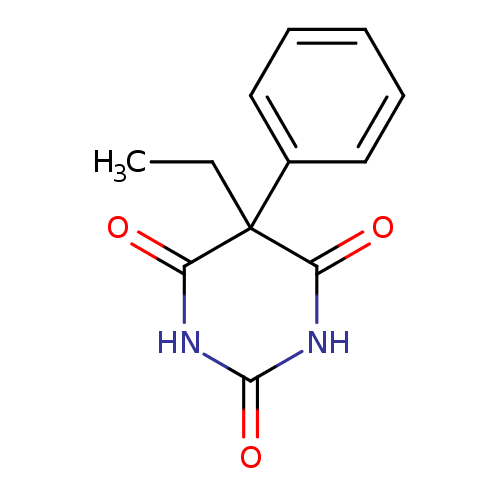
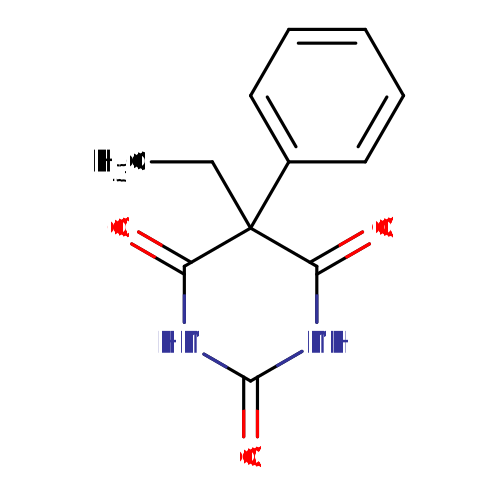
Chemical Structure
Thumb
Synonyms
ValueSource
5-Ethyl-5-phenyl-2,4,6(1H,3H,5H)-pyrimidinetrioneChEBI
5-Ethyl-5-phenyl-pyrimidine-2,4,6-trioneChEBI
5-Ethyl-5-phenylbarbituric acidChEBI
5-Ethyl-5-phenylpyrimidine-2,4,6(1H,3H,5H)-trioneChEBI
5-Phenyl-5-ethylbarbituric acidChEBI
LuminalChEBI
PhenobarbitolChEBI
PhenobarbitoneChEBI
Phenobarbituric acidChEBI
PhenylaethylbarbitursaeureChEBI
PhenylethylbarbiturateChEBI
Phenylethylbarbituric acidChEBI
PhenylethylbarbitursaeureChEBI
PHENYLETHYLMALONYLUREAChEBI
5-Ethyl-5-phenylbarbitateGenerator
5-Ethyl-5-phenylbarbitic acidGenerator
5-Phenyl-5-ethylbarbitateGenerator
5-Phenyl-5-ethylbarbitic acidGenerator
PhenobarbitateGenerator
Phenobarbitic acidGenerator
PhenylethylbarbitateGenerator
Phenylethylbarbitic acidGenerator
FenobarbitalHMDB
Acid, phenylethylbarbituricHMDB
PhenylbarbitalHMDB
Phenobarbital sodiumHMDB
Phenobarbital, monosodium saltHMDB
GardenalHMDB
HystepsHMDB
Monosodium salt phenobarbitalHMDB
Sodium, phenobarbitalHMDB
PhenemalHMDB
Chemical FormulaC12H12N2O3
Average Molecular Mass232.235 g/mol
Monoisotopic Mass232.085 g/mol
CAS Registry Number50-06-6
IUPAC Name5-ethyl-5-phenyl-1,3-diazinane-2,4,6-trione
Traditional Namephenobarbital
SMILESCCC1(C(=O)NC(=O)NC1=O)C1=CC=CC=C1
InChI IdentifierInChI=1S/C12H12N2O3/c1-2-12(8-6-4-3-5-7-8)9(15)13-11(17)14-10(12)16/h3-7H,2H2,1H3,(H2,13,14,15,16,17)
InChI KeyDDBREPKUVSBGFI-UHFFFAOYSA-N
Chemical Taxonomy
Description belongs to the class of organic compounds known as barbituric acid derivatives. Barbituric acid derivatives are compounds containing a perhydropyrimidine ring substituted at C-2, -4 and -6 by oxo groups.
KingdomOrganic compounds
Super ClassOrganoheterocyclic compounds
ClassDiazines
Sub ClassPyrimidines and pyrimidine derivatives
Direct ParentBarbituric acid derivatives
Alternative Parents
Substituents
  • Barbiturate
  • Ureide
  • N-acyl urea
  • Monocyclic benzene moiety
  • 1,3-diazinane
  • Benzenoid
  • Dicarboximide
  • Urea
  • Carbonic acid derivative
  • Carboxylic acid derivative
  • Azacycle
  • Organic nitrogen compound
  • Organonitrogen compound
  • Organooxygen compound
  • Hydrocarbon derivative
  • Organic oxide
  • Organopnictogen compound
  • Carbonyl group
  • Organic oxygen compound
  • Aromatic heteromonocyclic compound
Molecular FrameworkAromatic heteromonocyclic compounds
External Descriptors
Biological Properties
StatusDetected and Not Quantified
OriginExogenous
Cellular Locations
  • Membrane
Biofluid LocationsNot Available
Tissue Locations
  • Kidney
  • Liver
PathwaysNot Available
Applications
Biological Roles
Chemical RolesNot Available
Physical Properties
StateSolid
AppearanceWhite powder.
Experimental Properties
PropertyValue
Melting Point174°C
Boiling PointNot Available
Solubility1110 mg/L (at 25°C)
Predicted Properties
PropertyValueSource
Water Solubility0.28 g/LALOGPS
logP1.4ALOGPS
logP1.41ChemAxon
logS-2.9ALOGPS
pKa (Strongest Acidic)7.14ChemAxon
Physiological Charge0ChemAxon
Hydrogen Acceptor Count3ChemAxon
Hydrogen Donor Count2ChemAxon
Polar Surface Area75.27 ŲChemAxon
Rotatable Bond Count2ChemAxon
Refractivity59.75 m³·mol⁻¹ChemAxon
Polarizability22.62 ųChemAxon
Number of Rings2ChemAxon
Bioavailability1ChemAxon
Rule of FiveYesChemAxon
Ghose FilterYesChemAxon
Veber's RuleNoChemAxon
MDDR-like RuleNoChemAxon
Spectra
Spectra
Spectrum TypeDescriptionSplash KeyView
GC-MSGC-MS Spectrum - EI-B (Non-derivatized)splash10-0udi-5970000000-7bda34bd3bb88b5fd9fdSpectrum
GC-MSGC-MS Spectrum - CI-B (Non-derivatized)splash10-001i-0090000000-55265fc1e12027dc6454Spectrum
GC-MSGC-MS Spectrum - EI-B (Non-derivatized)splash10-0udi-5970000000-7bda34bd3bb88b5fd9fdSpectrum
GC-MSGC-MS Spectrum - CI-B (Non-derivatized)splash10-001i-0090000000-55265fc1e12027dc6454Spectrum
Predicted GC-MSPredicted GC-MS Spectrum - GC-MS (Non-derivatized) - 70eV, Positivesplash10-014i-1940000000-8377cca722b6479ce2fdSpectrum
Predicted GC-MSPredicted GC-MS Spectrum - GC-MS (Non-derivatized) - 70eV, PositiveNot AvailableSpectrum
LC-MS/MSLC-MS/MS Spectrum - LC-ESI-QFT , negativesplash10-001i-0190000000-8cf53cd66a890256ea98Spectrum
LC-MS/MSLC-MS/MS Spectrum - LC-ESI-QFT , negativesplash10-001i-1290000000-73d0e0b25f99ffc6a500Spectrum
LC-MS/MSLC-MS/MS Spectrum - LC-ESI-QFT , negativesplash10-0016-3950000000-ab62a9483b8a2a65b563Spectrum
LC-MS/MSLC-MS/MS Spectrum - LC-ESI-QFT , negativesplash10-0006-0900000000-4121e8dd703c01c1161cSpectrum
LC-MS/MSLC-MS/MS Spectrum - LC-ESI-QFT , negativesplash10-0006-0900000000-4976dfc244184e5d627bSpectrum
LC-MS/MSLC-MS/MS Spectrum - LC-ESI-QFT , positivesplash10-001i-1890000000-a12eb2be0b05b9f234deSpectrum
LC-MS/MSLC-MS/MS Spectrum - LC-ESI-QFT , positivesplash10-03di-1920000000-43ed71cd16bfceef49e6Spectrum
LC-MS/MSLC-MS/MS Spectrum - LC-ESI-QFT , positivesplash10-08fr-2900000000-236ae1dab83b15539a86Spectrum
LC-MS/MSLC-MS/MS Spectrum - LC-ESI-QFT , positivesplash10-053u-3900000000-2a994f0e45c022cca640Spectrum
LC-MS/MSLC-MS/MS Spectrum - LC-ESI-QFT , positivesplash10-053u-4900000000-066a53ca113150f58406Spectrum
LC-MS/MSLC-MS/MS Spectrum - LC-ESI-QFT , positivesplash10-05o3-6900000000-b8f9c9d0f71b6d2c6c2fSpectrum
LC-MS/MSLC-MS/MS Spectrum - LC-ESI-QFT , positivesplash10-0uy3-8900000000-6bcd457bfff85f05fe9cSpectrum
LC-MS/MSLC-MS/MS Spectrum - LC-ESI-QFT , positivesplash10-0udi-9500000000-0ecfff7e43e9e78d677eSpectrum
LC-MS/MSLC-MS/MS Spectrum - LC-ESI-QFT , positivesplash10-0uxs-9300000000-7413ad1c764a1ae4a98eSpectrum
LC-MS/MSLC-MS/MS Spectrum - 75V, Negativesplash10-0006-0900000000-4976dfc244184e5d627bSpectrum
LC-MS/MSLC-MS/MS Spectrum - 45V, Negativesplash10-0016-3950000000-ab62a9483b8a2a65b563Spectrum
LC-MS/MSLC-MS/MS Spectrum - 60V, Negativesplash10-0006-0900000000-4121e8dd703c01c1161cSpectrum
LC-MS/MSLC-MS/MS Spectrum - 120V, Positivesplash10-0uy3-8900000000-741b028c01a0bfefd003Spectrum
LC-MS/MSLC-MS/MS Spectrum - 15V, Positivesplash10-001i-0790000000-ab8562b536e84297ce37Spectrum
Predicted LC-MS/MSPredicted LC-MS/MS Spectrum - 10V, Positivesplash10-001i-0190000000-f722d696dc84bd92f7d2Spectrum
Predicted LC-MS/MSPredicted LC-MS/MS Spectrum - 20V, Positivesplash10-03xr-0910000000-d76f47fd3df15d7ea214Spectrum
Predicted LC-MS/MSPredicted LC-MS/MS Spectrum - 40V, Positivesplash10-014l-8910000000-29ca3dd7066d66bd0412Spectrum
Predicted LC-MS/MSPredicted LC-MS/MS Spectrum - 10V, Negativesplash10-0016-9670000000-ddcdac3a0cb816b2307cSpectrum
Predicted LC-MS/MSPredicted LC-MS/MS Spectrum - 20V, Negativesplash10-0006-9610000000-315a80c916d24f8b59e8Spectrum
Predicted LC-MS/MSPredicted LC-MS/MS Spectrum - 40V, Negativesplash10-000x-9700000000-e2564ed7f0e6acd73e7bSpectrum
MSMass Spectrum (Electron Ionization)splash10-0uxr-6950000000-193bf296d3e5d1705628Spectrum
1D NMR1H NMR SpectrumNot AvailableSpectrum
1D NMR13C NMR SpectrumNot AvailableSpectrum
Toxicity Profile
Route of ExposureAbsorbed in varying degrees following oral, rectal or parenteral administration. The salts are more rapidly absorbed than are the acids. The rate of absorption is increased if the sodium salt is ingested as a dilute solution or taken on an empty stomach.
Mechanism of ToxicityPhenobarbital acts on GABAA receptors, increasing synaptic inhibition. This has the effect of elevating seizure threshold and reducing the spread of seizure activity from a seizure focus. Phenobarbital may also inhibit calcium channels, resulting in a decrease in excitatory transmitter release. The sedative-hypnotic effects of phenobarbital are likely the result of its effect on the polysynaptic midbrain reticular formation, which controls CNS arousal.
MetabolismHepatic (mostly via CYP2C19). Half Life: 53 to 118 hours (mean 79 hours)
Toxicity ValuesNot Available
Lethal DoseNot Available
Carcinogenicity (IARC Classification)2B, possibly carcinogenic to humans. (6)
Uses/SourcesFor the treatment of all types of seizures except absence seizures.
Minimum Risk LevelNot Available
Health EffectsThey cause slurred speech, disorientation and "drunken" behavior. They are physically and psychologically addictive. May cause a potentially dangerous rash that may develop into Stevens Johnson syndrome, an extremely rare but potentially fatal skin disease.
SymptomsCNS and respiratory depression which may progress to Cheyne-Stokes respiration, areflexia, constriction of the pupils to a slight degree (though in severe poisoning they may wshow paralytic dilation), oliguria, tachycardia, hypotension, lowered body temperature, and coma. Typical shock syndrome (apnea, circulatory collapse, respiratory arrest, and death) may occur.
TreatmentTreatment of overdosage is mainly supportive and consists of maintaining an adequate airway with assisted respiration and oxygen administration as necessary, as well as monitoring of vital signs and fluid balance. If the patient is conscious and has not lost the gag reflex, emesis may be induced with ipecac. Care should be taken to prevent pulmonary aspiration of vomitus. After completion of vomiting, 30 grams activated charcoal in a glass of water may be administered. If emesis is contraindicated, gastric lavage may be performed with a cuffed endotracheal tube in place with the patient in the face down position. Activated charcoal may be left in the emptied stomach and a saline cathartic administered. Fluid therapy and other standard treatment for shock should be performed if needed. If renal function is normal, forced diuresis may aid in the elimination of the barbiturate. Alkalinization of the urine increases renal excretion of some barbiturates, especially phenobarbital, also aprobarbital, and mephobarbital (which is metabolized to phenobarbital). Although not recommended as a routine procedure, hemodialysis may be used in severe barbiturate intoxications or if the patient is anuric or in shock. Patient should be rolled from side to side every 30 minutes, and antibiotics should be given if pneumonia is suspected. Appropriate nursing care to prevent hypostatic pneumonia, decubiti, aspiration and other complications of patients with altered states of consciousness should also be performed. (7)
Concentrations
Not Available
DrugBank IDDB01174
HMDB IDHMDB0015305
FooDB IDNot Available
Phenol Explorer IDNot Available
KNApSAcK IDNot Available
BiGG IDNot Available
BioCyc IDNot Available
METLIN IDNot Available
PDB IDNot Available
Wikipedia LinkPhenobarbital
Chemspider ID4599
ChEBI ID8069
PubChem Compound ID4763
Kegg Compound IDC07434
YMDB IDNot Available
ECMDB IDNot Available
References
Synthesis Reference

Tong Sun, Shawn Watson, Rajesh Manchanda, “PHENOBARBITAL SALTS; METHODS OF MAKING; AND METHODS OF USE THEREOF.” U.S. Patent US20100035904, issued February 11, 2010.

MSDSLink
General References
1. https://www.ncbi.nlm.nih.gov/pubmed/?term=10866370
2. https://www.ncbi.nlm.nih.gov/pubmed/?term=10891117
3. https://www.ncbi.nlm.nih.gov/pubmed/?term=11311072
4. https://www.ncbi.nlm.nih.gov/pubmed/?term=12361404
5. https://www.ncbi.nlm.nih.gov/pubmed/?term=12873507
6. https://www.ncbi.nlm.nih.gov/pubmed/?term=1495012
7. https://www.ncbi.nlm.nih.gov/pubmed/?term=15324906
8. https://www.ncbi.nlm.nih.gov/pubmed/?term=15857133
9. https://www.ncbi.nlm.nih.gov/pubmed/?term=16139502
10. https://www.ncbi.nlm.nih.gov/pubmed/?term=16190747
11. https://www.ncbi.nlm.nih.gov/pubmed/?term=16789751
12. https://www.ncbi.nlm.nih.gov/pubmed/?term=16793262
13. https://www.ncbi.nlm.nih.gov/pubmed/?term=1681105
14. https://www.ncbi.nlm.nih.gov/pubmed/?term=17300161
15. https://www.ncbi.nlm.nih.gov/pubmed/?term=17481896
16. https://www.ncbi.nlm.nih.gov/pubmed/?term=17827020
17. https://www.ncbi.nlm.nih.gov/pubmed/?term=17870541
18. https://www.ncbi.nlm.nih.gov/pubmed/?term=1875341
19. https://www.ncbi.nlm.nih.gov/pubmed/?term=1992141
20. https://www.ncbi.nlm.nih.gov/pubmed/?term=2061925
21. https://www.ncbi.nlm.nih.gov/pubmed/?term=2170646
22. https://www.ncbi.nlm.nih.gov/pubmed/?term=2296016
23. https://www.ncbi.nlm.nih.gov/pubmed/?term=2308141
24. https://www.ncbi.nlm.nih.gov/pubmed/?term=2308142
25. https://www.ncbi.nlm.nih.gov/pubmed/?term=2579237
26. https://www.ncbi.nlm.nih.gov/pubmed/?term=2724304
27. https://www.ncbi.nlm.nih.gov/pubmed/?term=3016269
28. https://www.ncbi.nlm.nih.gov/pubmed/?term=3336019
29. https://www.ncbi.nlm.nih.gov/pubmed/?term=3572984
30. https://www.ncbi.nlm.nih.gov/pubmed/?term=3599019
31. https://www.ncbi.nlm.nih.gov/pubmed/?term=3654008
32. https://www.ncbi.nlm.nih.gov/pubmed/?term=3735320
33. https://www.ncbi.nlm.nih.gov/pubmed/?term=3783589
34. https://www.ncbi.nlm.nih.gov/pubmed/?term=3783590
35. https://www.ncbi.nlm.nih.gov/pubmed/?term=3820228
36. https://www.ncbi.nlm.nih.gov/pubmed/?term=3950916
37. https://www.ncbi.nlm.nih.gov/pubmed/?term=3950919
38. https://www.ncbi.nlm.nih.gov/pubmed/?term=4032429
39. https://www.ncbi.nlm.nih.gov/pubmed/?term=6716399
40. https://www.ncbi.nlm.nih.gov/pubmed/?term=6737420
41. https://www.ncbi.nlm.nih.gov/pubmed/?term=6864729
42. https://www.ncbi.nlm.nih.gov/pubmed/?term=7205879
43. https://www.ncbi.nlm.nih.gov/pubmed/?term=7381857
44. https://www.ncbi.nlm.nih.gov/pubmed/?term=7562939
45. https://www.ncbi.nlm.nih.gov/pubmed/?term=7799408
46. https://www.ncbi.nlm.nih.gov/pubmed/?term=8035421
47. https://www.ncbi.nlm.nih.gov/pubmed/?term=8230125
48. https://www.ncbi.nlm.nih.gov/pubmed/?term=8246220
49. https://www.ncbi.nlm.nih.gov/pubmed/?term=8627613
50. https://www.ncbi.nlm.nih.gov/pubmed/?term=8691481
51. https://www.ncbi.nlm.nih.gov/pubmed/?term=9016327
52. https://www.ncbi.nlm.nih.gov/pubmed/?term=9544213
53. Taylor S, Tudur Smith C, Williamson PR, Marson AG: Phenobarbitone versus phenytoin monotherapy for partial onset seizures and generalized onset tonic-clonic seizures. Cochrane Database Syst Rev. 2001;(4):CD002217.
54. Tudur Smith C, Marson AG, Williamson PR: Carbamazepine versus phenobarbitone monotherapy for epilepsy. Cochrane Database Syst Rev. 2003;(1):CD001904.
55. Kwan P, Brodie MJ: Phenobarbital for the treatment of epilepsy in the 21st century: a critical review. Epilepsia. 2004 Sep;45(9):1141-9.
56. Booth D, Evans DJ: Anticonvulsants for neonates with seizures. Cochrane Database Syst Rev. 2004 Oct 18;(4):CD004218.
57. Kalviainen R, Eriksson K, Parviainen I: Refractory generalised convulsive status epilepticus : a guide to treatment. CNS Drugs. 2005;19(9):759-68.