Record Information
Version1.0
Creation Date2009-07-21 20:28:31 UTC
Update Date2026-03-31 17:46:10 UTC
Accession NumberCHEM002363
Identification
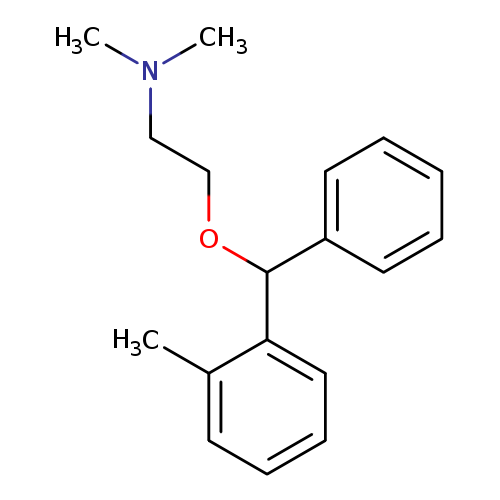
Common NameOrphenadrine
ClassSmall Molecule
DescriptionOrphenadrine is only found in individuals that have used or taken this drug. It is a muscarinic antagonist used to treat drug-induced parkinsonism and to relieve pain from muscle spasm. [PubChem] Orphenadrine binds and inhibits both histamine H1 receptors and NMDA receptors. It restores the motor disturbances induced by neuroleptics, in particular the hyperkinesia. The dopamine deficiency in the striatum increases the stimulating effects of the cholinergic system. This stimulation is counteracted by the anticholinergic effect of orphenadrine. It may have a relaxing effect on skeletal muscle spasms and it has a mood elevating effect.
Contaminant Sources
  • HMDB Contaminants - Urine
  • STOFF IDENT Compounds
  • T3DB toxins
Contaminant Type
  • Amine
  • Antidyskinetic
  • Antiparkinson Agent
  • Drug
  • Ether
  • Metabolite
  • Muscarinic Antagonist
  • Muscle Relaxant, Central
  • Muscle Relaxant, Skeletal
  • Organic Compound
  • Parasympatholytic
  • Synthetic Compound
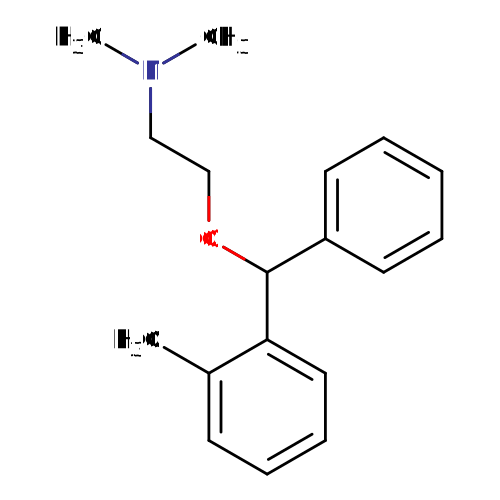
Chemical Structure
Thumb
Synonyms
ValueSource
2-(Phenyl-O-tolylmethoxy)ethyldimethylamineChEBI
2-MethyldiphenhydramineChEBI
beta-Dimethylaminoethyl 2-methylbenzhydryl etherChEBI
Dimethyl-[2-(phenyl-O-tolyl-methoxy)-ethyl]-amineChEBI
N,N-Dimethyl-2-(alpha-2-tolylbenzoyloxy)ethylamineChEBI
N,N-Dimethyl-2-(phenyl(O-tolyl)methoxy)ethanamineChEBI
N,N-Dimethyl-2-[(O-methyl-alpha-phenylbenzyl)oxy]ethylamineChEBI
O-MethyldiphenhydramineChEBI
O-MonomethyldiphenhydramineChEBI
OrfenadrinaChEBI
OrphenadrinumChEBI
Phenyl-O-tolylmethyl dimethyaminoethyl etherChEBI
MialginKegg
b-Dimethylaminoethyl 2-methylbenzhydryl etherGenerator
Β-dimethylaminoethyl 2-methylbenzhydryl etherGenerator
N,N-Dimethyl-2-(a-2-tolylbenzoyloxy)ethylamineGenerator
N,N-Dimethyl-2-(α-2-tolylbenzoyloxy)ethylamineGenerator
N,N-Dimethyl-2-[(O-methyl-a-phenylbenzyl)oxy]ethylamineGenerator
N,N-Dimethyl-2-[(O-methyl-α-phenylbenzyl)oxy]ethylamineGenerator
MephenamineHMDB
OrphenadineHMDB
OrphenadrinHMDB
Orphenadrine citrateHMDB
OrphenateHMDB
OrphenedrineHMDB
LysantinHMDB
Mefenamine, sodiumHMDB
Norflex orphenadrine citrateHMDB
Citrate, orphenadrineHMDB
DisipalHMDB
MethyldiphenylhydramineHMDB
NorflexHMDB
Citrate, norflex orphenadrineHMDB
Hydrochloride, orphenadrineHMDB
MefenamineHMDB
Orphenadrine citrate, norflexHMDB
Sodium mefenamineHMDB
Orphenadrine hydrochlorideHMDB
Chemical FormulaC18H23NO
Average Molecular Mass269.381 g/mol
Monoisotopic Mass269.178 g/mol
CAS Registry Number83-98-7
IUPAC Namedimethyl({2-[(2-methylphenyl)(phenyl)methoxy]ethyl})amine
Traditional Nameorphenadrine
SMILESCN(C)CCOC(C1=CC=CC=C1)C1=CC=CC=C1C
InChI IdentifierInChI=1S/C18H23NO/c1-15-9-7-8-12-17(15)18(20-14-13-19(2)3)16-10-5-4-6-11-16/h4-12,18H,13-14H2,1-3H3
InChI KeyQVYRGXJJSLMXQH-UHFFFAOYSA-N
Chemical Taxonomy
Description belongs to the class of organic compounds known as diphenylmethanes. Diphenylmethanes are compounds containing a diphenylmethane moiety, which consists of a methane wherein two hydrogen atoms are replaced by two phenyl groups.
KingdomOrganic compounds
Super ClassBenzenoids
ClassBenzene and substituted derivatives
Sub ClassDiphenylmethanes
Direct ParentDiphenylmethanes
Alternative Parents
Substituents
  • Diphenylmethane
  • Benzylether
  • Toluene
  • Tertiary aliphatic amine
  • Tertiary amine
  • Ether
  • Dialkyl ether
  • Organic nitrogen compound
  • Organic oxygen compound
  • Organopnictogen compound
  • Hydrocarbon derivative
  • Organooxygen compound
  • Organonitrogen compound
  • Amine
  • Aromatic homomonocyclic compound
Molecular FrameworkAromatic homomonocyclic compounds
External Descriptors
Biological Properties
StatusDetected and Not Quantified
OriginExogenous
Cellular Locations
  • Extracellular
  • Membrane
Biofluid LocationsNot Available
Tissue LocationsNot Available
PathwaysNot Available
Applications
Biological Roles
Chemical RolesNot Available
Physical Properties
StateLiquid
AppearanceNot Available
Experimental Properties
PropertyValue
Melting Point< 25°C
Boiling Point195°C at 1.20E+01 mm Hg
SolubilitySparingly soluble in water
Predicted Properties
PropertyValueSource
Water Solubility0.03 g/LALOGPS
logP3.5ALOGPS
logP4.17ChemAxon
logS-4ALOGPS
pKa (Strongest Basic)8.87ChemAxon
Physiological Charge1ChemAxon
Hydrogen Acceptor Count2ChemAxon
Hydrogen Donor Count0ChemAxon
Polar Surface Area12.47 ŲChemAxon
Rotatable Bond Count6ChemAxon
Refractivity84.97 m³·mol⁻¹ChemAxon
Polarizability31.83 ųChemAxon
Number of Rings2ChemAxon
Bioavailability1ChemAxon
Rule of FiveYesChemAxon
Ghose FilterYesChemAxon
Veber's RuleYesChemAxon
MDDR-like RuleNoChemAxon
Spectra
Spectra
Spectrum TypeDescriptionSplash KeyView
Predicted GC-MSPredicted GC-MS Spectrum - GC-MS (Non-derivatized) - 70eV, Positivesplash10-053r-7900000000-1125d9172d3a93e92a56Spectrum
Predicted GC-MSPredicted GC-MS Spectrum - GC-MS (Non-derivatized) - 70eV, PositiveNot AvailableSpectrum
LC-MS/MSLC-MS/MS Spectrum - LC-ESI-QFT , positivesplash10-001i-0900000000-e233c4258b887b1c4d95Spectrum
LC-MS/MSLC-MS/MS Spectrum - LC-ESI-QFT , positivesplash10-001i-0900000000-6eb16a45ba9f222e4a96Spectrum
LC-MS/MSLC-MS/MS Spectrum - LC-ESI-QFT , positivesplash10-001i-0900000000-46ad662bd87fac31bf96Spectrum
LC-MS/MSLC-MS/MS Spectrum - LC-ESI-QFT , positivesplash10-014i-0900000000-1e90246098db8159dcddSpectrum
LC-MS/MSLC-MS/MS Spectrum - LC-ESI-QFT , positivesplash10-014i-0900000000-98528e097df59735a4a2Spectrum
LC-MS/MSLC-MS/MS Spectrum - LC-ESI-QFT , positivesplash10-014i-0900000000-b09cb35d4c4d1563eab0Spectrum
LC-MS/MSLC-MS/MS Spectrum - LC-ESI-QFT , positivesplash10-014i-0900000000-98fb2ac7e2a7b5389c76Spectrum
LC-MS/MSLC-MS/MS Spectrum - LC-ESI-QFT , positivesplash10-014i-0900000000-f5b29d73b614d9a50c8cSpectrum
LC-MS/MSLC-MS/MS Spectrum - LC-ESI-QFT , positivesplash10-02t9-2900000000-5e46822ba471971d2ed4Spectrum
LC-MS/MSLC-MS/MS Spectrum - , positivesplash10-00lr-0900000000-02f47ad2686722a25761Spectrum
LC-MS/MSLC-MS/MS Spectrum - , positivesplash10-00lr-0900000000-c646cee3a03cb818670bSpectrum
LC-MS/MSLC-MS/MS Spectrum - 15V, Positivesplash10-001i-0900000000-2e9d76988136705f609eSpectrum
LC-MS/MSLC-MS/MS Spectrum - 30V, Positivesplash10-001i-0900000000-a72a380e118fb835fb66Spectrum
LC-MS/MSLC-MS/MS Spectrum - 90V, Positivesplash10-014i-0900000000-a46666f03d45f46ab715Spectrum
LC-MS/MSLC-MS/MS Spectrum - 75V, Positivesplash10-014i-0900000000-ea0698765985111d4210Spectrum
LC-MS/MSLC-MS/MS Spectrum - 45V, Positivesplash10-001i-0900000000-97f69ccd350138f79526Spectrum
LC-MS/MSLC-MS/MS Spectrum - 60V, Positivesplash10-014i-0900000000-4c978347af9b3509fd28Spectrum
Predicted LC-MS/MSPredicted LC-MS/MS Spectrum - 10V, Positivesplash10-00di-2190000000-9a5752136bf30980fbbfSpectrum
Predicted LC-MS/MSPredicted LC-MS/MS Spectrum - 20V, Positivesplash10-00di-6690000000-440a3e9a238f42556d6cSpectrum
Predicted LC-MS/MSPredicted LC-MS/MS Spectrum - 40V, Positivesplash10-00di-9400000000-0d0ab00b78797f30d9eeSpectrum
Predicted LC-MS/MSPredicted LC-MS/MS Spectrum - 10V, Negativesplash10-014i-2290000000-9e0be4c70dbfcc9eb72eSpectrum
Predicted LC-MS/MSPredicted LC-MS/MS Spectrum - 20V, Negativesplash10-014j-4790000000-bb9cc76650057f164459Spectrum
Predicted LC-MS/MSPredicted LC-MS/MS Spectrum - 40V, Negativesplash10-004m-9300000000-9fb3bdd2df4cd0bec407Spectrum
Predicted LC-MS/MSPredicted LC-MS/MS Spectrum - 10V, Positivesplash10-00di-1690000000-307a51968b21b4478b96Spectrum
Predicted LC-MS/MSPredicted LC-MS/MS Spectrum - 20V, Positivesplash10-001i-1900000000-40275912271dbc75f9aaSpectrum
MSMass Spectrum (Electron Ionization)splash10-0a4i-9200000000-213fd17f1f5014e79c8bSpectrum
Toxicity Profile
Route of ExposureOrphenadrine is almost completely absorbed in the gastrointestinal tract.
Mechanism of ToxicityOrphenadrine binds and inhibits both histamine H1 receptors and NMDA receptors. It restores the motor disturbances induced by neuroleptics, in particular the hyperkinesia. The dopamine deficiency in the striatum increases the stimulating effects of the cholinergic system. This stimulation is counteracted by the anticholinergic effect of orphenadrine. It may have a relaxing effect on skeletal muscle spasms and it has a mood elevating effect.
MetabolismBiotransformation occurs mainly in the liver. Pharmacologically active metabolites are N-demethyl orphenadrine and N,N-didemethyl orphenadrine. Half Life: 13-20 hours
Toxicity ValuesLD50: 100 mg/kg (Oral, Mouse) (1) LD50: 255 mg/kg (Oral, Rat) (1)
Lethal DoseNot Available
Carcinogenicity (IARC Classification)No indication of carcinogenicity to humans (not listed by IARC).
Uses/SourcesIndicated for the treatment of Parkinson's disease.
Minimum Risk LevelNot Available
Health EffectsNot Available
SymptomsNot Available
TreatmentTreatment for orphenadrine overdose is evacuation of stomach contents (when necessary), charcoal at repeated doses, intensive monitoring, and appropriate supportive treatment of any emergent anticholinergic effects. (4)
Concentrations
Not Available
DrugBank IDDB01173
HMDB IDHMDB0015304
FooDB IDNot Available
Phenol Explorer IDNot Available
KNApSAcK IDNot Available
BiGG IDNot Available
BioCyc IDNot Available
METLIN IDNot Available
PDB IDNot Available
Wikipedia LinkOrphenadrine
Chemspider ID4440
ChEBI ID7789
PubChem Compound ID4601
Kegg Compound IDC07935
YMDB IDNot Available
ECMDB IDNot Available
References
Synthesis ReferenceNot Available
MSDSLink
General References
1. Ji D, Sui ZY, Ma YY, Luo F, Cui CL, Han JS: NMDA receptor in nucleus accumbens is implicated in morphine withdrawal in rats. Neurochem Res. 2004 Nov;29(11):2113-20.