Record Information
Version1.0
Creation Date2009-07-21 20:28:29 UTC
Update Date2026-05-14 16:58:19 UTC
Accession NumberCHEM002360
Identification
Common NameHalothane
ClassSmall Molecule
DescriptionA nonflammable, halogenated, hydrocarbon anesthetic that provides relatively rapid induction with little or no excitement. Analgesia may not be adequate. nitrous oxide is often given concomitantly. Because halothane may not produce sufficient muscle relaxation, supplemental neuromuscular blocking agents may be required. (From AMA Drug Evaluations Annual, 1994, p178)
Contaminant Sources
  • HMDB Contaminants - Urine
  • STOFF IDENT Compounds
  • T3DB toxins
  • ToxCast & Tox21 Chemicals
Contaminant Type
  • Anesthetic
  • Anesthetic, Inhalation
  • Bromide Compound
  • Drug
  • General Anesthetic
  • Human Neurotoxin
  • Metabolite
  • Organic Compound
  • Organobromide
  • Organochloride
  • Organofluoride
  • Synthetic Compound
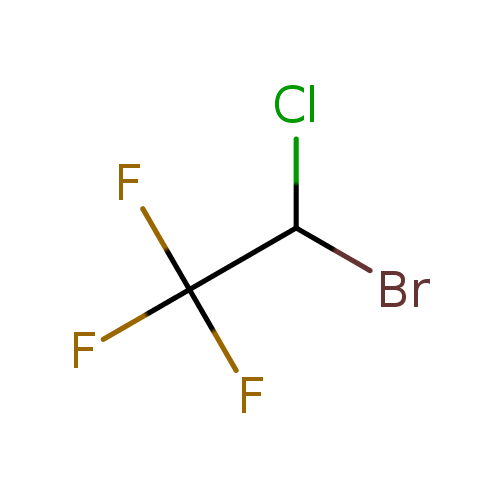
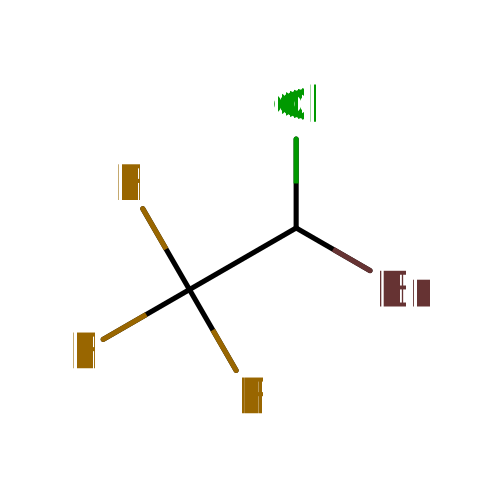
Chemical Structure
Thumb
Synonyms
ValueSource
1,1,1-Trifluoro-2-bromo-2-chloroethaneChEBI
1,1,1-Trifluoro-2-chloro-2-bromoethaneChEBI
1-Bromo-1-chloro-2,2,2-trifluoroethaneChEBI
2,2,2-Trifluoro-1-chloro-1-bromoethaneChEBI
2-Bromo-2-chloro-1,1,1-trifluoroethaneChEBI
BromochlorotrifluoroethaneChEBI
FluothaneChEBI
NarcotaneChEBI
PhthorothanumChEBI
RhodialothanChEBI
AlotanoHMDB
BromchlortrifluoraethanumHMDB
CF3CHCLBRHMDB
FluorotaneHMDB
FluorothaneHMDB
Freon 123b1HMDB
FtorotanHMDB
FtuorotanHMDB
HalothanHMDB
Narcotann ne-spofaHMDB
NarcotanHMDB
Chemical FormulaC2HBrClF3
Average Molecular Mass197.382 g/mol
Monoisotopic Mass195.890 g/mol
CAS Registry Number151-67-7
IUPAC Name2-bromo-2-chloro-1,1,1-trifluoroethane
Traditional Namehalothane
SMILESFC(F)(F)C(Cl)Br
InChI IdentifierInChI=1S/C2HBrClF3/c3-1(4)2(5,6)7/h1H
InChI KeyBCQZXOMGPXTTIC-UHFFFAOYSA-N
Chemical Taxonomy
Description belongs to the class of organic compounds known as organofluorides. Organofluorides are compounds containing a chemical bond between a carbon atom and a fluorine atom.
KingdomOrganic compounds
Super ClassOrganohalogen compounds
ClassOrganofluorides
Sub ClassNot Available
Direct ParentOrganofluorides
Alternative Parents
Substituents
  • Hydrocarbon derivative
  • Organofluoride
  • Organochloride
  • Organobromide
  • Alkyl halide
  • Alkyl fluoride
  • Alkyl chloride
  • Alkyl bromide
  • Aliphatic acyclic compound
Molecular FrameworkAliphatic acyclic compounds
External Descriptors
Biological Properties
StatusDetected and Not Quantified
OriginExogenous
Cellular Locations
  • Cytoplasm
  • Extracellular
  • Membrane
Biofluid LocationsNot Available
Tissue LocationsNot Available
PathwaysNot Available
Applications
Biological RolesNot Available
Chemical RolesNot Available
Physical Properties
StateLiquid
AppearanceNot Available
Experimental Properties
PropertyValue
Melting Point50-50.5°C
Boiling Point50.2°C
Solubility4070 mg/L (at 25°C)
Predicted Properties
PropertyValueSource
Water Solubility3.81 g/LALOGPS
logP2.5ALOGPS
logP2.12ChemAxon
logS-1.7ALOGPS
Physiological Charge0ChemAxon
Hydrogen Acceptor Count0ChemAxon
Hydrogen Donor Count0ChemAxon
Polar Surface Area0 ŲChemAxon
Rotatable Bond Count1ChemAxon
Refractivity24.63 m³·mol⁻¹ChemAxon
Polarizability9.78 ųChemAxon
Number of Rings0ChemAxon
Bioavailability1ChemAxon
Rule of FiveYesChemAxon
Ghose FilterNoChemAxon
Veber's RuleYesChemAxon
MDDR-like RuleNoChemAxon
Spectra
Spectra
Spectrum TypeDescriptionSplash KeyView
Predicted GC-MSPredicted GC-MS Spectrum - GC-MS (Non-derivatized) - 70eV, Positivesplash10-00mk-2900000000-b9380ce034e632d13402Spectrum
Predicted GC-MSPredicted GC-MS Spectrum - GC-MS (Non-derivatized) - 70eV, PositiveNot AvailableSpectrum
Predicted LC-MS/MSPredicted LC-MS/MS Spectrum - 10V, Positivesplash10-0002-0900000000-22f95ee41cfa595e0b94Spectrum
Predicted LC-MS/MSPredicted LC-MS/MS Spectrum - 20V, Positivesplash10-0002-0900000000-b33703eb3b6a5c2081b7Spectrum
Predicted LC-MS/MSPredicted LC-MS/MS Spectrum - 40V, Positivesplash10-004i-0900000000-6147e552fc5d064b7171Spectrum
Predicted LC-MS/MSPredicted LC-MS/MS Spectrum - 10V, Negativesplash10-0006-0900000000-d1429848e3c55176452cSpectrum
Predicted LC-MS/MSPredicted LC-MS/MS Spectrum - 20V, Negativesplash10-0006-0900000000-d1429848e3c55176452cSpectrum
Predicted LC-MS/MSPredicted LC-MS/MS Spectrum - 40V, Negativesplash10-0006-0900000000-d1429848e3c55176452cSpectrum
Predicted LC-MS/MSPredicted LC-MS/MS Spectrum - 10V, Positivesplash10-0002-0900000000-576b4613dcb239b66cf4Spectrum
Predicted LC-MS/MSPredicted LC-MS/MS Spectrum - 20V, Positivesplash10-0002-0900000000-576b4613dcb239b66cf4Spectrum
Predicted LC-MS/MSPredicted LC-MS/MS Spectrum - 40V, Positivesplash10-004i-1900000000-3ab70f32bc1768fc8debSpectrum
Predicted LC-MS/MSPredicted LC-MS/MS Spectrum - 10V, Negativesplash10-0006-0900000000-d1c062299d2fe297943dSpectrum
Predicted LC-MS/MSPredicted LC-MS/MS Spectrum - 20V, Negativesplash10-0006-0900000000-d1c062299d2fe297943dSpectrum
Predicted LC-MS/MSPredicted LC-MS/MS Spectrum - 40V, Negativesplash10-0006-0900000000-d1c062299d2fe297943dSpectrum
MSMass Spectrum (Electron Ionization)splash10-014j-2900000000-e961932e23eafc2cc0a5Spectrum
1D NMR1H NMR SpectrumNot AvailableSpectrum
1D NMR13C NMR SpectrumNot AvailableSpectrum
1D NMR1H NMR SpectrumNot AvailableSpectrum
1D NMR13C NMR SpectrumNot AvailableSpectrum
1D NMR1H NMR SpectrumNot AvailableSpectrum
1D NMR13C NMR SpectrumNot AvailableSpectrum
1D NMR1H NMR SpectrumNot AvailableSpectrum
1D NMR13C NMR SpectrumNot AvailableSpectrum
1D NMR1H NMR SpectrumNot AvailableSpectrum
1D NMR13C NMR SpectrumNot AvailableSpectrum
1D NMR1H NMR SpectrumNot AvailableSpectrum
1D NMR13C NMR SpectrumNot AvailableSpectrum
1D NMR1H NMR SpectrumNot AvailableSpectrum
1D NMR13C NMR SpectrumNot AvailableSpectrum
1D NMR1H NMR SpectrumNot AvailableSpectrum
1D NMR13C NMR SpectrumNot AvailableSpectrum
1D NMR1H NMR SpectrumNot AvailableSpectrum
1D NMR13C NMR SpectrumNot AvailableSpectrum
1D NMR1H NMR SpectrumNot AvailableSpectrum
1D NMR13C NMR SpectrumNot AvailableSpectrum
1D NMR1H NMR SpectrumNot AvailableSpectrum
1D NMR13C NMR SpectrumNot AvailableSpectrum
Toxicity Profile
Route of Exposureinhalation
Mechanism of ToxicityHalothane causes general anaethesia due to its actions on multiple ion channels, which ultimately depresses nerve conduction, breathing, cardiac contractility. Its immobilizing effects have been attributed to its binding to potassium channels in cholinergic neurons. Halothane's effect are also likely due to binding to NMDA and calcium channels, causing hyperpolarization. Halothane induces a reduction in junctional conductance by decreasing gap junction channel opening times and increasing gap junction channel closing times. Halothane also activates calcium dependent ATPase in the sarcoplasmic reticulum by increasing the fluidity of the lipid membrane. Also appears to bind the D subunit of ATP synthase and NADH dehydogenase. Halothane also binds to the GABA receptor, the large conductance Ca2+ activated potassium channel, the glutamate receptor and the glycine receptor.
MetabolismHalothane is metabolized in the liver, primarily by CYP2E1, and to a lesser extent by CYP3A4 and CYP2A6.
Toxicity ValuesNot Available
Lethal DoseNot Available
Carcinogenicity (IARC Classification)No indication of carcinogenicity to humans (not listed by IARC).
Uses/SourcesFor the induction and maintenance of general anesthesia
Minimum Risk LevelNot Available
Health EffectsDamage or injury to the liver.
SymptomsAsymptomatic - mild liver damage, nausea, vomitting, abdominal pain, loss of appetite.
TreatmentIn the event of overdosage, or what may appear to be overdosage, drug administration should be stopped, and assisted or controlled ventilation with pure oxygen initiated. There is no specific antidote. Treatment should be aimed at maintaining respiratory function (by moving the patient to fresh air or inserting an emergency airway with respiratory support) and cardiovascular function. Cases of internal ingestion must be treated symptomatically. (4)
Concentrations
Not Available
DrugBank IDDB01159
HMDB IDHMDB0015290
FooDB IDNot Available
Phenol Explorer IDNot Available
KNApSAcK IDNot Available
BiGG IDNot Available
BioCyc IDNot Available
METLIN IDNot Available
PDB IDNot Available
Wikipedia LinkHalothane
Chemspider ID3441
ChEBI ID5615
PubChem Compound ID3562
Kegg Compound IDC07515
YMDB IDNot Available
ECMDB IDNot Available
References
Synthesis Reference

U.S. Patents 2,849,502, 2,921,098, 2,959,624, 3,082,263.

MSDSLink
General References
1. https://www.ncbi.nlm.nih.gov/pubmed/?term=7519986
2. Bovill JG: Inhalation anaesthesia: from diethyl ether to xenon. Handb Exp Pharmacol. 2008;(182):121-42. doi: 10.1007/978-3-540-74806-9_6.