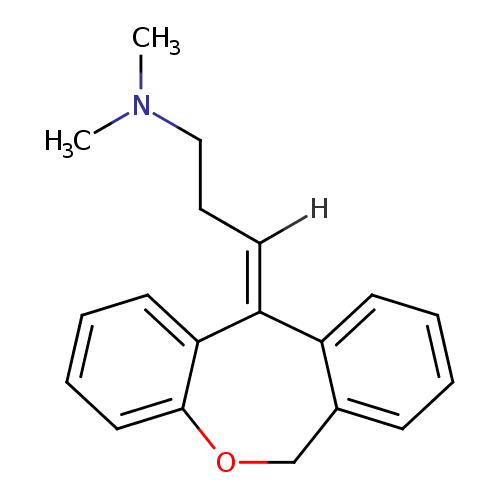
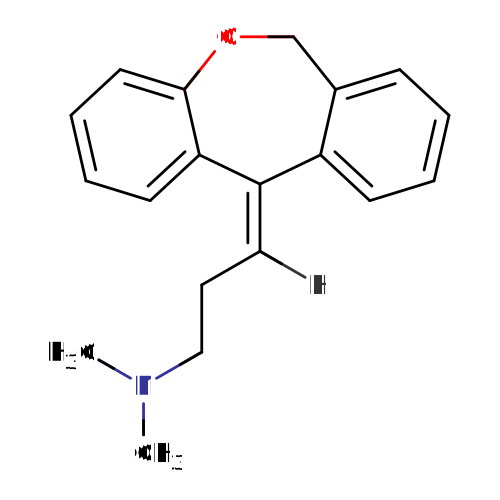
Doxepin hydrochloride is a dibenzoxepin-derivative tricyclic antidepressant (TCA). TCAs are structurally similar to phenothiazines. They contain a tricyclic ring system with an alkyl amine substituent on the central ring. In non-depressed individuals, doxepin does not affect mood or arousal, but may cause sedation. In depressed individuals, doxepin exerts a positive effect on mood. TCAs are potent inhibitors of serotonin and norepinephrine reuptake. Tertiary amine TCAs, such as doxepin and amitriptyline, are more potent inhibitors of serotonin reuptake than secondary amine TCAs, such as nortriptyline and desipramine. TCAs also down-regulate cerebral cortical β-adrenergic receptors and sensitize post-synaptic serotonergic receptors with chronic use. The antidepressant effects of TCAs are thought to be due to an overall increase in serotonergic neurotransmission. TCAs also block histamine H1 receptors, α1-adrenergic receptors and muscarinic receptors, which accounts for their sedative, hypotensive and anticholinergic effects (e.g. blurred vision, dry mouth, constipation, urinary retention), respectively. Doxepin has less sedative and anticholinergic effects than amitriptyline. See toxicity section below for a complete listing of side effects. Doxepin may be used to treat depression and insomnia. Unlabeled indications include chronic and neuropathic pain, and anxiety. Doxepin may also be used as a second line agent to treat idiopathic urticaria.
belongs to the class of organic compounds known as dibenzoxepines. Dibenzoxepines are compounds containing a dibenzoxepine moiety, which consists of two benzene connected by an oxazepine ring.
Well-absorbed from the GI tract. Peak plasma concentrations occur within 2 hours of oral administration.
Mechanism of Toxicity
The mechanism of action of doxepin is not completely understood. It is thought that like amitriptyline, doxepin enhances the actions of norepinephrine and serotonin by blocking their reuptake at the neuronal membrane. However, doxepin weakly inhibits the reuptake of dopamine. Doxepin may also act on histamine H1-receptors, resulting in sedative effects, and β-adrenergic receptors. It is also an antagonist of 5-hydroxytryptamine (serotonin) receptors, alpha-1 adrenergic receptor, and muscarinic cholinergic receptors.
Metabolism
Extensively metabolized in the liver via the same pathways as other TCAs. N-demethylation produces an active metabolite, N-desmethyldoxepin. CYP2D6 specifically hydroxylates the E-isomer.
Half Life: 6 - 24.5 hours
No indication of carcinogenicity to humans (not listed by IARC).
Uses/Sources
Doxepin is used for the treatment of depression, insomina, alcohol and drug withdrawal, gastrointestinal ulceration and other GI-problems. It can also be used for chronic urticaria and in the management of pain.
Minimum Risk Level
Not Available
Health Effects
hypotension, postural collapse (if patient arises too fast from lying/sitting position to standing), arrhythmias (sinus-tachycardia, bradycardia, av-blockade). Allergic/toxic effetcs also include skin rash, photosensitivity, liver damage of the cholostatic type (rarely), hepatitis (extremely rare), leuko- or thrombopenia (rarely), agranulocytosis (very rarely), hypoplastic anemia (rarely). [Wikipedia]
Symptoms
Cardiac dysrhythmias, severe hypotension, convulsions, and CNS depression, including coma. Changes in the electrocardiogram, particularly in QRS axis or width, are clinically significant indicators of tricyclic antidepressant toxicity.
Treatment
Obtain an ECG and immediately initiate cardiac monitoring. Protect the patient's airway, establish an intravenous line and initiate gastric decontamination. A minimum of six hours of observation with cardiac monitoring and observation for signs of CNS or respiratory depression, hypotension, cardiac dysrhythmias and/or conduction blocks, and seizures is strongly advised. If signs of toxicity occur at any time during this period, extended monitoring is recommended. (8)
Luigi Schioppi, Brian Talmadge Dorsey, Michael Skinner, John Carter, Robert Mansbach, Philip Jochelson, Roberta L. Rogowski, Cara Casseday, Meredith Perry, Bryan Knox, “LOW-DOSEDOXEPINFORMULATIONSANDMETHODS OF MAKINGANDUSINGTHESAME.” U.S. Patent US20090074862, issued March 19, 2009.