Record Information
Version1.0
Creation Date2009-07-21 20:28:25 UTC
Update Date2026-05-14 16:58:01 UTC
Accession NumberCHEM002351
Identification
Common NamePhenacemide
ClassSmall Molecule
DescriptionPhenacemide is only found in individuals that have used or taken this drug. It is used to control certain seizures in the treatment of epilepsy. This medicine acts on the central nervous system (CNS) to reduce the number and severity of seizures.Phenacemide binds to and blocks neuronal sodium channels or voltage sensitive calcium channels. This blocks or suppresses neuronal depolarization and hypersynchronization. Hypersynchronization is what often causes seizures.
Contaminant Sources
  • FooDB Chemicals
  • HMDB Contaminants - Urine
  • T3DB toxins
  • ToxCast & Tox21 Chemicals
Contaminant Type
  • Amide
  • Amine
  • Anticonvulsant
  • Drug
  • Metabolite
  • Organic Compound
  • Synthetic Compound
Chemical Structure
Thumb
Synonyms
ValueSource
PhenuroneKegg
Carbamide phenylacetateHMDB
PhenacetylcarbamideHMDB
PhenacetylureaHMDB
PhenylacetylureaHMDB
PhenylacetylureeHMDB
PhenuronHMDB
(Phenylacetyl)ureaHMDB
Chemical FormulaC9H10N2O2
Average Molecular Mass178.188 g/mol
Monoisotopic Mass178.074 g/mol
CAS Registry Number63-98-9
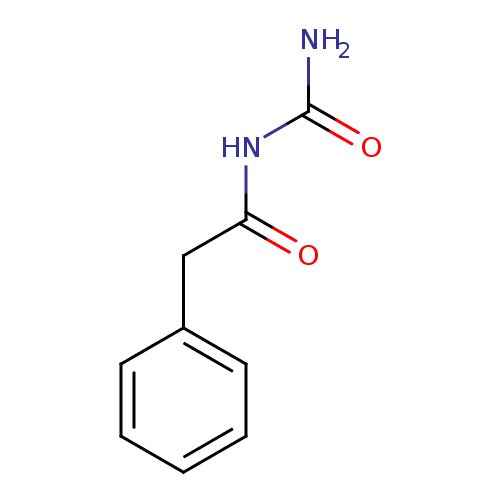
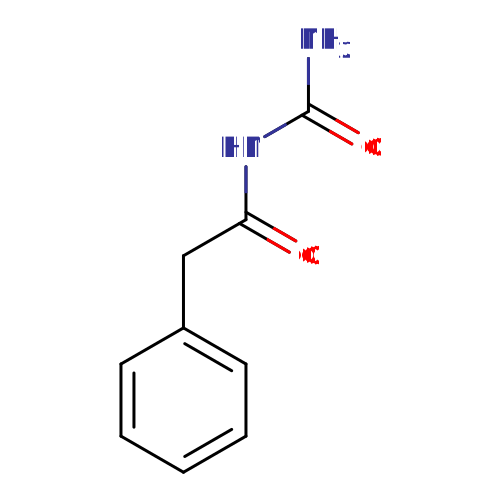
IUPAC Name(2-phenylacetyl)urea
Traditional Namephenacemide
SMILESNC(=O)NC(=O)CC1=CC=CC=C1
InChI IdentifierInChI=1S/C9H10N2O2/c10-9(13)11-8(12)6-7-4-2-1-3-5-7/h1-5H,6H2,(H3,10,11,12,13)
InChI KeyXPFRXWCVYUEORT-UHFFFAOYSA-N
Chemical Taxonomy
Description belongs to the class of organic compounds known as phenylacetamides. These are amide derivatives of phenylacetic acids.
KingdomOrganic compounds
Super ClassBenzenoids
ClassBenzene and substituted derivatives
Sub ClassPhenylacetamides
Direct ParentPhenylacetamides
Alternative Parents
Substituents
  • Phenylacetamide
  • N-acyl urea
  • Ureide
  • Dicarboximide
  • Carbonic acid derivative
  • Urea
  • Carboxylic acid derivative
  • Organopnictogen compound
  • Carbonyl group
  • Organooxygen compound
  • Organonitrogen compound
  • Organic oxygen compound
  • Organic nitrogen compound
  • Organic oxide
  • Hydrocarbon derivative
  • Aromatic homomonocyclic compound
Molecular FrameworkAromatic homomonocyclic compounds
External Descriptors
Biological Properties
StatusDetected and Not Quantified
OriginExogenous
Cellular Locations
  • Cytoplasm
  • Extracellular
  • Membrane
Biofluid LocationsNot Available
Tissue LocationsNot Available
PathwaysNot Available
ApplicationsNot Available
Biological RolesNot Available
Chemical RolesNot Available
Physical Properties
StateSolid
AppearanceWhite powder.
Experimental Properties
PropertyValue
Melting Point215°C
Boiling PointNot Available
Solubility10.2 g/L
Predicted Properties
PropertyValueSource
Water Solubility1.06 g/LALOGPS
logP0.81ALOGPS
logP0.46ChemAxon
logS-2.2ALOGPS
pKa (Strongest Acidic)11.75ChemAxon
pKa (Strongest Basic)-7.8ChemAxon
Physiological Charge0ChemAxon
Hydrogen Acceptor Count2ChemAxon
Hydrogen Donor Count2ChemAxon
Polar Surface Area72.19 ŲChemAxon
Rotatable Bond Count2ChemAxon
Refractivity47.43 m³·mol⁻¹ChemAxon
Polarizability17.49 ųChemAxon
Number of Rings1ChemAxon
Bioavailability1ChemAxon
Rule of FiveYesChemAxon
Ghose FilterYesChemAxon
Veber's RuleNoChemAxon
MDDR-like RuleNoChemAxon
Spectra
Spectra
Spectrum TypeDescriptionSplash KeyView
Predicted GC-MSPredicted GC-MS Spectrum - GC-MS (Non-derivatized) - 70eV, Positivesplash10-0006-9300000000-1bdb50bda427a0a6b759Spectrum
Predicted GC-MSPredicted GC-MS Spectrum - GC-MS (Non-derivatized) - 70eV, PositiveNot AvailableSpectrum
Predicted LC-MS/MSPredicted LC-MS/MS Spectrum - 10V, Positivesplash10-004i-2900000000-bbe6000c85c6e7cad8d7Spectrum
Predicted LC-MS/MSPredicted LC-MS/MS Spectrum - 20V, Positivesplash10-014u-4900000000-65aecc6405e7dc3960dbSpectrum
Predicted LC-MS/MSPredicted LC-MS/MS Spectrum - 40V, Positivesplash10-0006-9100000000-470744c360a51861385eSpectrum
Predicted LC-MS/MSPredicted LC-MS/MS Spectrum - 10V, Negativesplash10-000x-7900000000-33581cec0b1c89a374a1Spectrum
Predicted LC-MS/MSPredicted LC-MS/MS Spectrum - 20V, Negativesplash10-000x-7900000000-c6b59b20b89c19c87759Spectrum
Predicted LC-MS/MSPredicted LC-MS/MS Spectrum - 40V, Negativesplash10-0006-9100000000-812937333ee84aac004aSpectrum
Predicted LC-MS/MSPredicted LC-MS/MS Spectrum - 10V, Positivesplash10-00kf-9600000000-eb2dcdcc261eec29fa08Spectrum
Predicted LC-MS/MSPredicted LC-MS/MS Spectrum - 20V, Positivesplash10-0006-9100000000-6f93f0492b5f06695057Spectrum
Predicted LC-MS/MSPredicted LC-MS/MS Spectrum - 40V, Positivesplash10-0006-9000000000-d3ddfb9a0b95dad2b026Spectrum
Predicted LC-MS/MSPredicted LC-MS/MS Spectrum - 10V, Negativesplash10-0006-9000000000-2cca984c3d943209d9feSpectrum
Predicted LC-MS/MSPredicted LC-MS/MS Spectrum - 20V, Negativesplash10-0006-9000000000-90726b17dc36e29c5299Spectrum
Predicted LC-MS/MSPredicted LC-MS/MS Spectrum - 40V, Negativesplash10-0006-9000000000-90726b17dc36e29c5299Spectrum
MSMass Spectrum (Electron Ionization)splash10-00kf-9200000000-38554ddfe2ad3808dc2aSpectrum
1D NMR1H NMR SpectrumNot AvailableSpectrum
Toxicity Profile
Route of ExposureAlmost completely absorbed.
Mechanism of ToxicityPhenacemide binds to and blocks neuronal sodium channels or voltage sensitive calcium channels. This blocks or suppresses neuronal depolarization and hypersynchronization. Hypersynchronization is what often causes seizures.
MetabolismMetabolized in the liver by hepatic microsomal enzymes, where it is inactivated by p-hydroxylation. Half Life: 22-25 hours.
Toxicity ValuesLD50: 987 mg/kg (Oral, Mouse) (1) LD50: 2500 mg/kg (Oral, Rabbit) (1) LD50: 1600 mg/kg (Oral, Rat) (1)
Lethal DoseNot Available
Carcinogenicity (IARC Classification)No indication of carcinogenicity to humans (not listed by IARC).
Uses/SourcesUsed to control certain seizures in the treatment of epilepsy.
Minimum Risk LevelNot Available
Health EffectsMay cause a potentially dangerous rash that may develop into Stevens Johnson syndrome, an extremely rare but potentially fatal skin disease.
SymptomsNot Available
TreatmentNot Available
Concentrations
Not Available
DrugBank IDDB01121
HMDB IDHMDB0015253
FooDB IDFDB007356
Phenol Explorer IDNot Available
KNApSAcK IDNot Available
BiGG IDNot Available
BioCyc IDNot Available
METLIN IDNot Available
PDB IDNot Available
Wikipedia LinkPhenacemide
Chemspider ID4589
ChEBI ID183000
PubChem Compound ID4753
Kegg Compound IDC07428
YMDB IDNot Available
ECMDB IDNot Available
References
Synthesis ReferenceNot Available
MSDSLink
General References
1. Coker SB: The use of phenacemide for intractable partial complex epilepsy in children. Pediatr Neurol. 1986 Jul-Aug;2(4):230-2.
2. Coker SB, Holmes EW, Egel RT: Phenacemide therapy of complex partial epilepsy in children: determination of plasma drug concentrations. Neurology. 1987 Dec;37(12):1861-6.