Record Information
Version1.0
Creation Date2009-07-21 20:28:22 UTC
Update Date2026-05-14 16:57:49 UTC
Accession NumberCHEM002345
Identification
Common NamePimozide
ClassSmall Molecule
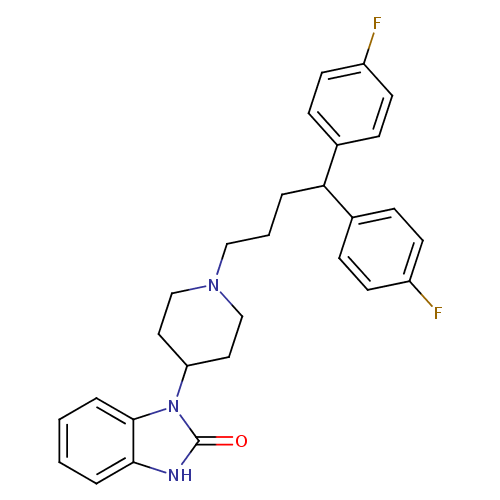
DescriptionA diphenylbutylpiperidine that is effective as an antipsychotic agent and as an alternative to haloperidol for the suppression of vocal and motor tics in patients with Tourette syndrome. Although the precise mechanism of action is unknown, blockade of postsynaptic dopamine receptors has been postulated. (From AMA Drug Evaluations Annual, 1994, p403)
Contaminant Sources
  • HMDB Contaminants - Urine
  • STOFF IDENT Compounds
  • T3DB toxins
  • ToxCast & Tox21 Chemicals
Contaminant Type
  • Amine
  • Anti-Dyskinesia Agent
  • Antidyskinetic
  • Antipsychotic Agent
  • Dopamine Antagonist
  • Drug
  • Human Neurotoxin
  • Metabolite
  • Organic Compound
  • Organofluoride
  • Synthetic Compound
Chemical Structure
Thumb
Synonyms
ValueSource
HalomonthChEBI
NeoperidoleChEBI
OpiranChEBI
OrapChEBI
PimozidaChEBI
PimozidumChEBI
Janssen brand OF pimozideHMDB
Pharmascience brand OF pimozideHMDB
Orap forteHMDB
ASTA medica brand OF pimozideHMDB
AntalonHMDB
Chemical FormulaC28H29F2N3O
Average Molecular Mass461.546 g/mol
Monoisotopic Mass461.228 g/mol
CAS Registry Number2062-78-4
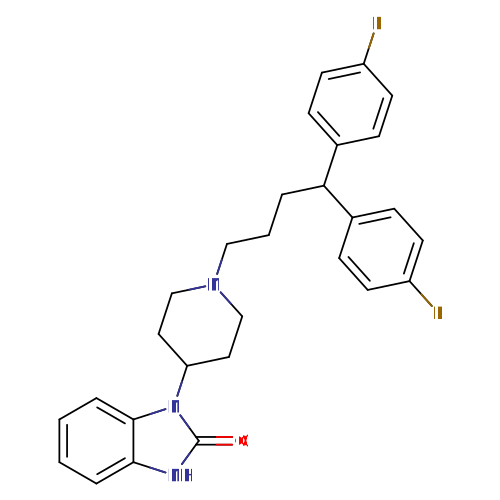
IUPAC Name1-{1-[4,4-bis(4-fluorophenyl)butyl]piperidin-4-yl}-2,3-dihydro-1H-1,3-benzodiazol-2-one
Traditional Namepimozide
SMILESFC1=CC=C(C=C1)C(CCCN1CCC(CC1)N1C(=O)NC2=CC=CC=C12)C1=CC=C(F)C=C1
InChI IdentifierInChI=1S/C28H29F2N3O/c29-22-11-7-20(8-12-22)25(21-9-13-23(30)14-10-21)4-3-17-32-18-15-24(16-19-32)33-27-6-2-1-5-26(27)31-28(33)34/h1-2,5-14,24-25H,3-4,15-19H2,(H,31,34)
InChI KeyYVUQSNJEYSNKRX-UHFFFAOYSA-N
Chemical Taxonomy
Description belongs to the class of organic compounds known as diphenylmethanes. Diphenylmethanes are compounds containing a diphenylmethane moiety, which consists of a methane wherein two hydrogen atoms are replaced by two phenyl groups.
KingdomOrganic compounds
Super ClassBenzenoids
ClassBenzene and substituted derivatives
Sub ClassDiphenylmethanes
Direct ParentDiphenylmethanes
Alternative Parents
Substituents
  • Diphenylmethane
  • Phenylbutylamine
  • Benzimidazole
  • Aralkylamine
  • Fluorobenzene
  • Halobenzene
  • Aryl fluoride
  • Aryl halide
  • Piperidine
  • N-substituted imidazole
  • Azole
  • Heteroaromatic compound
  • Imidazole
  • Tertiary aliphatic amine
  • Tertiary amine
  • Azacycle
  • Organoheterocyclic compound
  • Organonitrogen compound
  • Organooxygen compound
  • Amine
  • Hydrocarbon derivative
  • Organopnictogen compound
  • Organic oxygen compound
  • Organic nitrogen compound
  • Organofluoride
  • Organohalogen compound
  • Aromatic heteropolycyclic compound
Molecular FrameworkAromatic heteropolycyclic compounds
External Descriptors
Biological Properties
StatusDetected and Not Quantified
OriginExogenous
Cellular Locations
  • Membrane
Biofluid LocationsNot Available
Tissue LocationsNot Available
PathwaysNot Available
Applications
Biological Roles
Chemical RolesNot Available
Physical Properties
StateSolid
AppearanceWhite powder.
Experimental Properties
PropertyValue
Melting Point214-218°C
Boiling PointNot Available
Solubility10 mg/L (at 25°C)
Predicted Properties
PropertyValueSource
Water Solubility0.0017 g/LALOGPS
logP6.36ALOGPS
logP5.83ChemAxon
logS-5.4ALOGPS
pKa (Strongest Acidic)12.9ChemAxon
pKa (Strongest Basic)8.38ChemAxon
Physiological Charge1ChemAxon
Hydrogen Acceptor Count2ChemAxon
Hydrogen Donor Count1ChemAxon
Polar Surface Area35.58 ŲChemAxon
Rotatable Bond Count7ChemAxon
Refractivity132.21 m³·mol⁻¹ChemAxon
Polarizability50.04 ųChemAxon
Number of Rings5ChemAxon
Bioavailability1ChemAxon
Rule of FiveNoChemAxon
Ghose FilterNoChemAxon
Veber's RuleYesChemAxon
MDDR-like RuleYesChemAxon
Spectra
Spectra
Spectrum TypeDescriptionSplash KeyView
Predicted GC-MSPredicted GC-MS Spectrum - GC-MS (Non-derivatized) - 70eV, Positivesplash10-0ugi-1391000000-81a5491e04c0772aa266Spectrum
Predicted GC-MSPredicted GC-MS Spectrum - GC-MS (Non-derivatized) - 70eV, PositiveNot AvailableSpectrum
LC-MS/MSLC-MS/MS Spectrum - , positivesplash10-03fr-3945500000-63d831a19fe77286e9e1Spectrum
LC-MS/MSLC-MS/MS Spectrum - 90V, Positivesplash10-0a4i-2900000000-c5c24c6004ad63c44b7bSpectrum
LC-MS/MSLC-MS/MS Spectrum - 75V, Positivesplash10-0a4i-2900000000-4ec6383bd789926aace8Spectrum
LC-MS/MSLC-MS/MS Spectrum - 45V, Negativesplash10-001i-0900000000-f7e5bc8b3118f019d29aSpectrum
LC-MS/MSLC-MS/MS Spectrum - 60V, Negativesplash10-001i-0900000000-15ed37cc4150d726424fSpectrum
LC-MS/MSLC-MS/MS Spectrum - 60V, Positivesplash10-0a4j-2900000000-4cb696b16013c21eaeccSpectrum
LC-MS/MSLC-MS/MS Spectrum - 45V, Positivesplash10-054k-3922000000-3dece675311cfc7dcecbSpectrum
LC-MS/MSLC-MS/MS Spectrum - 15V, Positivesplash10-03di-0000900000-a6c11637d319ae7e0d4bSpectrum
LC-MS/MSLC-MS/MS Spectrum - 30V, Positivesplash10-03di-0001900000-e11e7746c656531d49c3Spectrum
LC-MS/MSLC-MS/MS Spectrum - 90V, Negativesplash10-001i-0900000000-a10c36c7b309fd6a144aSpectrum
Predicted LC-MS/MSPredicted LC-MS/MS Spectrum - 10V, Positivesplash10-03di-0010900000-930a125974bd00e0c2ebSpectrum
Predicted LC-MS/MSPredicted LC-MS/MS Spectrum - 20V, Positivesplash10-03dj-0292700000-2985b790e5501b39bbd6Spectrum
Predicted LC-MS/MSPredicted LC-MS/MS Spectrum - 40V, Positivesplash10-00ks-2981100000-75644e2a4fa99f98d3bcSpectrum
Predicted LC-MS/MSPredicted LC-MS/MS Spectrum - 10V, Negativesplash10-03di-0000900000-d214f454d376b4403eddSpectrum
Predicted LC-MS/MSPredicted LC-MS/MS Spectrum - 20V, Negativesplash10-03e9-0410900000-0d1a6255c713f6209ad8Spectrum
Predicted LC-MS/MSPredicted LC-MS/MS Spectrum - 40V, Negativesplash10-001i-2920000000-0b02fc753cd5d50662e6Spectrum
Predicted LC-MS/MSPredicted LC-MS/MS Spectrum - 10V, Positivesplash10-03di-0000900000-1007eb55b47c59016fd5Spectrum
Predicted LC-MS/MSPredicted LC-MS/MS Spectrum - 20V, Positivesplash10-03di-0001900000-6016ca53ea77d615c57cSpectrum
Predicted LC-MS/MSPredicted LC-MS/MS Spectrum - 40V, Positivesplash10-03yj-2790700000-5ee4d094cbf2edb564c4Spectrum
Predicted LC-MS/MSPredicted LC-MS/MS Spectrum - 10V, Negativesplash10-03di-0000900000-d24101b35641ce78a840Spectrum
Predicted LC-MS/MSPredicted LC-MS/MS Spectrum - 20V, Negativesplash10-03xr-1000900000-a8261095a6ae4bd8e429Spectrum
Predicted LC-MS/MSPredicted LC-MS/MS Spectrum - 40V, Negativesplash10-001i-3911100000-2bfbcbf4417742b7624dSpectrum
MSMass Spectrum (Electron Ionization)splash10-001i-4890100000-ff909df45204eac82c46Spectrum
Toxicity Profile
Route of ExposureGreater than 50% absorption after oral administration. Serum peak appears 6-8 hours post ingestion.
Mechanism of ToxicityThe ability of pimozide to suppress motor and phonic tics in Tourette's Disorder is thought to be primarily a function of its dopaminergic blocking activity. Pimozide binds and inhibits the dopamine D2 receptor in the CNS. It also appears to block voltage-operated calcium channels and acts as an antagonist at opiate receptors (OP2).
MetabolismNotable first-pass metabolism in the liver, primarily by N-dealkylation via the cytochrome P450 isoenzymes CYP3A and CYP1A2 (and possibly CYP2D6). The activity of the two major metabolites has not been determined. Half Life: 29 ± 10 hours (single-dose study of healthy volunteers).
Toxicity ValuesLD50: 1100 mg/kg (Oral, Rat) (1) LD50: 228 mg/kg (Oral, Mouse) (1)
Lethal DoseNot Available
Carcinogenicity (IARC Classification)No indication of carcinogenicity to humans (not listed by IARC).
Uses/SourcesUsed for the suppression of motor and phonic tics in patients with Tourette's Disorder who have failed to respond satisfactorily to standard treatment.
Minimum Risk LevelNot Available
Health EffectsNot Available
SymptomsNot Available
TreatmentIn the event of overdosage, gastric lavage, establishment of a patent airway and, if necessary, mechanically-assisted respiration are advised. Electrocardiographic monitoring should commence immediately and continue until the ECG parameters are within the normal range. Hypotension and circulatory collapse may be counteracted by use of intravenous fluids, plasma, or concentrated albumin, and vasopressor agents such as metaraminol, phenylephrine and norepinephrine. Epinephrine should not be used. In case of severe extrapyramidal reactions, antiparkinson medication should be administered. Because of the long half-life of pimozide, patients who take an overdose should be observed for at least 4 days. (3)
Concentrations
Not Available
DrugBank IDDB01100
HMDB IDHMDB0015232
FooDB IDNot Available
Phenol Explorer IDNot Available
KNApSAcK IDNot Available
BiGG IDNot Available
BioCyc IDNot Available
METLIN IDNot Available
PDB IDNot Available
Wikipedia LinkPimozide
Chemspider ID15520
ChEBI ID8212
PubChem Compound ID16362
Kegg Compound IDC07566
YMDB IDNot Available
ECMDB IDNot Available
References
Synthesis ReferenceNot Available
MSDSLink
General ReferencesNot Available