Record Information
Version1.0
Creation Date2009-07-21 20:28:21 UTC
Update Date2026-05-14 16:57:46 UTC
Accession NumberCHEM002343
Identification
Common NameDimethyl sulfoxide
ClassSmall Molecule
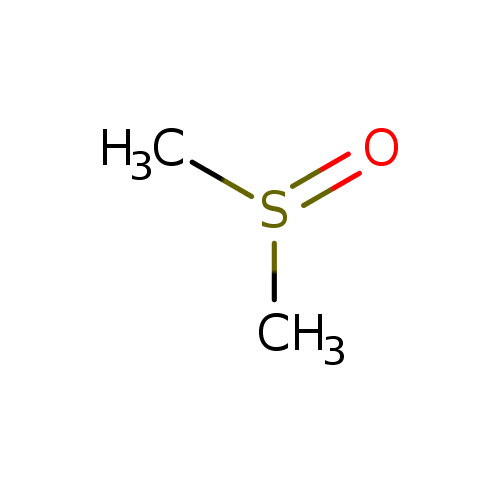
DescriptionDimethyl sulfoxide (DMSO) is a key dipolar aprotic solvent. It is less toxic than other members of this class: dimethylformamide, dimethylacetamide, N-methyl-2-pyrrolidone, HMPA. Dimethyl sulfoxide is the chemical compound (CH3)2SO. This colorless liquid is an important dipolar aprotic solvent. It is readily miscible in a wide range of organic solvents as well as water. It has a distinctive property of penetrating the skin very readily, allowing the handler to taste it. Some describe it as an oyster-like taste, others claim it tastes like garlic. DMSO is also employed as a rinsing agent in the electronics industry and, in its deuterated form (DMSO-d6), is a useful solvent in NMR due to its ability to dissolve a wide range of chemical compounds and its minimal interference with the sample signals. In cryobiology DMSO has been used as a cryoprotectant and is still an important constituent of cryoprotectant vitrification mixtures used to preserve organs, tissues, and cell suspensions. It is particularly important in the freezing and long-term storage of embryonic stem cells and hematopoietic stem cell, which are often frozen in a mixture of 10% DMSO and 90% fetal calf serum. As part of an autologous bone marrow transplant the DMSO is re-infused along with the patient's own hematopoietic stem cell. Dimethyl sulfoxide is a by-product of wood pulping. One of the leading suppliers of DMSO is the Gaylord company in the USA. DMSO is frequently used as solvent in a number of chemical reactions. In particular it is an excellent reaction solvent for SN2 alkylations: it is possible to alkylate indoles with very high yields using potassium hydroxide as the base and a similar reaction also occurs with phenols. DMSO can be reacted with methyl iodide to form a sulfoxonium ion which can be reacted with sodium hydride to form a sulfur ylide. The methyl groups of DMSO are somewhat acidic in character (pKa=35) due to the stabilization of the resultant anions by the sulfoxide group.
Contaminant Sources
  • EAFUS Chemicals
  • FooDB Chemicals
  • HMDB Contaminants - Feces
  • HPV EPA Chemicals
  • OECD HPV Chemicals
  • STOFF IDENT Compounds
  • T3DB toxins
  • ToxCast & Tox21 Chemicals
Contaminant Type
  • Analgesic, Non-Narcotic
  • Cryoprotective Agent
  • Drug
  • Food Toxin
  • Free Radical Scavenger
  • Household Toxin
  • Human Neurotoxin
  • Industrial/Workplace Toxin
  • Metabolite
  • Organic Compound
  • PMT
  • Solvent
  • Synthetic Compound
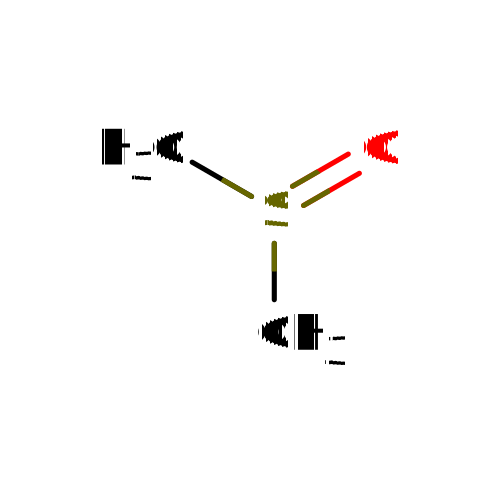
Chemical Structure
Thumb
Synonyms
ValueSource
(CH3)2SOChEBI
Dimethyl sulfur oxideChEBI
Dimethyl sulphoxideChEBI
Dimethyli sulfoxidumChEBI
DimethylsulfoxidChEBI
DimethylsulfoxydeChEBI
Dimetil sulfoxidoChEBI
DMSOChEBI
MethylsulfinylmethaneChEBI
S(O)Me2ChEBI
Sulfinylbis(methane)ChEBI
Rimso-50Kegg
ZymsoKegg
Dimethyl sulphur oxideGenerator
Dimethyli sulphoxidumGenerator
DimethylsulphoxidGenerator
DimethylsulphoxydeGenerator
Dimetil sulphoxidoGenerator
MethylsulphinylmethaneGenerator
Sulphinylbis(methane)Generator
(Methylsulfinyl)methaneHMDB
Dimethyl sulfoxixdeHMDB
Dimethyl sulpoxideHMDB
DimethylsulphoxideMeSH, HMDB
RheumabeneMeSH, HMDB
RimsoMeSH, HMDB
DimexideMeSH, HMDB
Research ind. corp. brand 1 OF dimethyl sulfoxideMeSH, HMDB
Shire brand OF dimethyl sulfoxideMeSH, HMDB
Sulphoxide, dimethylMeSH, HMDB
DimethylsulphinylMeSH, HMDB
Merckle brand OF dimethyl sulfoxideMeSH, HMDB
Research ind. corp. brand 2 OF dimethyl sulfoxideMeSH, HMDB
SclerosolMeSH, HMDB
Sulfoxide, dimethylMeSH, HMDB
DimethylsulfoxideMeSH, HMDB
rimso 100MeSH, HMDB
Rimso50MeSH, HMDB
Rimso 50MeSH, HMDB
Chemical FormulaC2H6OS
Average Molecular Mass78.133 g/mol
Monoisotopic Mass78.014 g/mol
CAS Registry Number67-68-5
IUPAC Namemethanesulfinylmethane
Traditional Namedimethyl sulfoxide
SMILESCS(C)=O
InChI IdentifierInChI=1S/C2H6OS/c1-4(2)3/h1-2H3
InChI KeyIAZDPXIOMUYVGZ-UHFFFAOYSA-N
Chemical Taxonomy
Description belongs to the class of organic compounds known as sulfoxides. Sulfoxides are compounds containing a sulfoxide functional group, with the structure RS(=O)R' (R,R' not H).
KingdomOrganic compounds
Super ClassOrganosulfur compounds
ClassSulfoxides
Sub ClassNot Available
Direct ParentSulfoxides
Alternative Parents
Substituents
  • Sulfoxide
  • Sulfinyl compound
  • Organic oxygen compound
  • Organic oxide
  • Hydrocarbon derivative
  • Aliphatic acyclic compound
Molecular FrameworkAliphatic acyclic compounds
External Descriptors
Biological Properties
StatusDetected and Not Quantified
OriginExogenous
Cellular Locations
  • Cytoplasm
  • Extracellular
Biofluid LocationsNot Available
Tissue LocationsNot Available
PathwaysNot Available
Applications
Biological Roles
Chemical Roles
Physical Properties
StateLiquid
AppearanceNot Available
Experimental Properties
PropertyValue
Melting Point18.5°C
Boiling Point63
Solubility1E+006 mg/L
Predicted Properties
PropertyValueSource
Water Solubility65.7 g/LALOGPS
logP-1.1ALOGPS
logP-1.4ChemAxon
logS-0.08ALOGPS
pKa (Strongest Basic)-8ChemAxon
Physiological Charge0ChemAxon
Hydrogen Acceptor Count1ChemAxon
Hydrogen Donor Count0ChemAxon
Polar Surface Area17.07 ŲChemAxon
Rotatable Bond Count0ChemAxon
Refractivity20.73 m³·mol⁻¹ChemAxon
Polarizability7.91 ųChemAxon
Number of Rings0ChemAxon
Bioavailability1ChemAxon
Rule of FiveYesChemAxon
Ghose FilterNoChemAxon
Veber's RuleYesChemAxon
MDDR-like RuleNoChemAxon
Spectra
Spectra
Spectrum TypeDescriptionSplash KeyView
GC-MSGC-MS Spectrum - EI-B (Non-derivatized)splash10-03fr-9000000000-f0f118841efd8b3297a3Spectrum
GC-MSGC-MS Spectrum - EI-B (Non-derivatized)splash10-03fs-9000000000-945240052686ea267e2bSpectrum
GC-MSGC-MS Spectrum - EI-B (Non-derivatized)splash10-03fs-9000000000-378b716bc39417224511Spectrum
GC-MSGC-MS Spectrum - EI-B (Non-derivatized)splash10-03fr-9000000000-f0f118841efd8b3297a3Spectrum
GC-MSGC-MS Spectrum - EI-B (Non-derivatized)splash10-03fs-9000000000-945240052686ea267e2bSpectrum
GC-MSGC-MS Spectrum - EI-B (Non-derivatized)splash10-03fs-9000000000-378b716bc39417224511Spectrum
Predicted GC-MSPredicted GC-MS Spectrum - GC-MS (Non-derivatized) - 70eV, Positivesplash10-01t9-9000000000-a87469bb1afda1828bbeSpectrum
Predicted GC-MSPredicted GC-MS Spectrum - GC-MS (Non-derivatized) - 70eV, PositiveNot AvailableSpectrum
LC-MS/MSLC-MS/MS Spectrum - 30V, Positivesplash10-0002-9000000000-b96781268f9bbbcb1544Spectrum
LC-MS/MSLC-MS/MS Spectrum - 10V, Positivesplash10-004i-9000000000-16f85b2cb3628d8d9358Spectrum
LC-MS/MSLC-MS/MS Spectrum - 35V, Positivesplash10-03dj-9000000000-c11b31839f52d556db57Spectrum
LC-MS/MSLC-MS/MS Spectrum - 0V, Positivesplash10-004i-9000000000-6fd68fb341597894c9e9Spectrum
Predicted LC-MS/MSPredicted LC-MS/MS Spectrum - 10V, Positivesplash10-004i-9000000000-c8f7a9f09c8bb456283cSpectrum
Predicted LC-MS/MSPredicted LC-MS/MS Spectrum - 20V, Positivesplash10-004i-9000000000-d8d98568ae59afba65e6Spectrum
Predicted LC-MS/MSPredicted LC-MS/MS Spectrum - 40V, Positivesplash10-03di-9000000000-e0a36c290f004f302f0bSpectrum
Predicted LC-MS/MSPredicted LC-MS/MS Spectrum - 10V, Negativesplash10-004i-9000000000-89687ba96456a97fb486Spectrum
Predicted LC-MS/MSPredicted LC-MS/MS Spectrum - 20V, Negativesplash10-01t9-9000000000-04ddc1322b21e4817d57Spectrum
Predicted LC-MS/MSPredicted LC-MS/MS Spectrum - 40V, Negativesplash10-0a4i-9000000000-d90c2fed7aad139b406cSpectrum
Predicted LC-MS/MSPredicted LC-MS/MS Spectrum - 10V, Negativesplash10-004i-9000000000-50c596e219854897fad2Spectrum
Predicted LC-MS/MSPredicted LC-MS/MS Spectrum - 20V, Negativesplash10-004i-9000000000-50c596e219854897fad2Spectrum
Predicted LC-MS/MSPredicted LC-MS/MS Spectrum - 40V, Negativesplash10-0bt9-9000000000-102e2e8c382c8f4c1975Spectrum
Predicted LC-MS/MSPredicted LC-MS/MS Spectrum - 10V, Positivesplash10-004i-9000000000-28072bae45639cb50943Spectrum
Predicted LC-MS/MSPredicted LC-MS/MS Spectrum - 20V, Positivesplash10-03di-9000000000-670c7176bed65aef23f5Spectrum
Predicted LC-MS/MSPredicted LC-MS/MS Spectrum - 40V, Positivesplash10-03di-9000000000-9ae0f01cd17306d4ecf0Spectrum
MSMass Spectrum (Electron Ionization)splash10-03fr-9000000000-1db858034b22d1646592Spectrum
1D NMR1H NMR SpectrumNot AvailableSpectrum
1D NMR13C NMR SpectrumNot AvailableSpectrum
1D NMR1H NMR SpectrumNot AvailableSpectrum
1D NMR13C NMR SpectrumNot AvailableSpectrum
1D NMR1H NMR SpectrumNot AvailableSpectrum
1D NMR13C NMR SpectrumNot AvailableSpectrum
1D NMR1H NMR SpectrumNot AvailableSpectrum
1D NMR13C NMR SpectrumNot AvailableSpectrum
1D NMR1H NMR SpectrumNot AvailableSpectrum
1D NMR13C NMR SpectrumNot AvailableSpectrum
1D NMR1H NMR SpectrumNot AvailableSpectrum
1D NMR13C NMR SpectrumNot AvailableSpectrum
1D NMR1H NMR SpectrumNot AvailableSpectrum
1D NMR13C NMR SpectrumNot AvailableSpectrum
1D NMR1H NMR SpectrumNot AvailableSpectrum
1D NMR13C NMR SpectrumNot AvailableSpectrum
1D NMR1H NMR SpectrumNot AvailableSpectrum
1D NMR13C NMR SpectrumNot AvailableSpectrum
1D NMR1H NMR SpectrumNot AvailableSpectrum
1D NMR13C NMR SpectrumNot AvailableSpectrum
1D NMR1H NMR SpectrumNot AvailableSpectrum
Toxicity Profile
Route of ExposureTopical ; parenteral(intravesical). Readily and rapidly absorbed following administration by all routes and distributed throughout the body.
Mechanism of ToxicityThe mechanism of dimethyl sulfoxide's actions is not well understood. Dimethyl sulfoxide has demonstrated antioxidant activity in certain biological settings. For example, the cardiovascular protective effect of dimethyl sulfoxide in copper-deficient rats is thought to occur by an antioxidant mechanism. It is also thought that dimethyl sulfoxide's possible anti-inflammatory activity is due to antioxidant action.
MetabolismDimethyl sulfoxide is metabolized in man by oxidation to dimethyl sulfone or by reduction in dimethyl sulfide. Dimethyl sulfoxide and dimethyl sulfone are excreted in the urine and feces. Route of Elimination: Dimethyl sulfoxide and dimethyl sulfone are excreted in the urine and feces.
Toxicity ValuesLD50: >10 gm/kg (Oral, Dog) (1)
Lethal DoseNot Available
Carcinogenicity (IARC Classification)No indication of carcinogenicity to humans (not listed by IARC).
Uses/SourcesDMSO is an important polar aprotic solvent. In cryobiology DMSO has been used as a cryoprotectant and is still an important constituent of cryoprotectant vitrification mixtures used to preserve organs, tissues, and cell suspensions.[Wikipedia]
Minimum Risk LevelNot Available
Health EffectsNot Available
SymptomsTaking DMSO internally is reported to cause a fish- or oyster-like taste or odor in the mouth, likely due to the sulfoxide metabolites of DMSO. [Wikipedia]
TreatmentIn case of accidental oral ingestion, specifc measures should be taken to induce emesis. Additional measures which may be considered are gastric lavage, activated charcoal and force diuresis. (3)
Concentrations
Not Available
DrugBank IDDB01093
HMDB IDHMDB0002151
FooDB IDFDB000764
Phenol Explorer IDNot Available
KNApSAcK IDC00053120
BiGG IDNot Available
BioCyc IDDMSO
METLIN ID3985
PDB IDNot Available
Wikipedia LinkDimethyl_sulfoxide
Chemspider ID659
ChEBI ID28262
PubChem Compound ID679
Kegg Compound IDC11143
YMDB IDNot Available
ECMDB IDECMDB21208
References
Synthesis Reference

Zhi Guo, Indra Prakash, “Synthesis and purification of 3,3-dimethylbutyraldehyde via oxidation of 1-chloro-3,3-dimethylbutane with dimethyl sulfoxide.” U.S. Patent US5905175, issued October, 1990.

MSDSLink
General References
1. https://www.ncbi.nlm.nih.gov/pubmed/?term=10298633
2. https://www.ncbi.nlm.nih.gov/pubmed/?term=11162043
3. https://www.ncbi.nlm.nih.gov/pubmed/?term=11350866
4. https://www.ncbi.nlm.nih.gov/pubmed/?term=11474739
5. https://www.ncbi.nlm.nih.gov/pubmed/?term=12663039
6. https://www.ncbi.nlm.nih.gov/pubmed/?term=15237653
7. https://www.ncbi.nlm.nih.gov/pubmed/?term=15588915
8. https://www.ncbi.nlm.nih.gov/pubmed/?term=15868171
9. https://www.ncbi.nlm.nih.gov/pubmed/?term=16434015
10. https://www.ncbi.nlm.nih.gov/pubmed/?term=16522014
11. https://www.ncbi.nlm.nih.gov/pubmed/?term=19096138
12. https://www.ncbi.nlm.nih.gov/pubmed/?term=19382398
13. https://www.ncbi.nlm.nih.gov/pubmed/?term=19443933
14. https://www.ncbi.nlm.nih.gov/pubmed/?term=21426213
15. https://www.ncbi.nlm.nih.gov/pubmed/?term=22030943
16. https://www.ncbi.nlm.nih.gov/pubmed/?term=22722716
17. https://www.ncbi.nlm.nih.gov/pubmed/?term=22768202
18. https://www.ncbi.nlm.nih.gov/pubmed/?term=22814967
19. https://www.ncbi.nlm.nih.gov/pubmed/?term=23050031
20. https://www.ncbi.nlm.nih.gov/pubmed/?term=28220525
21. https://www.ncbi.nlm.nih.gov/pubmed/?term=29938311
22. https://www.ncbi.nlm.nih.gov/pubmed/?term=31489176
23. https://www.ncbi.nlm.nih.gov/pubmed/?term=3510103
24. https://www.ncbi.nlm.nih.gov/pubmed/?term=3898376
25. https://www.ncbi.nlm.nih.gov/pubmed/?term=3916302
26. https://www.ncbi.nlm.nih.gov/pubmed/?term=4223708
27. https://www.ncbi.nlm.nih.gov/pubmed/?term=4556944
28. https://www.ncbi.nlm.nih.gov/pubmed/?term=4963226
29. https://www.ncbi.nlm.nih.gov/pubmed/?term=6309056
30. https://www.ncbi.nlm.nih.gov/pubmed/?term=6379027
31. Goeb, Andre. Dimethyl sulfoxide. Ger. Offen. (1976), 12 pp.
32. Vazquez-Landaverde PA, Torres JA, Qian MC: Quantification of trace volatile sulfur compounds in milk by solid-phase microextraction and gas chromatography-pulsed flame photometric detection. J Dairy Sci. 2006 Aug;89(8):2919-27. doi: 10.3168/jds.S0022-0302(06)72564-4.
33. Goeb, Andre. Dimethyl sulfoxide. Ger. Offen. (1976), 12 pp.
34. Engelke UF, Tangerman A, Willemsen MA, Moskau D, Loss S, Mudd SH, Wevers RA: Dimethyl sulfone in human cerebrospinal fluid and blood plasma confirmed by one-dimensional (1)H and two-dimensional (1)H-(13)C NMR. NMR Biomed. 2005 Aug;18(5):331-6.