Record Information
Version1.0
Creation Date2009-07-21 20:28:19 UTC
Update Date2026-03-26 20:04:12 UTC
Accession NumberCHEM002340
Identification
Common NameDiphenoxylate
ClassSmall Molecule
DescriptionA meperidine congener used as an antidiarrheal, usually in combination with atropine. At high doses, it acts like morphine. Its unesterified metabolite difenoxin has similar properties and is used similarly. It has little or no analgesic activity. This medication is classified as a Schedule V under the Controlled Substances Act by the Food and Drug Administration (FDA) and the DEA in the United States when used in preparations. When diphenoxylate is used alone, it is classified as a Schedule II.
Contaminant Sources
  • HMDB Contaminants - Urine
  • STOFF IDENT Compounds
  • T3DB toxins
Contaminant Type
  • Amine
  • Analgesic, Opioid
  • Antidiarrheal
  • Antiperistaltic Agent
  • Drug
  • Ester
  • Ether
  • Food Toxin
  • Metabolite
  • Narcotic
  • Nitrile
  • Organic Compound
  • Synthetic Compound
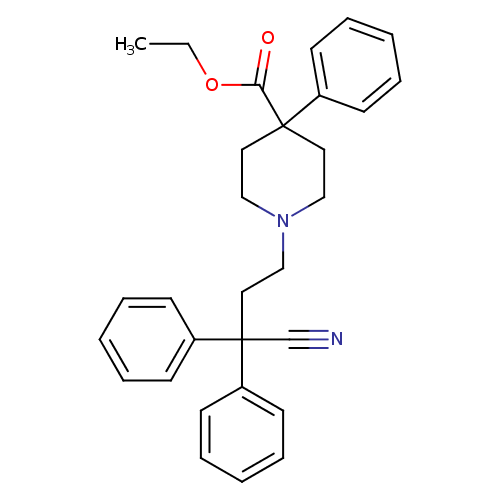
Chemical Structure
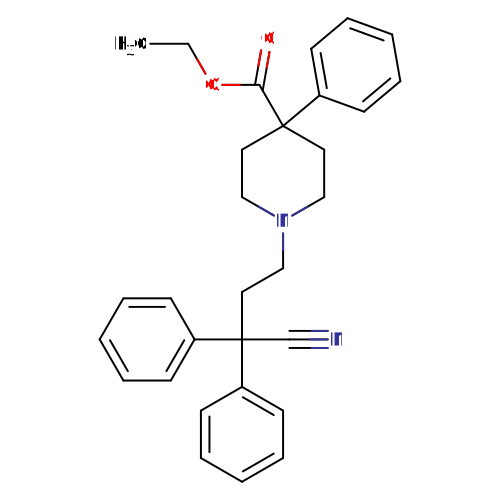
Thumb
Synonyms
ValueSource
1-(3-Cyano-3,3-diphenylpropyl)-4-phenyl-isonipecotic acid ethyl esterChEBI
2,2-Diphenyl-4-(4-carbethoxy-4-phenylpiperidino)butyronitrileChEBI
4-Ethoxycarbonyl-alpha,alpha,4-triphenyl-1-piperidinebutyronitrileChEBI
DifenoxilatoChEBI
DiphenoxylatumChEBI
Ethyl 1-(3-cyano-3,3-diphenylpropyl)-4-phenyl-4-piperidinecarboxylateChEBI
Ethyl 1-(3-cyano-3,3-diphenylpropyl)-4-phenylisonipecotateChEBI
1-(3-Cyano-3,3-diphenylpropyl)-4-phenyl-isonipecotate ethyl esterGenerator
4-Ethoxycarbonyl-a,a,4-triphenyl-1-piperidinebutyronitrileGenerator
4-Ethoxycarbonyl-α,α,4-triphenyl-1-piperidinebutyronitrileGenerator
Ethyl 1-(3-cyano-3,3-diphenylpropyl)-4-phenyl-4-piperidinecarboxylic acidGenerator
Ethyl 1-(3-cyano-3,3-diphenylpropyl)-4-phenylisonipecotic acidGenerator
Diphenoxylic acidGenerator
Dea no. 9170HMDB
DifenossilatoHMDB
DiphenoxalateHMDB
Diphenoxylate monohydrochlorideHMDB
Monohydrochloride, diphenoxylateHMDB
Hydrochloride, diphenoxylateHMDB
Diphenoxylate hydrochlorideHMDB
Chemical FormulaC30H32N2O2
Average Molecular Mass452.587 g/mol
Monoisotopic Mass452.246 g/mol
CAS Registry Number915-30-0
IUPAC Nameethyl 1-(3-cyano-3,3-diphenylpropyl)-4-phenylpiperidine-4-carboxylate
Traditional Namediphenoxylate
SMILESCCOC(=O)C1(CCN(CCC(C#N)(C2=CC=CC=C2)C2=CC=CC=C2)CC1)C1=CC=CC=C1
InChI IdentifierInChI=1S/C30H32N2O2/c1-2-34-28(33)29(25-12-6-3-7-13-25)18-21-32(22-19-29)23-20-30(24-31,26-14-8-4-9-15-26)27-16-10-5-11-17-27/h3-17H,2,18-23H2,1H3
InChI KeyHYPPXZBJBPSRLK-UHFFFAOYSA-N
Chemical Taxonomy
Description belongs to the class of organic compounds known as diphenylacetonitriles. These are cyclic aromatic compounds containing a diphenylacetonitrile moiety, which consists of a diphenylmethane linked to and acetonitrile to form 2,2-diphenylacetonitrile.
KingdomOrganic compounds
Super ClassBenzenoids
ClassBenzene and substituted derivatives
Sub ClassDiphenylacetonitriles
Direct ParentDiphenylacetonitriles
Alternative Parents
Substituents
  • Diphenylacetonitrile
  • Diphenylmethane
  • Phenylpiperidine
  • Piperidinecarboxylic acid
  • Aralkylamine
  • Piperidine
  • Amino acid or derivatives
  • Carboxylic acid ester
  • Tertiary amine
  • Tertiary aliphatic amine
  • Nitrile
  • Carbonitrile
  • Monocarboxylic acid or derivatives
  • Carboxylic acid derivative
  • Organoheterocyclic compound
  • Azacycle
  • Hydrocarbon derivative
  • Organic oxide
  • Amine
  • Organooxygen compound
  • Organonitrogen compound
  • Organic oxygen compound
  • Organic nitrogen compound
  • Organopnictogen compound
  • Carbonyl group
  • Aromatic heteromonocyclic compound
Molecular FrameworkAromatic heteromonocyclic compounds
External Descriptors
Biological Properties
StatusDetected and Not Quantified
OriginExogenous
Cellular Locations
  • Membrane
Biofluid LocationsNot Available
Tissue LocationsNot Available
PathwaysNot Available
Applications
Biological RolesNot Available
Chemical RolesNot Available
Physical Properties
StateSolid
AppearanceWhite powder.
Experimental Properties
PropertyValue
Melting Point220.5-222°C
Boiling PointNot Available
Solubility800 mg/L (at 25°C)
Predicted Properties
PropertyValueSource
Water Solubility0.0015 g/LALOGPS
logP5.74ALOGPS
logP5.88ChemAxon
logS-5.5ALOGPS
pKa (Strongest Basic)8.5ChemAxon
Physiological Charge1ChemAxon
Hydrogen Acceptor Count3ChemAxon
Hydrogen Donor Count0ChemAxon
Polar Surface Area53.33 ŲChemAxon
Rotatable Bond Count9ChemAxon
Refractivity146.76 m³·mol⁻¹ChemAxon
Polarizability51.58 ųChemAxon
Number of Rings4ChemAxon
Bioavailability1ChemAxon
Rule of FiveNoChemAxon
Ghose FilterNoChemAxon
Veber's RuleNoChemAxon
MDDR-like RuleYesChemAxon
Spectra
Spectra
Spectrum TypeDescriptionSplash KeyView
GC-MSGC-MS Spectrum - EI-B (Non-derivatized)splash10-0002-6591000000-e04da61bbde263b104e3Spectrum
Predicted GC-MSPredicted GC-MS Spectrum - GC-MS (Non-derivatized) - 70eV, Positivesplash10-004i-1129000000-033454565afde0495c58Spectrum
Predicted GC-MSPredicted GC-MS Spectrum - GC-MS (Non-derivatized) - 70eV, PositiveNot AvailableSpectrum
LC-MS/MSLC-MS/MS Spectrum - LC-ESI-QTOF , positivesplash10-0udi-0000900000-e2841fe11576faaa404eSpectrum
LC-MS/MSLC-MS/MS Spectrum - LC-ESI-QTOF , positivesplash10-0udi-0000900000-f16aa8a859221ed0173cSpectrum
LC-MS/MSLC-MS/MS Spectrum - LC-ESI-QTOF , positivesplash10-0udi-0220900000-38d21080081c6d144498Spectrum
LC-MS/MSLC-MS/MS Spectrum - LC-ESI-QTOF , positivesplash10-0ap0-2920000000-ed4957b090e4b3a6f38dSpectrum
LC-MS/MSLC-MS/MS Spectrum - LC-ESI-QTOF , positivesplash10-0aor-2900000000-becb90ead622a0131fdbSpectrum
LC-MS/MSLC-MS/MS Spectrum - , positivesplash10-0udi-0210900000-f33819852c9168d0f8a0Spectrum
LC-MS/MSLC-MS/MS Spectrum - 40V, Positivesplash10-0ap0-2930000000-27b1d68dee5988eaa135Spectrum
LC-MS/MSLC-MS/MS Spectrum - 30V, Positivesplash10-0udi-0220900000-eb48236d047d8482c9dbSpectrum
LC-MS/MSLC-MS/MS Spectrum - 10V, Positivesplash10-0udi-0000900000-e2841fe11576faaa404eSpectrum
LC-MS/MSLC-MS/MS Spectrum - 20V, Positivesplash10-0udi-0000900000-f16aa8a859221ed0173cSpectrum
LC-MS/MSLC-MS/MS Spectrum - 35V, Positivesplash10-0ufr-1222900000-c125937f2ff362112070Spectrum
LC-MS/MSLC-MS/MS Spectrum - 50V, Positivesplash10-0aor-2900000000-b973c5ffabd9b4d287caSpectrum
LC-MS/MSLC-MS/MS Spectrum - 50V, Positivesplash10-0aor-2900000000-5fa40194a7aea2fbeaffSpectrum
LC-MS/MSLC-MS/MS Spectrum - 30V, Positivesplash10-0udi-0220900000-38d21080081c6d144498Spectrum
LC-MS/MSLC-MS/MS Spectrum - 40V, Positivesplash10-0ap0-2920000000-ed4957b090e4b3a6f38dSpectrum
LC-MS/MSLC-MS/MS Spectrum - 50V, Positivesplash10-0aor-2900000000-becb90ead622a0131fdbSpectrum
LC-MS/MSLC-MS/MS Spectrum - 40V, Positivesplash10-0ap0-2930000000-315293eb975bc2a18e68Spectrum
Predicted LC-MS/MSPredicted LC-MS/MS Spectrum - 10V, Positivesplash10-0udi-0011900000-4f997e63c9c65b9c3cf3Spectrum
Predicted LC-MS/MSPredicted LC-MS/MS Spectrum - 20V, Positivesplash10-05g0-0344900000-56fc8f46c973ef960e51Spectrum
Predicted LC-MS/MSPredicted LC-MS/MS Spectrum - 40V, Positivesplash10-00di-0971000000-b83c6e7e52cb3ee497b0Spectrum
Predicted LC-MS/MSPredicted LC-MS/MS Spectrum - 10V, Negativesplash10-0udi-0000900000-ec078fed32982bfba96eSpectrum
Predicted LC-MS/MSPredicted LC-MS/MS Spectrum - 20V, Negativesplash10-0ufr-2343900000-eaa7ee09954f3184115dSpectrum
Predicted LC-MS/MSPredicted LC-MS/MS Spectrum - 40V, Negativesplash10-116u-3941000000-217be57f7c4a4f20f18aSpectrum
Predicted LC-MS/MSPredicted LC-MS/MS Spectrum - 10V, Positivesplash10-0udi-0003900000-ed80455eb1b0d171468dSpectrum
Predicted LC-MS/MSPredicted LC-MS/MS Spectrum - 20V, Positivesplash10-0ugi-0009100000-945c8f0ee309cb0cc7dfSpectrum
MSMass Spectrum (Electron Ionization)splash10-0002-2390000000-0d133bb29f340639db02Spectrum
Toxicity Profile
Route of ExposureOral. 90%
Mechanism of ToxicityDiphenoxylate is an opiate receptor agonists that stimulate mu receptors in GI to decrease the peristalsis and constrict the sphincters. Diphenoxylate has a direct effect on circular smooth muscle of the bowel, that conceivably results in segmentation and prolongation of gastrointestinal transit time. The clinical antidiarrheal action of diphenoxylate may thus be a consequence of enhanced segmentation that allows increased contact of the intraluminal contents with the intestinal mucosa.
MetabolismHepatic Half Life: 12-14 hours
Toxicity ValuesNot Available
Lethal DoseNot Available
Carcinogenicity (IARC Classification)No indication of carcinogenicity to humans (not listed by IARC).
Uses/SourcesFor as adjunctive therapy in the management of diarrhea
Minimum Risk LevelNot Available
Health EffectsMedical problems can include congested lungs, liver disease, tetanus, infection of the heart valves, skin abscesses, anemia and pneumonia. Death can occur from overdose.
SymptomsComa, dry skin and mucous membranes, enlarged pupils of the eyes, extremely high body temperature, flushing, involuntary eyeball movement, lower than normal muscle tone, pinpoint pupils, rapid heartbeat, restlessness, sluggishness, suppressed breathing
TreatmentIn the event of overdose, induction of vomiting, gastric lavage, establishment of a patent airway, and possibly mechanically assisted respiration are advised. in vitro and animal studies indicate that activated charcoal may significantly decrease the bioavailability of diphenoxylate. In noncomatose patients, a slurry of 100 g of activated charcoal can be administered immediately after the induction of vomiting or gastric lavage. A pure narcotic antagonist (eg, naloxone) should be used in the treatment of respiratory depression caused by Lomotil. When a narcotic antagonist is administered intravenously, the onset of action is generally apparent within two minutes. It may also be administered subcutaneously or intramuscularly, providing a slightly less rapid onset of action but a more prolonged effect. (2)
Concentrations
Not Available
DrugBank IDDB01081
HMDB IDHMDB0015213
FooDB IDNot Available
Phenol Explorer IDNot Available
KNApSAcK IDNot Available
BiGG IDNot Available
BioCyc IDNot Available
METLIN IDNot Available
PDB IDNot Available
Wikipedia LinkDiphenoxylate
Chemspider ID12919
ChEBI ID4639
PubChem Compound ID13505
Kegg Compound IDC07872
YMDB IDNot Available
ECMDB IDNot Available
References
Synthesis Reference

Janssen, P.A.J.; U.S.Patent 2,898,340; August 4,1959.
Dryden, H.L. Jr. and Erickson, R.A.; U.S. Patent 4,086,234; April 25,1978; assigned to
G.D.Searle & Co.

MSDSLink
General ReferencesNot Available