Record Information
Version1.0
Creation Date2009-07-21 20:28:19 UTC
Update Date2026-03-26 18:48:14 UTC
Accession NumberCHEM002339
Identification
Common NameVigabatrin
ClassSmall Molecule
DescriptionVigabatrin is only found in individuals that have used or taken this drug. It is an analogue of gamma-aminobutyric acid. It is an irreversible inhibitor of 4-aminobutyrate transaminase, the enzyme responsible for the catabolism of gamma-aminobutyric acid. (From Martindale The Extra Pharmacopoeia, 31st ed)It is believed that vigabatrin increases brain concentrations of gamma-aminobutyric acid (GABA), an inhibitory neurotransmitter in the CNS, by irreversibly inhibiting enzymes that catabolize GABA (gamma-aminobutyric acid transaminase GABA-T) or block the reuptake of GABA into glia and nerve endings. Vigabatrin may also work by suppressing repetitive neuronal firing through inhibition of voltage-sensitive sodium channels.
Contaminant Sources
  • HMDB Contaminants - Urine
  • STOFF IDENT Compounds
  • T3DB toxins
  • ToxCast & Tox21 Chemicals
Contaminant Type
  • Amine
  • Anticonvulsant
  • Drug
  • Enzyme Inhibitor
  • GABA Agent
  • Metabolite
  • Organic Compound
  • Synthetic Compound
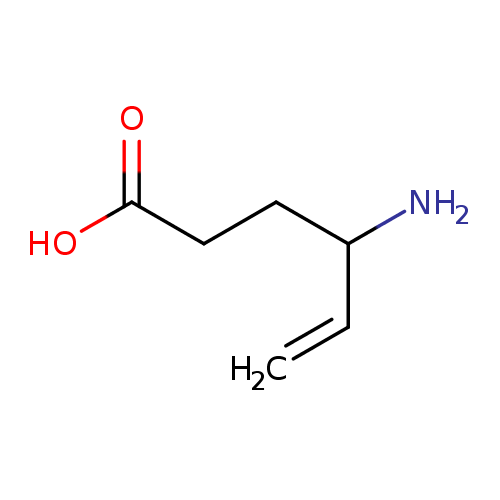
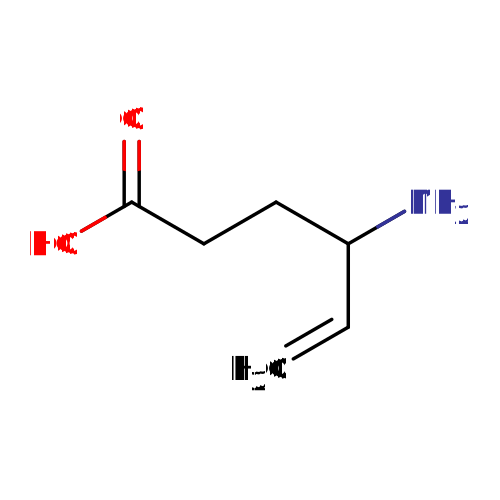
Chemical Structure
Thumb
Synonyms
ValueSource
4-Amino-5-hexenoic acidChEBI
gamma-Vinyl gabaChEBI
gamma-Vinyl-gamma-aminobutyric acidChEBI
GVGChEBI
VigabatrinaChEBI
VigabatrineChEBI
VigabatrinumChEBI
SabrilKegg
4-Amino-5-hexenoateGenerator
g-Vinyl gabaGenerator
Γ-vinyl gabaGenerator
g-Vinyl-g-aminobutyrateGenerator
g-Vinyl-g-aminobutyric acidGenerator
gamma-Vinyl-gamma-aminobutyrateGenerator
Γ-vinyl-γ-aminobutyrateGenerator
Γ-vinyl-γ-aminobutyric acidGenerator
Acid, gamma-vinyl-gamma-aminobutyricHMDB
Yamanouchi brand OF vigabatrinHMDB
gamma Vinyl gabaHMDB
gamma-Vinyl-gabaHMDB
SabrilexHMDB
Vigabatrin aventis brandHMDB
Hoechst brand OF vigabatrinHMDB
Vigabatrin hoechst brandHMDB
gamma Vinyl gamma aminobutyric acidHMDB
Aventis brand OF vigabatrinHMDB
Vigabatrin yamanouchi brandHMDB
Chemical FormulaC6H11NO2
Average Molecular Mass129.157 g/mol
Monoisotopic Mass129.079 g/mol
CAS Registry Number60643-86-9
IUPAC Name4-aminohex-5-enoic acid
Traditional Namevigabatrin
SMILESNC(CCC(O)=O)C=C
InChI IdentifierInChI=1S/C6H11NO2/c1-2-5(7)3-4-6(8)9/h2,5H,1,3-4,7H2,(H,8,9)
InChI KeyPJDFLNIOAUIZSL-UHFFFAOYSA-N
Chemical Taxonomy
Description belongs to the class of organic compounds known as gamma amino acids and derivatives. These are amino acids having a (-NH2) group attached to the gamma carbon atom.
KingdomOrganic compounds
Super ClassOrganic acids and derivatives
ClassCarboxylic acids and derivatives
Sub ClassAmino acids, peptides, and analogues
Direct ParentGamma amino acids and derivatives
Alternative Parents
Substituents
  • Gamma amino acid or derivatives
  • Medium-chain fatty acid
  • Amino fatty acid
  • Unsaturated fatty acid
  • Fatty acyl
  • Fatty acid
  • Amino acid
  • Carboxylic acid
  • Monocarboxylic acid or derivatives
  • Amine
  • Hydrocarbon derivative
  • Primary amine
  • Organooxygen compound
  • Organonitrogen compound
  • Organic oxide
  • Primary aliphatic amine
  • Organopnictogen compound
  • Organic oxygen compound
  • Carbonyl group
  • Organic nitrogen compound
  • Aliphatic acyclic compound
Molecular FrameworkAliphatic acyclic compounds
External Descriptors
Biological Properties
StatusDetected and Not Quantified
OriginExogenous
Cellular Locations
  • Cytoplasm
  • Extracellular
  • Membrane
Biofluid LocationsNot Available
Tissue LocationsNot Available
PathwaysNot Available
Applications
Biological Roles
Chemical Roles
Physical Properties
StateSolid
AppearanceWhite powder.
Experimental Properties
PropertyValue
Melting PointNot Available
Boiling PointNot Available
Solubility55.1 mg/mL
Predicted Properties
PropertyValueSource
Water Solubility96.6 g/LALOGPS
logP-2.6ALOGPS
logP-2.1ChemAxon
logS-0.13ALOGPS
pKa (Strongest Acidic)4.61ChemAxon
pKa (Strongest Basic)9.91ChemAxon
Physiological Charge0ChemAxon
Hydrogen Acceptor Count3ChemAxon
Hydrogen Donor Count2ChemAxon
Polar Surface Area63.32 ŲChemAxon
Rotatable Bond Count4ChemAxon
Refractivity34.29 m³·mol⁻¹ChemAxon
Polarizability13.64 ųChemAxon
Number of Rings0ChemAxon
Bioavailability1ChemAxon
Rule of FiveYesChemAxon
Ghose FilterNoChemAxon
Veber's RuleNoChemAxon
MDDR-like RuleNoChemAxon
Spectra
Spectra
Spectrum TypeDescriptionSplash KeyView
Predicted GC-MSPredicted GC-MS Spectrum - GC-MS (Non-derivatized) - 70eV, Positivesplash10-0a6r-9000000000-ed9483c326234125f4adSpectrum
Predicted GC-MSPredicted GC-MS Spectrum - GC-MS (1 TMS) - 70eV, Positivesplash10-004i-3900000000-6c317e49ab8cc532a558Spectrum
Predicted GC-MSPredicted GC-MS Spectrum - GC-MS (Non-derivatized) - 70eV, PositiveNot AvailableSpectrum
Predicted GC-MSPredicted GC-MS Spectrum - GC-MS (TMS_1_2) - 70eV, PositiveNot AvailableSpectrum
Predicted GC-MSPredicted GC-MS Spectrum - GC-MS (TBDMS_1_1) - 70eV, PositiveNot AvailableSpectrum
Predicted GC-MSPredicted GC-MS Spectrum - GC-MS (TBDMS_1_2) - 70eV, PositiveNot AvailableSpectrum
LC-MS/MSLC-MS/MS Spectrum - LC-ESI-QFT , positivesplash10-00di-9400000000-0215823a9ba364cc48cbSpectrum
LC-MS/MSLC-MS/MS Spectrum - LC-ESI-QFT , positivesplash10-00di-9400000000-c7d21d36dfb8e7079ee2Spectrum
LC-MS/MSLC-MS/MS Spectrum - LC-ESI-QFT , positivesplash10-00di-9200000000-e0c504f980ef5bbc0501Spectrum
LC-MS/MSLC-MS/MS Spectrum - LC-ESI-QFT , positivesplash10-00di-9000000000-e1b2ea8d5a2da84a5a64Spectrum
LC-MS/MSLC-MS/MS Spectrum - LC-ESI-QFT , positivesplash10-00di-9000000000-52958176067fd9bae916Spectrum
LC-MS/MSLC-MS/MS Spectrum - LC-ESI-QFT , positivesplash10-00di-9000000000-263da4b132ca66986967Spectrum
LC-MS/MSLC-MS/MS Spectrum - LC-ESI-QFT , positivesplash10-01b9-9000000000-1f8826cc32ef269c1a7cSpectrum
LC-MS/MSLC-MS/MS Spectrum - LC-ESI-QFT , positivesplash10-014i-9000000000-32306e2f90cd529accc7Spectrum
LC-MS/MSLC-MS/MS Spectrum - LC-ESI-QFT , positivesplash10-0gb9-9000000000-aefa9f2682087c7b78edSpectrum
LC-MS/MSLC-MS/MS Spectrum - 90V, Positivesplash10-00di-9000000000-2e8122bd9fa086c48c81Spectrum
LC-MS/MSLC-MS/MS Spectrum - 60V, Positivesplash10-00di-9000000000-c89fa23e4a66cb1fda0eSpectrum
LC-MS/MSLC-MS/MS Spectrum - 75V, Positivesplash10-00di-9000000000-ee55e365ddd88597a424Spectrum
LC-MS/MSLC-MS/MS Spectrum - 120V, Positivesplash10-01b9-9000000000-59ee75afd49600cf9595Spectrum
LC-MS/MSLC-MS/MS Spectrum - 150V, Positivesplash10-014i-9000000000-32306e2f90cd529accc7Spectrum
LC-MS/MSLC-MS/MS Spectrum - 45V, Positivesplash10-00di-9200000000-6c0ed7a9357b20c8ddecSpectrum
LC-MS/MSLC-MS/MS Spectrum - 30V, Positivesplash10-00di-9400000000-67f3710d9b1a8968c528Spectrum
LC-MS/MSLC-MS/MS Spectrum - 180V, Positivesplash10-0gb9-9000000000-aefa9f2682087c7b78edSpectrum
Predicted LC-MS/MSPredicted LC-MS/MS Spectrum - 10V, Positivesplash10-01q9-3900000000-5bf6d0079fa19a719d28Spectrum
Predicted LC-MS/MSPredicted LC-MS/MS Spectrum - 20V, Positivesplash10-01q9-9400000000-1d89cce66d591018b8b6Spectrum
Predicted LC-MS/MSPredicted LC-MS/MS Spectrum - 40V, Positivesplash10-0gb9-9000000000-25ce972a542597293a60Spectrum
Predicted LC-MS/MSPredicted LC-MS/MS Spectrum - 10V, Negativesplash10-004i-2900000000-14e6a479b3001860431bSpectrum
Predicted LC-MS/MSPredicted LC-MS/MS Spectrum - 20V, Negativesplash10-004i-7900000000-fd7f3b3f074734314a87Spectrum
Predicted LC-MS/MSPredicted LC-MS/MS Spectrum - 40V, Negativesplash10-0a4l-9100000000-db0d4ab6ed018a7e6a3fSpectrum
Predicted LC-MS/MSPredicted LC-MS/MS Spectrum - 10V, Positivesplash10-001i-9400000000-6179584a37d7e78d7234Spectrum
Predicted LC-MS/MSPredicted LC-MS/MS Spectrum - 20V, Positivesplash10-014i-9000000000-ff84f320ba47dd80531bSpectrum
1D NMR1H NMR SpectrumNot AvailableSpectrum
1D NMR13C NMR SpectrumNot AvailableSpectrum
1D NMR1H NMR SpectrumNot AvailableSpectrum
1D NMR13C NMR SpectrumNot AvailableSpectrum
1D NMR1H NMR SpectrumNot AvailableSpectrum
1D NMR13C NMR SpectrumNot AvailableSpectrum
1D NMR1H NMR SpectrumNot AvailableSpectrum
1D NMR13C NMR SpectrumNot AvailableSpectrum
1D NMR1H NMR SpectrumNot AvailableSpectrum
1D NMR13C NMR SpectrumNot AvailableSpectrum
1D NMR1H NMR SpectrumNot AvailableSpectrum
1D NMR13C NMR SpectrumNot AvailableSpectrum
1D NMR1H NMR SpectrumNot AvailableSpectrum
1D NMR13C NMR SpectrumNot AvailableSpectrum
1D NMR1H NMR SpectrumNot AvailableSpectrum
1D NMR13C NMR SpectrumNot AvailableSpectrum
1D NMR1H NMR SpectrumNot AvailableSpectrum
1D NMR13C NMR SpectrumNot AvailableSpectrum
1D NMR1H NMR SpectrumNot AvailableSpectrum
1D NMR13C NMR SpectrumNot AvailableSpectrum
Toxicity Profile
Route of ExposureRapidly absorbed following oral administration, absorption is comparable between neonates, infants, and children. Cmax, 50 mg/kg dose, neonates= 14 mg/L; Tmax, 50 mg/kg dose, neonates = 2.1 hours; However, extent of absorption is higher and elimination half life is longer in neonates compared to children and infants. This is because neonates have reduced renal function compared to the aforementioned population groups. AUC, 50 mg/kg dose, neonates = 142.6 ± 44.0 mg/L/hr; Food may slightly decrease the rate (Cmax decreased by 33%, Tmax increased to 2 hours), but not the extent of absorption. Furthermore, vigabatrin does not cross the blood-brain-barrier well, thus high doses are needed.
Mechanism of ToxicityVigabatrin increases brain concentrations of gamma-aminobutyric acid (GABA), an inhibitory neurotransmitter in the CNS, by irreversibly inhibiting enzymes that catabolize GABA (gamma-aminobutyric acid transaminase, GABA-T). Duration of action is determined by rate of GABA-T re-synthesis. Vigabatrin may also work by suppressing repetitive neuronal firing through inhibition of voltage-sensitive sodium channels. Although administered as a racemic mixture, only the S(+) enantiomer is pharmacologically active.
MetabolismAlmost no metabolic transformation. Does not induce the hepatic cytochrome P450 system. Route of Elimination: Eliminated primarily through renal excretion as unchanged drugs (80%). Half Life: Neonates, 50 mg/kg = 7.5 ± 2.1 hours (due to reduced renal function); Infants = 5.7 hours; Adults = 7.5 hours; Elderly = 12 - 13 hours
Toxicity ValuesLD50, oral, rat: 3000 mg/kg
Lethal DoseNot Available
Carcinogenicity (IARC Classification)No indication of carcinogenicity to humans (not listed by IARC).
Uses/SourcesFor use as an adjunct in treatment resistant epilepsy, refractory complex partial seizures, and secondary generalized seizures. It is also used as monotherapy in infantile spasms in West syndrome.
Minimum Risk LevelNot Available
Health EffectsMay cause a potentially dangerous rash that may develop into Stevens Johnson syndrome, an extremely rare but potentially fatal skin disease.
SymptomsNot Available
TreatmentNot Available
Concentrations
Not Available
DrugBank IDDB01080
HMDB IDHMDB0015212
FooDB IDNot Available
Phenol Explorer IDNot Available
KNApSAcK IDNot Available
BiGG IDNot Available
BioCyc IDNot Available
METLIN IDNot Available
PDB IDNot Available
Wikipedia LinkVigabatrin
Chemspider ID5463
ChEBI ID63638
PubChem Compound ID5665
Kegg Compound IDC07500
YMDB IDNot Available
ECMDB IDNot Available
References
Synthesis ReferenceNot Available
MSDSLink
General References
1. https://www.ncbi.nlm.nih.gov/pubmed/?term=20018576
2. https://www.ncbi.nlm.nih.gov/pubmed/?term=20878340
3. https://www.ncbi.nlm.nih.gov/pubmed/?term=20926323
4. https://www.ncbi.nlm.nih.gov/pubmed/?term=21361740
5. https://www.ncbi.nlm.nih.gov/pubmed/?term=22061177
6. https://www.ncbi.nlm.nih.gov/pubmed/?term=22061178
7. https://www.ncbi.nlm.nih.gov/pubmed/?term=22061182
8. https://www.ncbi.nlm.nih.gov/pubmed/?term=22234618
9. Lindberger M, Luhr O, Johannessen SI, Larsson S, Tomson T: Serum concentrations and effects of gabapentin and vigabatrin: observations from a dose titration study. Ther Drug Monit. 2003 Aug;25(4):457-62.
10. Gram L, Larsson OM, Johnsen A, Schousboe A: Experimental studies of the influence of vigabatrin on the GABA system. Br J Clin Pharmacol. 1989;27 Suppl 1:13S-17S.
11. Browne TR: Pharmacokinetics of antiepileptic drugs. Neurology. 1998 Nov;51(5 Suppl 4):S2-7.
12. Zwanzger P, Baghai TC, Schuele C, Strohle A, Padberg F, Kathmann N, Schwarz M, Moller HJ, Rupprecht R: Vigabatrin decreases cholecystokinin-tetrapeptide (CCK-4) induced panic in healthy volunteers. Neuropsychopharmacology. 2001 Nov;25(5):699-703.
13. Hawker DD, Silverman RB: Synthesis and evaluation of novel heteroaromatic substrates of GABA aminotransferase. Bioorg Med Chem. 2012 Oct 1;20(19):5763-73. doi: 10.1016/j.bmc.2012.08.009. Epub 2012 Aug 16.
14. Tulloch JK, Carr RR, Ensom MH: A systematic review of the pharmacokinetics of antiepileptic drugs in neonates with refractory seizures. J Pediatr Pharmacol Ther. 2012 Jan;17(1):31-44. doi: 10.5863/1551-6776-17.1.31.
15. Clayton LM, Stern WM, Newman WD, Sander JW, Acheson J, Sisodiya SM: Evolution of visual field loss over ten years in individuals taking vigabatrin. Epilepsy Res. 2013 Aug;105(3):262-71. doi: 10.1016/j.eplepsyres.2013.02.014. Epub 2013 Mar 28.