Record Information
Version1.0
Creation Date2009-07-21 20:28:15 UTC
Update Date2026-05-14 16:56:39 UTC
Accession NumberCHEM002332
Identification
Common NameRifampin
ClassSmall Molecule
DescriptionA semisynthetic antibiotic produced from Streptomyces mediterranei. It has a broad antibacterial spectrum, including activity against several forms of Mycobacterium. In susceptible organisms it inhibits DNA-dependent RNA polymerase activity by forming a stable complex with the enzyme. It thus suppresses the initiation of RNA synthesis. Rifampin is bactericidal, and acts on both intracellular and extracellular organisms. (From Gilman et al., Goodman and Gilman's The Pharmacological Basis of Therapeutics, 9th ed, p1160)
Contaminant Sources
  • HMDB Contaminants - Urine
  • IARC Carcinogens Group 3
  • STOFF IDENT Compounds
  • T3DB toxins
  • ToxCast & Tox21 Chemicals
Contaminant Type
  • Amide
  • Amine
  • Antibiotic
  • Antibiotic, Antitubercular
  • Antitubercular Agent
  • Antituberculosis Agent
  • Drug
  • Enzyme Inhibitor
  • Ester
  • Ether
  • Hydrazine
  • Leprostatic Agent
  • Metabolite
  • Nucleic Acid Synthesis Inhibitor
  • Organic Compound
  • Synthetic Compound
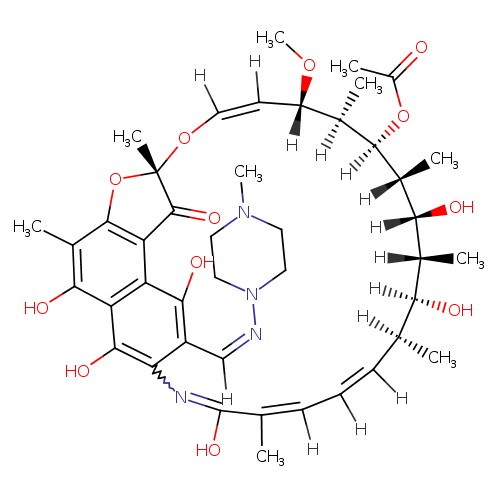
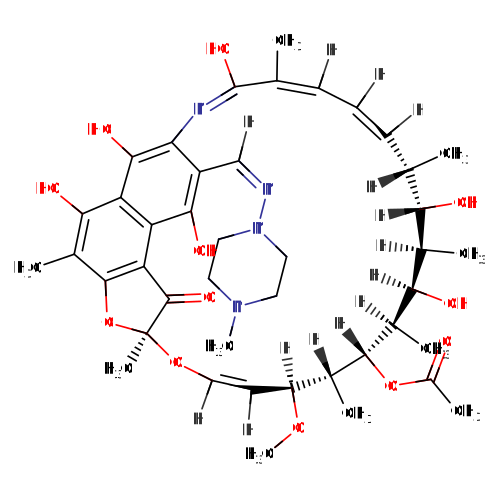
Chemical Structure
Thumb
Synonyms
ValueSource
BenemycinMeSH
RifadinMeSH
RifampinMeSH
RimactanMeSH
TubocinMeSH
RimactaneMeSH
Chemical FormulaC43H58N4O12
Average Molecular Mass822.953 g/mol
Monoisotopic Mass822.405 g/mol
CAS Registry Number13292-46-1
IUPAC Name(7S,9E,11S,12R,13S,14R,15R,16R,17S,18S,19E,21Z)-2,15,17,27,29-pentahydroxy-11-methoxy-3,7,12,14,16,18,22-heptamethyl-26-[(E)-[(4-methylpiperazin-1-yl)imino]methyl]-6,23-dioxo-8,30-dioxa-24-azatetracyclo[23.3.1.1^{4,7}.0^{5,28}]triaconta-1(29),2,4,9,19,21,25,27-octaen-13-yl acetate
Traditional Name(7S,9Z,11S,12R,13S,14R,15R,16R,17S,18S,19E,21Z)-2,15,17,23,27,29-hexahydroxy-11-methoxy-3,7,12,14,16,18,22-heptamethyl-26-[(1Z)-[(4-methylpiperazin-1-yl)imino]methyl]-6-oxo-8,30-dioxa-24-azatetracyclo[23.3.1.1⁴,⁷.0⁵,²⁸]triaconta-1(28),2,4,9,19,21,23,25(29),26-nonaen-13-yl acetate
SMILES[H]\C(=N\N1CCN(C)CC1)C1=C(O)C2=C3C(O)=C(C)C4=C2C(=O)[C@](C)(O4)O\C([H])=C([H])/[C@]([H])(OC)[C@@]([H])(C)[C@@]([H])(OC(C)=O)[C@]([H])(C)[C@]([H])(O)[C@]([H])(C)[C@@]([H])(O)[C@@]([H])(C)\C([H])=C(\[H])/C(/[H])=C(C)\C(O)=NC1=C3O
InChI IdentifierInChI=1S/C43H58N4O12/c1-21-12-11-13-22(2)42(55)45-33-28(20-44-47-17-15-46(9)16-18-47)37(52)30-31(38(33)53)36(51)26(6)40-32(30)41(54)43(8,59-40)57-19-14-29(56-10)23(3)39(58-27(7)48)25(5)35(50)24(4)34(21)49/h11-14,19-21,23-25,29,34-35,39,49-53H,15-18H2,1-10H3,(H,45,55)/b12-11-,19-14-,22-13-,44-20-/t21-,23+,24+,25+,29-,34-,35+,39+,43-/m0/s1
InChI KeyJQXXHWHPUNPDRT-RAFOWSHMSA-N
Chemical Taxonomy
Description belongs to the class of organic compounds known as naphthofurans. Naphthofurans are compounds containing a furan ring fused to a naphthalene moiety. Furan is a 5 membered- ring aromatic ring with four carbon and one oxygen atoms. Naphthalene is a polycyclic aromatic hydrocarbon made up of two fused benzene rings.
KingdomOrganic compounds
Super ClassOrganoheterocyclic compounds
ClassNaphthofurans
Sub ClassNot Available
Direct ParentNaphthofurans
Alternative Parents
Substituents
  • Naphthofuran
  • 1-naphthol
  • Naphthalene
  • Coumaran
  • Benzofuran
  • Aryl alkyl ketone
  • Aryl ketone
  • Hydroquinone
  • Ketal
  • N-alkylpiperazine
  • N-methylpiperazine
  • Benzenoid
  • Piperazine
  • 1,4-diazinane
  • Cyclic carboximidic acid
  • Tertiary aliphatic amine
  • Tertiary amine
  • Secondary alcohol
  • Ketone
  • Carboxylic acid ester
  • Amino acid or derivatives
  • Oxacycle
  • Azacycle
  • Organic 1,3-dipolar compound
  • Propargyl-type 1,3-dipolar organic compound
  • Polyol
  • Monocarboxylic acid or derivatives
  • Hydrazone
  • Ether
  • Dialkyl ether
  • Carboxylic acid derivative
  • Acetal
  • Organic nitrogen compound
  • Organic oxygen compound
  • Organopnictogen compound
  • Organic oxide
  • Hydrocarbon derivative
  • Organooxygen compound
  • Organonitrogen compound
  • Carbonyl group
  • Amine
  • Alcohol
  • Aromatic heteropolycyclic compound
Molecular FrameworkAromatic heteropolycyclic compounds
External DescriptorsNot Available
Biological Properties
StatusDetected and Not Quantified
OriginExogenous
Cellular Locations
  • Cytoplasm
  • Membrane
Biofluid LocationsNot Available
Tissue LocationsNot Available
PathwaysNot Available
Applications
Biological Roles
Chemical Roles
Physical Properties
StateSolid
AppearanceWhite powder.
Experimental Properties
PropertyValue
Melting Point183°C
Boiling PointNot Available
Solubility1400 mg/L (at 25°C)
Predicted Properties
PropertyValueSource
Water Solubility0.025 g/LALOGPS
logP3.91ALOGPS
logP3.01ChemAxon
logS-4.5ALOGPS
pKa (Strongest Acidic)-1.6ChemAxon
pKa (Strongest Basic)15.13ChemAxon
Physiological Charge0ChemAxon
Hydrogen Acceptor Count15ChemAxon
Hydrogen Donor Count6ChemAxon
Polar Surface Area223.64 ŲChemAxon
Rotatable Bond Count5ChemAxon
Refractivity226.34 m³·mol⁻¹ChemAxon
Polarizability85.58 ųChemAxon
Number of Rings5ChemAxon
Bioavailability0ChemAxon
Rule of FiveNoChemAxon
Ghose FilterNoChemAxon
Veber's RuleNoChemAxon
MDDR-like RuleNoChemAxon
Spectra
Spectra
Spectrum TypeDescriptionSplash KeyView
Predicted LC-MS/MSPredicted LC-MS/MS Spectrum - 10V, Positivesplash10-0bt9-1400001970-0a8ebda9569ce94a02adSpectrum
Predicted LC-MS/MSPredicted LC-MS/MS Spectrum - 20V, Positivesplash10-06re-2000002920-628b980fb3dafff8778cSpectrum
Predicted LC-MS/MSPredicted LC-MS/MS Spectrum - 40V, Positivesplash10-05fu-9100005200-d9f32b931d5916a06105Spectrum
Predicted LC-MS/MSPredicted LC-MS/MS Spectrum - 10V, Negativesplash10-00di-3000001980-5cb7b24c53679b91341aSpectrum
Predicted LC-MS/MSPredicted LC-MS/MS Spectrum - 20V, Negativesplash10-08fr-6400004940-fccc2ad8301595d82dc4Spectrum
Predicted LC-MS/MSPredicted LC-MS/MS Spectrum - 40V, Negativesplash10-055f-9000006400-bb87850cfde7ace2b07cSpectrum
Toxicity Profile
Route of ExposureOral. Well absorbed from gastrointestinal tract.
Mechanism of ToxicityRifampin acts via the inhibition of DNA-dependent RNA polymerase, leading to a suppression of RNA synthesis and cell death.
MetabolismPrimarily hepatic, rapidly deacetylated. Route of Elimination: Less than 30% of the dose is excreted in the urine as rifampin or metabolites. Half Life: 3.35 (+/- 0.66) hours
Toxicity ValuesLD50: 1570 mg/kg (Rat) (1)
Lethal DoseNot Available
Carcinogenicity (IARC Classification)3, not classifiable as to its carcinogenicity to humans. (3)
Uses/SourcesFor the treatment of Tuberculosis and Tuberculosis-related mycobacterial infections.
Minimum Risk LevelNot Available
Health EffectsAntibiotic resistance
SymptomsChronic exposure may cause nausea and vomiting and unconsciousness
TreatmentIntensive support measures should be instituted and individual symptoms treated as they arise. Since nausea and vomiting are likely to be present, gastric lavage is probably preferable to induction of emesis. Following evacuation of the gastric contents, the instillation of activated charcoal slurry into the stomach may help absorb any remaining drug from the gastrointestinal tract. Antiemetic medication may be required to control severe nausea and vomiting. Active diuresis (with measured intake and output) will help promote excretion of the drug. Hemodialysis may be of value in some patients. (5)

Concentrations
Not Available
DrugBank IDNot Available
HMDB IDNot Available
FooDB IDNot Available
Phenol Explorer IDNot Available
KNApSAcK IDNot Available
BiGG IDNot Available
BioCyc IDNot Available
METLIN IDNot Available
PDB IDNot Available
Wikipedia LinkNot Available
Chemspider IDNot Available
ChEBI IDNot Available
PubChem Compound ID136709103
Kegg Compound IDNot Available
YMDB IDNot Available
ECMDB IDNot Available
References
Synthesis Reference

Klaus Jurgen, Joachim Seydel, “Combination preparations containing rifampicin and thioacetazon.” U.S. Patent US5104875, issued August, 1973.

MSDSLink
General ReferencesNot Available