Record Information
Version1.0
Creation Date2009-07-21 20:28:14 UTC
Update Date2026-05-14 16:56:35 UTC
Accession NumberCHEM002330
Identification
Common NameMemantine
ClassSmall Molecule
DescriptionMemantine is an amantadine derivative with low to moderate-affinity for NMDA receptors. It is a noncompetitive NMDA receptor antagonist that binds preferentially to NMDA receptor-operated cation channels. It blocks the effects of excessive levels of glutamate that may lead to neuronal dysfunction. It is under investigation for the treatment of Alzheimer's disease, but there has been no clinical support for the prevention or slowing of disease progression.
Contaminant Sources
  • HMDB Contaminants - Urine
  • STOFF IDENT Compounds
  • T3DB toxins
  • ToxCast & Tox21 Chemicals
Contaminant Type
  • Amine
  • Antidyskinetic
  • Antiparkinson Agent
  • Central Nervous System Agent
  • Dopamine Agent
  • Drug
  • Excitatory Amino Acid Antagonist
  • Human Neurotoxin
  • Metabolite
  • Organic Compound
  • Synthetic Compound
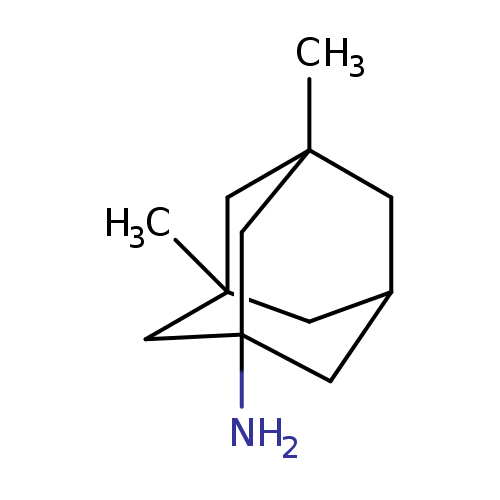
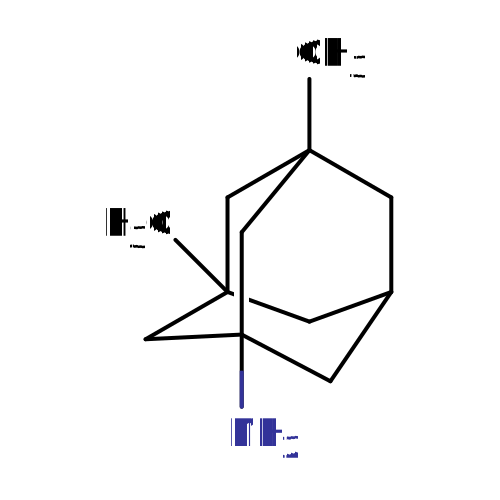
Chemical Structure
Thumb
Synonyms
ValueSource
1,3-Dimethyl-5-adamantanamineChEBI
1-Amino-3,5-dimethyladamantaneChEBI
3,5-Dimethyl-1-adamantanamineChEBI
3,5-Dimethyl-1-aminoadamantaneChEBI
3,5-Dimethyltricyclo(3.3.1.1(3,7))decan-1-amineChEBI
MemantinaChEBI
MemantinumChEBI
ExibaKegg
AxuraHMDB
Lundbeck brand OF memantine hydrochlorideHMDB
Merz brand OF memantine hydrochlorideHMDB
EbixaHMDB
MemantinHMDB
Memantine hydrochlorideHMDB
NamendaHMDB
1,3-Dimethyl-5-aminoadamantaneHMDB
Chemical FormulaC12H21N
Average Molecular Mass179.302 g/mol
Monoisotopic Mass179.167 g/mol
CAS Registry Number19982-08-2
IUPAC Name3,5-dimethyladamantan-1-amine
Traditional Namememantine
SMILESCC12CC3CC(C)(C1)CC(N)(C3)C2
InChI IdentifierInChI=1S/C12H21N/c1-10-3-9-4-11(2,6-10)8-12(13,5-9)7-10/h9H,3-8,13H2,1-2H3
InChI KeyBUGYDGFZZOZRHP-UHFFFAOYSA-N
Chemical Taxonomy
Description belongs to the class of organic compounds known as monoalkylamines. These are organic compounds containing an primary aliphatic amine group.
KingdomOrganic compounds
Super ClassOrganic nitrogen compounds
ClassOrganonitrogen compounds
Sub ClassAmines
Direct ParentMonoalkylamines
Alternative Parents
Substituents
  • Organopnictogen compound
  • Hydrocarbon derivative
  • Primary aliphatic amine
  • Aliphatic homopolycyclic compound
Molecular FrameworkAliphatic homopolycyclic compounds
External Descriptors
Biological Properties
StatusDetected and Not Quantified
OriginExogenous
Cellular Locations
  • Membrane
Biofluid LocationsNot Available
Tissue LocationsNot Available
PathwaysNot Available
Applications
Biological Roles
Chemical RolesNot Available
Physical Properties
StateSolid
AppearanceWhite powder.
Experimental Properties
PropertyValue
Melting Point258°C
Boiling PointNot Available
Solubility35 mg/mL (HCl salt), 0.9 mg/mL for free base
Predicted Properties
PropertyValueSource
Water Solubility0.046 g/LALOGPS
logP3.31ALOGPS
logP2.07ChemAxon
logS-3.6ALOGPS
pKa (Strongest Basic)10.7ChemAxon
Physiological Charge1ChemAxon
Hydrogen Acceptor Count1ChemAxon
Hydrogen Donor Count1ChemAxon
Polar Surface Area26.02 ŲChemAxon
Rotatable Bond Count0ChemAxon
Refractivity54.49 m³·mol⁻¹ChemAxon
Polarizability21.82 ųChemAxon
Number of Rings3ChemAxon
Bioavailability1ChemAxon
Rule of FiveYesChemAxon
Ghose FilterYesChemAxon
Veber's RuleYesChemAxon
MDDR-like RuleNoChemAxon
Spectra
Spectra
Spectrum TypeDescriptionSplash KeyView
Predicted GC-MSPredicted GC-MS Spectrum - GC-MS (Non-derivatized) - 70eV, Positivesplash10-03fr-0900000000-4db94b4b87705e834d5dSpectrum
Predicted GC-MSPredicted GC-MS Spectrum - GC-MS (Non-derivatized) - 70eV, PositiveNot AvailableSpectrum
LC-MS/MSLC-MS/MS Spectrum - LC-ESI-QFT , positivesplash10-03e9-0900000000-65172d14e0f6b9102d73Spectrum
LC-MS/MSLC-MS/MS Spectrum - LC-ESI-QFT , positivesplash10-03di-0900000000-ce475f103d528ff4d342Spectrum
LC-MS/MSLC-MS/MS Spectrum - LC-ESI-QFT , positivesplash10-03di-0900000000-1c9199c5cf1c902223aeSpectrum
LC-MS/MSLC-MS/MS Spectrum - LC-ESI-QFT , positivesplash10-08fr-0900000000-1bac817f714e7eec7488Spectrum
LC-MS/MSLC-MS/MS Spectrum - LC-ESI-QFT , positivesplash10-0a4i-2900000000-eb58e236084a93a3d37bSpectrum
LC-MS/MSLC-MS/MS Spectrum - LC-ESI-QFT , positivesplash10-0a4i-4900000000-5a87d54400c3e9720ad0Spectrum
LC-MS/MSLC-MS/MS Spectrum - LC-ESI-QFT , positivesplash10-052f-9500000000-95eb2b63a2392449ec4aSpectrum
LC-MS/MSLC-MS/MS Spectrum - LC-ESI-QFT , positivesplash10-0006-9100000000-608b372857aacd60eb61Spectrum
LC-MS/MSLC-MS/MS Spectrum - LC-ESI-QFT , positivesplash10-00kf-9000000000-f283a81168372575c2aaSpectrum
LC-MS/MSLC-MS/MS Spectrum - LC-ESI-QFT , positivesplash10-03di-0900000000-bbf1127413d0f995a000Spectrum
LC-MS/MSLC-MS/MS Spectrum - 20V, Positivesplash10-08fr-1900000000-af0d7a2139a4f0101029Spectrum
LC-MS/MSLC-MS/MS Spectrum - 120V, Positivesplash10-052f-9500000000-7d8b0b05d4e422cf43ffSpectrum
LC-MS/MSLC-MS/MS Spectrum - 90V, Positivesplash10-0a4i-4900000000-c38a0c0bf1d221876255Spectrum
LC-MS/MSLC-MS/MS Spectrum - 40V, Positivesplash10-052f-9400000000-b9b0845988ac96d13655Spectrum
LC-MS/MSLC-MS/MS Spectrum - 150V, Positivesplash10-0006-9100000000-c0a9196c8aea3bbc9ba5Spectrum
LC-MS/MSLC-MS/MS Spectrum - 50V, Positivesplash10-044i-0900000000-dbaa35eb2bd2e8a926eeSpectrum
LC-MS/MSLC-MS/MS Spectrum - 40V, Positivesplash10-03di-0900000000-fe3a10c3c4ef737f6317Spectrum
LC-MS/MSLC-MS/MS Spectrum - 35V, Positivesplash10-08fr-0900000000-31518410ee334d4b0e50Spectrum
LC-MS/MSLC-MS/MS Spectrum - 10V, Positivesplash10-03e9-0900000000-d6a33792b66ebc7fcaa5Spectrum
Predicted LC-MS/MSPredicted LC-MS/MS Spectrum - 10V, Positivesplash10-01q9-0900000000-d5fdfd99bc401e75f44dSpectrum
Predicted LC-MS/MSPredicted LC-MS/MS Spectrum - 20V, Positivesplash10-01q9-0900000000-8e06cea62d1b5b2287fdSpectrum
Predicted LC-MS/MSPredicted LC-MS/MS Spectrum - 40V, Positivesplash10-03di-0900000000-07e8313e47d270feab02Spectrum
Predicted LC-MS/MSPredicted LC-MS/MS Spectrum - 10V, Negativesplash10-004i-0900000000-8a0b61ba65a9638329fbSpectrum
Predicted LC-MS/MSPredicted LC-MS/MS Spectrum - 20V, Negativesplash10-004i-0900000000-242508d651dfd0b38ea8Spectrum
Predicted LC-MS/MSPredicted LC-MS/MS Spectrum - 40V, Negativesplash10-01t9-0900000000-710a53b2a03cd1789d69Spectrum
Toxicity Profile
Route of ExposureWell absorbed orally with a bioavailability of approximately 100%. Peak plasma concentrations are reached in 3-7 hours. Food has no effect on absorption.
Mechanism of ToxicityMemantine exerts its action through uncompetitive NMDA receptor antagonism, binding preferentially to the NMDA receptor-operated cation channels. Prolonged increased levels of glutamate in the brain of demented patients are sufficient to counter the voltage-dependent block of NMDA receptors by Mg2+ ions and allow continuous influx of Ca2+ ions into cells, ultimately resulting in neuronal degeneration. Studies suggest that memantine binds more effectively than Mg2+ ions at the NMDA receptor, and thereby effectively blocks this prolonged influx of Ca2+ ions through the NMDA channel whilst preserving the transient physiological activation of the channels by higher concentrations of synaptically released glutamate. Thus memantine protects against chronically elevated concentrations of glutamate. Memantine also has antagonistic activity at the type 3 serotonergic (5-HT3) receptor with a potency that is similar to that at the NMDA receptor, and lower antagonistic activity at the nicotinic acetylcholine receptor. This drug has no affinity for gamma-aminobutyric acid (GABA), benzodiazepine, dopamine, adrenergic, histamine, or glycine receptors or for voltage-dependent calcium, sodium, or potassium channels.
MetabolismExcreted largely unchanged. About 20% is metabolized to 1-amino-3-hydroxymethyl-5-methyl-adamantane and 3-amino-1-hydroxy-5,7-dimethyl-adamantane. Route of Elimination: Memantine undergoes partial hepatic metabolism. About 48% of administered drug is excreted unchanged in urine; the remainder is converted primarily to three polar metabolites which possess minimal NMDA receptor antagonistic activity: the N-glucuronide conjugate, 6-hydroxy memantine, and 1-nitroso-deaminated memantine. It is excreted predominantly in the urine, unchanged. Half Life: 60-100 hours
Toxicity ValuesNot Available
Lethal DoseNot Available
Carcinogenicity (IARC Classification)No indication of carcinogenicity to humans (not listed by IARC).
Uses/SourcesFor the treatment of moderate to severe dementia of the Alzheimer's type.
Minimum Risk LevelNot Available
Health EffectsNot Available
SymptomsSide effects include pain, abnormal crying, leg pain, fever, increased apetite. Adverse drug reactions include: dizziness, confusion, headache, hallucinations, tiredness. Less common side effects include: vomiting, anxiety, hypertonia, cystitis, and increased libido. Doses of up to 400 mg have been tolerated.
TreatmentAs in any cases of overdose, general supportive measures should be utilized, and treatment should be symptomatic. Elimination of memantine can be enhanced by acidification of urine. (7)
Concentrations
Not Available
DrugBank IDDB01043
HMDB IDHMDB0015177
FooDB IDNot Available
Phenol Explorer IDNot Available
KNApSAcK IDNot Available
BiGG IDNot Available
BioCyc IDNot Available
METLIN IDNot Available
PDB IDNot Available
Wikipedia LinkMemantine
Chemspider ID3914
ChEBI ID64312
PubChem Compound ID4054
Kegg Compound IDC13736
YMDB IDNot Available
ECMDB IDNot Available
References
Synthesis Reference

DrugSyn.org

MSDSLink
General References
1. https://www.ncbi.nlm.nih.gov/pubmed/?term=20104942
2. https://www.ncbi.nlm.nih.gov/pubmed/?term=21953515
3. https://www.ncbi.nlm.nih.gov/pubmed/?term=21955815
4. https://www.ncbi.nlm.nih.gov/pubmed/?term=22030128
5. https://www.ncbi.nlm.nih.gov/pubmed/?term=22134197
6. https://www.ncbi.nlm.nih.gov/pubmed/?term=22245025
7. https://www.ncbi.nlm.nih.gov/pubmed/?term=22248638
8. https://www.ncbi.nlm.nih.gov/pubmed/?term=22290557
9. https://www.ncbi.nlm.nih.gov/pubmed/?term=22297273
10. https://www.ncbi.nlm.nih.gov/pubmed/?term=22300835
11. https://www.ncbi.nlm.nih.gov/pubmed/?term=22311362
12. https://www.ncbi.nlm.nih.gov/pubmed/?term=22327556
13. https://www.ncbi.nlm.nih.gov/pubmed/?term=22329473
14. https://www.ncbi.nlm.nih.gov/pubmed/?term=22392787
15. https://www.ncbi.nlm.nih.gov/pubmed/?term=22414570
16. https://www.ncbi.nlm.nih.gov/pubmed/?term=22425751
17. Cacabelos R, Takeda M, Winblad B: The glutamatergic system and neurodegeneration in dementia: preventive strategies in Alzheimer's disease. Int J Geriatr Psychiatry. 1999 Jan;14(1):3-47.
18. Rogawski MA: Low affinity channel blocking (uncompetitive) NMDA receptor antagonists as therapeutic agents--toward an understanding of their favorable tolerability. Amino Acids. 2000;19(1):133-49.
19. Rammes G, Rupprecht R, Ferrari U, Zieglgansberger W, Parsons CG: The N-methyl-D-aspartate receptor channel blockers memantine, MRZ 2/579 and other amino-alkyl-cyclohexanes antagonise 5-HT(3) receptor currents in cultured HEK-293 and N1E-115 cell systems in a non-competitive manner. Neurosci Lett. 2001 Jun 22;306(1-2):81-4.
20. Rogawski MA, Wenk GL: The neuropharmacological basis for the use of memantine in the treatment of Alzheimer's disease. CNS Drug Rev. 2003 Fall;9(3):275-308.
21. Robinson DM, Keating GM: Memantine: a review of its use in Alzheimer's disease. Drugs. 2006;66(11):1515-34.