Record Information
Version1.0
Creation Date2009-07-21 20:28:08 UTC
Update Date2026-05-14 16:55:19 UTC
Accession NumberCHEM002316
Identification
Common NameDoxorubicin
ClassSmall Molecule
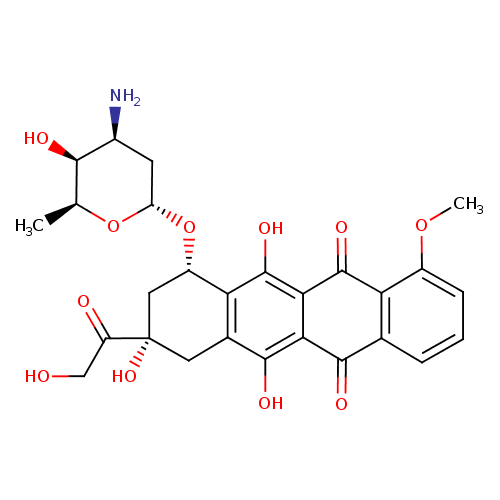
DescriptionDoxorubicin is only found in individuals that have used or taken this drug. It is antineoplastic antibiotic obtained from Streptomyces peucetius. It is a hydroxy derivative of daunorubicin. [PubChem]Doxorubicin has antimitotic and cytotoxic activity through a number of proposed mechanisms of action: Doxorubicin forms complexes with DNA by intercalation between base pairs, and it inhibits topoisomerase II activity by stabilizing the DNA-topoisomerase II complex, preventing the religation portion of the ligation-religation reaction that topoisomerase II catalyzes.
Contaminant Sources
  • HMDB Contaminants - Urine
  • IARC Carcinogens Group 2A
  • STOFF IDENT Compounds
  • T3DB toxins
Contaminant Type
  • Amine
  • Antibiotic
  • Antibiotic, Antineoplastic
  • Antineoplastic Agent
  • Drug
  • Ester
  • Ether
  • Human Neurotoxin
  • Metabolite
  • Organic Compound
  • Synthetic Compound
Chemical Structure
Thumb
Synonyms
ValueSource
(1S,3S)-3-Glycoloyl-3,5,12-trihydroxy-10-methoxy-6,11-dioxo-1,2,3,4,6,11-hexahydrotetracen-1-yl 3-amino-2,3,6-trideoxy-alpha-L-lyxo-hexopyranosideChEBI
(8S-cis)-10-((3-Amino-2,3,6-trideoxy-alpha-L-lyxo-hexopyranosyl)oxy)-7,8,9,10-tetrahydro-6,8,11-trihydroxy-8-(hydroxyacetyl)-1-methoxy-5,12-naphthacenedioneChEBI
14-HydroxydaunomycinChEBI
14-HydroxydaunorubicineChEBI
AdriamycinChEBI
DoxorubicineChEBI
DoxorubicinumChEBI
ADRKegg
AdriblastinaKegg
(1S,3S)-3-Glycoloyl-3,5,12-trihydroxy-10-methoxy-6,11-dioxo-1,2,3,4,6,11-hexahydrotetracen-1-yl 3-amino-2,3,6-trideoxy-a-L-lyxo-hexopyranosideGenerator
(1S,3S)-3-Glycoloyl-3,5,12-trihydroxy-10-methoxy-6,11-dioxo-1,2,3,4,6,11-hexahydrotetracen-1-yl 3-amino-2,3,6-trideoxy-α-L-lyxo-hexopyranosideGenerator
(8S-cis)-10-((3-Amino-2,3,6-trideoxy-a-L-lyxo-hexopyranosyl)oxy)-7,8,9,10-tetrahydro-6,8,11-trihydroxy-8-(hydroxyacetyl)-1-methoxy-5,12-naphthacenedioneGenerator
(8S-cis)-10-((3-Amino-2,3,6-trideoxy-α-L-lyxo-hexopyranosyl)oxy)-7,8,9,10-tetrahydro-6,8,11-trihydroxy-8-(hydroxyacetyl)-1-methoxy-5,12-naphthacenedioneGenerator
AdriablastinHMDB
AdriblastinHMDB
Baxter brand OF doxorubicin hydrochlorideHMDB
Doxorubicin hydrochlorideHMDB
Doxorubicina ferrer farmHMDB
Ferrer brand OF doxorubicin hydrochlorideHMDB
Onkoworks brand OF doxorubicin hydrochlorideHMDB
Urokit doxo-cellHMDB
Ribosepharm brand OF doxorubicin hydrochlorideHMDB
AdrimedacHMDB
Bedford brand OF doxorubicin hydrochlorideHMDB
Doxorubicin hexalHMDB
Doxorubicin NCHMDB
Doxorubicina funkHMDB
DoxotecHMDB
Kenfarma brand OF doxorubicin hydrochlorideHMDB
Prasfarma brand OF doxorubicin hydrochlorideHMDB
RubexHMDB
Tedec meiji brand OF doxorubicin hydrochlorideHMDB
Cell pharm brand OF doxorubicin hydrochlorideHMDB
AdriblastineHMDB
Columbia brand OF doxorubicin hydrochlorideHMDB
Doxo cellHMDB
Doxo-cellHMDB
Elan brand OF doxorubicin hydrochlorideHMDB
FarmiblastinaHMDB
Lemery brand OF doxorubicin hydrochlorideHMDB
MyocetHMDB
OnkodoxHMDB
RibodoxoHMDB
AdriablastineHMDB
Bristol-myers squibb brand OF doxorubicin hydrochlorideHMDB
DoxolemHMDB
Doxorubicina tedecHMDB
Doxorubicine baxterHMDB
Hexal brand OF doxorubicin hydrochlorideHMDB
Hydrochloride, doxorubicinHMDB
Neocorp brand OF doxorubicin hydrochlorideHMDB
Pfizer brand OF doxorubicin hydrochlorideHMDB
Urokit doxo cellHMDB
Medac brand OF doxorubicin hydrochlorideHMDB
Chemical FormulaC27H29NO11
Average Molecular Mass543.519 g/mol
Monoisotopic Mass543.174 g/mol
CAS Registry Number23214-92-8
IUPAC Name(8S,10S)-10-{[(2R,4S,5S,6S)-4-amino-5-hydroxy-6-methyloxan-2-yl]oxy}-6,8,11-trihydroxy-8-(2-hydroxyacetyl)-1-methoxy-5,7,8,9,10,12-hexahydrotetracene-5,12-dione
Traditional Namedoxorubicin
SMILESCOC1=CC=CC2=C1C(=O)C1=C(O)C3=C(C[C@](O)(C[C@@H]3O[C@H]3C[C@H](N)[C@H](O)[C@H](C)O3)C(=O)CO)C(O)=C1C2=O
InChI IdentifierInChI=1S/C27H29NO11/c1-10-22(31)13(28)6-17(38-10)39-15-8-27(36,16(30)9-29)7-12-19(15)26(35)21-20(24(12)33)23(32)11-4-3-5-14(37-2)18(11)25(21)34/h3-5,10,13,15,17,22,29,31,33,35-36H,6-9,28H2,1-2H3/t10-,13-,15-,17-,22+,27-/m0/s1
InChI KeyAOJJSUZBOXZQNB-TZSSRYMLSA-N
Chemical Taxonomy
Description belongs to the class of organic compounds known as gamma amino acids and derivatives. These are amino acids having a (-NH2) group attached to the gamma carbon atom.
KingdomOrganic compounds
Super ClassOrganic acids and derivatives
ClassCarboxylic acids and derivatives
Sub ClassAmino acids, peptides, and analogues
Direct ParentGamma amino acids and derivatives
Alternative Parents
Substituents
  • Gamma amino acid or derivatives
  • Amino fatty acid
  • Fatty acyl
  • Amino acid
  • Carboxylic acid
  • Monocarboxylic acid or derivatives
  • Organopnictogen compound
  • Primary amine
  • Organooxygen compound
  • Organonitrogen compound
  • Amine
  • Primary aliphatic amine
  • Organic oxygen compound
  • Carbonyl group
  • Organic nitrogen compound
  • Hydrocarbon derivative
  • Organic oxide
  • Aliphatic homomonocyclic compound
Molecular FrameworkAliphatic homomonocyclic compounds
External Descriptors
Biological Properties
StatusDetected and Not Quantified
OriginExogenous
Cellular Locations
  • Cytoplasm
  • Extracellular
  • Membrane
Biofluid LocationsNot Available
Tissue LocationsNot Available
PathwaysNot Available
ApplicationsNot Available
Biological RolesNot Available
Chemical RolesNot Available
Physical Properties
StateSolid
AppearanceWhite powder.
Experimental Properties
PropertyValue
Melting Point229-231°C
Boiling PointNot Available
SolubilitySoluble
Predicted Properties
PropertyValueSource
Water Solubility1.18 g/LALOGPS
logP1.41ALOGPS
logP0.92ChemAxon
logS-2.7ALOGPS
pKa (Strongest Acidic)9.53ChemAxon
pKa (Strongest Basic)8.94ChemAxon
Physiological Charge1ChemAxon
Hydrogen Acceptor Count12ChemAxon
Hydrogen Donor Count6ChemAxon
Polar Surface Area206.07 ŲChemAxon
Rotatable Bond Count5ChemAxon
Refractivity134.59 m³·mol⁻¹ChemAxon
Polarizability53.87 ųChemAxon
Number of Rings5ChemAxon
Bioavailability0ChemAxon
Rule of FiveNoChemAxon
Ghose FilterNoChemAxon
Veber's RuleNoChemAxon
MDDR-like RuleNoChemAxon
Spectra
Spectra
Spectrum TypeDescriptionSplash KeyView
Predicted GC-MSPredicted GC-MS Spectrum - GC-MS (Non-derivatized) - 70eV, Positivesplash10-0a4i-9100210000-2b807cbc2c92b3239ce2Spectrum
Predicted GC-MSPredicted GC-MS Spectrum - GC-MS (2 TMS) - 70eV, Positivesplash10-0fl0-4910224000-4bfde6a587c553084e35Spectrum
Predicted GC-MSPredicted GC-MS Spectrum - GC-MS (TMS_1_1) - 70eV, PositiveNot AvailableSpectrum
Predicted GC-MSPredicted GC-MS Spectrum - GC-MS (TMS_1_2) - 70eV, PositiveNot AvailableSpectrum
Predicted GC-MSPredicted GC-MS Spectrum - GC-MS (TMS_1_3) - 70eV, PositiveNot AvailableSpectrum
Predicted GC-MSPredicted GC-MS Spectrum - GC-MS (TMS_1_4) - 70eV, PositiveNot AvailableSpectrum
Predicted GC-MSPredicted GC-MS Spectrum - GC-MS (TMS_1_5) - 70eV, PositiveNot AvailableSpectrum
Predicted GC-MSPredicted GC-MS Spectrum - GC-MS (TMS_1_6) - 70eV, PositiveNot AvailableSpectrum
Predicted GC-MSPredicted GC-MS Spectrum - GC-MS (TMS_1_7) - 70eV, PositiveNot AvailableSpectrum
Predicted GC-MSPredicted GC-MS Spectrum - GC-MS (TMS_2_2) - 70eV, PositiveNot AvailableSpectrum
Predicted GC-MSPredicted GC-MS Spectrum - GC-MS (TMS_2_3) - 70eV, PositiveNot AvailableSpectrum
Predicted GC-MSPredicted GC-MS Spectrum - GC-MS (TMS_2_4) - 70eV, PositiveNot AvailableSpectrum
Predicted GC-MSPredicted GC-MS Spectrum - GC-MS (TMS_2_5) - 70eV, PositiveNot AvailableSpectrum
Predicted GC-MSPredicted GC-MS Spectrum - GC-MS (TMS_2_6) - 70eV, PositiveNot AvailableSpectrum
Predicted GC-MSPredicted GC-MS Spectrum - GC-MS (TMS_2_7) - 70eV, PositiveNot AvailableSpectrum
Predicted GC-MSPredicted GC-MS Spectrum - GC-MS (TMS_2_8) - 70eV, PositiveNot AvailableSpectrum
Predicted GC-MSPredicted GC-MS Spectrum - GC-MS (TMS_2_9) - 70eV, PositiveNot AvailableSpectrum
Predicted GC-MSPredicted GC-MS Spectrum - GC-MS (TMS_2_10) - 70eV, PositiveNot AvailableSpectrum
Predicted GC-MSPredicted GC-MS Spectrum - GC-MS (TMS_2_11) - 70eV, PositiveNot AvailableSpectrum
Predicted GC-MSPredicted GC-MS Spectrum - GC-MS (TMS_2_12) - 70eV, PositiveNot AvailableSpectrum
Predicted GC-MSPredicted GC-MS Spectrum - GC-MS (TMS_2_13) - 70eV, PositiveNot AvailableSpectrum
Predicted GC-MSPredicted GC-MS Spectrum - GC-MS (TMS_2_14) - 70eV, PositiveNot AvailableSpectrum
Predicted GC-MSPredicted GC-MS Spectrum - GC-MS (TMS_2_15) - 70eV, PositiveNot AvailableSpectrum
Predicted GC-MSPredicted GC-MS Spectrum - GC-MS (TMS_2_16) - 70eV, PositiveNot AvailableSpectrum
Predicted GC-MSPredicted GC-MS Spectrum - GC-MS (TMS_2_17) - 70eV, PositiveNot AvailableSpectrum
LC-MS/MSLC-MS/MS Spectrum - LC-ESI-qTof , Positivesplash10-006t-0109000000-ac65f689e3fa439adddcSpectrum
LC-MS/MSLC-MS/MS Spectrum - , positivesplash10-006t-0109000000-ac65f689e3fa439adddcSpectrum
LC-MS/MSLC-MS/MS Spectrum - 35V, Positivesplash10-03k9-0309000000-868891bb4c99d599c284Spectrum
LC-MS/MSLC-MS/MS Spectrum - 35V, Negativesplash10-0002-0009000000-5b676bfe14711ba000d6Spectrum
Predicted LC-MS/MSPredicted LC-MS/MS Spectrum - 10V, Positivesplash10-00ov-0005390000-f948ee4b89881c04094fSpectrum
Predicted LC-MS/MSPredicted LC-MS/MS Spectrum - 20V, Positivesplash10-00l2-1319310000-6809908c73812c7294b0Spectrum
Predicted LC-MS/MSPredicted LC-MS/MS Spectrum - 40V, Positivesplash10-0pea-4109100000-aa6428ee7c0e41ed2d97Spectrum
Predicted LC-MS/MSPredicted LC-MS/MS Spectrum - 10V, Negativesplash10-01ox-0002390000-1d86ac1de2afc3f4ce0dSpectrum
Predicted LC-MS/MSPredicted LC-MS/MS Spectrum - 20V, Negativesplash10-08fv-5209740000-2da58c964c8e55c74f5eSpectrum
Predicted LC-MS/MSPredicted LC-MS/MS Spectrum - 40V, Negativesplash10-08fr-7207900000-9dd3041a50cddfad58dcSpectrum
Predicted LC-MS/MSPredicted LC-MS/MS Spectrum - 10V, Positivesplash10-004j-0409070000-1f754ac056625a678f5eSpectrum
Predicted LC-MS/MSPredicted LC-MS/MS Spectrum - 20V, Positivesplash10-01u1-2619140000-93871ebd236804cb7e03Spectrum
Predicted LC-MS/MSPredicted LC-MS/MS Spectrum - 40V, Positivesplash10-03e9-4910200000-64c8902380be8a1fd183Spectrum
Predicted LC-MS/MSPredicted LC-MS/MS Spectrum - 10V, Negativesplash10-000t-0009000000-c2261d7295031ec8b1a3Spectrum
Predicted LC-MS/MSPredicted LC-MS/MS Spectrum - 20V, Negativesplash10-00kr-0009000000-c0d23b7b41211d5bcf7dSpectrum
Predicted LC-MS/MSPredicted LC-MS/MS Spectrum - 40V, Negativesplash10-0006-1009230000-adab49e4224b716b7c2fSpectrum
Toxicity Profile
Route of ExposureParenteral (intravenous)
Mechanism of ToxicityDoxorubicin has antimitotic and cytotoxic activity through a number of proposed mechanisms of action: Doxorubicin forms complexes with DNA by intercalation between base pairs, and it inhibits topoisomerase II activity by stabilizing the DNA-topoisomerase II complex, preventing the religation portion of the ligation-religation reaction that topoisomerase II catalyzes.
MetabolismDoxorubicin is capable of undergoing 3 metabolic routes: one-electron reduction, two-electron reduction, and deglycosidation. However, approximately half of the dose is eliminated from the body unchanged. Two electron reduction yields doxorubicinol, a secondary alcohol. This pathway is considered the primary metabolic pathway. The one electron reduction is facilitated by several oxidoreductases to form a doxirubicin-semiquinone radical. These enzymes include mitochondrial and cystolic NADPH dehydrogenates, xanthine oxidase, and nitric oxide synthases. Deglycosidation is a minor metabolic pathway (1-2% of the dose undergoes this pathway). The resultant metabolites are deoxyaglycone or hydroxyaglycone formed via reduction or hydrolysis respectively. Enzymes that may be involved with this pathway include xanthine oxidase, NADPH-cytochrome P450 reductase, and cytosolic NADPH dehydrogenase. Route of Elimination: 40% of the dose appears in bile in 5 days. 5-12% of the drug and its metabolites appears in urine during the same time period. <3% of the dose recovered in urine was doxorubicinol. Half Life: Terminal half life = 20 - 48 hours.
Toxicity ValuesLD50: 21 800 ug/kg (Subcutaneous, Rat) (1)
Lethal DoseNot Available
Carcinogenicity (IARC Classification)2A, probably carcinogenic to humans. (9)
Uses/SourcesDoxorubicin is used to produce regression in disseminated neoplastic conditions like acute lymphoblastic leukemia, acute myeloblastic leukemia, Wilms' tumor, neuroblastoma, soft tissue and bone sarcomas, breast carcinoma, ovarian carcinoma, transitional cell bladder carcinoma, thyroid carcinoma, gastric carcinoma, Hodgkin's disease, malignant lymphoma and bronchogenic carcinoma in which the small cell histologic type is the most responsive compared to other cell types. Doxorubicin is also indicated for use as a component of adjuvant therapy in women with evidence of axillary lymph node involvement following resection of primary breast cancer.
Minimum Risk LevelNot Available
Health EffectsAntibiotic resistance
SymptomsThe most common side effects from antibiotics are diarrhea, nausea, vomiting. Fungal infections of the mouth, digestive tract and vagina can also occur with antibiotics
TreatmentTreatment of acute overdosage consists of treatment of the severely myelosuppressed patient with hospitalization, antibiotics, platelet and granulocyte transfusions, and symptomatic treatment of mucositis. (11)
Concentrations
Not Available
DrugBank IDDB00997
HMDB IDHMDB0015132
FooDB IDNot Available
Phenol Explorer IDNot Available
KNApSAcK IDNot Available
BiGG IDNot Available
BioCyc IDNot Available
METLIN IDNot Available
PDB IDNot Available
Wikipedia LinkDoxorubicin
Chemspider ID29400
ChEBI ID28748
PubChem Compound ID31703
Kegg Compound IDC01661
YMDB IDNot Available
ECMDB IDM2MDB005619
References
Synthesis Reference

Gian P. Vicario, Sergio Penco, Federico Arcamone, “Daunorubicin and doxorubicin labelled with .sup.14 C at the 14-position and processes for their preparation.” U.S. Patent US4211864, issued March, 1976.

MSDSLink
General References
1. Weiss RB: The anthracyclines: will we ever find a better doxorubicin? Semin Oncol. 1992 Dec;19(6):670-86.
2. Minotti G: Reactions of adriamycin with microsomal iron and lipids. Free Radic Res Commun. 1989;7(3-6):143-8.
3. Tan C, Tasaka H, Yu KP, Murphy ML, Karnofsky DA: Daunomycin, an antitumor antibiotic, in the treatment of neoplastic disease. Clinical evaluation with special reference to childhood leukemia. Cancer. 1967 Mar;20(3):333-53.
4. Arcamone F, Cassinelli G, Fantini G, Grein A, Orezzi P, Pol C, Spalla C: Adriamycin, 14-hydroxydaunomycin, a new antitumor antibiotic from S. peucetius var. caesius. Biotechnol Bioeng. 1969 Nov;11(6):1101-10.
5. Di Marco A, Gaetani M, Scarpinato B: Adriamycin (NSC-123,127): a new antibiotic with antitumor activity. Cancer Chemother Rep. 1969 Feb;53(1):33-7.
6. Lomovskaya N, Otten SL, Doi-Katayama Y, Fonstein L, Liu XC, Takatsu T, Inventi-Solari A, Filippini S, Torti F, Colombo AL, Hutchinson CR: Doxorubicin overproduction in Streptomyces peucetius: cloning and characterization of the dnrU ketoreductase and dnrV genes and the doxA cytochrome P-450 hydroxylase gene. J Bacteriol. 1999 Jan;181(1):305-18.
7. Mordente A, Meucci E, Silvestrini A, Martorana GE, Giardina B: New developments in anthracycline-induced cardiotoxicity. Curr Med Chem. 2009;16(13):1656-72.