Record Information
Version1.0
Creation Date2009-07-21 20:28:03 UTC
Update Date2026-03-26 18:34:59 UTC
Accession NumberCHEM002313
Identification
Common NameMepivacaine
ClassSmall Molecule
DescriptionA local anesthetic that is chemically related to bupivacaine but pharmacologically related to lidocaine. It is indicated for infiltration, nerve block, and epidural anesthesia. Mepivacaine is effective topically only in large doses and therefore should not be used by this route. (From AMA Drug Evaluations, 1994, p168)
Contaminant Sources
  • HMDB Contaminants - Urine
  • STOFF IDENT Compounds
  • T3DB toxins
Contaminant Type
  • Amide
  • Amine
  • Anesthetic, Local
  • Drug
  • Metabolite
  • Organic Compound
  • Synthetic Compound
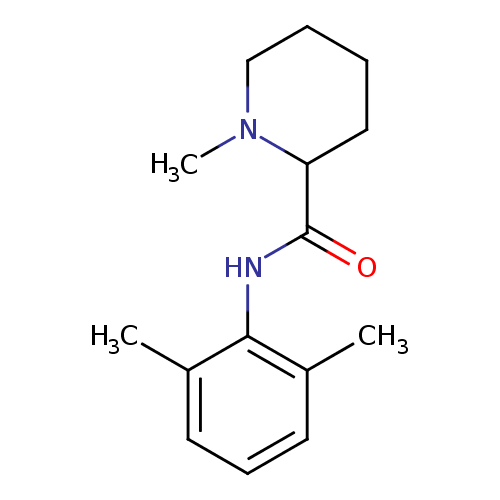
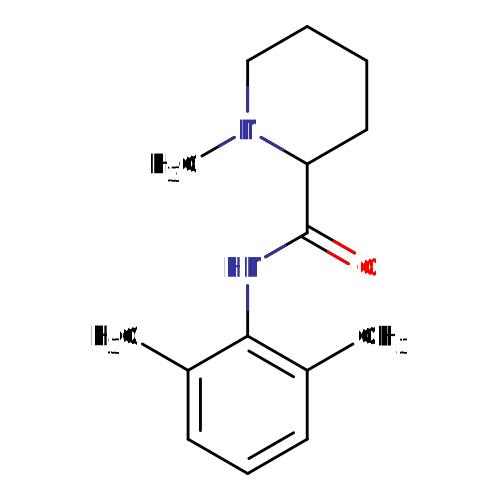
Chemical Structure
Thumb
Synonyms
ValueSource
(+-)-1-Methyl-2',6'-pipecoloxylidideChEBI
1-Methyl-2',6'-pipecoloxylidideChEBI
CarbocaineChEBI
DL-MepivacaineChEBI
MepivacainaChEBI
MepivacainumChEBI
N-(2,6-Dimethylphenyl)-1-methyl-2-piperidinecarboxamideChEBI
N-(2,6-Dimethylphenyl)-1-methylpiperidine-2-carboxamideChEBI
Carboplyin dentalKegg
Mepivacaine HCLHMDB
Mepivacaine hydrochlorideHMDB
MepivicaineHMDB
S-Ropivacaine mesylateHMDB
3m Brand OF mepivacaine hydrochlorideHMDB
AstraZeneca brand OF mepivacaine hydrochlorideHMDB
Inibsa brand OF mepivacaine hydrochlorideHMDB
IsogaineHMDB
Mepivacain injektopasHMDB
Mepivacaina braunHMDB
Monohydrochloride, mepivacaineHMDB
Pascoe brand OF mepivacaine hydrochlorideHMDB
ScandicaineHMDB
Astra brand OF mepivacaine hydrochlorideHMDB
Hexal brand OF mepivacaine hydrochlorideHMDB
Hydrochloride, mepivacaineHMDB
MepihexalHMDB
MepivastesinHMDB
Novocol brand OF mepivacaine hydrochlorideHMDB
PolocaineHMDB
Curasan brand OF mepivacaine hydrochlorideHMDB
Abbott brand OF mepivacaine hydrochlorideHMDB
Braun, mepivacainaHMDB
Clarben brand OF mepivacaine hydrochlorideHMDB
Dentsply brand OF mepivacaine hydrochlorideHMDB
MeaverinHMDB
MecainHMDB
Sanofi brand OF mepivacaine hydrochlorideHMDB
ScandinibsaHMDB
Aventis brand OF mepivacaine hydrochlorideHMDB
Braun brand OF mepivicaine hydrochlorideHMDB
CarbocaïneHMDB
IsocaineHMDB
Mepivacain-injektopasHMDB
Mepivacaine monohydrochlorideHMDB
ScandicainHMDB
ScandonestHMDB
Chemical FormulaC15H22N2O
Average Molecular Mass246.348 g/mol
Monoisotopic Mass246.173 g/mol
CAS Registry Number96-88-8
IUPAC NameN-(2,6-dimethylphenyl)-1-methylpiperidine-2-carboxamide
Traditional Namemepivacaine
SMILESCN1CCCCC1C(=O)NC1=C(C)C=CC=C1C
InChI IdentifierInChI=1S/C15H22N2O/c1-11-7-6-8-12(2)14(11)16-15(18)13-9-4-5-10-17(13)3/h6-8,13H,4-5,9-10H2,1-3H3,(H,16,18)
InChI KeyINWLQCZOYSRPNW-UHFFFAOYSA-N
Chemical Taxonomy
Description belongs to the class of organic compounds known as piperidinecarboxamides. Piperidinecarboxamides are compounds containing a piperidine ring substituted with a carboxamide functional group.
KingdomOrganic compounds
Super ClassOrganoheterocyclic compounds
ClassPiperidines
Sub ClassPiperidinecarboxylic acids and derivatives
Direct ParentPiperidinecarboxamides
Alternative Parents
Substituents
  • 2-piperidinecarboxamide
  • Piperidinecarboxamide
  • M-xylene
  • Xylene
  • Monocyclic benzene moiety
  • Benzenoid
  • Tertiary aliphatic amine
  • Tertiary amine
  • Carboximidic acid
  • Carboximidic acid derivative
  • Azacycle
  • Organic 1,3-dipolar compound
  • Propargyl-type 1,3-dipolar organic compound
  • Amine
  • Hydrocarbon derivative
  • Organooxygen compound
  • Organonitrogen compound
  • Organopnictogen compound
  • Organic oxygen compound
  • Organic nitrogen compound
  • Aromatic heteromonocyclic compound
Molecular FrameworkAromatic heteromonocyclic compounds
External Descriptors
Biological Properties
StatusDetected and Not Quantified
OriginExogenous
Cellular Locations
  • Cytoplasm
  • Extracellular
  • Membrane
Biofluid LocationsNot Available
Tissue LocationsNot Available
Pathways
NameSMPDB LinkKEGG Link
Mepivacaine PathwayNot AvailableNot Available
Applications
Biological RolesNot Available
Chemical RolesNot Available
Physical Properties
StateSolid
AppearanceWhite powder.
Experimental Properties
PropertyValue
Melting Point150.5°C
Boiling PointNot Available
Solubility7000 mg/L (at 23°C)
Predicted Properties
PropertyValueSource
Water Solubility0.62 g/LALOGPS
logP2.16ALOGPS
logP3.19ChemAxon
logS-2.6ALOGPS
pKa (Strongest Acidic)13.62ChemAxon
pKa (Strongest Basic)7.25ChemAxon
Physiological Charge1ChemAxon
Hydrogen Acceptor Count2ChemAxon
Hydrogen Donor Count1ChemAxon
Polar Surface Area32.34 ŲChemAxon
Rotatable Bond Count2ChemAxon
Refractivity76.32 m³·mol⁻¹ChemAxon
Polarizability28.61 ųChemAxon
Number of Rings2ChemAxon
Bioavailability1ChemAxon
Rule of FiveYesChemAxon
Ghose FilterYesChemAxon
Veber's RuleYesChemAxon
MDDR-like RuleNoChemAxon
Spectra
Spectra
Spectrum TypeDescriptionSplash KeyView
Predicted GC-MSPredicted GC-MS Spectrum - GC-MS (Non-derivatized) - 70eV, Positivesplash10-0092-9200000000-a3a931af35da130669aaSpectrum
Predicted GC-MSPredicted GC-MS Spectrum - GC-MS (Non-derivatized) - 70eV, PositiveNot AvailableSpectrum
LC-MS/MSLC-MS/MS Spectrum - LC-ESI-QFT , positivesplash10-0002-9040000000-3c0a89a13f39484eef97Spectrum
LC-MS/MSLC-MS/MS Spectrum - LC-ESI-QFT , positivesplash10-0002-9000000000-9073826aa2631981fe72Spectrum
LC-MS/MSLC-MS/MS Spectrum - LC-ESI-QFT , positivesplash10-0002-9000000000-9b273b91b5148ef6a8faSpectrum
LC-MS/MSLC-MS/MS Spectrum - LC-ESI-QFT , positivesplash10-0002-9000000000-d541d397ca20f2f1a799Spectrum
LC-MS/MSLC-MS/MS Spectrum - LC-ESI-QFT , positivesplash10-0002-9000000000-eda45d03ea77058a8429Spectrum
LC-MS/MSLC-MS/MS Spectrum - LC-ESI-QFT , positivesplash10-006t-9000000000-f42a147676c3c718e38fSpectrum
LC-MS/MSLC-MS/MS Spectrum - 30V, Positivesplash10-0002-9000000000-9073826aa2631981fe72Spectrum
LC-MS/MSLC-MS/MS Spectrum - 45V, Positivesplash10-0002-9000000000-9b273b91b5148ef6a8faSpectrum
LC-MS/MSLC-MS/MS Spectrum - 15V, Positivesplash10-0002-9040000000-3c0a89a13f39484eef97Spectrum
LC-MS/MSLC-MS/MS Spectrum - 60V, Positivesplash10-0002-9000000000-d541d397ca20f2f1a799Spectrum
LC-MS/MSLC-MS/MS Spectrum - 75V, Positivesplash10-0002-9000000000-4b9a3b3048a6c1bbd656Spectrum
LC-MS/MSLC-MS/MS Spectrum - 90V, Positivesplash10-006t-9000000000-f42a147676c3c718e38fSpectrum
LC-MS/MSLC-MS/MS Spectrum - 35V, Positivesplash10-0002-9000000000-e7a7508a46c81f01a0f6Spectrum
Predicted LC-MS/MSPredicted LC-MS/MS Spectrum - 10V, Positivesplash10-006t-2890000000-4fd4344949c8e98d2d22Spectrum
Predicted LC-MS/MSPredicted LC-MS/MS Spectrum - 20V, Positivesplash10-006t-9600000000-eccb3e339a3aafb57c83Spectrum
Predicted LC-MS/MSPredicted LC-MS/MS Spectrum - 40V, Positivesplash10-00di-9100000000-923210fdcbf3093cec8cSpectrum
Predicted LC-MS/MSPredicted LC-MS/MS Spectrum - 10V, Negativesplash10-0002-0190000000-5c29854d995646f8e15fSpectrum
Predicted LC-MS/MSPredicted LC-MS/MS Spectrum - 20V, Negativesplash10-00fs-0960000000-75e4d525847b240eb8ddSpectrum
Predicted LC-MS/MSPredicted LC-MS/MS Spectrum - 40V, Negativesplash10-0g4i-6900000000-79da7c9893bedd422f3eSpectrum
Predicted LC-MS/MSPredicted LC-MS/MS Spectrum - 10V, Positivesplash10-0002-9380000000-6935f06f321d22f49f8fSpectrum
Predicted LC-MS/MSPredicted LC-MS/MS Spectrum - 20V, Positivesplash10-0002-9630000000-fc9251019b6aa4d95ac0Spectrum
Predicted LC-MS/MSPredicted LC-MS/MS Spectrum - 40V, Positivesplash10-0002-9000000000-64648fb1fd5128b76827Spectrum
Predicted LC-MS/MSPredicted LC-MS/MS Spectrum - 10V, Negativesplash10-0002-0090000000-4a0996a0879be85733edSpectrum
Predicted LC-MS/MSPredicted LC-MS/MS Spectrum - 20V, Negativesplash10-00dj-0950000000-7a84cb81cb305d4c644eSpectrum
Predicted LC-MS/MSPredicted LC-MS/MS Spectrum - 40V, Negativesplash10-00xr-1910000000-dcbc91df93a09683c261Spectrum
MSMass Spectrum (Electron Ionization)splash10-0002-9000000000-6a3d80d214452a24ab62Spectrum
Toxicity Profile
Route of ExposureAbsorbed locally. The rate of systemic absorption of local anesthetics is dependent upon the total dose and concentration of drug administered, the route of administration, the vascularity of the administration site, and the presence or absence of epinephrine in the anesthetic solution. Subcutaneous, injection ; Infiltration
Mechanism of ToxicityLocal anesthetics block the generation and the conduction of nerve impulses, presumably by increasing the threshold for electrical excitation in the nerve, by slowing the propagation of the nerve impulse, and by reducing the rate of rise of the action potential. In general, the progression of anesthesia is related to the diameter, myelination, and conduction velocity of affected nerve fibers. Clinically, the order of loss of nerve function is as follows: pain, temperature, touch, proprioception, and skeletal muscle tone.
MetabolismRapidly metabolized, with only a small percentage of the anesthetic (5 percent to 10 percent) being excreted unchanged in the urine. The liver is the principal site of metabolism, with over 50% of the administered dose being excreted into the bile as metabolites. Route of Elimination: It is rapidly metabolized, with only a small percentage of the anesthetic (5 percent to 10 percent) being excreted unchanged in the urine.The liver is the principal site of metabolism, with over 50% of the administered dose being excreted into the bile as metabolites. Half Life: The half-life of mepivacaine in adults is 1.9 to 3.2 hours and in neonates 8.7 to 9 hours.
Toxicity ValuesThe mean seizure dosage of mepivacaine in rhesus monkeys was found to be 18.8 mg/kg with mean arterial plasma concentration of 24.4 µg/mL. LD50: 23-35 mg/kg (Intravenous, Mouse) (1) LD50: 280 mg/kg (Subcutaneous, Mouse (1)
Lethal DoseNot Available
Carcinogenicity (IARC Classification)No indication of carcinogenicity to humans (not listed by IARC).
Uses/SourcesFor production of local or regional analgesia and anesthesia by local infiltration, peripheral nerve block techniques, and central neural techniques including epidural and caudal blocks.
Minimum Risk LevelNot Available
Health EffectsNot Available
SymptomsNot Available
TreatmentTreatment of a patient with toxic manifestations consists of assuring and maintaining a patient airway and supporting ventilation (respiration) as required. This usually will be sufficient in the management of most reactions. Should a convulsion persist despite ventilatory therapy, small increments of anticonvulsive agents may be given intravenously, such as benzodiazephine (e.g., diazepam) or ultrashort-acting barbiturates (e.g., thiopental or thiamylal) or short-acting barbiturates (e.g., pentobarbital or secobarbital). Cardiovascular depression may require circulatory assistance with intravenous fluids and/or vasopressor (e.g., Ephedrine) as dictated by the clinical situation. (3)
Concentrations
Not Available
DrugBank IDDB00961
HMDB IDHMDB0015096
FooDB IDNot Available
Phenol Explorer IDNot Available
KNApSAcK IDNot Available
BiGG IDNot Available
BioCyc IDNot Available
METLIN IDNot Available
PDB IDNot Available
Wikipedia LinkMepivacaine
Chemspider ID3922
ChEBI ID6759
PubChem Compound ID4062
Kegg Compound IDC07528
YMDB IDNot Available
ECMDB IDNot Available
References
Synthesis Reference

DrugSyn.org

MSDSLink
General References
1. https://www.ncbi.nlm.nih.gov/pubmed/?term=13760073
2. https://www.ncbi.nlm.nih.gov/pubmed/?term=13859098
3. https://www.ncbi.nlm.nih.gov/pubmed/?term=25369391
4. https://www.ncbi.nlm.nih.gov/pubmed/?term=25827158
5. https://www.ncbi.nlm.nih.gov/pubmed/?term=26169676
6. https://www.ncbi.nlm.nih.gov/pubmed/?term=26780408
7. https://www.ncbi.nlm.nih.gov/pubmed/?term=9013953
8. https://www.ncbi.nlm.nih.gov/pubmed/?term=9425972
9. https://www.ncbi.nlm.nih.gov/pubmed/?term=9989796