Record Information
Version1.0
Creation Date2009-07-21 20:27:53 UTC
Update Date2026-05-14 16:51:26 UTC
Accession NumberCHEM002295
Identification
Common NameSirolimus
ClassSmall Molecule
DescriptionA macrolide compound obtained from Streptomyces hygroscopicus that acts by selectively blocking the transcriptional activation of cytokines thereby inhibiting cytokine production. It is bioactive only when bound to immunophilins. Sirolimus is a potent immunosuppressant and possesses both antifungal and antineoplastic properties. [PubChem]
Contaminant Sources
  • HMDB Contaminants - Urine
  • STOFF IDENT Compounds
  • T3DB toxins
  • ToxCast & Tox21 Chemicals
Contaminant Type
  • Amide
  • Amine
  • Anti-Bacterial Agent
  • Antibiotic, Antineoplastic
  • Antifungal Agent
  • Drug
  • Ester
  • Ether
  • Human Neurotoxin
  • Immunosuppressive Agent
  • Macrolide
  • Metabolite
  • Organic Compound
  • Synthetic Compound
Chemical Structure
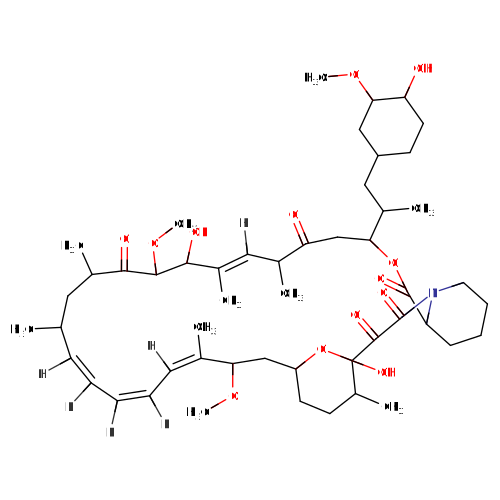
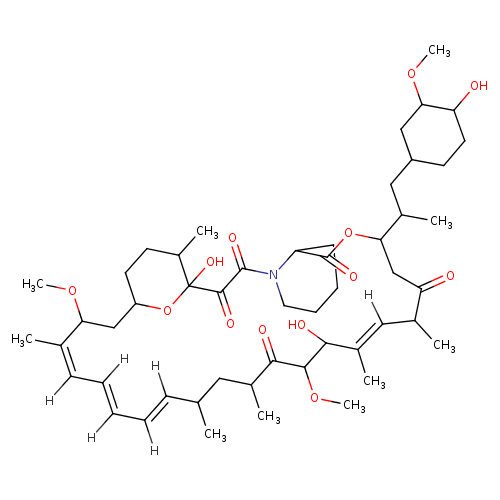
Thumb
SynonymsNot Available
Chemical FormulaC51H79NO13
Average Molecular Mass914.187 g/mol
Monoisotopic Mass913.555 g/mol
CAS Registry Number53123-88-9
IUPAC Name(1R,9S,12S,15R,16E,18R,19R,21R,23S,24E,26E,28E,30S,32S,35R)-1,18-dihydroxy-12-[(2R)-1-[(1S,3R,4R)-4-hydroxy-3-methoxycyclohexyl]propan-2-yl]-19,30-dimethoxy-15,17,21,23,29,35-hexamethyl-11,36-dioxa-4-azatricyclo[30.3.1.0^{4,9}]hexatriaconta-16,24,26,28-tetraene-2,3,10,14,20-pentone
Traditional Namesirolimus
SMILES[H]\C1=C(\[H])/C(/[H])=C(\[H])/C(/[H])=C(C)\C(CC2CCC(C)C(O)(O2)C(=O)C(=O)N2CCCCC2C(=O)OC(CC(=O)C(C)\C([H])=C(C)\C(O)C(OC)C(=O)C(C)CC1C)C(C)CC1CCC(O)C(C1)OC)OC
InChI IdentifierInChI=1S/C51H79NO13/c1-30-16-12-11-13-17-31(2)42(61-8)28-38-21-19-36(7)51(60,65-38)48(57)49(58)52-23-15-14-18-39(52)50(59)64-43(33(4)26-37-20-22-40(53)44(27-37)62-9)29-41(54)32(3)25-35(6)46(56)47(63-10)45(55)34(5)24-30/h11-13,16-17,25,30,32-34,36-40,42-44,46-47,53,56,60H,14-15,18-24,26-29H2,1-10H3/b13-11+,16-12+,31-17-,35-25+
InChI KeyQFJCIRLUMZQUOT-LYULEKIKSA-N
Chemical Taxonomy
Description belongs to the class of organic compounds known as macrolide lactams. These are cyclic polyketides containing both a cyclic amide and a cyclic ester group.
KingdomOrganic compounds
Super ClassPhenylpropanoids and polyketides
ClassMacrolide lactams
Sub ClassNot Available
Direct ParentMacrolide lactams
Alternative Parents
Substituents
  • Macrolide lactam
  • Alpha-amino acid ester
  • Macrolide
  • Alpha-amino acid or derivatives
  • Cyclohexanol
  • Oxane
  • Piperidine
  • Cyclic alcohol
  • Tertiary carboxylic acid amide
  • Cyclic ketone
  • Secondary alcohol
  • Carboxamide group
  • Carboxylic acid ester
  • Hemiacetal
  • Ketone
  • Lactam
  • Lactone
  • Organoheterocyclic compound
  • Azacycle
  • Carboxylic acid derivative
  • Oxacycle
  • Dialkyl ether
  • Ether
  • Monocarboxylic acid or derivatives
  • Organopnictogen compound
  • Alcohol
  • Organic oxygen compound
  • Carbonyl group
  • Organooxygen compound
  • Organonitrogen compound
  • Organic nitrogen compound
  • Hydrocarbon derivative
  • Organic oxide
  • Aliphatic heteropolycyclic compound
Molecular FrameworkAliphatic heteropolycyclic compounds
External DescriptorsNot Available
Biological Properties
StatusDetected and Not Quantified
OriginExogenous
Cellular Locations
  • Cytoplasm
  • Membrane
Biofluid LocationsNot Available
Tissue Locations
  • Kidney
  • Liver
PathwaysNot Available
Applications
Biological Roles
Chemical Roles
Physical Properties
StateSolid
AppearanceWhite powder.
Experimental Properties
PropertyValue
Melting Point183-185°C
Boiling PointNot Available
Solubility1.73e-03 g/L
Predicted Properties
PropertyValueSource
Water Solubility0.0017 g/LALOGPS
logP4.85ALOGPS
logP7.45ChemAxon
logS-5.7ALOGPS
pKa (Strongest Acidic)9.96ChemAxon
pKa (Strongest Basic)-3ChemAxon
Physiological Charge0ChemAxon
Hydrogen Acceptor Count12ChemAxon
Hydrogen Donor Count3ChemAxon
Polar Surface Area195.43 ŲChemAxon
Rotatable Bond Count6ChemAxon
Refractivity250.66 m³·mol⁻¹ChemAxon
Polarizability101.27 ųChemAxon
Number of Rings4ChemAxon
Bioavailability0ChemAxon
Rule of FiveNoChemAxon
Ghose FilterNoChemAxon
Veber's RuleNoChemAxon
MDDR-like RuleYesChemAxon
Spectra
Spectra
Spectrum TypeDescriptionSplash KeyView
Predicted LC-MS/MSPredicted LC-MS/MS Spectrum - 10V, Positivesplash10-03dj-0100000295-538de958471c20cea7a0Spectrum
Predicted LC-MS/MSPredicted LC-MS/MS Spectrum - 20V, Positivesplash10-001j-0632390280-a3032c3e232d4a2c7bdfSpectrum
Predicted LC-MS/MSPredicted LC-MS/MS Spectrum - 40V, Positivesplash10-01wr-0814113910-19c7692bfd13e245e54dSpectrum
Predicted LC-MS/MSPredicted LC-MS/MS Spectrum - 10V, Negativesplash10-03di-0613322389-d91ce39dafa2a54bef2cSpectrum
Predicted LC-MS/MSPredicted LC-MS/MS Spectrum - 20V, Negativesplash10-014i-0202013090-dae32b81660bfccea140Spectrum
Predicted LC-MS/MSPredicted LC-MS/MS Spectrum - 40V, Negativesplash10-000i-0925201100-d361305ce62d4f62a9ffSpectrum
Toxicity Profile
Route of ExposureOral
Mechanism of ToxicitySirolimus inhibits T lymphocyte activation and proliferation that occurs in response to antigenic and cytokine (Interleukin IL-2, IL-4, and IL-15) stimulation by a mechanism that is distinct from that of other immunosuppressants. Sirolimus also inhibits antibody production. In cells, sirolimus binds to the immunophilin, FK Binding Protein-12 (FKBP-12), to generate an immunosuppressive complex. The sirolimus:FKBP-12 complex has no effect on calcineurin activity. This complex binds to and inhibits the activation of the mammalian Target Of Rapamycin (mTOR), a key regulatory kinase. This inhibition suppresses cytokine-driven T-cell proliferation, inhibiting the progression from the G1 to the S phase of the cell cycle.
Metabolism Half Life: 57-63 hours
Toxicity ValuesLD50: >800 mg/kg (oral, rat) (8) LD50: >800 mg/kg (oral, mice) (8)
Lethal DoseNot Available
Carcinogenicity (IARC Classification)No indication of carcinogenicity to humans (not listed by IARC).
Uses/SourcesUsed to prevent rejection in organ transplantation; it is especially useful in kidney transplants. [Wikipedia]
Minimum Risk LevelNot Available
Health EffectsIncreased susceptibility to infection, lymphoma, and malignancy; bronchial anastomotic dehiscence in lung transplant patients; decline in renal function in long-term combination of cyclosporine with Rapamune; proteinuria. (8)
SymptomsThe most common ( ≥ 30%) adverse reactions observed with Rapamune in clinical studies are: peripheral edema, hypertriglyceridemia, hypertension, hypercholesterolemia, creatinine increased, constipation, abdominal pain, diarrhea, headache, fever, urinary tract infection, anemia, nausea, arthralgia, pain, and thrombocytopenia. (8)
TreatmentGeneral supportive measures should be followed in all cases of overdose. Based on the low aqueous solubility and high erythrocyte and plasma protein binding of sirolimus, it is anticipated that sirolimus is not dialyzable to any significant extent. (7)
Concentrations
Not Available
DrugBank IDNot Available
HMDB IDNot Available
FooDB IDNot Available
Phenol Explorer IDNot Available
KNApSAcK IDNot Available
BiGG IDNot Available
BioCyc IDNot Available
METLIN IDNot Available
PDB IDNot Available
Wikipedia LinkNot Available
Chemspider IDNot Available
ChEBI IDNot Available
PubChem Compound ID58863407
Kegg Compound IDNot Available
YMDB IDNot Available
ECMDB IDNot Available
References
Synthesis Reference

Madhup K. Dhaon, Chi-nung Hsiao, Subhash R. Patel, Peter J. Bonk, Sanjay R. Chemburkar, Yong Y. Chen, “One pot synthesis of tetrazole derivatives of sirolimus.” U.S. Patent US20080167335, issued July 10, 2008.

MSDSNot Available
General ReferencesNot Available