Record Information
Version1.0
Creation Date2009-07-21 20:27:51 UTC
Update Date2026-05-14 16:51:00 UTC
Accession NumberCHEM002292
Identification
Common NameDiflunisal
ClassSmall Molecule
DescriptionDiflunisal, a salicylate derivative, is a nonsteroidal anti-inflammatory agent (NSAIA) with pharmacologic actions similar to other prototypical NSAIAs. Diflunisal possesses anti-inflammatory, analgesic and antipyretic activity. Though its mechanism of action has not been clearly established, most of its actions appear to be associated with inhibition of prostaglandin synthesis via the arachidonic acid pathway. Diflunisal is used to relieve pain accompanied with inflammation and in the symptomatic treatment of rheumatoid arthritis and osteoarthritis.
Contaminant Sources
  • HMDB Contaminants - Urine
  • STOFF IDENT Compounds
  • T3DB toxins
  • ToxCast & Tox21 Chemicals
Contaminant Type
  • Anti-Inflammatory Agent, Non-Steroidal
  • Cyclooxygenase Inhibitor
  • Drug
  • Ester
  • Metabolite
  • Organic Compound
  • Organofluoride
  • Synthetic Compound
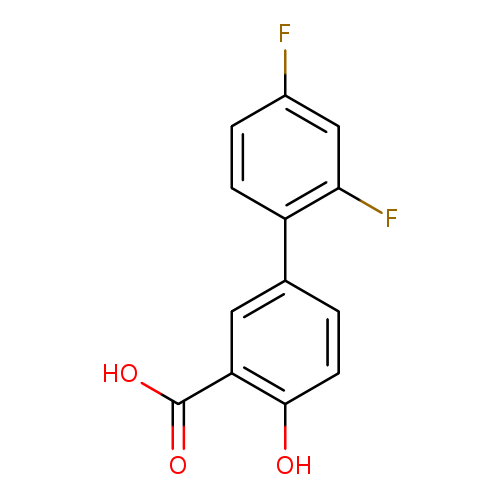
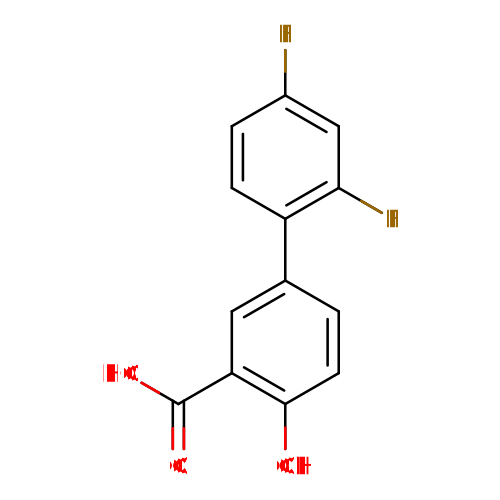
Chemical Structure
Thumb
Synonyms
ValueSource
2',4'-Difluoro-4-hydroxy-3-biphenylcarboxylic acidChEBI
2-(Hydroxy)-5-(2,4-difluorophenyl)benzoic acidChEBI
5-(2,4-Difluorophenyl)salicylic acidChEBI
DolobidChEBI
2',4'-Difluoro-4-hydroxy-3-biphenylcarboxylateGenerator
2-(Hydroxy)-5-(2,4-difluorophenyl)benzoateGenerator
5-(2,4-Difluorophenyl)salicylateGenerator
Diflunisal novopharm brandHMDB
DolocidHMDB
Frosst sa brand OF diflunisalHMDB
Novopharm brand OF diflunisalHMDB
Nu pharm brand OF diflunisalHMDB
Nu-diflunisalHMDB
Merck brand OF diflunisalHMDB
Novo-diflunisalHMDB
Apo-diflunisalHMDB
DolobisHMDB
Merck sharp and dohme brand OF diflunisalHMDB
Nu-pharm brand OF diflunisalHMDB
Apotex brand OF diflunisalHMDB
Cahill may roberts brand OF diflunisalHMDB
Apo diflunisalHMDB
ApoDiflunisalHMDB
Novo diflunisalHMDB
Nu diflunisalHMDB
NovoDiflunisalHMDB
NuDiflunisalHMDB
Chemical FormulaC13H8F2O3
Average Molecular Mass250.198 g/mol
Monoisotopic Mass250.044 g/mol
CAS Registry Number22494-42-4
IUPAC Name2',4'-difluoro-4-hydroxy-[1,1'-biphenyl]-3-carboxylic acid
Traditional Namediflunisal
SMILESOC(=O)C1=C(O)C=CC(=C1)C1=C(F)C=C(F)C=C1
InChI IdentifierInChI=1S/C13H8F2O3/c14-8-2-3-9(11(15)6-8)7-1-4-12(16)10(5-7)13(17)18/h1-6,16H,(H,17,18)
InChI KeyHUPFGZXOMWLGNK-UHFFFAOYSA-N
Chemical Taxonomy
Description belongs to the class of organic compounds known as biphenyls and derivatives. These are organic compounds containing to benzene rings linked together by a C-C bond.
KingdomOrganic compounds
Super ClassBenzenoids
ClassBenzene and substituted derivatives
Sub ClassBiphenyls and derivatives
Direct ParentBiphenyls and derivatives
Alternative Parents
Substituents
  • Biphenyl
  • Hydroxybenzoic acid
  • Salicylic acid or derivatives
  • Salicylic acid
  • Benzoic acid or derivatives
  • Benzoic acid
  • Benzoyl
  • 1-hydroxy-2-unsubstituted benzenoid
  • Fluorobenzene
  • Halobenzene
  • Phenol
  • Aryl fluoride
  • Aryl halide
  • Vinylogous acid
  • Monocarboxylic acid or derivatives
  • Carboxylic acid
  • Carboxylic acid derivative
  • Hydrocarbon derivative
  • Organic oxide
  • Organic oxygen compound
  • Organohalogen compound
  • Organofluoride
  • Organooxygen compound
  • Aromatic homomonocyclic compound
Molecular FrameworkAromatic homomonocyclic compounds
External Descriptors
Biological Properties
StatusDetected and Not Quantified
OriginExogenous
Cellular Locations
  • Cytoplasm
  • Extracellular
  • Membrane
Biofluid LocationsNot Available
Tissue LocationsNot Available
Pathways
NameSMPDB LinkKEGG Link
Diflunisal PathwayNot AvailableNot Available
Applications
Biological Roles
Chemical RolesNot Available
Physical Properties
StateSolid
AppearanceWhite powder.
Experimental Properties
PropertyValue
Melting Point210-211°C
Boiling PointNot Available
SolubilityPractically insoluble (14.5 mg/L) at neutral or acidic pH.
Predicted Properties
PropertyValueSource
Water Solubility0.071 g/LALOGPS
logP3.11ALOGPS
logP3.91ChemAxon
logS-3.6ALOGPS
pKa (Strongest Acidic)2.69ChemAxon
pKa (Strongest Basic)-6.3ChemAxon
Physiological Charge-1ChemAxon
Hydrogen Acceptor Count3ChemAxon
Hydrogen Donor Count2ChemAxon
Polar Surface Area57.53 ŲChemAxon
Rotatable Bond Count2ChemAxon
Refractivity60.86 m³·mol⁻¹ChemAxon
Polarizability22.29 ųChemAxon
Number of Rings2ChemAxon
Bioavailability1ChemAxon
Rule of FiveYesChemAxon
Ghose FilterYesChemAxon
Veber's RuleNoChemAxon
MDDR-like RuleNoChemAxon
Spectra
Spectra
Spectrum TypeDescriptionSplash KeyView
Predicted GC-MSPredicted GC-MS Spectrum - GC-MS (Non-derivatized) - 70eV, Positivesplash10-0pc0-1190000000-37ea5d58644c01ef5b1eSpectrum
Predicted GC-MSPredicted GC-MS Spectrum - GC-MS (2 TMS) - 70eV, Positivesplash10-05fr-5019000000-223530358c78521d8313Spectrum
Predicted GC-MSPredicted GC-MS Spectrum - GC-MS (Non-derivatized) - 70eV, PositiveNot AvailableSpectrum
LC-MS/MSLC-MS/MS Spectrum - LC-ESI-QQ , negativesplash10-0002-2690000000-64056c9dc4e2f14d3c59Spectrum
LC-MS/MSLC-MS/MS Spectrum - LC-ESI-QQ , negativesplash10-0a4j-5590000000-462ea99995ea9238bf94Spectrum
LC-MS/MSLC-MS/MS Spectrum - LC-ESI-QQ , negativesplash10-0a4i-5490000000-ec23e03578a95364b748Spectrum
LC-MS/MSLC-MS/MS Spectrum - LC-ESI-QQ , negativesplash10-0a4i-9550000000-2fa065aea811fa7b6c5aSpectrum
LC-MS/MSLC-MS/MS Spectrum - LC-ESI-QQ , negativesplash10-000t-9000000000-01d2c7c75ab3756b3df7Spectrum
Predicted LC-MS/MSPredicted LC-MS/MS Spectrum - 10V, Positivesplash10-0udi-0090000000-e1009fb8e100faed2065Spectrum
Predicted LC-MS/MSPredicted LC-MS/MS Spectrum - 20V, Positivesplash10-0f89-0090000000-e9bcdf3ba0212ee28f45Spectrum
Predicted LC-MS/MSPredicted LC-MS/MS Spectrum - 40V, Positivesplash10-0fc0-1970000000-baed3c5d64825d6b04b2Spectrum
Predicted LC-MS/MSPredicted LC-MS/MS Spectrum - 10V, Negativesplash10-052b-0090000000-6427bf95a0116aa621f1Spectrum
Predicted LC-MS/MSPredicted LC-MS/MS Spectrum - 20V, Negativesplash10-0a4i-0090000000-83af00a8dd308410951dSpectrum
Predicted LC-MS/MSPredicted LC-MS/MS Spectrum - 40V, Negativesplash10-0a4i-0690000000-a756057c6442130830efSpectrum
Predicted LC-MS/MSPredicted LC-MS/MS Spectrum - 10V, Positivesplash10-0ue9-0090000000-645b3ae2575f11227813Spectrum
Predicted LC-MS/MSPredicted LC-MS/MS Spectrum - 20V, Positivesplash10-001i-0090000000-78fd25facb031cdb643fSpectrum
Predicted LC-MS/MSPredicted LC-MS/MS Spectrum - 40V, Positivesplash10-056r-0940000000-9920437171fca6936f28Spectrum
Predicted LC-MS/MSPredicted LC-MS/MS Spectrum - 10V, Negativesplash10-0002-0090000000-3e0ed3bddcaf7a500b10Spectrum
Predicted LC-MS/MSPredicted LC-MS/MS Spectrum - 20V, Negativesplash10-052b-0090000000-4ac100e6866826f4e00aSpectrum
Predicted LC-MS/MSPredicted LC-MS/MS Spectrum - 40V, Negativesplash10-0kdi-1930000000-6c51e381123d99125d70Spectrum
MSMass Spectrum (Electron Ionization)splash10-0fai-1690000000-d231ff5a9ac7d9769d2dSpectrum
Toxicity Profile
Route of ExposureRapidly and completely absorbed following oral administration, with a bioavailability of 80-90%. Peak plasma concentrations are achieved 2 - 3 hours following oral administration.
Mechanism of ToxicityThe precise mechanism of the analgesic and anti-inflammatory actions of diflunisal is not known. Diflunisal is a prostaglandin synthetase inhibitor. In animals, prostaglandins sensitize afferent nerves and potentiate the action of bradykinin in inducing pain. Since prostaglandins are known to be among the mediators of pain and inflammation, the mode of action of diflunisal may be due to a decrease of prostaglandins in peripheral tissues.
MetabolismHepatic, primarily via glucuronide conjugation (90% of administered dose). Route of Elimination: The drug is excreted in the urine as two soluble glucuronide conjugates accounting for about 90% of the administered dose. Little or no diflunisal is excreted in the feces. Half Life: 8 to 12 hours
Toxicity ValuesLD50: 392 mg/kg (Oral, Rat) (1) LD50: 439 mg/kg (Oral, Mouse) (1) LD50: 603 mg/kg (Oral, Rabbit) (1)
Lethal DoseThe lowest dose without the presence of other medicines which caused death was 15 grams.
Carcinogenicity (IARC Classification)No indication of carcinogenicity to humans (not listed by IARC).
Uses/SourcesUsed to relieve pain, tenderness, swelling and stiffness caused by osteoarthritis (arthritis caused by a breakdown of the lining of the joints) and rheumatoid arthritis (arthritis caused by swelling of the lining of the joints). [L1869]
Minimum Risk LevelNot Available
Health EffectsNot Available
SymptomsSymptoms of overdose include coma, tachycardia, stupor, and vomiting.
TreatmentIn the event of overdosage, the stomach should be emptied by inducing vomiting or by gastric lavage, and the patient carefully observed and given symptomatic and supportive treatment. Because of the high degree of protein binding, hemodialysis may not be effective. (2)
Concentrations
Not Available
DrugBank IDDB00861
HMDB IDHMDB0014999
FooDB IDNot Available
Phenol Explorer IDNot Available
KNApSAcK IDNot Available
BiGG IDNot Available
BioCyc IDNot Available
METLIN IDNot Available
PDB ID1FL
Wikipedia LinkDiflunisal
Chemspider ID2951
ChEBI ID39669
PubChem Compound ID3059
Kegg Compound IDC01691
YMDB IDNot Available
ECMDB IDNot Available
References
Synthesis Reference

Ruyle, W.V., Jarett, L.H. and Matzuk, A.R. ; U S . Patent 3,714,226; January 30, 1973; assigned to Merck & Co., Inc.

MSDSLink
General References
1. https://www.ncbi.nlm.nih.gov/pubmed/?term=23144359
2. https://www.ncbi.nlm.nih.gov/pubmed/?term=23416065
3. https://www.ncbi.nlm.nih.gov/pubmed/?term=28166217