Record Information
Version1.0
Creation Date2009-07-21 20:27:49 UTC
Update Date2026-03-27 00:50:37 UTC
Accession NumberCHEM002289
Identification
Common NamePerphenazine
ClassSmall Molecule
DescriptionAn antipsychotic phenothiazine derivative with actions and uses similar to those of chlorpromazine. [PubChem]
Contaminant Sources
  • HMDB Contaminants - Urine
  • STOFF IDENT Compounds
  • T3DB toxins
  • ToxCast & Tox21 Chemicals
Contaminant Type
  • Amine
  • Antipsychotic Agent
  • Dopamine Antagonist
  • Drug
  • Ether
  • Metabolite
  • Organic Compound
  • Organochloride
  • Phenothiazine
  • Synthetic Compound
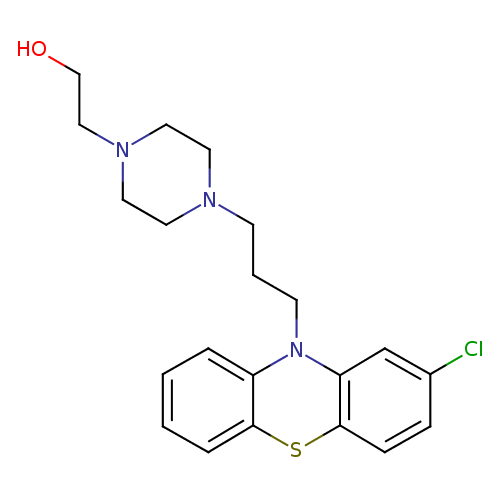
Chemical Structure
Thumb
Synonyms
ValueSource
2-(4-[3-(2-Chloro-10H-phenothiazin-10-yl)propyl]-1-piperazinyl)ethanolChEBI
2-Chloro-10-(3-(4-(2-hydroxyethyl)piperazin-1-yl)propyl)phenothiazineChEBI
4-[3-(2-Chloro-10H-phenothiazin-10-yl)propyl]-1-piperazineethanolChEBI
4-[3-(2-Chlorophenothiazin-10-yl)propyl]-1-piperazineethanolChEBI
ChlorpiprazineChEBI
gamma-(4-(beta-Hydroxyethyl)piperazin-1-yl)propyl-2-chlorophenothiazineChEBI
PerfenazinaChEBI
PerfenazineChEBI
PerphenazinChEBI
PerphenazinumChEBI
TrilafonChEBI
4-(3-(2-Chlorophenothiazin-10-yl)propyl)-1-piperazineethanolKegg
g-(4-(b-Hydroxyethyl)piperazin-1-yl)propyl-2-chlorophenothiazineGenerator
Γ-(4-(β-hydroxyethyl)piperazin-1-yl)propyl-2-chlorophenothiazineGenerator
ChlorperphenazineHMDB
EtaperazinHMDB
EtaperazineHMDB
EthaperazineHMDB
PZCHMDB
Chemical FormulaC21H26ClN3OS
Average Molecular Mass403.969 g/mol
Monoisotopic Mass403.149 g/mol
CAS Registry Number58-39-9
IUPAC Name2-{4-[3-(2-chloro-10H-phenothiazin-10-yl)propyl]piperazin-1-yl}ethan-1-ol
Traditional Nameperphenazine
SMILESOCCN1CCN(CCCN2C3=CC=CC=C3SC3=C2C=C(Cl)C=C3)CC1
InChI IdentifierInChI=1S/C21H26ClN3OS/c22-17-6-7-21-19(16-17)25(18-4-1-2-5-20(18)27-21)9-3-8-23-10-12-24(13-11-23)14-15-26/h1-2,4-7,16,26H,3,8-15H2
InChI KeyRGCVKNLCSQQDEP-UHFFFAOYSA-N
Chemical Taxonomy
Description belongs to the class of organic compounds known as phenothiazines. These are polycyclic aromatic compounds containing a phenothiazine moiety, which is a linear tricyclic system that consists of a two benzene rings joined by a para-thiazine ring.
KingdomOrganic compounds
Super ClassOrganoheterocyclic compounds
ClassBenzothiazines
Sub ClassPhenothiazines
Direct ParentPhenothiazines
Alternative Parents
Substituents
  • Phenothiazine
  • Alkyldiarylamine
  • Diarylthioether
  • Aryl thioether
  • Tertiary aliphatic/aromatic amine
  • N-alkylpiperazine
  • Para-thiazine
  • Aryl chloride
  • Aryl halide
  • 1,4-diazinane
  • Piperazine
  • Benzenoid
  • Tertiary amine
  • Tertiary aliphatic amine
  • 1,2-aminoalcohol
  • Azacycle
  • Thioether
  • Alkanolamine
  • Organic oxygen compound
  • Organonitrogen compound
  • Organochloride
  • Organohalogen compound
  • Organooxygen compound
  • Alcohol
  • Organic nitrogen compound
  • Amine
  • Primary alcohol
  • Organopnictogen compound
  • Hydrocarbon derivative
  • Aromatic heteropolycyclic compound
Molecular FrameworkAromatic heteropolycyclic compounds
External Descriptors
Biological Properties
StatusDetected and Not Quantified
OriginExogenous
Cellular Locations
  • Membrane
Biofluid LocationsNot Available
Tissue LocationsNot Available
PathwaysNot Available
Applications
Biological Roles
Chemical RolesNot Available
Physical Properties
StateSolid
AppearanceWhite powder.
Experimental Properties
PropertyValue
Melting Point97°C
Boiling Point278-281°C at 1.00E+00 mm Hg
Solubility28.3 mg/L (at 24°C)
Predicted Properties
PropertyValueSource
Water Solubility0.024 g/LALOGPS
logP4.15ALOGPS
logP3.69ChemAxon
logS-4.2ALOGPS
pKa (Strongest Acidic)15.59ChemAxon
pKa (Strongest Basic)8.21ChemAxon
Physiological Charge1ChemAxon
Hydrogen Acceptor Count4ChemAxon
Hydrogen Donor Count1ChemAxon
Polar Surface Area29.95 ŲChemAxon
Rotatable Bond Count6ChemAxon
Refractivity116.1 m³·mol⁻¹ChemAxon
Polarizability44.77 ųChemAxon
Number of Rings4ChemAxon
Bioavailability1ChemAxon
Rule of FiveYesChemAxon
Ghose FilterYesChemAxon
Veber's RuleYesChemAxon
MDDR-like RuleYesChemAxon
Spectra
Spectra
Spectrum TypeDescriptionSplash KeyView
GC-MSGC-MS Spectrum - EI-B (Non-derivatized)splash10-0006-9450000000-c13808005c7ad3a43067Spectrum
Predicted GC-MSPredicted GC-MS Spectrum - GC-MS (Non-derivatized) - 70eV, Positivesplash10-0095-9657000000-60700e1919a2a347a71bSpectrum
Predicted GC-MSPredicted GC-MS Spectrum - GC-MS (1 TMS) - 70eV, Positivesplash10-0229-9487500000-73c379ba5c6abc82840dSpectrum
Predicted GC-MSPredicted GC-MS Spectrum - GC-MS (Non-derivatized) - 70eV, PositiveNot AvailableSpectrum
LC-MS/MSLC-MS/MS Spectrum - LC-ESI-qTof , Positivesplash10-0f6t-2930000000-57d820b40a3c2c072840Spectrum
LC-MS/MSLC-MS/MS Spectrum - , positivesplash10-0zfr-0410900000-0910eefd789edd7f94c9Spectrum
LC-MS/MSLC-MS/MS Spectrum - , positivesplash10-006x-3940100000-e722b009e1511bd2bb57Spectrum
LC-MS/MSLC-MS/MS Spectrum - , positivesplash10-0f6t-2930000000-57d820b40a3c2c072840Spectrum
Predicted LC-MS/MSPredicted LC-MS/MS Spectrum - 10V, Positivesplash10-0udi-0212900000-26811bdbf39c3e1f8128Spectrum
Predicted LC-MS/MSPredicted LC-MS/MS Spectrum - 20V, Positivesplash10-0fki-3948400000-a80b04752eda36cb7edbSpectrum
Predicted LC-MS/MSPredicted LC-MS/MS Spectrum - 40V, Positivesplash10-0aej-8951000000-b1b95a17c6520a72fbcfSpectrum
Predicted LC-MS/MSPredicted LC-MS/MS Spectrum - 10V, Negativesplash10-0udi-0004900000-610370bca54ab9e9c9d6Spectrum
Predicted LC-MS/MSPredicted LC-MS/MS Spectrum - 20V, Negativesplash10-0kal-0092100000-d3e759bb26e17fa9ca6cSpectrum
Predicted LC-MS/MSPredicted LC-MS/MS Spectrum - 40V, Negativesplash10-001i-6790000000-a28fc2d16e6ed9427ab6Spectrum
Predicted LC-MS/MSPredicted LC-MS/MS Spectrum - 10V, Positivesplash10-0udi-0000900000-fdd66a3be8cc27f249dfSpectrum
Predicted LC-MS/MSPredicted LC-MS/MS Spectrum - 20V, Positivesplash10-0udi-0311900000-06e01a3d1767fa33c605Spectrum
Predicted LC-MS/MSPredicted LC-MS/MS Spectrum - 40V, Positivesplash10-0h7r-2925000000-d9a982d7b5cbf608d58cSpectrum
Predicted LC-MS/MSPredicted LC-MS/MS Spectrum - 10V, Negativesplash10-0udi-0000900000-63d2610cf91fae71d084Spectrum
Predicted LC-MS/MSPredicted LC-MS/MS Spectrum - 20V, Negativesplash10-0fk9-0019400000-5b6c925124075a568e5fSpectrum
Predicted LC-MS/MSPredicted LC-MS/MS Spectrum - 40V, Negativesplash10-001i-9065100000-6329f86de2658ba85f88Spectrum
MSMass Spectrum (Electron Ionization)splash10-0002-4591100000-97d36958b3e0fe519db6Spectrum
Toxicity Profile
Route of ExposureAbsolute bioavailability is 40% following oral administration.
Mechanism of ToxicityBinds to the dopamine D1 and dopamine D2 receptors and inhibits their activity. The mechanism of the anti-emetic effect is due predominantly to blockage of the dopamine D2 neurotransmitter receptors in the chemoreceptor trigger zone and vomiting centre. Perphenazine also binds the alpha andrenergic receptor. This receptor's action is mediated by association with G proteins that activate a phosphatidylinositol-calcium second messenger system.
MetabolismHepatic. Route of Elimination: Perphenazine is extensively metabolized in the liver to a number of metabolites by sulfoxidation, hydroxylation, dealkylation, and glucuronidation. Half Life: 8-12 hours, but ranges up to 20 hours.
Toxicity ValuesLD50:318 mg/kg (Oral, Rat) (1) LD50: 64 mg/kg (Intraperitoneal, Mouse) (1)
Lethal DoseNot Available
Carcinogenicity (IARC Classification)No indication of carcinogenicity to humans (not listed by IARC).
Uses/SourcesFor use in the management of the manifestations of psychotic disorders and for the control of severe nausea and vomiting in adults.
Minimum Risk LevelNot Available
Health EffectsNot Available
SymptomsSymptoms of overdose include stupor or coma, and children may have convulsive seizures. Signs of arousal may not occur for 48 hours.
TreatmentTreatment is symptomatic and supportive. Induction of emesis is not recommended because of the possibility of a seizure, CNS depression, or dystonic reaction of the head or neck and subsequent aspiration. Gastric lavage (after intubation, if the patient is unconscious) and administration of activated charcoal together with a laxative should be considered. There is no specific antidote. Standard measures (oxygen, intravenous fluids, corticosteroids) should be used to manage circulatory shock or metabolic acidosis. An open airway and adequate fluid intake should be maintained. Body temperature should be regulated. Hypothermia is expected, but severe hyperthermia may occur and must be treated vigorously. An electrocardiogram should be taken and close monitoring of cardiac function instituted if there is any sign of abnormality. Close monitoring of cardiac function is advisable for not less than five days. Vasopressors such as norepinephrine may be used to treat hypotension, but epinephrine should NOT be used. (3)
Concentrations
Not Available
DrugBank IDDB00850
HMDB IDHMDB0014988
FooDB IDNot Available
Phenol Explorer IDNot Available
KNApSAcK IDNot Available
BiGG IDNot Available
BioCyc IDNot Available
METLIN IDNot Available
PDB IDNot Available
Wikipedia LinkPerphenazine
Chemspider ID4586
ChEBI ID8028
PubChem Compound ID4748
Kegg Compound IDC07427
YMDB IDNot Available
ECMDB IDNot Available
References
Synthesis Reference

DrugSyn.org

MSDSLink
General References
1. https://www.ncbi.nlm.nih.gov/pubmed/?term=14401911
2. https://www.ncbi.nlm.nih.gov/pubmed/?term=15674907
3. https://www.ncbi.nlm.nih.gov/pubmed/?term=1650428
4. https://www.ncbi.nlm.nih.gov/pubmed/?term=26660173
5. https://www.ncbi.nlm.nih.gov/pubmed/?term=27150024