Record Information
Version1.0
Creation Date2009-07-21 20:27:45 UTC
Update Date2026-05-14 16:50:05 UTC
Accession NumberCHEM002282
Identification
Common NamePhenmetrazine
ClassSmall Molecule
DescriptionA sympathomimetic drug used primarily as an appetite depressant. Its actions and mechanisms are similar to dextroamphetamine. [PubChem]
Contaminant Sources
  • HMDB Contaminants - Urine
  • STOFF IDENT Compounds
  • T3DB toxins
Contaminant Type
  • Amine
  • Appetite Depressant
  • Central Nervous System Agent
  • Central Nervous System Stimulant
  • Drug
  • Ether
  • Metabolite
  • Organic Compound
  • Sympathomimetic
  • Synthetic Compound
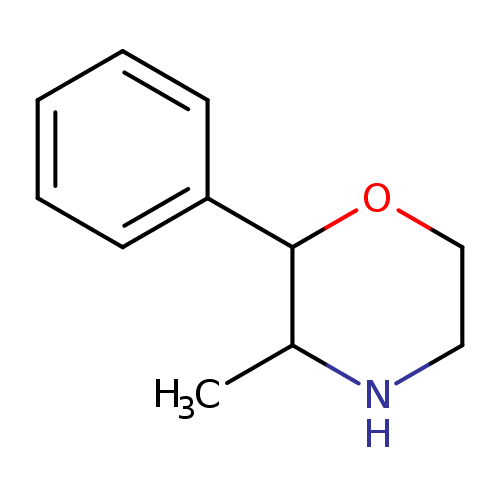
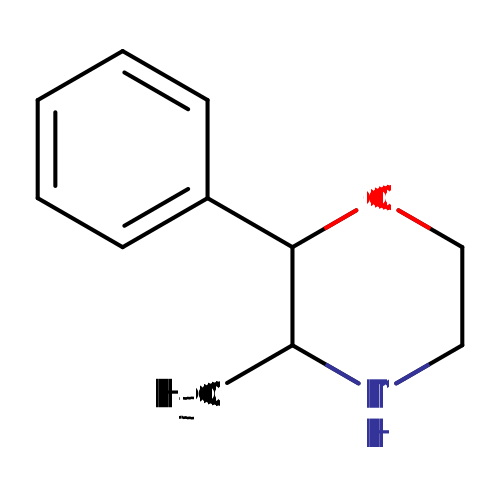
Chemical Structure
Thumb
Synonyms
ValueSource
2-Phenyl-3-methylmorpholineChEBI
3-Methyl-2-phenylmorpholineHMDB
DefenmetrazinHMDB
DexphenmetrazineHMDB
FenmetrazinHMDB
OxazimedrineHMDB
USAF ge-1HMDB
Hydrochloride, phenmetrazineHMDB
PhenmetralineHMDB
Phenmetrazine hydrochlorideHMDB
PreludinHMDB
Chemical FormulaC11H15NO
Average Molecular Mass177.243 g/mol
Monoisotopic Mass177.115 g/mol
CAS Registry Number134-49-6
IUPAC Name3-methyl-2-phenylmorpholine
Traditional Namephenmetrazine
SMILESCC1NCCOC1C1=CC=CC=C1
InChI IdentifierInChI=1S/C11H15NO/c1-9-11(13-8-7-12-9)10-5-3-2-4-6-10/h2-6,9,11-12H,7-8H2,1H3
InChI KeyOOBHFESNSZDWIU-UHFFFAOYSA-N
Chemical Taxonomy
Description belongs to the class of organic compounds known as phenylmorpholines. These are aromatic compounds containing a morpholine ring and a benzene ring linked to each other through a CC or a CN bond.
KingdomOrganic compounds
Super ClassOrganoheterocyclic compounds
ClassOxazinanes
Sub ClassMorpholines
Direct ParentPhenylmorpholines
Alternative Parents
Substituents
  • Phenylmorpholine
  • Aralkylamine
  • Monocyclic benzene moiety
  • Benzenoid
  • Dialkyl ether
  • Secondary aliphatic amine
  • Ether
  • Secondary amine
  • Azacycle
  • Oxacycle
  • Organooxygen compound
  • Organonitrogen compound
  • Organic oxygen compound
  • Amine
  • Organopnictogen compound
  • Hydrocarbon derivative
  • Organic nitrogen compound
  • Aromatic heteromonocyclic compound
Molecular FrameworkAromatic heteromonocyclic compounds
External Descriptors
Biological Properties
StatusDetected and Not Quantified
OriginExogenous
Cellular Locations
  • Cytoplasm
  • Extracellular
  • Membrane
Biofluid LocationsNot Available
Tissue Locations
  • Kidney
  • Liver
PathwaysNot Available
Applications
Biological Roles
Chemical RolesNot Available
Physical Properties
StateSolid
AppearanceWhite powder.
Experimental Properties
PropertyValue
Melting Point139°C
Boiling PointNot Available
Solubility>5 mg/L
Predicted Properties
PropertyValueSource
Water Solubility2.44 g/LALOGPS
logP1.45ALOGPS
logP1.79ChemAxon
logS-1.9ALOGPS
pKa (Strongest Basic)8.22ChemAxon
Physiological Charge1ChemAxon
Hydrogen Acceptor Count2ChemAxon
Hydrogen Donor Count1ChemAxon
Polar Surface Area21.26 ŲChemAxon
Rotatable Bond Count1ChemAxon
Refractivity52.47 m³·mol⁻¹ChemAxon
Polarizability20.1 ųChemAxon
Number of Rings2ChemAxon
Bioavailability1ChemAxon
Rule of FiveYesChemAxon
Ghose FilterYesChemAxon
Veber's RuleYesChemAxon
MDDR-like RuleNoChemAxon
Spectra
Spectra
Spectrum TypeDescriptionSplash KeyView
GC-MSGC-MS Spectrum - EI-B (Non-derivatized)splash10-00di-9100000000-da503eda1d0e6fdabb4cSpectrum
Predicted GC-MSPredicted GC-MS Spectrum - GC-MS (Non-derivatized) - 70eV, Positivesplash10-0536-4900000000-7f843e150425b2270782Spectrum
Predicted GC-MSPredicted GC-MS Spectrum - GC-MS (Non-derivatized) - 70eV, PositiveNot AvailableSpectrum
LC-MS/MSLC-MS/MS Spectrum - 35V, Positivesplash10-016r-1900000000-75ef4995f957a6b2743fSpectrum
Predicted LC-MS/MSPredicted LC-MS/MS Spectrum - 10V, Positivesplash10-004i-0900000000-24b7f4265cec33a3f7d3Spectrum
Predicted LC-MS/MSPredicted LC-MS/MS Spectrum - 20V, Positivesplash10-016r-1900000000-d0cc2a151a961714468aSpectrum
Predicted LC-MS/MSPredicted LC-MS/MS Spectrum - 40V, Positivesplash10-00kf-9100000000-88a1417b8f49b65d8b5aSpectrum
Predicted LC-MS/MSPredicted LC-MS/MS Spectrum - 10V, Negativesplash10-004i-1900000000-25cc59ac71d2e73e2bd0Spectrum
Predicted LC-MS/MSPredicted LC-MS/MS Spectrum - 20V, Negativesplash10-004i-2900000000-3ed3032c5a6bc82bea0dSpectrum
Predicted LC-MS/MSPredicted LC-MS/MS Spectrum - 40V, Negativesplash10-052f-9400000000-b69c243353419b061a46Spectrum
Predicted LC-MS/MSPredicted LC-MS/MS Spectrum - 10V, Positivesplash10-004i-0900000000-26748d51e43e3187c79dSpectrum
Predicted LC-MS/MSPredicted LC-MS/MS Spectrum - 20V, Positivesplash10-004i-2900000000-a2a9a5dc8ea066f027d5Spectrum
Predicted LC-MS/MSPredicted LC-MS/MS Spectrum - 40V, Positivesplash10-0006-9300000000-a1844e2b82002001186eSpectrum
Predicted LC-MS/MSPredicted LC-MS/MS Spectrum - 10V, Negativesplash10-004i-3900000000-559bc1feaf1e68623d28Spectrum
Predicted LC-MS/MSPredicted LC-MS/MS Spectrum - 20V, Negativesplash10-004i-7900000000-e7bb7d24b30ebe1cec75Spectrum
Predicted LC-MS/MSPredicted LC-MS/MS Spectrum - 40V, Negativesplash10-004l-9600000000-1f5dc0cdbd9228f2452aSpectrum
MSMass Spectrum (Electron Ionization)splash10-05fu-9000000000-391e092b81a9d4597b70Spectrum
1D NMR13C NMR SpectrumNot AvailableSpectrum
1D NMR1H NMR SpectrumNot AvailableSpectrum
1D NMR13C NMR SpectrumNot AvailableSpectrum
1D NMR1H NMR SpectrumNot AvailableSpectrum
1D NMR13C NMR SpectrumNot AvailableSpectrum
1D NMR1H NMR SpectrumNot AvailableSpectrum
1D NMR13C NMR SpectrumNot AvailableSpectrum
1D NMR1H NMR SpectrumNot AvailableSpectrum
1D NMR13C NMR SpectrumNot AvailableSpectrum
1D NMR1H NMR SpectrumNot AvailableSpectrum
1D NMR13C NMR SpectrumNot AvailableSpectrum
1D NMR1H NMR SpectrumNot AvailableSpectrum
1D NMR13C NMR SpectrumNot AvailableSpectrum
1D NMR1H NMR SpectrumNot AvailableSpectrum
1D NMR13C NMR SpectrumNot AvailableSpectrum
1D NMR1H NMR SpectrumNot AvailableSpectrum
1D NMR13C NMR SpectrumNot AvailableSpectrum
1D NMR1H NMR SpectrumNot AvailableSpectrum
1D NMR13C NMR SpectrumNot AvailableSpectrum
1D NMR1H NMR SpectrumNot AvailableSpectrum
Toxicity Profile
Route of ExposureReadily absorbed from the gastro-intestinal tract and buccal mucosa.
Mechanism of ToxicityPhenmetrazine is thought to block the reuptake of norepinephrine and dopamine into the presynaptic neuron leading to an increase in the release of these monoamines into the extraneuronal space. Dopamine integrates incoming sensory stimuli, initiates and controls fine movement (nigro-neostriatal pathway), controls emotional behavior (midbrain mesolimbic-forebrain system) and controls hypothalamic-pituitary endocrine system (tubero-infundibular system). It is this latter effect on the tubero-infundibular systm that seems to lead to reduced food intake. Phenmetrazine also acts as a monoamine oxidase inhibitor.
MetabolismPrimarily hepatic (via CYP3A and CYP2D6). Resistant to metabolism by monoamine oxidase. Metabolism involves deamination to para-hydroxyamphetamine and phenylacetone; this latter compound is subsequently oxidize to benzoic acid and excreted as glucuronide or glycine (hippuric acid) conjugate. Smaller amounts of amphetamine are converted to norephedrine by oxidation. Half Life: 16 to 31 hours
Toxicity ValuesAdult monkeys have an LD50 of 15 to 20 mg/kg, whereas for young monkeys the LD50 is only 5 mg/kg. (1)
Lethal DoseNot Available
Carcinogenicity (IARC Classification)No indication of carcinogenicity to humans (not listed by IARC).
Uses/SourcesUsed as an anorectic in the treatment of obesity.
Minimum Risk LevelNot Available
Health EffectsUsing large amounts of these drugs can result in a condition known as amphetamine psychosis -- which can result in auditory, visual and tactile hallucinations, intense paranoia, irrational thoughts and beliefs, delusions, and mental confusion.
SymptomsSymptoms of overdose include acute central nervous system stimulation, cardiotoxicity causing tachycardia, arrhythmias, hypertension, and cardiovascular collapse. Whilst some patients show signs of toxicity at blood concentrations of 20 µg/L, chronic abusers of amphetamine have been known to have blood concentration of up to 3000 µg/L.
TreatmentNot Available
Concentrations
Not Available
DrugBank IDDB00830
HMDB IDHMDB0014968
FooDB IDNot Available
Phenol Explorer IDNot Available
KNApSAcK IDNot Available
BiGG IDNot Available
BioCyc IDNot Available
METLIN IDNot Available
PDB IDNot Available
Wikipedia LinkPhenmetrazine
Chemspider ID4598
ChEBI ID8067
PubChem Compound ID4762
Kegg Compound IDC07432
YMDB IDNot Available
ECMDB IDNot Available
References
Synthesis ReferenceNot Available
MSDSLink
General References
1. https://www.ncbi.nlm.nih.gov/pubmed/?term=14196928
2. https://www.ncbi.nlm.nih.gov/pubmed/?term=23211394
3. https://www.ncbi.nlm.nih.gov/pubmed/?term=4125018
4. https://www.ncbi.nlm.nih.gov/pubmed/?term=5356063